3 - Macromolecules (Notes)
Polar vs. Nonpolar Ideas - Polarity happens because electrons are not spread out evenly in a molecule.
Polar molecules have an end that is slightly positive and an end that is slightly negative; nonpolar molecules are balanced everywhere.
Examples:
a) a polar molecule with hydrogen on one side and an atom that pulls electrons strongly (like oxygen) on the other
b) Methane is a mostly nonpolar, very balanced molecule.
How a Molecule's Shape Affects What It Does:
What a molecule does is strongly connected to its shape. (SHAPE CORRELATES TO FUNCTION)
Even big molecules (like proteins) have shapes that make little spaces or pockets (called active sites) where other smaller molecules (substrates) can fit.
How well they fit depends on the size of the space and how electric charges are spread out inside the pocket.
Hydrogen bonds (weak attractions) can help keep the enzyme and the molecule it acts on (substrate) held together.
Enzymes and Substrates (proteins that act as enzymes are a good example):
Enzymes are proteins that speed up chemical reactions.
Enzyme active site: a special 3D spot that strongly connects to specific molecules (substrates).
When the enzyme and substrate join, an enzyme-substrate complex forms. Then the enzyme helps the reaction happen, making new products. (Enzyme + Substrate = Enzyme-Substrate Complex) —> Products
Example: amylase (an enzyme) working on starch (amylose) to make maltose.
Substrate: amylose or starch connects to the active site.
The enzyme and substrate join together.
The enzyme helps break the long sugar chain into smaller sugars (like maltose).
Receptors, Ligands, and How Specific They Are
Proteins on cell membranes (receptors) have very specific shapes and charge patterns to recognize particular signaling molecules (ligands).
Self Note: Think of it as a key system, the receptor is a particular lock, and the ligand is a particular key. Only a specific key can fit in the lock, or in other words, only a specific ligand can fit in a receptor. Once the ligand connects with the receptor, a signal is released— that singla can trigger or initiate a specific chain of events associated with that cell
Example: endorphin (a natural signaling molecule from the body) connects to nerve cell receptors to send a signal inside the cell.
If a substance from outside the body (exogenous) acts like the natural signaling molecule, it can also connect to the receptor and cause a body response.
Pictures of How Enzymes and Substrates Interact
Enzymes are biological catalysts that speed up chemical reactions by lowering the activation energy.
The substrate binds to the active site of the enzyme, forming an enzyme-substrate complex (substrate + enzyme). This binding induces a conformational change in the enzyme that facilitates the conversion of the substrate into products.
Self Note: A substrate combines with an enzyme to create a substrate-enzyme complex, which is then used to speed up chemical reactions by lowering the amount of NRG needed to proceed with the chemical reaction and leads to a new product
This interaction stabilizes the transition state, leading to the conversion of substrate into product, which is then released, allowing the enzyme to catalyze further reactions. (Self Note: enzymes cannot be consumed during the reaction, which enables the enzymes to move on to the next substrate to create another enzyme-substrate complex and essentially repeat the catalyst action for the same desired product)
These processes are influenced by the polarity of the substrate and the enzyme's active site, as complementary charges and hydrophilic or hydrophobic regions play critical roles in the specificity and efficiency of the catalytic reaction. (Self Note: polarity, complementary charges, and hydrophobic and hydrophilic attributes all must match up perfectly due to the “specificity” of the site that must be maintained to carry out the catalytic actions)
Thus, any alterations in the structure of the enzyme or substrate can significantly impact their interaction, resulting in diminished catalytic efficiency or complete loss of enzymatic activity.
Citrate example: citrate going into an enzyme's active site and being changed by the enzyme.
Main Idea: A Molecule's Shape Determines What It Does (SHAPE EQUATES TO FUNCTION!!!)
This same rule applies to all large molecules and how molecules interact with each other.
Hydrogen Bonds Are Very Important -
Hydrogen bonds are often found in big molecules like DNA and proteins.
They can happen between water and other molecules, and even within one large molecule (called intra-molecular hydrogen bonds).
In proteins, hydrogen bonds inside the molecule help keep its secondary structures (like coils and folds) stable.
(Self Note: Hydrogen bonds are essential to maintaining the structure of a molecule, which translates to the function of the molecule as well, as shape equates to function. The ability for hydrogen bonds to maintain certain structures in these large molecules is crucial for the function these molecules carry out)
Quick Practice: Check Polarity of Small Molecules - General rule: whether a molecule is polar or not depends on how much atoms pull electrons differently (electronegativity difference) and if the molecule has a balanced shape.
How to classify polarity (based on electronegativity difference, ):
\text{Nonpolar covalent: } \Delta\chi < 0.5 (Electrons are shared almost equally)
Polar 0.5 < \Delta\chi \text{ up to } 2.0 (Electrons are shared UNEVENLY)
\text{Ionic: } \Delta\chi > 2.0 (Electrons are practically STOLEN, not shared)
A balanced shape (symmetry) can be more important than how much atoms pull electrons: a molecule can have polar parts but still be nonpolar overall if the electrons are spread out perfectly evenly.
Polarity Examples Discussed in Class (quick review) - Ammonia (): polar (Nitrogen and Hydrogen pull electrons differently, ; its shape is not balanced because Nitrogen has an extra pair of electrons, making it a trigonal pyramid shape and causing an overall charge difference).
Methane (): nonpolar (Carbon and Hydrogen pull electrons somewhat similarly, ; it has a very balanced, four-sided (tetrahedral) shape, so electrons are pulled equally in all directions).
Carbon dioxide (): usually called nonpolar overall even though Carbon and Oxygen pull electrons differently () because the molecule is straight and balanced, so the pulls cancel each other out.
Overview of Large Molecules (Macromolecules) and What They Are -
Macromolecule: a very large molecule usually made by joining smaller pieces called monomers.
Monomer (a single building block) vs. polymer (a chain made of many monomers) — Polymers are made up of monomers
Four main types of large molecules:
Carbohydrates (chains made of sugar units).
Lipids (molecules that don't mix with water, or have both water-loving and water-hating parts; they aren't true chains like the others but include fats, phospholipids, and cholesterol).
Proteins (chains made of amino acids).
Nucleic acids (chains made of nucleotides).
Carbohydrates - Basic unit: sugar (like glucose)
Monomers: monosaccharides (glucose, fructose, and galactose)
Polymers:polysaccharides (starch, glycogen, cellulose, and chitin) — starch is a type of NRG storage for plants, glycogen is a type of NRG storage for animals
Glucose often looks like a ring with an oxygen atom in it; it has many -OH groups which make it polar (mix well with water).
Because it's polar, glucose can dissolve in water and be used in the body's watery processes.
Polysaccharides (long sugar chains) are made by special reactions called dehydration synthesis (which removes water) to form strong connections called glycosidic bonds.
Self Note: Dehydration synthesis is the process by which two glucose monomers combine, but in the process, one loses a hydrogen (H) while the other other loses hydroxyl (OH), the H and the OH combine to make water, illustrating how water is lost in the process of the building the linkages of each monomer, glycosidic bonds, that create a bigger polymer, polysaccharides
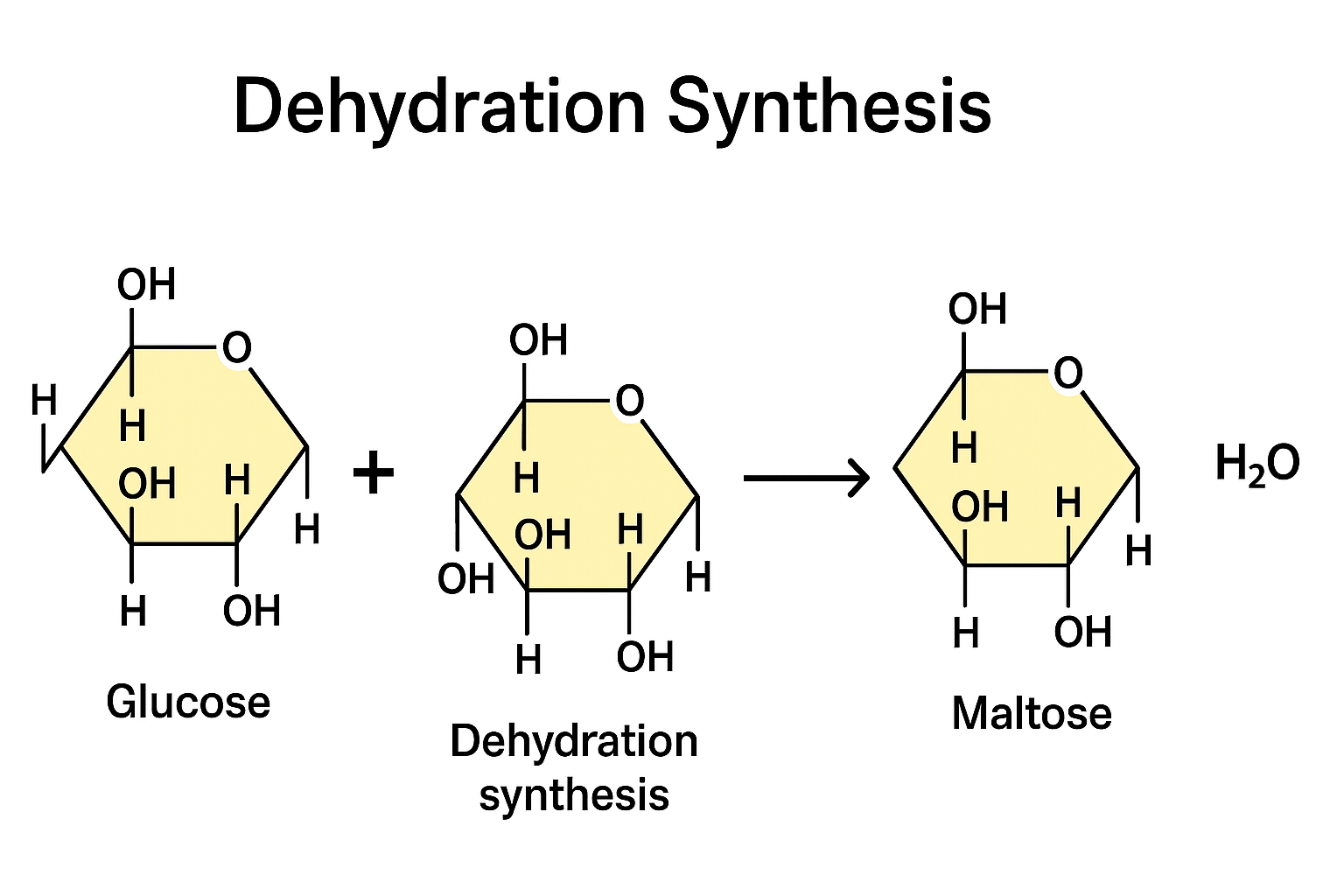
Dehydration (condensation) reaction: takes away water and creates a strong bond.
Hydrolysis is the opposite reaction: it adds water to break bonds.
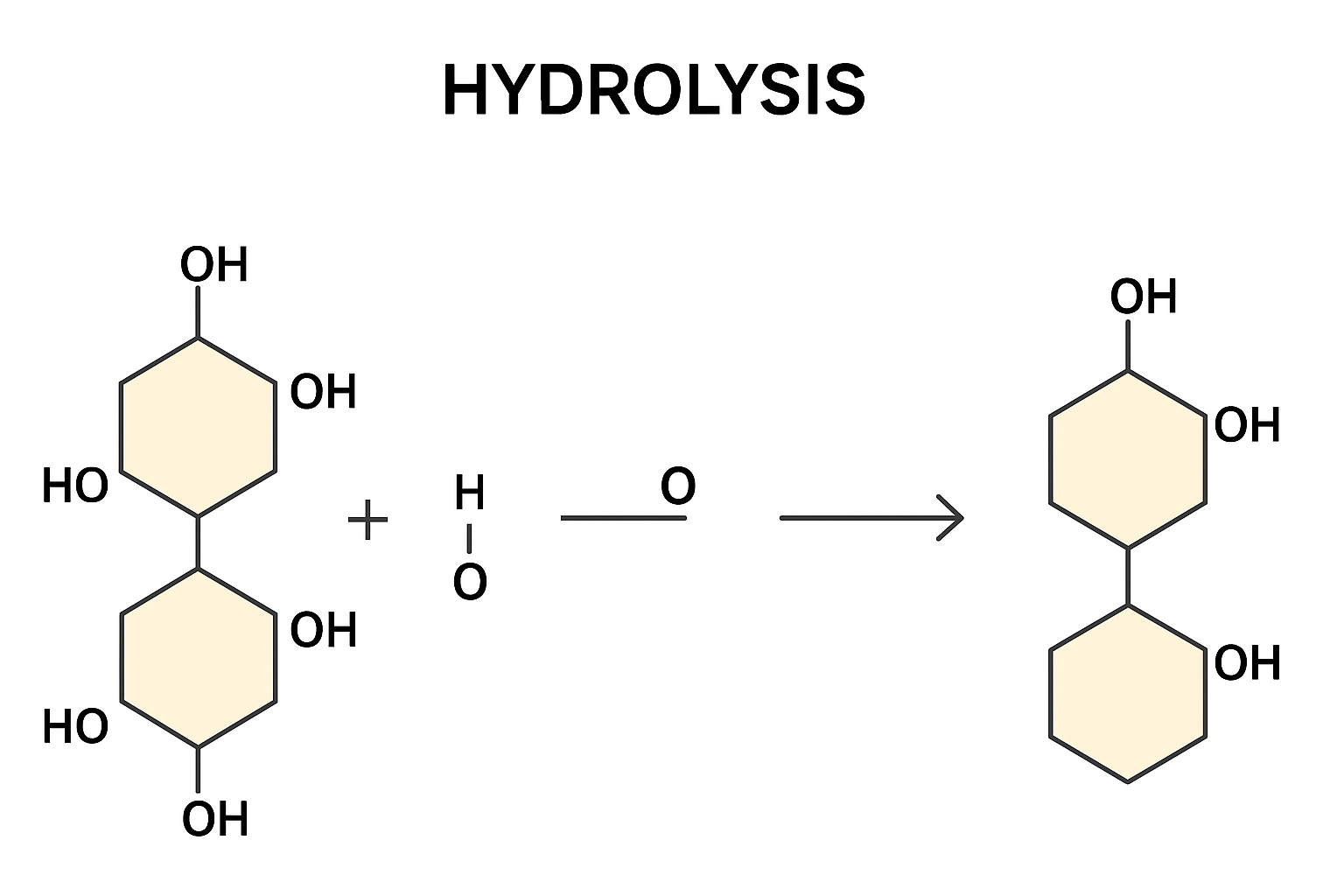
Self note: hydrolysis is the process by which a glycolic linkage between monomers creating a polysaccharide is broken with the addition of water. The Hydrogen goes to one monomer, while the hydroxide goes to the other monomer
Common carbohydrate chains and what they do
Starch: how plants store energy;
amylose is a straight chain of glucose;
amylopectin is a branched chain.
Glycogen: how animals store energy; it's very branched.
Cellulose: makes up plant cell walls; it's a straight, long chain that gives plants structure.
Proteoglycans: proteins with large sugar chains attached; found outside cells; they help form the material between cells and make joints slippery (like in joint fluid).
Sugar unit details: glucose and its different forms; strong connections like 14 (as in maltose, which is two glucose units joined by amylase).
Maltose is two glucose units joined by a 14 link.
The formula for two combined sugar units is usually (because water is lost when they join).
Fructose: another type of sugar with a different setup; it joins with glucose to form sugars like sucrose through a similar bond.
How plants and animals use carbohydrates
Plant cellulose for structure; starch for energy storage.
Animal glycogen for energy storage; the way starch, glycogen, and amylose are branched is different.
What else carbohydrates do besides store energy
They attach to proteins (proteoglycans) and the material outside cells; they also help cushion joints.
Self Note: carbohydrates connect to proteins to act as “ID tags” that enable cells to identify each other (ex: immune cells identifying invaders and domestic cells or the different blood types), helps with communication, structure, and stability
Inherently, carbohydrate as connected to proteins identify as glycoproteins or proteoglycans depending on how much sugar is attached
Lipids - General features
Mostly nonpolar (don't mix with water); hydrophobic (tend to push water away).
This group includes fats (triglycerides), phospholipids, cholesterol, and steroid hormones.
Phospholipids
Amphipathic: they have a part that loves water (hydrophilic, "polar head" with a phosphate group) and a part that hates water (hydrophobic, "nonpolar tails" made of fatty acids).
They line up to form a double layer (phospholipid bilayer) with the water-loving heads facing water and the water-hating tails tucked inside.
This double layer makes up the cell membrane and other cell coverings, acting as a boundary and controlling what goes in and out.
Interactions: the heads form weak connections (hydrogen bonds) with water; the tails stick together by avoiding water (hydrophobic interactions).
Self Note: the primary purpose of phosolipids is to form a cellular membrane with selectively permeable properties structued around its amphipathic nature, which is characterized by its hydrophillic, polar heads, and hydrophobic, non-polar tails that effectively regulate the movement of substances in and out of the cell, ensuring a stable internal environment. The water-loving (hydrophillic) heads face the water and form hydrogen bonds, and the water-hating (hydrophonic) tails remain in the inner bilayer of the cellular membrane.
Fats and triglycerides
Triglycerides are made of glycerol (a 3-carbon backbone that holds the molecule together) connected to three fatty acids.
Fatty acids can be:
saturated (no double bonds, so they're straight)
“full of hydrogens” , which allows them to pack tightly together, forming solid fats at room temperature.
unsaturated (one or more double bonds, which cause bends or kinks).
Saturated fats can pack tightly together and are usually solid at room temperature; unsaturated fats have kinks and are more often liquid.
Self Note: Fatty acids can be saturated or unsaturated. Saturated means the fatty acid has no double bonds, enabling the fatty acid chains to be straight and pack tightly to form a solid at room temperature. Unsaturated means the fatty acid has one or more double bonds, causing kinks in the structure and leading to a more liquid, fluid state at room temperature. Inherently, fatty acids being saturated ir unsaturated influences the overall structure of the fat.
Lipids in sending signals and making membranes
Some lipids (like certain steroids) act as signal messengers; steroids can travel between cells and connect with proteins to start signals inside cells.
Aldosterone and other steroids help cells talk to each other and manage body processes.
How polarity affects lipids and their interactions
The head parts (with phosphate) are polar; the tail parts are nonpolar.
The watery environment causes lipids to form double layers and other shapes because the nonpolar tails try to avoid water and stick to each other (hydrophobic interactions and weak attractions called van der Waals forces).
What lipids do
Lipids store energy, create cell membrane structures, and send signals.
lipids store energy in the carbohydrate bonds in the fatty acid tailsand release it when needed for metabolic processes, ensuring efficient energy management within the cell.
Proteins - Proteins as large molecules and chains
Made from smaller units called amino acids, which are joined by strong links called peptide bonds.
The specific order of amino acids (called primary structure) decides how the protein will fold up and what it will do.
Monomer: amino acid, polymer: polypeptide, bond: peptide bond
Amino acid basics
Every amino acid has a central carbon atom (alpha carbon) with:
An amino group ().
A carboxyl group ().
A side chain (R group) which is different for each of the 20 common amino acids.
The R groups determine if an amino acid is polar, nonpolar, acidic, or basic.
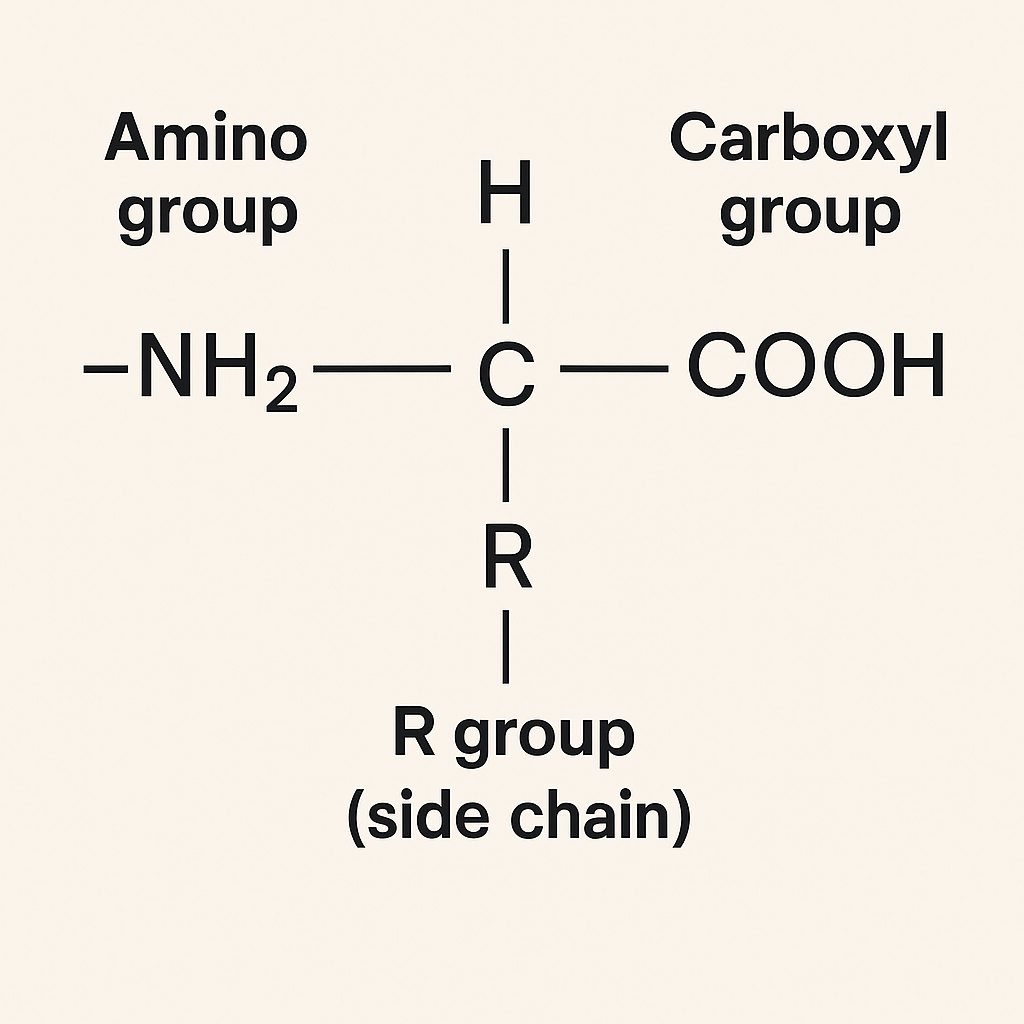
Self Note: Every amino acid, an individual monomers that connect through peptide bonds to make the polypeptides, consists of an amino group, a base that acts as a linkage to other amino acids, and a carboxyl group, an acid, that reacts with the other amino group to inherently form the whole polypeptide molecule. The R group gives the amino acid “personality”, as it determines if it is polar, non-polar, base, or an acid.
Peptide bonds and making protein chains
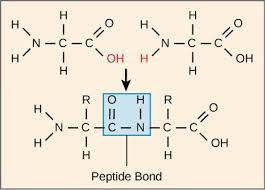
A peptide bond forms when water is removed (dehydration reaction) between the carboxyl group of one amino acid and the amino group of another.
Self Note: in the dehydration synthesis between amino acids, the hydroxide (OH) comes from the carboxyl group and the hydrogen (H) comes from the amino group… together, the two make H2O, which leaves a C-N peptide bond that is essentially connecting each amino acid to create the overall polypeptide molecule.
Protein structure levels (how proteins are organized)
Primary structure: the simple, linear chain of amino acids, from start (N-terminus) to end (C-terminus).
line of amino acids
Secondary structure: regular, local shapes formed by hydrogen bonds along the protein backbone:
Looking at the hydrogen bonds in the peptide bonds
Alpha helix (like a coil).
Beta sheet (like a folded paper).
Tertiary structure: the overall 3D shape of a single protein chain, caused by interactions between the side chains (R groups):
all the interactions between the side chains (r-groups)
Nonpolar parts avoiding water and sticking together, hydrogen bonds, strong electrical attractions (ionic bonds), and very strong bonds called disulfide bonds (S–S bonds between specific amino acids called cysteine).
Quaternary structure: when several protein chains come together to form one working protein.
Primary = amino acid sequence (the order of beads on the chain).
Secondary = local motifs → α-helices & β-sheets formed by backbone H-bonds.
Tertiary = overall 3D shape of one polypeptide (all helices & sheets folded together via R-group interactions).
Quaternary = when multiple polypeptide chains assemble into one functional protein.
Self Note: each polypeptide is made up of a primary, secondary, and tertiary structure. The primary consists of the sequence of the amino acids, which determines the function of the polypeptide as a whole. The secondary consists of the local motifs (which can be spirals or folds) that are formed by hydrogen bonds with the backbone. Finally, the tertiary structure consists of the entire 3-D shape of the polypeptide as a whole, which is created by the interactions of r-groups (side chains) between the amino acids. The quarternary structure only occurs when multiple polypeptide chains connect to make one big functioning protein.
What proteins do and examples
Enzymes: proteins that speed up chemical reactions; the shape and charge of their active site decide which molecules they can work on.
Proteins that carry oxygen: for example, hemoglobin (its shape affects how well it can pick up oxygen).
Mutations: even small changes in the amino acid order can change a protein's shape and what it does.
Nucleic Acids - Basic units: nucleotides.
Each nucleotide has a sugar (deoxyribose in DNA, ribose in RNA), a phosphate group, and a base (adenine, thymine, cytosine, guanine in DNA; adenine, uracil, cytosine, guanine in RNA).
Monomer: nucleotides, polymers: nucleic acids (DNA or RNA), bonds: phosphodiester bonds
DNA structure and what it does
DNA is a chain of nucleotides joined by special bonds called phosphodiester bonds.
It usually has two strands twisted together (double-stranded) where bases pair up using hydrogen bonds: and .
Purines and pyrimidines: The two categories of nitrogenous bases found in DNA, where purines (adenine and guanine) have a two-ring structure, while pyrimidines (cytosine and thymine) have a single-ring structure.
This twisted ladder (double helix) shape stores and passes on genetic information.

RNA structure and what it does
RNA, or ribonucleic acid, typically exists as a single strand
essential for various biological roles, including serving as a messenger between DNA and the ribosomes, where proteins are synthesized
Unlike DNA, RNA contains the base uracil (U) instead of thymine (T), allowing the complementary pairing of adenine (A) with uracil (U) during the processes of transcription and translation.

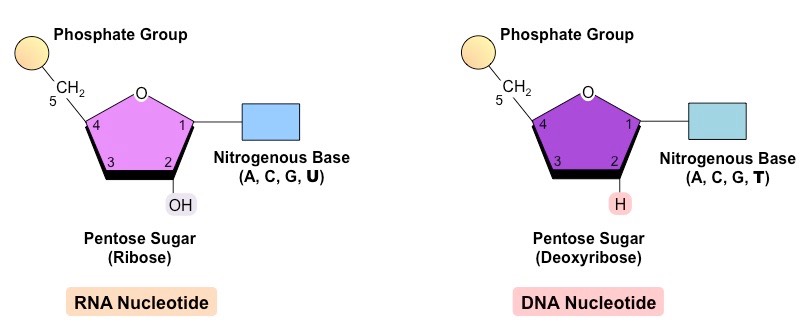
RNA is usually made of a single strand.
It works as a middle messenger (mRNA) that carries genetic instructions from DNA to the cell's protein-making factories (ribosomes); some types of RNA also speed up reactions or control cell processes.
Summary of the Four Major Large Molecules -
Carbohydrates: store energy (starch in plants, glycogen in animals); provide structure (cellulose in plants); attached to proteins (glycoproteins) and in the material outside cells (proteoglycans).
Lipids: build cell membranes (phospholipid bilayer), store energy (fats/triglycerides), send signals (steroid hormones).
Proteins: provide structure, speed up reactions, send signals, control cell processes; their many different jobs come from their sequence and shape; more complex shapes ("higher-order structures") decide what they can do.
Nucleic acids: store and pass on genetic information; allow cells to make proteins and control their actions.
Key Lessons About Shape and What It Does in Biology - A molecule's shape and how its electric charges are spread out decide how it connects with other molecules (how specifically it binds, weak hydrogen bonds, or water-avoiding interactions).
Having parts that like water (polar) versus parts that don't (nonpolar) controls how molecules interact with water, cell membranes, and other molecules.
The way small units (monomers) build up into large chains (polymers), from the simplest chain (primary structure) to the most complex (quaternary structure), creates all the different roles and abilities in cells.
Real-World Uses and Things to Think About -
Enzymes work best under specific conditions (temperature, pH); changes can mess up their shape and the active site where they do their job.
Knowing if something is polar (mixes with water) or hydrophobic (hates water) helps guess how well it will dissolve, pass through cell membranes, and interact in cell processes.
Creating new medicines (drug design and pharmacology) depends on how specifically signaling molecules (ligands) connect to receptors, and how well new drugs can copy natural signals in the body.
How These Notes Link to Other Important Ideas and Future Topics - Thinking about a molecule's shape and what it does will come up again in Unit 2 and later, especially in topics about how the body uses energy (metabolism) and how cells send signals.
Ideas about DNA and RNA are connected to genes, making copies of DNA (transcription), making proteins (translation), and how proteins are produced.
Ethical and Real-World Questions - Using substances from outside the body (exogenous ligands) to target cell receptors or transporters brings up safety and ethical issues in medicine and drug treatment; understanding how shape affects function helps us judge risks and develop drugs safely.
Changing the shape of large molecules (like through mutations or altered enzymes) has big impacts in biotechnology and medicine, which need careful thought about right and wrong, strict rules, and monitoring.
Questions to Test Your Understanding - Think about how a change in the basic amino acid order (like swapping one amino acid for another) can change a protein's secondary and tertiary shape and affect what it does.
Consider how being polar (water-loving) or nonpolar (water-hating) and hydrogen bonds affect how proteins fold, how large molecules interact, and how things move in and out of cells.