Unit 7: Industrial and Economic Development
The Industrial Revolution
The Industrial Revolution was not a single event, but a series of improvements in industrial technology that transformed the process of manufacturing goods. Before this period, industry was geographically dispersed across the landscape in a system known as cottage industry (home-based manufacturing).
Origins and Diffusion
The revolution began in Great Britain in the mid-to-late 18th century (1700s). Britain possessed a unique combination of site factors that allowed this spark to ignite:
- Flow of Capital: Wealth from colonialism and trade allowed investment in new machines.
- Second Agricultural Revolution: Improved farming practices released workers from the land, creating an urban labor workforce.
- Resources: Abundant coal (energy) and iron ore (machinery and infrastructure).
- Transportation: A network of navigable rivers and canals, later supplemented by railroads.
The most significant technological catalyst was the Steam Engine (perfected by James Watt in 1769), which allowed factories to move away from running water sources and locate closer to coal fields and transportation hubs.
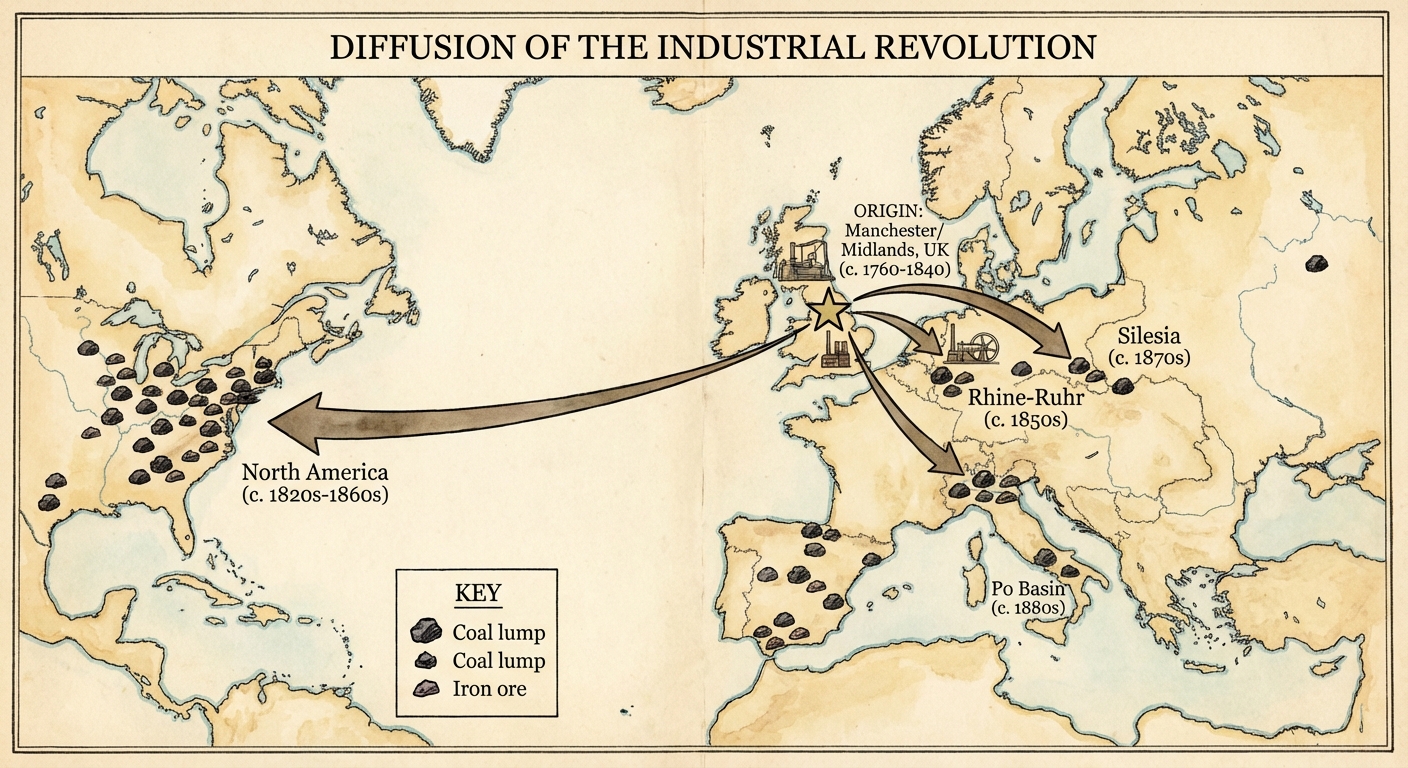
Diffusion Pattern
Industrialization diffused hierarchically and contagiously from the UK:
- Western Europe: Specifically to the Rhine-Ruhr Valley (Germany) and the Po Basin (Italy), driven by proximity to coal fields and iron.
- North America: Arrived in the early 1800s, concentrating in New England (textiles) and the Great Lakes (steel/automobiles).
- Eastern Europe/Russia: developed later, often state-directed (e.g., Donbas region in Ukraine).
- East Asia: Japan (Meiji Restoration) followed by the Four Asian Tigers and China in the late 20th century.
Social and Geopolitical Impacts
- Urbanization: Massive rural-to-urban migration created rapid, often unplanned city growth.
- Imperialism: Industrialized nations needed two things: huge amounts of raw materials and new markets to sell finished goods. This drove the colonization of Africa and Asia (verify Scramble for Africa).
- Class Structure: Creation of a rigid working class (proletariat) and a wealthy owner class (bourgeoisie).
Economic Sectors and Patterns
Economies are classified by the types of activities the workforce performs. As a country develops from a Least Developed Country (LDC) to a More Developed Country (MDC), the proportion of the workforce in each sector shifts.
The Five Sectors
Primary Sector (Extraction)
- Definition: Activities that directly extract materials from the Earth.
- Examples: Agriculture, fishing, mining, forestry.
- Trend: Dominant in LDCs (Periphery); makes up a tiny percentage of the workforce in MDCs (Core) due to mechanization.
Secondary Sector (Manufacturing)
- Definition: Processing, transforming, and assembling raw materials into useful products.
- Examples: Automobile assembly, textile production, brewing, construction.
- Trend: Rapidly growing in Newly Industrialized Countries (NICs) like Vietnam or Mexico; declining in Post-Industrial MDCs (the "Rust Belt" phenomenon).
Tertiary Sector (Services)
- Definition: Provision of goods and services to people in exchange for payment.
- Examples: Retail, restaurant servers, hair stylists, basic clerks.
- Trend: The dominant sector in MDCs.
Quaternary Sector (Knowledge)
- Definition: Knowledge-based acts involving data processing, research, and information.
- Examples: Software development, financial analysis, teaching, consultancy.
- Note: Often considered a specialized subset of the Tertiary sector.
Quinary Sector (Decision Making)
- Definition: The highest levels of decision-making in a society or economy.
- Examples: CEOs of multinational corporations, top government officials, university presidents.
- Note: This sector requires high levels of specialized education or experience.
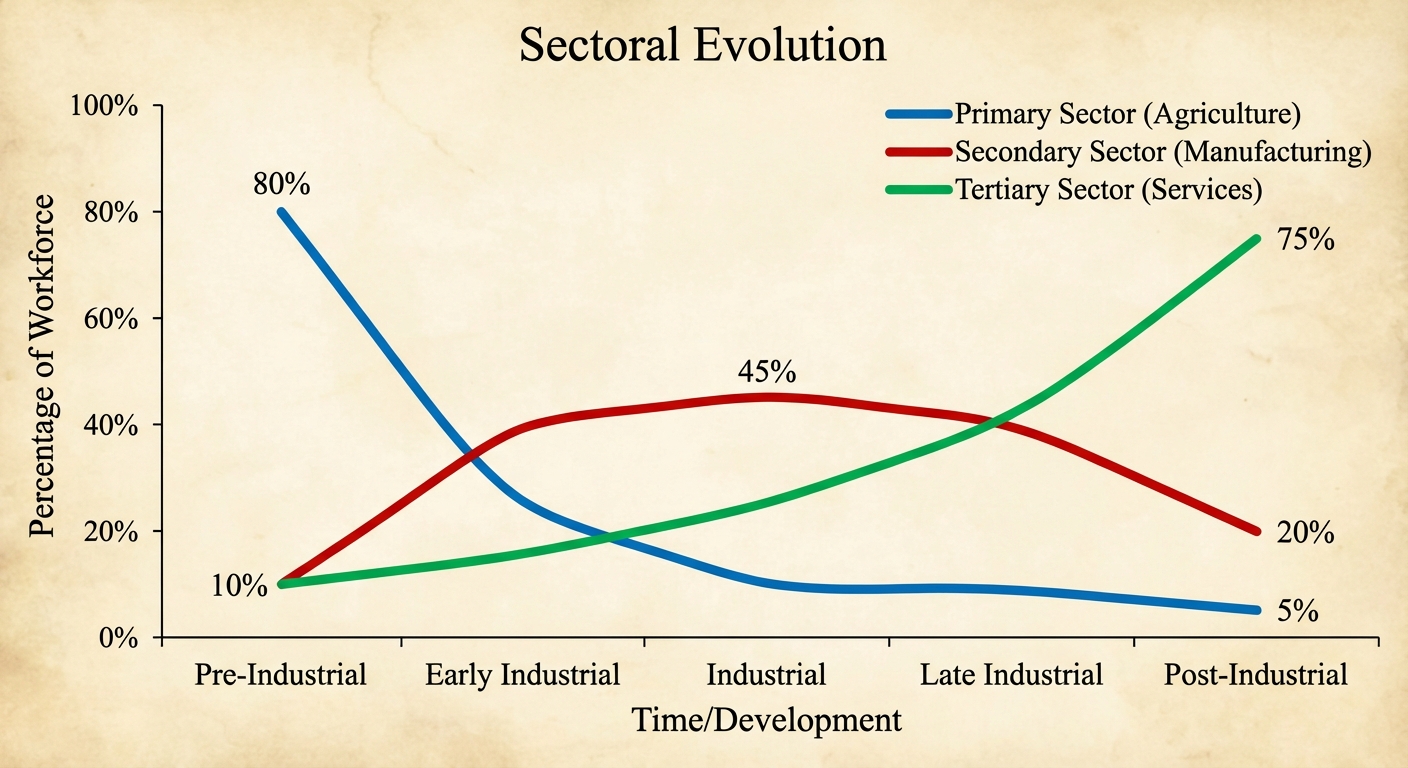
The Sectoral Shift
Different stages of development (like Rostow's Stages of Growth) correspond to specific economic makeups:
| Stage of Development | Dominant Sector | Example Countries |
|---|---|---|
| Pre-Industrial | Primary | Chad, Niger |
| Industrializing (NIC) | Secondary | China, Vietnam, Mexico |
| Post-Industrial | Tertiary/Quaternary | USA, UK, Japan, Germany |
Weber’s Model of Industrial Location
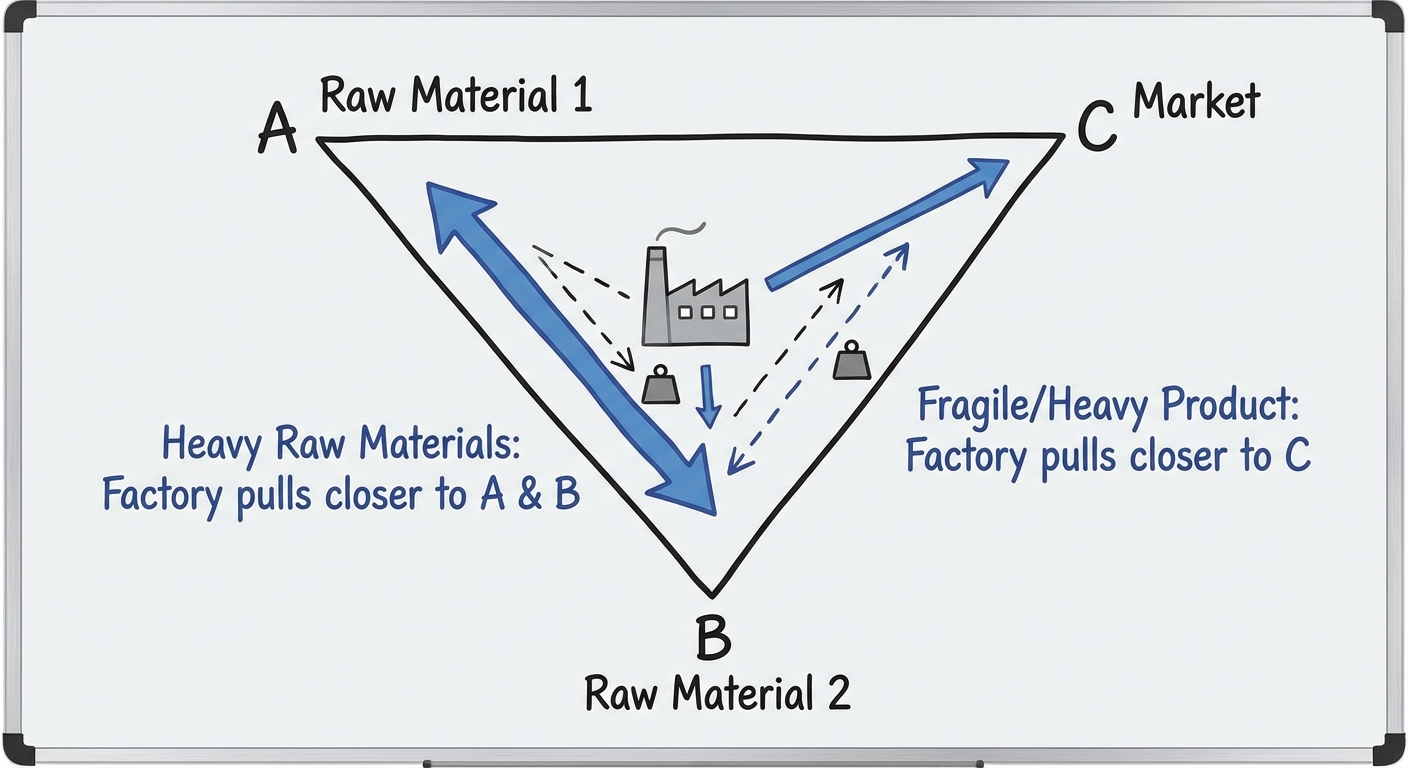
Developed by Alfred Weber (1909), the Least Cost Theory attempts to predict the location of a manufacturing site relative to the location of the resources needed to produce the product and the market where it will be sold.
The Three Factors of Cost
Weber argued companies try to minimize costs in this order of importance:
- Transportation Costs (Most Critical): Moving raw materials to the factory and finished products to the market.
- Labor Costs: Cheap labor can sometimes justify higher transport costs (e.g., outsourcing to Southeast Asia).
- Agglomeration: Clustering of similar industries to share infrastructure and talent (e.g., Silicon Valley, Detroit auto industry).
Transportation Logic: Weight and Bulk
To minimize transport costs, the factory must account for whether the process makes the final product heavier or lighter.
1. Bulk-Reducing Industries
- Concept: The final product weighs less (or is easier to transport) than the raw materials.
- Equation: Input\ Weight > Output\ Weight
- Location Rule: Locate near the Raw Materials.
- Example: Copper Smelting. The ore is heavy and full of waste rock. The pure copper bar is light. You do not want to ship waste rock to the market; you refine it at the mine.
- Example: Paper production (trees are heavy; paper is light).
2. Bulk-Gaining Industries
- Concept: The final product weighs more (or is larger/more fragile) than the raw materials.
- Equation: Input\ Weight < Output\ Weight
- Location Rule: Locate near the Market.
- Example: Soft Drink Bottling. Syrup is light and easy to ship. Water is heavy. You ship the syrup to the city, add the local water there, and sell it immediate. You don't ship full bottles of water across the country if you can avoid it.
- Example: Auto Assembly (Process puts together thousands of parts into a massive, hard-to-ship car).
3. Single-Market Manufacturers
- Definition: Specialized manufacturers with only one or two customers.
- Location: Close to the customer (e.g., a zipper manufacturer locating right next to a clothing factory).
4. Perishable Products
- Definition: Goods that expire or spoil quickly (Newspapers, Bakeries, Dairy).
- Location: Very close to the market to ensure freshness.
Limitations of Weber's Theory Today
Weber's model assumes a uniform landscape (isotropic plain) and focuses heavily on weight. Modern geography challenges this with:
- Containerization: Drastically reduced transport costs, making labor costs more important than transport.
- Footloose Industries: Products that are so light/valuable (like computer chips or diamonds) that transport costs are negligible. They can locate anywhere.
- Just-in-Time Delivery: Factories locate near assembly plants not just for weight, but to eliminate storage costs.
Summary & Mnemonics
Mnemonic: "The Three Tiers of Jobs"
- Primary: Plants and Pulling things from the earth.
- Secondary: Smelting, Sewing, and Structing (Constructing).
- Tertiary: Trading, Teaching, and Technology.
Mnemonic: Weber's Weight
- If it Loses weight (Bulk-Reducing), keep it at the Location (Resource).
- If it Gains weight (Bulk-Gaining), Go to the market.
Common Mistakes to Avoid
- Confusing Quaternary and Quinary:
- Correction: Think of Quinary as the "Quarterback"—the leader/decision maker. Quaternary is the researcher/analyst supporting them.
- Assuming LDCs have no industry:
- Correction: LDCs often have industry, but it is typically low-tech or textile-based. Conversely, MDCs still have agriculture, but it is highly mechanized and employs very few people.
- Misidentifying Bulk-Gaining:
- Correction: Students often think cars are bulk-reducing because steel is heavy. However, car parts enter the factory compact, and the car leaves taking up huge amounts of volume (bulk). Therefore, assembly is usually bulk-gaining.
- Ignoring Substitutability:
- Correction: Companies will sometimes accept higher transport costs if the labor is cheap enough (Substitution Principle). This is why clothes are made in Bangladesh (labor is cheap) and shipped to the USA (high transport cost), violating strict Weberian theory.