3.3 blood
Learning Outcomes Review
Key conditions and components relevant to blood health:
Thrombocytopenia: Low platelet count, leading to increased bleeding risk.
Anaemia: Insufficient red blood cells or hemoglobin, resulting in fatigue and weakness.
Haematocrit: Measurement of the proportion of blood volume occupied by red blood cells.
Thrombopoietin: Hormone regulating platelet production.
Thrombocytes: Platelets, crucial for blood clotting, live about 8 days.
Fibrinogen: Soluble protein in plasma; converts to fibrin during blood clotting.
Haemophilia: Genetic disorder causing difficulty in blood clotting.
Fibrin: Insoluble protein essential for clot formation.
Clotting: The process of forming a stable clot to prevent blood loss.
Haemorrhage: Excessive bleeding, often requiring medical intervention.
Haemochromatosis: Condition leading to excessive iron accumulation in the body.
Nutrients and Waste Transport
Blood transports:
O2 and CO2
Nutrients (e.g., amino acids, lipids, sugars)
Waste products for excretion.
Plasma components:
Albumin: Major protein, maintains oncotic pressure.
Globins and Immunoglobins: Involved in immunity.
Electrolytes: Help regulate osmolarity and pH.
Transferrin and Ferritin: Proteins that bind iron.
Fibrinogen: Soluble protein in plasma; converts to fibrin during blood clotting.
The constituents and role of blood elements
Plasma
Water: Provides circulatory volume and serves as a medium for dissolved solutes, aiding in transport, distribution, and heat loss.
Electrolytes: Important for volume regulation, osmolarity, pH regulation, and membrane potential.
Nutrients: Includes amino acids, lipids, sugars, metabolic wastes, hormones, and dissolved gases (e.g., CO2, O2).
Plasma Proteins:
Albumin: Maintains oncotic pressure, acts as a carrier protein, and contributes to pH buffering.
Immunoglobulins and Antibodies: Involved in immune responses.
Coagulation Factors: Essential for blood clotting.
Transferrin & Ferritin: Proteins involved in iron transport and storage.
Cellular elements
Red Blood Cells (Erythrocytes): Responsible for transporting oxygen (O2) and carbon dioxide (CO2); characterized by the absence of nuclei.
White Blood Cells (Leukocytes):
Lymphocytes:
B-Type: Produce antibodies.
T-Type: Involved in immune response (produced in lymph nodes, spleen, and thymus).
Monocytes: Differentiate into tissue macrophages that manage foreign pathogens and debris through engulfment.
Neutrophils: Destroy and engulf invading bacteria.
Eosinophils: Respond to allergic reactions and parasites.
Basophils: Involved in allergic responses; release histamine (vasodilator) and heparin (anticoagulant).
Platelets
Platelets: Acellular components crucial for haemostasis; they lack nuclei and are stimulated to produce platelets from megakaryocytes by thrombopoietin.
Plasma Composition
Comprises:
Water (92%): Medium for solutes, provides circulatory volume.
Proteins (7%): Albumin (60% of plasma proteins), globins, immunoglobins, etc.
Miscellaneous (1%): Organic molecules and ions (Na+, K+, Ca2+, etc.).
Haematocrit Information
Haematocrit: Measures the volume of RBCs in blood, can indicate:
Normal/Anemia: Normal ≈ 45%, lower levels indicate anemia.
Polycythemia: Increased levels due to dehydration or disease.
Haemorrhage: Results in rapid drop in levels.
Blood Cell Production (Haematopoiesis)
Originates from pluripotent haematopoietic stem cells in:
Fetal development: Liver, spleen, and bone marrow involved.
Adulthood: Active in pelvis, spine, ribs, cranium, long bone ends.
Bone Marrow Color:
Active Bone Marrow: Red due to the presence of haemoglobin.
Yellow Bone Marrow: Contains an abundance of adipocytes and lacks haemoglobin.
Cell Distribution:
~25% of developing cells are Red Blood Cells (RBC).
~75% of developing cells are White Blood Cells (WBC). (This distribution might be due to the shorter half-life of WBC compared to RBC, requiring ongoing production.)
Lifespan of blood cells varies:
RBCs: ~100 days
Neutrophils: ~6 hours to years
Platelets: ~8 days.
Erythropoiesis Process
Kidneys detect reduced O2 levels in blood.
Secretion of Erythropoietin stimulates RBC production in bone marrow.
Erythropoietin stimulates erythropoiesis by bone marrow
Increase in erythrocytes improves O2 delivery.
Positive feedback mechanism regulates erythropoietin secretion.
The normal range of blood cells and elements
Leukocytes: 4-10 ×109 cells/L
Polymorphonuclear granulocytes
Neutrophil: 60-70%
Eosinophil: 1-4%
Basophil: 0.25-0.5%
Mononuclear agranulocytes
Monocytes: 2-6%
Lymphocytes: 25-33%
Erythrocytes: 4.2-5.9 x 10¹²cells/L
Platelets: 150-350 ×109 cells/L
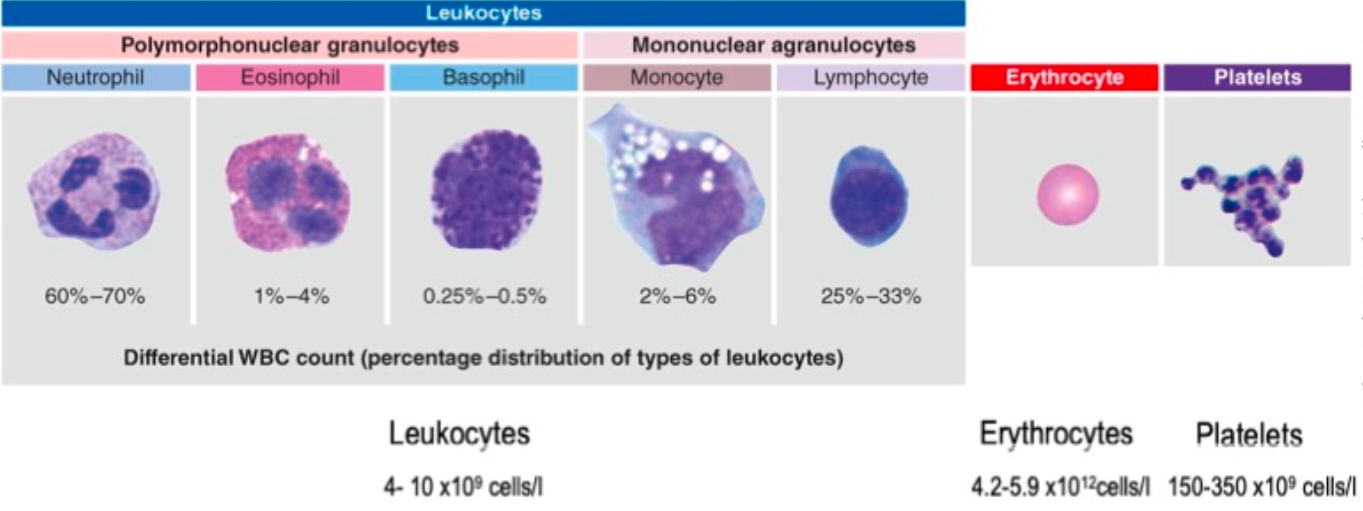
Blood count (normal ranges)
Males
Haematocrit: 40-54%
Haemoglobin: 130-180g/L
RBC/L: 4.6-6.5 × 10¹²
WBC/L: 4-11 × 109
Females
Haematocrit: 37-47%
Haemoglobin: 120-160 g/L
RBC/L: 3.9-5.6 × 10¹²
WBC/L: 4-11 × 109
Anticoagulant
Warfarin: Vitamin K antagonist, blocks synthesis of the Ca2+ dependent clotting factors II, VII, IX, X
Dabigatran: direct thrombin antagonist
Heparin: Activates antithrombin III
Clotting and Haemostasis
Haemostasis: Process to prevent and stop bleeding.
Involves:
Activation of platelets and coagulation factors.
Fibrinogen converted to fibrin, forming a stable clot.
Thrombin: Central regulator in clotting cascade.
Disorders: Genetic deficiencies in coagulation factors can lead to bleeding disorders like haemophilia.
Aspirin influences platelet aggregation, reducing clot formation.
Blood clot: Red blood cells are trapped in a clot of fibrin. Exposure of the connective tissue in blood vessels triggers a series of events that lead to the conversion of fibrinogen (an inactive sealant in our blood) to fibrin.
The Fibrinolytic System
Uses tPA to convert plasminogen to plasmin, aiding in clot dissolution.