3) Civil Liberties & Civil Rights
“The arc of the moral universe is long, but it bends toward justice.”
Martin Luther King Jr.
BIG IDEAS
In what ways does the Constitution
The U.S Constitution includes a Bill of Rights specifically designed to protect individual liberties and rights.
First 10 Amendments Included
Created to protect the people of the United States from Government injustices
1st Amendment — Freedom of Speech, Petition, Religion, Assembly, Press
2nd Amendment — Right to bear arms
3rd Amendment — Rights against quartering troops
4th Amendment — Rights against unlawful search and seizure
5th Amendment — Rights of the accused
6th Amendment — Right to speedy, fair trial and a lawyer
7th Amendment — Right to civil suits (Suing)
8th Amendment — Rights against unreasonable bail or punishment
9th Amendment — Any other rights reserved to the people
10th Amendment — Powers reserved to the states
Civil Liberties are constitutionally established guarantees and freedoms that protect citizens, opinions, and property against arbitrary government interference.
The application of the Bill of Rights is continuously interpreted by the courts.
The interpretation and application of the First Amendment’s establishment and free exercise clauses reflect an ongoing tension between government power to make law and an individual’s rights to religious freedom.
Establishment Clause
Congress can not make an official state religion.
Free Exercise Clause
The government can not prohibit the free exercise of religion.
The Supreme Court has held that speech, including symbolic speech (nonverbal action that communicates an idea or belief), is protected by the First Amendment
Efforts to balance social order and individual freedom are reflected in interpretations of the First Amendment that limit speech, including:
Time, place, and manner regulations
Time — Limits on the time of day an event can be held
Place — Limits on where an event can be held
Manner — Limits on the noise levels at an event
If a law is passed, it must pass these requirements:
1. The law must be content-neutral
2. The law must serve a significant government interest
3. The law must be narrowly tailored
4. There must be an adequate alternative ways of expression
Limitations on some obscene & offensive communication
Obscene — something that is morally offensive in a sexual way
Miller Test Applies:
1. The average person applying contemporary community standards finds it appeals to the prurient (excessively sexual) interest.
2. If it depicts or describes, in a patently offensive way, sexual conduct, specifically defined by state law.
3. It lacks serious literary, artistic, political, or scientific value.
Protections against defamation, including libel and slander
Libel — false printed statement to hurt someone’s reputation
Slander — false spoken statement to hurt someone’s reputation
Restrictions on speech that create a clear and present danger
The Supreme Court has bolstered the freedom of press, affirming support for a heavy presumption against prior restraint, even in cases involving national security
Prior Restraint — Government PREVENTING material from being published
Typically unconstitutional
Near v. Minnesota set the precedent and incorporated freedom of the press to the states
The Supreme Court’s decisions on the Second Amendment rest upon its constitutional interpretation of the right to bear arms.
U.S. v. Miller (1939)
Does the Second Amendment protect and individual’s right to keep and bear a sawed-off double-barrel shotgun?
Answer: No (8-0)
District of Columbia v. Heller (2008)
Do the provisions of the District of Columbia Code that restrict the licensing of handguns and require licensed firearms kept in the home to be kept nonfunctional violate the Second Amendment?
Answer: Yes (5-4)
The doctrine of selective incorporation has imposed limitations on state regulation of civil liberties by extending select protections of the Bill of Rights to the states through the due process clause of the Fourteenth Amendment
The Bill of right applies to all states, not just the federal government.
The Miranda Rule involves the interpretation and application of accused persons’ due process rights as protected by the Fifth and Sixth Amendments, yet the Supreme Court has sanctioned a public safety exception that allows un-warned interrogation to stand as direct evidence in court.
Procedural Due Process
Addresses the manner in which the law is carried out
Due Process — ensures fair procedures when the government burdens or deprives an individual
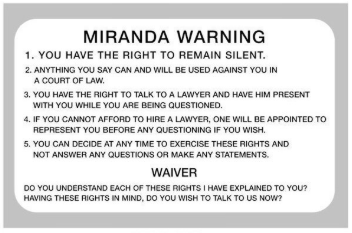
Procedural rights of the accused and the prohibition of unreasonable searches and seizures are intended to ensure that individual liberties are not eclipsed by the need for social order and security, including:
The right to legal counsel, a speedy & public trial, and an impartial jury
Rights of the Accused:
Right to legal counsel
Right to a speedy & public trial
Right to an impartial jury
Procedural due process also protects the rights of the accused during a trial. The Bill of Rights guarantees the right to an attorney and protection from unreasonable search and seizures. The exclusionary rule, as decided by the Supreme Court, stipulates that evidence illegally seized by law enforcement officers in violation of the suspect’s Fourth Amendment rights (including the right to be free from unreasonable searches and seizures) cannot be used against that suspect in criminal prosecution.
Court decisions defining cruel and unusual punishment involve interpretation of the Eighth Amendment and its application to death penalty statutes.
Pretrial rights of the accused and the prohibition of unreasonable searches and seizures are intended to ensure that individual liberties are not eclipsed by the need for social order and security, including:
Protection against warrant-less searches of cell phone data under the Fourth Amendment
Limitations placed on bulk collection of telecommunication metadata (Patriot and USA Freedom Acts)
The 4th Amendment States:
“The right of the people to be secure in their persons, houses, papers, and effects, against unreasonable search and seizures, shall not be violated, and no warrants shall issue, but upon probably cause supported by Oath or affirmation, and particularly describing the place to be searched, and the persons or things to be seized.”
Patriot Act — October 26, 2001
Post-9/11, the government secretly (and illegally — without a warrant) acquired and examined cell phone data.
USA Freedom Act — June 2, 2015
Limitations placed on bulk collection of telecommunication metadata
Metadata: cell phone communication information but not the actual conversation
Must remain in storage under protection of telecommunication companies
The debate about the Second and Fourth Amendments involves concerns about public safety and whether or not the government regulation of firearms or collection of digital metadata promotes or interferes with public safety and individual rights.
Over time, the Supreme Court has recognized constitutionally protected rights that are not explicitly listed in the Bill of Rights. The unenumerated rights include the right to privacy. Justices and scholars have drawn on several arguments to defend the existence of unenumerated rights. In a range of cases, the Supreme Court has used substantive due process to examine whether government laws and actions are arbitrary infringements of individual rights.
Unenumerated Rights
Constitutionally protected rights that are not specifically stated in the Bill of Rights
Interpretations of Extent of Civil Liberties
Implied by certain amendments that assume the existence of such rights
Ninth Amendment, which states that individuals have protected beyond those listed in the first eight amendments, provides support the existence of unenumerated rights
Substantive Due Process
Addresses the essence of a law
Does the point of the law violate a basic right to life, liberty, or property?
While a right to privacy is not explicitly named in the Constitution, the Supreme Court, in Grisworld v. Connecticut (1965), interpreted the due process clause to protect the right of privacy from Government infringement. In Roe v. Wade (1973), the Supreme Court held that the application of substantive due process further extended the privacy right to abortion. The Supreme Court’s decision in Dobbs v. Jackson Women’s Health Organization (2022) overturned Roe v. Wade, holding that the Constitution does not confer to a right to abortion, leaving decisions about the regulation of abortion to legislatures. The actions that are protected by the right to privacy and substantive due process continue to be debated.
Civil rights protect individuals from discrimination based on characteristics such as race, national origin, religion, and sex; these rights are guaranteed to all persons under the due process and equal protection clauses of the U.S Constitution as acts of Congress.
Civil Rights
Protect from discrimination on the basis of
Race
National Origin
Religion
Sex
Reconstruction Amendments
13th Amendment — Abolition of Slavery (1865)
14th Amendment — Citizen Rights and Equal Protection (1868)
15th Amendment — Right to Vote not Denied by Race (1870)
The Civil Rights Movement… [is] evidence of how the equal protection clause can support and motivate social movements, as represented by: Dr. Martin Luther King Jr.’s “Letter from a Birmingham Jail” and the civil rights movement of the 1960’s.
The government can respond to social movements through court rulings and/or policies, as in:
The Civil Rights Act of 1964
Required equal application of voter registration rules
Banned discrimination in public accommodations and public facillities
Empowered the Attorney General to initiate suits against non compliant schools
Cut off federal funding for discriminating government agences
Outlawed discrimination in hiring based on race, color, religion, sex or national origin
Minority rights have been restricted at time protected at other times.
Majority Minority Districts:
Voting districts in which a minority group or group of minorities make up a majority
Racial Gerrymandering: Race becomes a primary factor in drawing district lines
Thomburg v. Gingles (1982) — Court ruled in favor of majority-minority districts
Shaw v. Reno (1993) — Strict Scrutiny must be applied if race is used as a factor in redistricting
The Women’s Rights Movement… [is] evidence of how the equal protection clause can support and motivate social movements, as represented by:
The National Organization for Women and the women’s rights movement of the 1960’s.
The government can respond to social movements through court rulings and/or policies, as in:
Title IX of the Education Amendments Act of 1972 prohibits sex discrimination in any education program or activity receiving federal financial assistance.