Exponentials & Logarithms
Residuals & Regression
A residual is the difference between an actual value and the model value
residual = actual value - predicted value
If a model (regression) for a given set of data is appropriate, the residual plot should appear without a pattern
Exponential & Logarithmic Properties
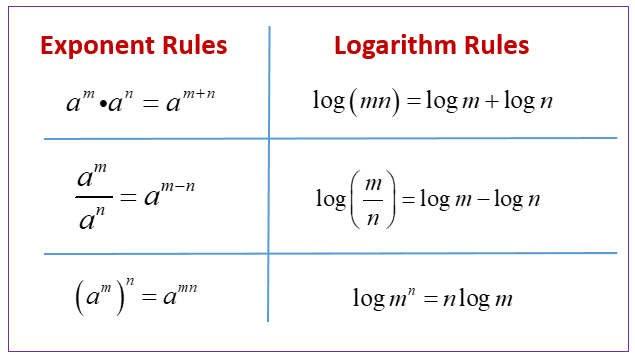
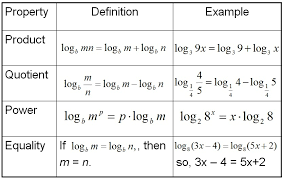
change of base theorem: logb a = logc a/logc b
Exponential & Logarithmic Equations Properties
Exponential Applications
standard model form: y = ab^x
half life model: A = P(1/2)^t/h
financial model: A = P(1 + r/n)^nt
continuous mode: A = Pe^rt
y = 2 × 3^x
y = 2 x (e^ln3^x)
A = R((1 + r/n)^nt - 1)/(r/n)) is the future value of an annuity
measures how much a deposit will be worth with continuous amounts of money deposited each month
P = R((1 + r/n)^nt -1)/(r/n)(r + r/n)^nt)
measures the present value of an annuity
Semilog Plots
If a function f shows exponential growth or decay, plotting (x, log(f(x))) will linearize the data
y = a x b^x
a = the predicted y intercept
b = predicted growth/decay
y = log a + xlogb
log a = predicted log of the y intercept
log b = predicted increase/decrease in log (dependent variable) per unit of independent variable