Obesity
Classifications, Calculate, Categories of BMI
Obesity
midpoint between lower border of rib cage and iliac crest
waist circumference of 35 in women or 40 in men
waist to hip ratio - r > 0.85 women or r > 1.0 men
Risk factors for - diabetes, heart disease (ASCVD), stroke, cancer, joint problems, psychosocial stress
Physiologic Factors - gene pool influences body shape, adiposity, disease susceptibility, weight gain tendency
Environmental Factors - support less activity and invite caloric excess through foods, large portions, readily available snack foods causing intake > expenditure
BMI or body mass index
= weight (kg) /height squared (m2)
1 kg = 2.2 lbs, 1 in = 2.54 cm
= weight (lbs)/height (in2) x 703
classification | BMI kg/m2 | Intervention |
underweight | < 18.5 | behavior changes, diet modification, physical activity |
normal weight | 18.5 - 24.9 | behavior changes, diet modification, physical activity |
overweight | 25-29.9 | Rx and OTC with comorbidities |
obesity class 1 | 30-34.9 | Rx and OTC |
obesity class 2 | 35-39.9 | Bariatric surgery with comorbidities |
obesity class 3 | >40 | Bariatric Surgery |
Non-pharmacologic treatment
Goal - reduce 5-10% body weight from baseline over 6 months at a rate of 1-2 lbs/wk
behavioral changes skills to be learned focusing on environmental modifications with trained professional
Core features - observation, stimulus control, cognitive restructuring, social support, problem solving, relapse prevention
SMART goals - specific objectives and goals, measurable change goals, achievable weight loss goals (5-10%), relevant to them, timeline for achieving
Lifestyle Changes
Dietary change - intake calories < output physical activity calories
meal planning - based on portion sizes, nutrient composition, food distribution in which intakes facilitate weight control
Physical Activity - ADA 150 min/wk moderate-intensity aerobic exercise ± 2 days/wk strength training
Modest weight loss 150-250 min/wk
Significant weight loss 250+ min/wk
Bariatric surgery - option when diet,exercise, and behavioral changes fail
reducing stomach size (storage space) or nutrient absorption
influencing hormones that reduce appetite
List of Weight Gain/Loss Medications
Gain | Neutral/Loss | |
diabetes drugs | Insulin, sulfonylureas, meglitinides, TZD | metformin, DPP4i, SGLT2i GLP-1RA, dual GIP/GLP-1 RA |
psychiatric | antidepressants (SSRI,TCA,MAOI, mirtazapine antipsychotics (clozapine, olanzapine, risperidone) anticonvulsants (valproic acid, gabapentin, carbamazepine) lithium | fluoxetine, bupropion aripiprazole, quetiapine, ziprasidone lamotrigine, topiramate, zonisamide |
antihypertensive | nonselective B-blockers (propranolol) a-adrenergic blockers (prazosin,clonidine) | selective B-blockers ACEi, ARBs, CCBs |
other | glucocorticoids systemic/chronic depo-provera (progesterone contraceptive injection) |
Pharmacological Treatments
Assessment- If pt does not lose 2 kg in the first 4 weeks of initiation means low likelihood of response. Effective response after 3 months ( 5% or more loss) can continue therapy otherwise D/C
Phentermine (Adipex-P) - stimulates hypothalamus to release NE for appetite suppression
ADR - increase BP/HR, dysrhythmia, dry mouth, insomnia, irritability,
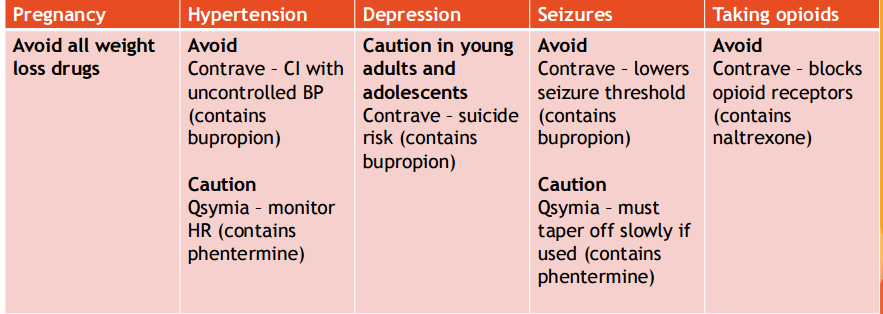
Caution - pts with HTN or history of CVD, not guideline recommended
CI - combination with monoamine oxidase inhibitors (MAOI)
Counsel - should only be used up to 3 months to avoid abuse potential (C3) and tolerance to effect builds up within weeks so D/C dont increase dose
Orlistat (Alli OTC 60 mg /Xenical 120 mg RX) - inhibits nutrient absorption by forming bond with gastric pancreatic lipase
ADRs - GI complaints and decrease absorption of fat-soluble vitamins ADEK separate MV by 2+ hours
Caution - hx of nephrolithiasis or pancreatitis
Avoid - in pts taking cyclosporine, levothyroxine, anticonvulsants
CI - malabsorption disorders, cholestasis, pregnancy
Counsel - FDA approved for long term use and most pt lost 5-10 lbs over 6 months PO TID. Take during or up to 1 hour before meals containing fat otherwise omit if < 30 calories from fat.
Phentermine+Topiramate ER (Osymia) - stimulates NE release for appetite suppression + suppress appetite and enhance satiety
ADRs- constipation, dry mouth, paresthesia, insomnia, nasopharyngitis, increase BP, cognitive impairment
CI - pregnancy due to REMS fecal defects and oral clefts 1st trime (topiramate)
Counsel - FDA approval for long-term use (C4), does require dose titration up and down so D/C if 5% weight loss not achieved after 12 weeks on max daily dose since average weight loss is 8-10%. good for those with seizures
Naltrexone+Bupropion SR (Contrave) - opioid antagonist + dopamine/NE RI to suppress appetite
ADRs - N/V/D, insomnia, Ha, constipation, dry mouth, increase HR and BP
BBW to increase suicidal ideation and behavior
Avoid - agents lowering seizure threshold or disorder, chronic use of opioids (7 day free recommended)
CI - D/C once pregnancy detected
Counsel - approved for long term use, titrate dose up weekly, do not take with high-fat meals (increases absorption and concentration), average weight loss of 5-10%
Liraglutide (Saxenda) and Semaglutide (wegovy) - glucagon like peptide-1 (GLP-1) receptor agonist
ADRs - N/V/D, GERD, injection site reaction, can enhance hypoglycemia of other diabetes meds
Caution - hx of nephrolithiasis or pancreatitis, GI disorders (constipation, bowel obstruction)
BBW for risk of Thyroid C-Cell tumors
Counsel - FDA approved for long-term use Saxenda 10% weight loss, Wegovy 15% weight loss
Tirzepatide (Zepbound) - dual glucose dependent insulinotropic polypeptide (GIP) and glucagon like peptide-1 (GLP-1) receptor agonist
ADRs - N/V/D, GERD, injection site reaction, can enhance hypoglycemia of other diabetes meds
Caution - hx of nephrolithiasis or pancreatitis, GI disorders (constipation, bowel obstruction)
BBW for risk of Thyroid C-Cell tumors
Counsel - pts on oral hormonal contraceptives should use a back-up method for 4 weeks after initiation and dose escalations, average 15-25% weight loss at 72 weeks, fda approval for long term use