Biology Chapter 2 Notes
Atoms
all non-living (gases, rocks, metal, oils) and living things (organisms) are made up of matter.
Matter: anything that has mass and takes up space. Three states → Solid, Liquid, Gas (also plasma)
Atoms
smallest units of matter that form all chemical substances.
cannot be further broken down by chemical reactions.
each specific type of atom is a chemical element → there are 92 naturally occurring elements.
Compound: when two or more elements are bonded together a compound if formed.
Compound
substances that consist of two or more different elements combined at a fixed ratio.
have emergent properties - different from those of the elements that make it
Ex: Na + Cl → NaCl
The Elements of Life
About 20-25% of the 92 natural elements are required for life (essential elements)
Carbon (C), Hydrogen (H), Oxygen (O) and Nitrogen (N) make up 96% of living matter. - most of the remaining 4% consists of calcium (Ca), phosphorus (P), potassium (K), and sulfur (S).
Trace Elements
required by an organism in only minute (very small) quantities
most are toxic at higher levels.
Atomic Structure
Subatomic Particles
Protons
positive charge (+)
found in nucleus
mass = 1.7 × 10^-24g = 1 dalton
Neutrons
neutral
found in nucleus
mass = 1.7 × 10^-24g = 1 dalton
Electrons
negative charge (-)
found in orbitals
mass = 9.11 × 10^-28g mass = 1/2000 dalton

Protons and electrons are present in equal numbers, giving the atom no net charge.
The number of neutrons can vary
Atoms want to have the same number of neutrons and protons.
When the number of neutrons is different that is called an isotope.
Protons
Number of protons is what distinguishes one element from another
Atomic Number
equals number of protons
also equal to the number of electrons in the atom so that the net charge is zero
Ex: Hydrogen → Atomic Number = 1 → 1 proton in nucleus
Atomic Mass
the atoms total mass, is the number of protons + number of neutrons
protons and neutrons are nearly equal in mass.
Dalton → unit of measurement for atomic mass.
Isotopes
two atoms of an element that differ in the number of neutrons
all atoms of an element have the same number of protons but may differ in the number of neutrons
this means they have the same atomic number (# of protons) but different atomic masses (# of protons + # of neutrons)

Electrons and Energy
An atom’s electrons vary in the amount of energy they possess
Potential Energy
energy that matter possesses because of its location or structure
therefore, electrons have potential energy based on their location within the atomic structure.
electrons energy level correlates with their average distance from the nucleus.
Electron Orbitals and Shells
Orbitals
the region of space surrounding the nucleus in which there is a high probability of finding that electron
each orbital can hold no more than 2 electrons
are arranged into shells which are divided into subshells

Calculating the Number of Valence Electrons
Ex: Nitrogen Atom
7 protons, 7 electrons
1st shell - 2 electrons → 7 total = 2 used = 5 electrons left.
2nd shell = 5 electrons → 2nd shell can accommodate up to 8 electrons so not full
Nitrogen has 5 valence electrons
Chemical Bonds and Molecules
Atoms can be combined to form molecules and compounds.
Chemical bond
the attraction that holds the atoms of a molecule/compound close together.
Molecular formula
contains chemical symbols of the elements in the molecule (C6H12O6)
subscript indicates how many of each atom are present (H2O) = 2 H and 1 O.
Three Types of Bonds
Covalent Bond
electrons are shared to fill valence shells
can be polar covalent or nonpolar covalent
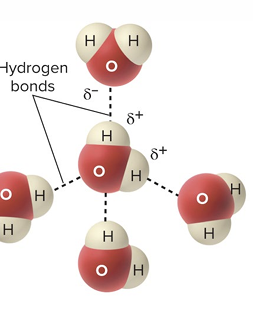
Hydrogen Bond
hydrogen atom from one polar molecule is attracted to an electronegative atom from another molecule
Ionic Bond
electrons are transferred, forming ions that are attracted to each other.
Covalent Bonds
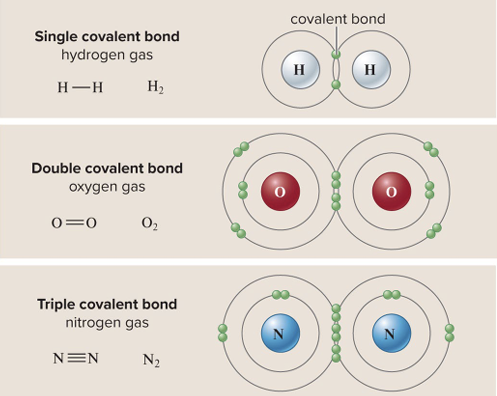
atoms share at least one pair of electrons.
occurs between atoms with unfilled valence electrons shells.
are strong chemical bonds - because the shared electrons behave as if they belong to each atom
two types → polar, nonpolar
Polar Covalent Bonds
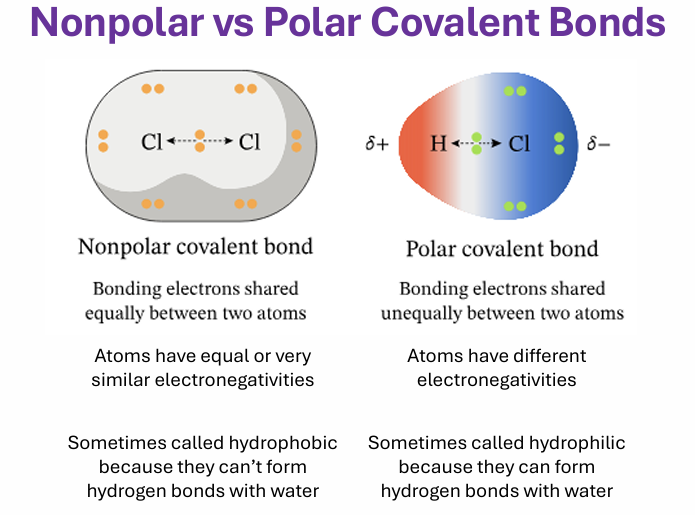
form between atoms of different electronegativity (attraction to electrons).
shared electrons are more likely to be close to the more electronegative atom.
the unequal distribution of electrons creates a polarity (difference in electric charge) across the molecule.
Nonpolar Covalent Bonds
form between atoms with the same or similar electronegativities
atoms have an equal sharing of electrons
molecules comprised of atoms connected by nonpolar covalent bonds have no charge difference across molecule.
Ionic Bonds
Ion
an atom or molecule that has gained or lost one or more electrons
Cations → have a net positive charge (+)
Anions → have a net negative charge (-)
Ionic bond occurs when a cation binds to an anion by electrostatic attraction.
Ionic compounds form between a metal and a nonmetal are all called salts
Ex: NaCl, KCl, CaCl2

Hydrogen Bonds
Individually, these are weak bonds that can form and break easily
Collectively, many H bonds can be strong overall
Ex: DNA
Chemical Reactions
one or more substances are changed into other substances
reactants → products
Properties of Chemical Reactions
require a source of energy
in living organisms, they often use an enzyme as a catalyst
tend to proceed in a particular direction but will eventually reach equilibrium
occur in liquid (water)

Water
life depends on water
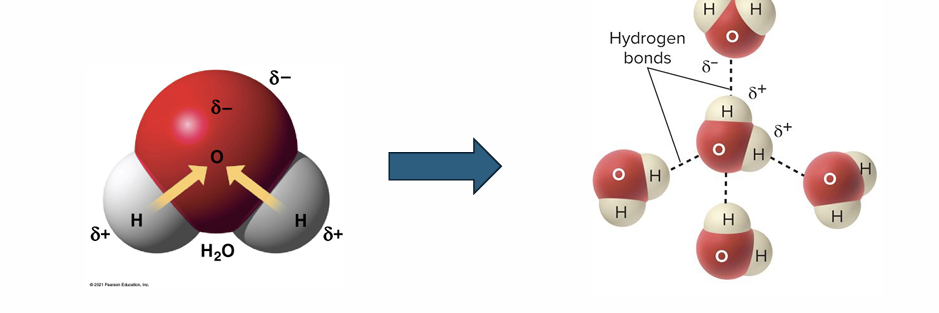
individual water molecules are created through polar covalent bonds.
the water molecule is a polar molecule overall - meaning that the overall charge is unevenly distributed.
because of its polarity, multiple water molecules are bonded together by hydrogen bonds.
Cohesive and Adhesive Properties
Cohesion
collectively, hydrogen bonds hold water molecules together.
results in high surface tension → a measure of how difficult it is to stretch or break the surface of a liquid.
contributes to the transport of water and dissolved nutrients against the gravity in plants.

Adhesion
an attraction between different substances, for example, between water and plant cell walls.
this helps to counter the downward pull of gravity.

Properties of Water
Water has a high specific heat. → a large amount of energy is required to change the temperature of water.
Water has a high heat of vaporization. → the evaporation of water from a surface causes cooling of that surface.
Solid water is less dense than liquid water. → bodies of water freeze from the top down.
Water is a good solvent. → polar molecules and ions are soluble in water.
Water organizes nonpolar molecules. → causes hydrophobic molecules to aggregate or assume specific shapes.
Water can form ions.
Continued
Properties that depend on amount of solutes.
Temperature at which a solution freezes or boils depends on number of dissolved solutes.
Addition of solutes to water
lowers the freezing point below 0 deg Celsius.
raises the boiling point above 100 deg Celsius.
Some animals produce antifreeze molecules → lowering the freezing point of body fluids to prevent blood and cells from freezing.
Substances vs. Water
Hydrophilic
“water-loving”
readily dissolve in water
molecules with ionic and/or polar covalent bonds
Hydrophobic
“water-fearing”
do not dissolve in water
nonpolar molecules like hydrocarbons, oilsd
Amphipathic
“both loves”
have both polar/ionized and nonpolar regions
detergent
Acids and Bases
Acids
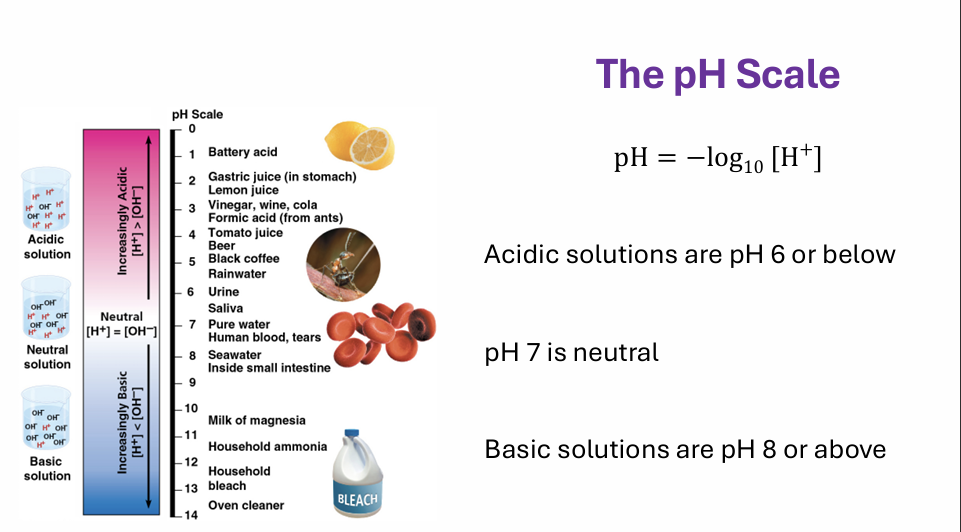
substances that dissociate in water to increase the H+ concentration.
Bases
substances that combine with H+ dissolved in water, and this lowers the H+ concentration.
Strong acids and bases dissociate completely in water.
Buffers
organisms usually tolerate only small changes in pH
Buffers → are substances that minimize changes in concentrations of H+ and OH- in a solution.
most buffer solutions contain a weak acid and its corresponding base, which combine reversibly with H+ ions.
