1 - Conservation and dissipation of energy
1.1 - Changes in energy stores
KEY POINTS:
- Energy can be stored in a variety of different energy stores.
- Energy is transferred by heating, by waves, by an electric current, or by a force when it moves an object.
- When an object falls and gains speed, its store of gravitational potential energy decreases and its kinetic energy store increases.
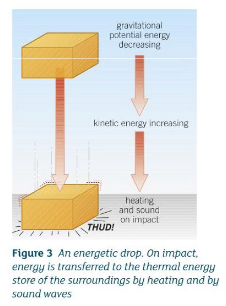
- When a falling object hits the ground without bouncing back, its kinetic energy store decreases. Some or all of its energy is transferred to the surroundings — the thermal energy store of the surroundings increases, and energy is also transferred by sound waves.
Energy stores
There are 8:
- Thermal energy stores
- Kinetic energy stores
- Gravitational potential energy stores
- Elastic potential energy stores
- Chemical energy stores
- Magnetic energy stores
- Electrostatic energy stores
- Nuclear energy stores
Vehicles
Cars, buses, planes, and ships all use fuels as chemical energy stores.
Electric trains use energy transferred from fuel in power stations. Electricity transfers energy from the power station to the train.
Energy can be stored in different ways and is transferred in 4 main ways:
- heating
- waves
- an electric current
- When a force moves an object.
Here are some examples:
Chemical energy stores include: fuels, foods, or the chemicals found in batteries. The energy is transferred during chemical reactions.
Kinetic energy stores: the energy an object has because it is Moving.
Gravitational potential energy stores are: the energy stored in an object because of its position, such as an object above the ground.
Elastic potential energy stores: the energy stored in a springy object when you stretch or squash it.
Thermal energy stores: the energy a substance has because of its temperature.
Energy can be transferred from one store to another.
Examples:
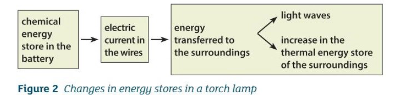
- In a torch, the torch’s battery pushes a current through the bulb. This makes the torch bulb emit light, and also get hot.
- When an electric kettle is used to boil water, the current in the kettle’s heating element transfers energy to the thermal energy store of the water and the kettle.
- When an object is thrown into the air, the object slows down as it goes up. Here, energy is transferred from the object's kinetic energy store to its gravitational potential energy store.
Energy changes can be shown in a flow diagram like this:
Or in a diagram:
Describe the energy changes taking place in a roller coaster as it climbs an incline and then descends
- As it climbs, its gravitational potential energy store increases.
- As the roller coaster descends, its gravitational potential energy store decreases.
- Most of this energy is transferred to its kinetic energy store, which therefore increases.
- However, some energy is transferred to the thermal energy store of the surroundings by air resistance and friction
- And some energy is transferred by sound waves.
KEY POINTS:
- Energy can be stored in a variety of different energy stores.
- Energy is transferred by heating, by waves, by an electric current, or by a force when it moves an object.
- When an object falls and gains speed, its store of gravitational potential energy decreases and its kinetic energy store increases.
- When a falling object hits the ground without bouncing back, its kinetic energy store decreases. Some or all of its energy is transferred to the surroundings — the thermal energy store of the surroundings increases, and energy is also transferred by sound waves.
1.2 Conservation of energy
KEY POINTS:
- Energy cannot be created or destroyed.
- Conservation of energy applies to all energy changes.
- A closed system: a system in which no energy transfers take place out of or into the energy stores of the system. Energy can be transferred between energy stores within a closed system. The total energy of the system is always the same, before and after, any such transfers.
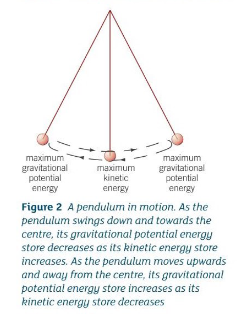
- A pendulum (see image above) would keep on swinging forever if it was in a vacuum because there would be no air resistance acting on it
- So no energy would be transferred from any of its energy stores.
- There would be no net change to the energy stored in the system.
- Because of this, it would be an example of a closed system.
- A system: an object or a group of objects.
- The total energy of a closed system is always the same before and after energy transfers to other energy stores within the closed system.
__**The principle of conservation of energy:**__ Energy cannot be created or destroyed.
Energy can be stored in various ways.
What energy transfers happen to a bungee jumper after jumping off the platform?
- When the rope is slack, energy is transferred from the gravitational potential energy store to the kinetic energy store as the jumper accelerates towards the ground due to the force of gravity.
- When the rope tightens, it slows the bungee jumper’s fall.
- This is because the force of the rope reduces the speed of the jumper.
- The jumper’s kinetic energy store decreases and the rope's elastic potential energy store increases as the rope stretches.
- Eventually, the jumper comes to a stop — the energy that was originally in the kinetic energy store of the jumper has all been transferred into the elastic potential energy store of the rope.
- After reaching the bottom, the rope recoils and pulls the jumper back up.
- As the jumper rises, the energy in the elastic potential energy store of the rope decreases and the bungee jumper's kinetic energy store increases until the rope becomes slack.
- After the rope becomes slack, and at the top of the ascent, the bungee jumper’s kinetic energy store decreases to zero.
- The bungee jumper's gravitational potential energy store increases throughout the ascent.
- The bungee jumper doesn't return to their original height.
- This is because some energy was transferred to the thermal energy store of the surroundings by heating as the rope stretched and then shortened again.
1.3 - energy and Work done
KEY POINTS:
- Energy cannot be created or destroyed.
- Conservation of energy applies to all energy changes.
- A closed system: a system in which no energy transfers take place out of or into the energy stores of the system. Energy can be transferred between energy stores within a closed system. The total energy of the system is always the same, before and after, any such transfers.

Work Done
- You have to apply force to move something.
- When the object is moved by the force you apply, work is done on the object by the force.
- The work done causes a transfer of energy.
The amount of energy transferred to the object is equal to the work done on it. For example, to raise an object, you need to apply a force to it to overcome the force of gravity on it. If the work you do on the object is 20J, the energy transferred to it must be 20J. So its gravitational potential energy store increases by 20).
__**REMEMBER:**__
Energy transferred = work done
Calculating work done
The work done by a force depends on the size of the for ce and the distance moved. One joule of work is done when a force of one newton causes an object to move a distance of one metre in the direction of the force. To calculate the work done by a force when it causes displacement of an object, use this equation:

Friction
Friction:
Work done to overcome friction is mainly transferred to thermal energy stores by heating.
How do brake pads on a vehicle work?
- Brake pads on a vehicle become hot if the brakes are applied for too long.
- Friction between the brake pads and the wheel discs opposes the motion of the wheel.
- The force of friction does work on the brake pads and the wheel discs.
- So energy is transferred from the kinetic energy store of the vehicle to the thermal energy store of the brake pads and the wheel discs.
- This makes them become hot and transfer energy by heating to the thermal energy store of the surrounding air.
KEY POINTS:
- You have to apply force to move something.
- When the object is moved by the force you apply, work is done on the object by the force.
- The work done causes a transfer of energy.
1.4 Gravitational potential energy stores
Changes in gravitational potential energy stores
- The gravitational potential energy (Ep or GPE) of an object (also known as its gravitational store) is: The energy an object has due to its height in a gravitational field
- This means:
- If an object is lifted up it will gain Ep
- If it falls, it will lose Ep
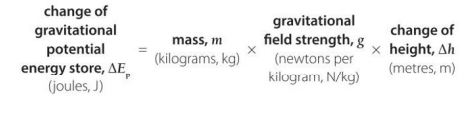
- The Ep of an object can be calculated using the equation: Ep = m × g × h
- In the equation Ep = m × g × h:
- Ep = gravitational potential energy, in Joules (J)
- m = mass, in kilograms (kg)
- g = gravitational field strength in Newtons per kilogram (N/kg)
- h = height in metres (m)
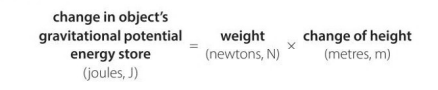
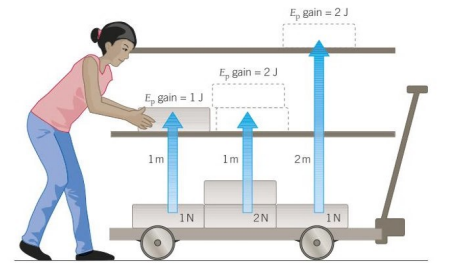
Using work done = force applied x distance moved in the direction the force:
Gravitational Field Strength
- The gravitational field strength (g) on the Earth is approximately 10 N/kg
- The gravitational field strength on the surface of the Moon is less than on the Earth
- This means it would be easier to lift a mass on the Moon than on the Earth
- The gravitational field strength on the surface of the gas giants (eg. Jupiter and Saturn) is more than on the Earth
- This means it would be harder to lift a mass on the gas giants than on the EarthGravitational potential energy stores and mass
Tips
- In physics, the Greek letter delta (A) is used to represent the phrase ‘change in’. For example, Ah can be used in place of ‘change in height’.
- Watch out for objects going up a slope. To calculate the increase in their gravitational potential energy stores, you need the vertical height gained, not the distance along the slope.
Key Points
The gravitational potential energy store of an object increases when it moves up and decreases when it moves down. e The gravitational potential energy store of an object increases when it is lifted up because work is done on it to overcome the gravitational force. e The gravitational field strength at the surface of the Moon is less than on the Earth. e The change in the gravitational potential energy store of an object is AE =m g Ah
1.5 Kinetic energy and elastic energy stores
Kinetic Energy
- The kinetic energy (Ek or KE) of an object (also known as its kinetic store) is defined as: The energy an object has as a result of its mass and speed
- This means that any object in motion has kinetic energy
- Kinetic energy can be calculated using the equation: Ek = ½ × m × v^2
- Where:
- Ek = kinetic energy in Joules (J)
- m = mass of the object in kilograms (kg)
- v = speed of the object in metres per second (m/s)
Elastic Potential Energy
- When a spring is stretched (or compressed), work is done on the spring which results in a transfer of energy to the spring’s elastic store
- Elastic potential energy is defined as: The energy stored in an elastic object when work is done on the object
- This means that any object that can change shape by stretching, bending or compressing (eg. springs, rubber bands) can store elastic energy
How to determine the extension, e, of a stretched spring
- The amount of elastic potential energy stored in a stretched spring can be calculated using the equation: Ee = ½ × k × e^2
- Where:
- Ee = elastic potential energy in Joules (J)
- k = spring constant in Newtons per metre (N/m)
- e = extension in metres (m)
- The equation to determine the extension of a stretched spring assumes - that the spring has not been stretched beyond its limit of proportionality
Key Points
- The energy in the kinetic energy store of a moving object depends on its mass and its speed.
- The kinetic energy store of an object is
- Elastic potential energy is the energy stored in an elastic object when work is done on the object.
- The elastic potential energy stored in a stretched spring is E. =4 ke?, where e is the extension of the spring. \n
1.6 Energy Dissipation
Useful energy - energy transferred to where it is wanted in the way that is wanted.
Wasted energy - the energy that is not usefully transferred.
In practice, most systems tend to be open systems
An open system - A system that can exchange both energy and matter with its surroundings.
Unlike other forms of energy, heat, light and sound have a tendency to spread out into the surroundings
- This is known as dissipation
When they do so it becomes very difficult to "gather" the energy back together again
- As a result, the energy becomes less useful
- Because of this, whenever a process produces unwanted heat, light or sound, the energy that ends up in those forms is essentially wasted
Friction
- Friction in machines always causes energy to be wasted.
Example:
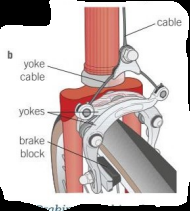
- When a bike rider brakes, friction acts between - the brake blocks and the wheels
- Energy is wasted as it is transferred from - the kinetic energy stores of the bike and the cyclist, to the thermal energy stores of the brake blocks and the wheels, which are heated by friction.
- Energy becomes less useful the more it spreads out.
- For example, the hot water from a central heating boiler in a building is pumped through pipes and radiators.
- The thermal energy store of the hot water decreases as it transfers energy by heating to the thermal energy stores of the radiators — heating the rooms in the building.
- But the energy supplied to heat these rooms will eventually be transferred to the surrounding air.
1.7 Energy and Efficiency
- The efficiency of a system - a measure of how well energy is transferred in a system
- Efficiency is defined as: The ratio of the useful power or energy transfer output from a system to its total power or energy transfer input
- If a system has high efficiency, this means most of the energy transferred is useful
- If a system has low efficiency, this means most of the energy transferred is wasted
- Determining which type of energy is useful or wasted depends on the system
- When electrical energy is converted to light in a lightbulb, the light energy is useful and the heat energy produced is wasted
- When electrical energy is converted to heat for a heater, the heat energy is useful and the sound energy produced is wasted
- Efficiency is represented as a percentage, and can be calculated using the equation:

- The energy can be of any form e.g. gravitational potential energy, kinetic energy
- The efficiency equation can also be written in terms of power:

- Power - the energy transferred per unit of time
- Efficiency can be given in a ratio (between 0 and 1) or percentage format (between 0 and 100 %)
- If a question asks for efficiency as a ratio, give your answer as a fraction or decimal.
- If the answer is required as a percentage, remember to multiply the ratio by 100 to convert it: if the ratio = 0.25, percentage = 0.25 × 100 = 25 %
- Efficiency has no units
Improving Efficiency
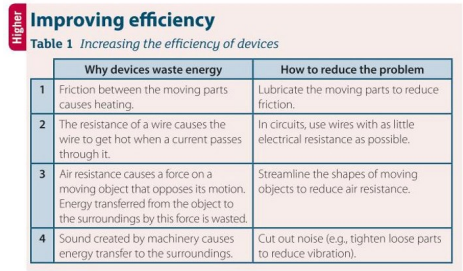
1.8 - Electrical Appliances
- Electricity - Not an energy store, rather a flow of charge that transfers energy from one energy store to another.
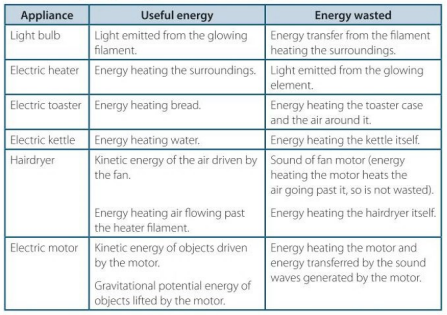
Key Points
- Electricity and gas and/or oil supply most of the energy you use in your home.
- Electrical appliances can transfer energy in the form of useful energy at the flick of a switch.
- Uses of everyday electrical appliances include heating, lighting, making objects move (using an electric motor), and producing sound and visual images.
- An electrical appliance is designed for a particular purpose and should waste as little energy as possible.
1.9 Energy and power
- Machines, such as car engines, transfer energy from one type to another every second
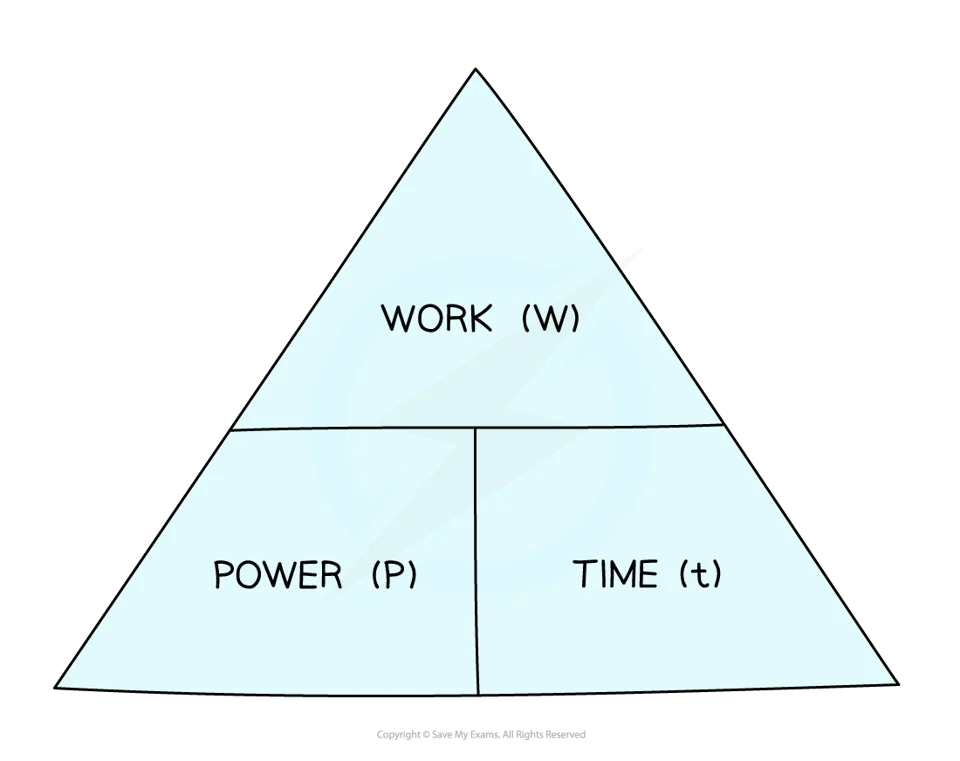
- The rate of this energy transfer, or the rate of work done, is called power
- Two identical cars accelerating to the same final speed will both gain the same amount of energy. But if one of them reaches that speed sooner, it will have a greater power
- Power - the energy transferred per unit time
- Power can also be defined as the work done per unit time
- The energy transferred, or work done, is always in units of joules (J)
- Time is measured in seconds (s)
- Power, P is measured in the units watts (W)
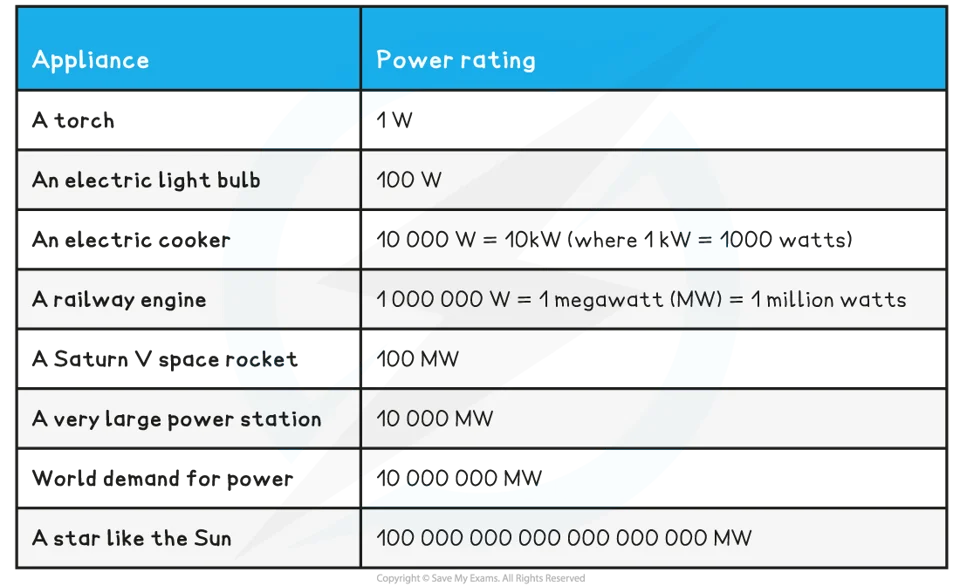
Some Common power ratings: