4.1.1 (12.6) Specific immune system (OCR A-Level Biology)
ANTIBODIES:
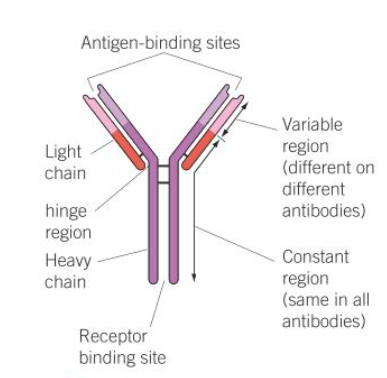
Y-shaped glycoprotiens called immunoglobulins
Two chains held together by disulfide bridge (heavy + light)
Bind with Antigen on pathogen to form antigen-antibody complex
HOW ANTIBODIES DEFEND
Acts as Opsonin signaling for phagocytosis
Pathogens can no longer effectively invade in this form
Act as Agglutinins casuing pathogens to clump together
Act as Anti-toxin by binding to toxins and making them harmless
Matured in: | Function | |
|---|---|---|
T-Helper cells | Thymus gland | Receptors which bind to surface antigens Produces interleukins (cytokine-cell signalling molecule) Interleukins stimulate:
|
T-Killer cells | Thymus gland | Destroy pathogen due to chemical they produce called perforin (makes holes in pathogens cell membrane) |
T-Memory cells | Thymus gland | Immunological memory Live for a long time If they meet antigen for a second time, divides rapidly to form large amount of clones for T-Killer cells |
T-Regulator cells | Thymus gland | Supresses immune response after Pathogen is dealt with Prevents auto-immune dsease |
Plasma cells | Bone Marrow | Produces antibodies to particular antigen and have them put into circulation Only active for a couple days but makes thousands of antibodies |
B-Effector cells | Bone Marrow | Divides to form plasma cell clones |
B-Memory cells | Bone Marrow | Immunological memory Live for a very long time Programmed to remember a speicifc antigen and can provide a very rapid response if encountered again |
DIFFERENCES BETWEEN T AND B LYMPHOCYTES:
B-cells in Bone Marrow, T-cells matured in the B-cellsThymus
B-cells produce antibodies, T-cells do not
B-cells become part of the adaptive immune system, T-cells have a faster + more potent response
CELL-MEDIATED IMMUNITY: T-Cells respond to cells in organism that have experienced some kind of change (Eg: viral infection)
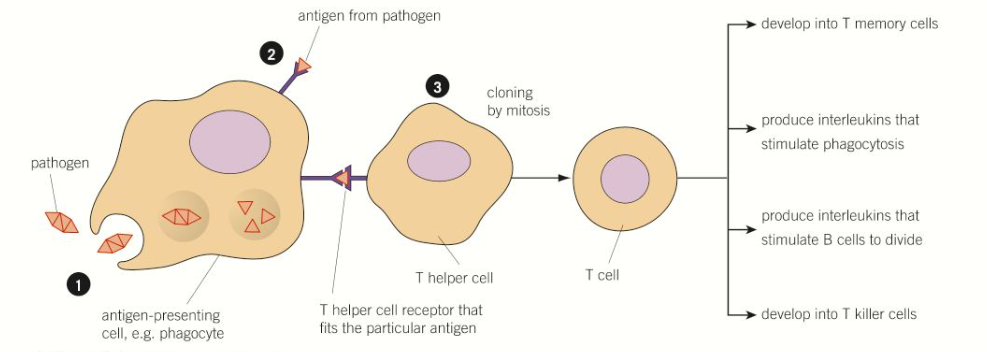
Macrophages engulf + digest pathogens (phagocytosis) and then present the antigens on the pathogens’ surface to make it an antigen-presenting cell (APC)
T-helper cells become activated + produce interleukins stimulating T-cells to divide rapidly
T-Cells then develop into:
T-Memory
Interleukins to stimulate phagocytosis/B-Cell division
Stimulate T-Killer cell clone development to kill infected cells
HUMORAL IMMUNITY