Part VII: The Philosopher Ruler
Pages 189-248
Parts 1 and 2: The ideal and the actual, and the definition of the philosopher
Plato first, for another time, is challenged about the practicability of his society. Plato admits that whilst they are not necessarily achievable, they are ideals to aspire to. Plato says that the only way for realising a system anywhere close to this is to make philosophers the ruler of the society. Plato employs the analogy of the painter to prove this - saying that if a painter paints a picture of something that does not exist, it does not make him any worse of a painter, nor does it make the picture he paints any less beautiful. This is Plato trying to say that just because his society is unrealistic, it does not make him any worse of a philosopher, no does it make the society any less just.
In response to being asked how guardians could be compelled to live in the bizarre way that Plato outlines in Part VI, he suggests that his system is only possible if the rulers are philosophers - thus introducing the concept of the “philosopher-king”, which dominates the rest of the republic.
Socrates says that a philosopher is someone who loves truth - not mere examples of truth but all truth.
Plato believes that the philosopher is truthful (“a lover of the truth will not tolerate an untruth” - the noble lie??); shuns physical pleasure (the stream analogy → “if a man’s desires are set strongly in one direction, they are correspondingly less strong in other directions… like a stream… physical pleasures will pass him by”; “self-controlled and not grasping about money” (no desires); no meanness (“pettiness of mind is incompatible with the constant attempt to grasp things divine”); courageous “human life is no thing of great consequence… he won’t think death anything to be afraid of”; finds learning easy and has a good memory “you can’t expect anyone to have much love for anything which he does with pain and difficulty and little success”.
Socrates first defines “philosopher” as a “lover of truth”, distinguishing the true philosopher from the sophist, a brand of pseudo-intellectuals whom are “lovers of sights and sounds”.
To distinguish sophists and the true philosopher, Plato uses the forms. The forms are eternal, unchanging, absolute ideas - that cannot be seen, but can only be grasped with the mind. They are responsible for making the things we sense around us into the sorts of things they are. They are a level of reality more real and ultimate than that which we perceive through our senses, they are not “in flux”.
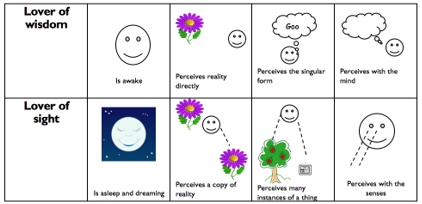
For example, anything red that we see participates in the form of the red, anything square participates in the form of the square.
What makes philosophers different from these sight-lovers is that they apprehend these forms - the sight-lovers can claim to know all about beautiful things but they cannot claim to know the form of beauty, or even recognise that there is such a thing. The philosopher ruler will have “the capacity to grasp the eternal and immutable, while those who have no such capacity are lost in multiplicity and change”.
The lovers of sight and sound only deal with “sensible particulars” - they can have opinions, but never knowledge. Only the philosopher can have knowledge, the objects of which are the forms.
The philosopher is wide awake while others are living in a dream world - appearances of the sensual world are relative and subjective, unlike the absolute nature of the world of forms.
This is a justification of Plato’s belief that only philosophers should be rulers - only they can have knowledge of the forms, the essence of things, which are absolute unchanging truths that transcend personal opinion, popular values, and cultural norms.
For Plato, what he is saying is self-evident and a priori.
To back up the claim that only philosophers can have knowledge, Socrates paints a fascinating metaphysical and epistemological picture. He divides all of existence up into three classes - what is completely, what is in no way, and what both is and is not.
What is completely - true knowledge (the forms) - infallible
What is in no way - ignorance
What both is and is not - the object of opinion or belief - fallible
Only the form of the beautiful is completely beautiful, only the form of the sweet is completely sweet. On the other hand, sensible particulars both are and are not - even the sweetest apple is also mixed in with some sourness, even the most beautiful woman is plain when judged against certain standards.
Non-philosophers are blind - they don’t have knowledge, so don’t know which rules should be implemented.
Plato is fundamentally suggesting why philosophy is crucial to the life of the city, rather than a threat to society. That the forms qualify as “what is completely” is a radical and contentious idea - the idea that no sensible particular can be completely anything holds some merit (in some way, everything will lack a quality, or at least deteriorate over time - withering, rotting, desiccating). A form, on the other hand, is the purest version of something that lasts without alteration forever. Knowledge, for Plato, consists in eternal, unchanging, absolute truths - therefore it cannot apply to the everchanging details of the sensible world.
Some might claim that Plato is making a mistake in leaping from the claim that knowledge must apply to unchanging truths, to the claim that knowledge only applies to the forms.
If philosophers contemplate solely the world of the forms, surely this then undermines their ability to rule the real world - and interact with those who exist solely within it.
Parts 3 and 4: The prejudice against philosophy and the corruption of philosophic nature in contemporary society and philosopher ruler not impossible
Given that only philosophers can have knowledge, they are clearly the ones best able to grasp what is good for the city, and so are in the best position to know how to run and govern the city. If we only knew that they were virtuous, or at least not inferior to others in virtue, then we could be sure that they are the ones most fit to rule.
Luckily, we can know that philosophers are superior in virtue to everyone else - a philosopher loves truth more than anything else - his entire soul strives after truth. This means that the rational part of his soul must rule, which means that his soul is just. ‘
Socrates states that the current philosophers are useless - as they are quickly preyed upon by family and friends, who hope to benefit from their natural gifts. They are encouraged to enter politics in order to win money and power by their parasitic family and friends. These people are vicious. The few good philosophers are considered useless because society has become antithetical to correct ideals.
He compares the situation to a ship on which the ship owner (the public) is “hard of hearing, has poor vision and lacks sea-faring skills”. All of the sailors on the ship quarrel over who should be captain, though they know nothing about navigation (politicians). In lieu of any skill, they make use of brute force and clever tricks to get the ship owner to choose them as captain. The crew are stronger than the ship owner, they overpower him and create a pleasure cruise. Whoever is successful in persuading the ship owner to choose them is called a navigator, or a captain. These sailors have no idea that there is a craft of navigation. In this scenario, Socrates points out that the true captain, the man who actually knows about navigation, would be called a useless stargazer. Plato compares this to current democracy: the owners of the ship are the citizens of a state - they are politically powerful (can vote), but lack any governmental acumen; the crew of the ship are the politicians who hold sway in a political assembly, all vying for the attention of their citizens (the owner); the true navigator is the philosopher with knowledge of the forms, a person of great learning and wisdom.
The most damage is caused to philosophy by those who pretend to practice it (sophists).
Like seeds need the right nourishment from soil, philosophers need the right environment to grow up
If a man was in charge of an animal, he may learn how to teach it, but wouldn’t know what it was motivated by - he’d not know its real nature, but would call what pleased it good and what didn’t bad. This is like the politicians - they please the masses without knowing the true nature of good.
Plato asserts in this section that the philosopher is not only the sole possessor of knowledge, but also the most virtuous of men. Plato indicates that through associating himself with the forms, the philosopher gets the forms in his soul and patterns his soul after the form of the good.
Since all of the philosopher strives towards truth, he has no drive towards money, honour and pleasure - so he will not be driven towards immoral behaviour. His reason dominates his soul.
Plato seems to be claiming that all that is needed for the change of state to happen is for a philosopher ruler to come into power. However, Plato attempted this is in reality and was unsuccessful.
Plato is stating that the only people who can be philosophers are those who agree with him - in his eyes his beliefs are the truth - but this seems unreasonable.
The differences in the faculties of opinion and knowledge may not exist, instead there are two alternatives: one, there is no absolute knowledge in the world, thus all knowledge is merely opinion. Two, opinion and knowledge are varying degrees of the same faculty- blurry sight is still sight.
Plato says that a philosopher needs to be in love with every aspect of knowledge to be a philosopher - is this true? Plato would argue that if not, they are not real philosophers.
One of the things that Plato wants to test his potential philosopher rulers for is to check how they withstand influences such as pain and pleasure. Contrastingly, Plato also states that philosophers usually have a bad reputation because they are swayed by people’s opinions.
Plato states that the philosophic nature is more corrupted by a bas environment because it is capable of more - but surely good natures are incorruptible?
Plato earlier says that philosopher rulers may have the need to tell myths and fictions (pseudos) to ensure that the characters of others are not corrupted. He argues that spoken ‘falsehoods’ can be useful as a ‘preventative medicine’ protecting those who are weaker. And so Plato contradicts himself.
Is it really possible that one could resist bodily desires through contemplation of the truth? (Maslow’s hierarchy of needs)
Why should philosophers have more power than anyone else just because they have knowledge of the forms? Who decides this? The philosopher ruler is not elected and so will assume power - there is no consent, and the rights of the ruler will take precedent over the ruled.
The properties of the forms:
Simple (GE Moore - cannot be broken down → criticism: Aristotle’s third man)
Ungenerated and indestructible (they do not come into being or cease to exist)
Immutable (permanent) - they provide the distinction between accidental and essential properties of things
Timeless
Independent existence
Not spatially located
The forms are unfalsifiable - according to Ayer this makes them meaningless.
What about the form of evil or temporality? If everything has a form they must exist, but they contradict the idea of forms in and of themselves. Plato would argue that evil and temporality are not things, but the absence of things - so they don’t need forms.
We don’t experience anything to suggest that there is an eternal, intelligible realm in existence - and that the sensory real is just opinion?
Silly forms
How do we gain knowledge of the forms?
Part 5: The Good as the Ultimate Object of Knowledge
Socrates now turns to the final stage in construction of the just city, the question of how to produce philosopher kings. The most important subject to a philosopher king is the study of the form of the good - it is this study that causes someone to gain the highest level of knowledge that causes them to be fit to be a philosopher king. To try and explain what good is, Socrates employs the simile of the sun.
The sun is to the visible realm what good is to the intelligible realm (the world of the forms) in three aspects.
Whilst the sun is the source of light (and visibility) in the visible realm, good is the source of intelligibility in the intelligible realm.
The sun is responsible for giving us sight, as it is only through light entering our eyes that we can see. In the same way, goodness gives us the capacity for knowledge.
Finally, the sun is responsible for causing things to exist in the visible realm. It regulates the seasons, and makes animals give birth. In response, the good is responsible for the existence of forms and the coming to be in the intelligible realm.
Part 6: The Divided Line
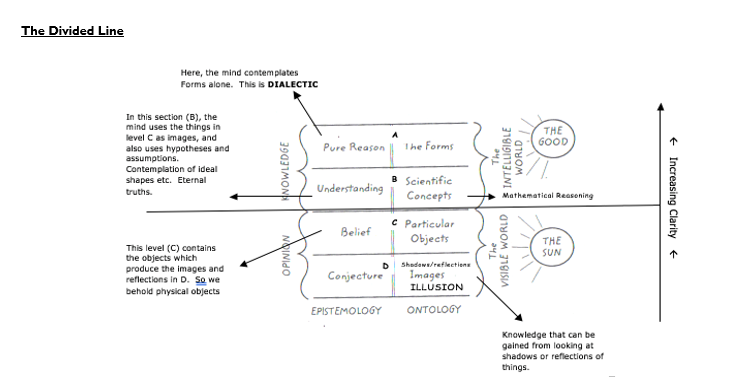
The form of the good is responsible for all knowledge, truth and for the knowing mind. It is the cause of the existence of the forms in the intelligible realm, and the source for all that that is good and beautiful in the visible realm. This leads into the analogy of the divided line, which is meant to illustrate the ways of accessing the world, the four grades of knowledge and opinion available to us.
Imagine a line broken into four segments. The bottom two segments represent our access to the visible realm, while the top two represent our access to the intelligible.
The lowest grade of cognition is imagination - a person in a state of imagination considers images and reflection as the most real things in the world.
The next stage on the line is belief - belief looks towards the realm of the visible, but it makes contact with real things. A person in a stage of belief thinks that sensible particulars are the most real things in the world.
Further up the line, there are two grades of knowledge: thought, and understanding. Although thought deals in forms, it uses sensible particulars as images to aid in its reasoning - it also relies on hypotheses and axioms (i.e. maths).
Understanding has no crutches, it is a purely abstract science, which deals exclusively with the forms, working off an unhypothetical first principle (the good).
To reach understanding, an individual using the crutches necessary to thought, works his way up with philosophical dialectic towards the form of the good. Once an individual understands the form of the good, and you have reached the highest stage of knowledge.
The Good
The form of the Good is the most important object of study for the rulers. All things are only useful, beneficial or good in relation to “the Good”
For Plato, the true good is good simply for its own sake and not in relation to something else
Since the good explains what is good in all other things, without knowledge of the Form one cannot fully comprehend ethical or aesthetic issues such as the nature of justice.
The most likely candidate for what Plato meant as the form of the Good was harmony (order and balance). Harmony between the three classes of society makes for a healthy, just city, and harmony in the soul makes for a healthy, just soul. When speaking of the superiority of the forms, he often appeals to their supreme order, and explains that they make the philosopher virtuous by inspiring the same order in his soul. Basically, Plato is arguing that the good of each thing is it possessing its appropriate harmony.
In the metaphor of the line, the most difficult stage to understand is imagination, since art is in this category, it is implied that a person existing in the imagination division views art as the most real thing. For example, such a person would be one who acquires their sense of self and of the world around him from images or television or movies.
However, some critics argue that Plato is mistaken in lumping art in with imagination - imagination could refer to a state in which our perceptions of the world are completely uncritical - which would make belief the stage in which we correlate our perceptions, but fail to subject them to critical analysis. Another interpretation is when imagination is a state in which we do not look for explanations, and belief is a state in which we look for explanations but only in particular terms, rather than universal terms.
Thought and understanding are easier to understand. Thought is abstract reasoning that makes use of images and unproven assumptions - geometry is a good example - geometers use diagrams of triangles, and mathematical axioms independent of proof. Understanding would then make these axioms and diagrams unnecessary by seizing on a single universal proposition on which the entire body of knowledge can be based.
Part 7: The simile of the Cave
Plato then presents the allegory of the cave. This metaphor is meant to illustrate the effects of education on the human soul. Education moves the philosopher through the stages on the divided line, and ultimately brings him to the form of the good.
Socrates describes a dark scene - a group of people have lived in a deep cave since birth, never seeing the light of day. These people are bound so that they cannot look to either side or behind them, but only straight ahead. Behind them is a fire, and behind the fire is a partial wall. On top of the wall are various statues, which are manipulated by another group of people, lying out of sight of the partial wall. Because of the fire, the statues cast shadows across the wall that the prisoners are facing - the prisoners watch the stories, and because these shadows are all they ever get to see, they believe them to be the most real things in the universe. When they talk to one another about “men”, “trees” or “horses”, they are referring to these shadows. These prisoners represent the lowest stage on the line - imagination.
A prisoner is freed from his bonds, and is forced to look at the fire and at the statues themselves. After an initial period of pain and confusion (because of eye pain after looking at the fire), the prisoner realises that what he sees now are more real than the shadows he has always taken to be reality. He grasps how the fire and the statues together cause the shadows, which are copies of these more real things. He accepts the statues and fire as the most real things in the world. This stage in the cave represents belief - the prisoner has made contact with real things, but he is not aware that there are things of greater reality - a world beyond his cave.
Next, this prisoner is dragged out of the cave into the world above. At first, he is so dazzled by the light that he can only look at shadows, then at reflections, then finally at real objects. He sees that these are even more real than the statues were, and that those were only copies of these. He has now reached the cognitive stage of thought, and has caught his first glimpse of the most real things - the Forms.
When the prisoner’s eyes have fully adjusted to the brightness, he lifts his sight towards the heavens and looks at the sun. He understands that the sun is the cause of everything he sees around him - the light, his capacity for sight, the existence of flowers. The sun represents the form of the good, and the former prisoner has reached the stage of understanding.
The goal of education is to drag every man as far out of the cave as possible. Education should not aim at putting knowledge into the soul, but at turning the soul towards right desires. Continuing the analogy between mind and sight, Socrates explains that the vision of a clever, wicked man might be just as sharp as that of a philosopher. The problem lies in what he turns his sharp vision toward.
The overarching goal of the city is to educate those with the right natures, so that they can turn their minds sharply toward the form of the good. Once they have done this, they cannot remain contemplating the form of the good forever. They must return periodically to the cave and rule there. They need to periodically turn away from the forms to return to the shadows to help other prisoners.
It is important to realise that Plato means to depict not only four ways of thinking, but four ways of life. To use an example, imagine that a person in each of these stages were asked to say what courage is - the understanding of courage would differ widely from stage to stage.
At the imagination stage, an individuals notion of courage would appeal to images from culture - for example “Luke Skywalker seems courageous - so that’s courage”.
At the belief stage, an individual would appeal to examples from real life - for example “Soldiers in the army are really courageous - so that’s courage”.
At the stage of thought, an individual would try to give a definition of courage - perhaps one that has already been given in the past - like Socrates in the republic when he says “courage is knowing what needs to be feared and what is not to be feared”. Since they don’t have true understanding, even if they are correct they are left open to attach and objection because they don’t have a true grasp of the concept.
At the stage of understanding, a person can back up their definition with knowledge from the form of the good. Speaking from understanding, the person will comprehend all the terms in the definition and can defend each one of them based on the first principle, the form of the good.
Because the form of the good illuminates all understanding once it is grasped, knowledge is holistic. You need to understand everything to understand anything. All the forms are connected, and are comprehended together in the following way - you work your way up to the form of the good, until you grasp the form of the good.
Since the stages in the cave are stages of life, it seems fair to say that Plato thought that we must all proceed through the lower stages in order to reach the higher stages. Not everyone can make it out - which is why some people are producers, some are warriors and some are philosopher-kings.
Plato’s friends raise the point that it’s unfair for the philosopher kings to be forced back into the cave. But Plato has three lines of response to this concern. First, he reminds us again that our goal is not to make one group especially happy, but rather to make the city as a whole as happy as possible. Second, he points out that the philosopher-kings are only able to enjoy the freedom above ground that they do because they were enabled by the education the city afforded them. They were moulded to be philosopher kings so that they could return to the cave and rule. They owe this city a form of gratitude and service. Finally, he adds that the philosophers will actually want to rule , because they know that the city would be less just if they refrained. Since they love the forms, they will want to imitate them by producing order and harmony in the city.
Socrates ends by remarking that the reluctance of the philosopher to rule is one of his best qualifications for ruling. The only good rules rules out of a sense of duty and obligation, rather than out of a desire for power and personal gain. The philosopher is the only type of person who could ever be in this position, because only he has subordinated lower drives towards honour and wealth to reason and the desire for truth.