Topic 2: Nuclear Energy
Reactions and correlation to energy produced
Change | Type of change | Energy released |
Gas → liquid | Phase change | 40.7kJ/mol |
Combustion | Chemical reaction | 802 KJ/mol |
Nuclear | Nuclear reaction | 1.82 × 10^9 KJ/mol |
A substance is radioactive if it emits energy in the form of EMR(gamma rays) or particles(alpha, beta, or neutrons)
Nuclear reaction are said to be ionizing because some forms of radiation and particles released can penetrate solid material and damage living cells
Isotopes
Isotopes are elements with the same atomic numbers, but different atomic masses because of a different number of neutrons
*to calculate neutrons mass-atomic#
Isotopes become unstable when the force of repulsion in the nucleus is greater than the nuclear force of attraction holding the nucleus together
The unstable isotope will change into another substance and release energy in the form of radiation and particles
Radiation
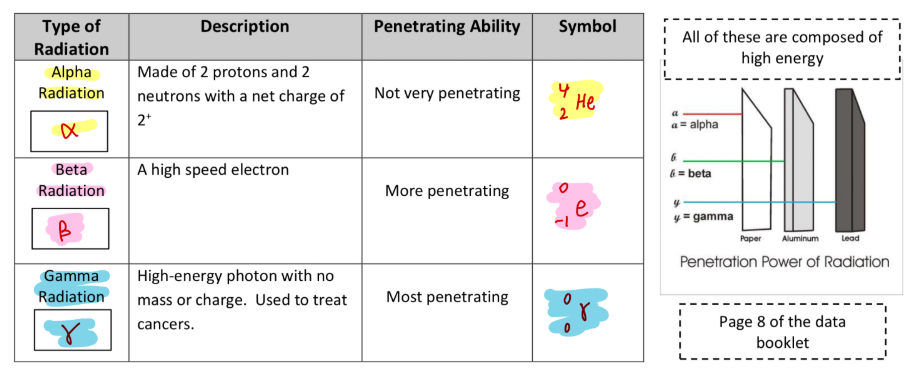
Atomic mass of an element is equal to the nucleons of an element: the number of protons and neutrons in a nucleus
Fusion vs Fission
Nuclear Fusion
Nuclear fusion: when 2 smaller nuclei with high-energy join together to form a larger nucleus while releasing energy
Occurs in the sun and all stars
Can we use nuclear fusion to produce energy?
Not yet! we have plenty of deuterium(raw material for fusion) but we cannot contain the energy produced
Nuclear Fission
Nuclear fission: When a large nucleus splits into smaller nuclei while releasing energy
Opposite of nuclear fusion
Begins when a large atom such as uranium is struck by a neutron causing it to become unstable
It then splits into 2 smaller nuclei and more neutrons that will go on to hit other atoms, therefor continuing the reaction
This reaction is difficult to control
The CANDU Reactor - Nuclear Fission
CANDU reactor stands for: Canadian Deuterium Uranium Reactor
Uses uranium-235 as fuel
Heavy water(deuterium oxide D2O) is used a moderator(use to sustain fission by slowing down neutrons)
Control Rod absorbs neutrons in an energy shut down(Also help to control the rate of fission)
Steel or concrete is used as shielding
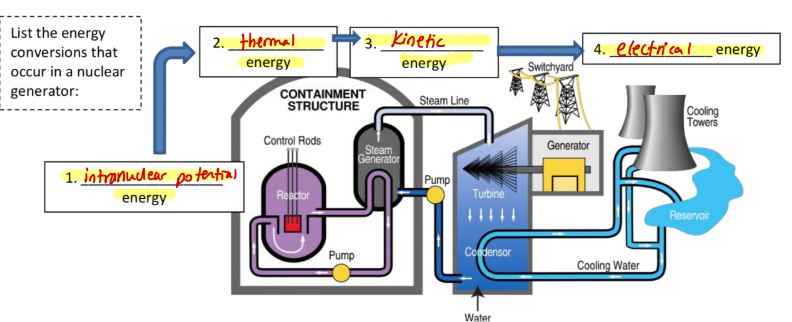
The energy from nuclear fission is used to heat water and produce steam, turning a turbine, spins a generator which creates electricity
Pros and cons
Perspectives to consider | Pro | Con |
Societal perspective |
|
|
Environmental/ecological perspective |
|
|
Economical perspective |
|
|
Coal-fired power plant vs Nuclear power plant
Coal-fired power plant | Nuclear power plant | |
Fuel source | Coal | Uranium-235 |
The energy stored in the fuel is called | Chemical potential | Intranuclear potential |
Reaction used to release energy from the fuel | Combustion | Nuclear fission(using a neutron) |
Energy conversion sequence | Solar→chemical potential→kinetic→electrical | Intranuclear potential→thermal→kinetic→electrical |
Einstein’s Famous Equation:
This formula says that mass can be converted into energy
A tiny loss in mass results in a gigantic gain in energy