1.2 Memory — The Working Memory Model
1. Introduction to the Working Memory Model
Baddeley & Hitch (1974)
Proposed the Working Memory Model (WMM) as an alternative to the Multi-Store Model.
Described STM as an active, limited-capacity system that temporarily stores and processes information.
Criticised the MSM for oversimplifying STM and overemphasising rehearsal.
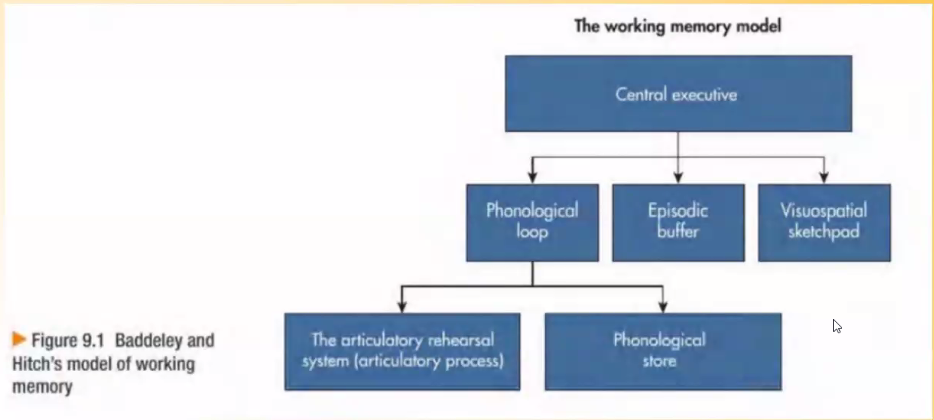
Originally proposed three components:
Central executive
Phonological loop
Visuospatial sketchpad (VSSP)
Key idea: Working memory actively processes and manipulates information rather than simply storing it.
I. The Central Executive
Controls and coordinates the working memory system.
Acts as an attentional controller, directing information to the appropriate slave system.
Controls three attentional processes:
Focusing: Concentrating attention.
Dividing: Sharing attention between tasks.
Switching: Moving attention between tasks.
Has limited capacity and is modality-free (can process different types of information).
Evaluation – Psychology as a Science
The central executive is an abstract, theoretical concept that cannot be directly observed or easily tested.
This limits the empirical evidence supporting its existence and makes it difficult to study scientifically.
II. The Phonological Loop
Temporarily stores and processes verbal and auditory information.
→ think of phone → auditory information over a phone call so retaining it though listening over the phone conversation
Consists of two components:
Component | Function |
|---|---|
Phonological store | Temporarily holds speech-based information for a few seconds. |
Articulatory rehearsal system | Repeats information subvocally (silently) to refresh it and prevent decay. |
Supporting research – How the phonological loop works
Research / concept | Key findings | What it supports |
|---|---|---|
Phonological similarity effect (Baddeley, 1966a) | Similar-sounding words are harder to recall than dissimilar-sounding words. | Acoustic encoding in the phonological store. |
Word length effect | Short words are recalled better than long words because long words take longer to rehearse, allowing earlier items to decay. | Limited capacity of the phonological loop. |
Articulatory suppression | Repeating an irrelevant word (e.g. "the") while memorising information prevents rehearsal and reduces recall. | The importance of articulatory rehearsal in maintaining verbal information. |
Further research – Language acquisition
Research | Key findings | What it supports |
|---|---|---|
Baddeley et al. (1988) | A woman (VP) with a phonological impairment struggled to learn vocabulary in a new language. | The phonological loop is important for learning new languages. |
Gathercole & Baddeley (1996) | Children with Specific Language Impairment (SLI) struggled to repeat non-words; performance was related to vocabulary size. | The phonological loop plays a role in language acquisition. |
Application: Non-word repetition tasks can help identify Specific Language Impairment (SLI).
Wider Issue – Psychology as a Science
Working memory research uses controlled laboratory experiments and measurable outcomes (e.g. word recall).
Emphasises objectivity, control and replicability.
Therefore, much of the research meets scientific criteria.
III. Visuospatial Sketchpad (VSSP)
Visuospatial Sketchpad (VSSP) | Description |
|---|---|
Function | Temporarily stores and manipulates visual and spatial information |
Coding | Visual coding |
Processes | Shape, colour, location and movement of objects. |
Capacity | Limited |
Corsi Block-Tapping Task | Participants repeat a sequence of blocks lighting up on a screen. Errors increase as sequences become longer, supporting the limited capacity of spatial memory. |
Wider Issues and Debates: Application to Education
Gathercole & Alloway (2008)
Working memory research helps identify children with working memory difficulties.
These children may struggle with concentration, lengthy instructions and complex vocabulary.
Research has led to classroom interventions to support learning.
Evaluation – Melby-Lervåg & Hulme (2012)
Argue that improvements from working memory training may be task-specific and short-lived.
Questions how effective these interventions are in improving overall academic achievement.
The Episodic Buffer
Baddeley (2000) added the episodic buffer to the original model.
Temporary store with limited capacity.
Integrates information from the:
Central executive
Phonological loop
Visuospatial sketchpad
Long-term memory (LTM)
Combines verbal, visual and spatial information into a single, meaningful representation.
Why was it added?
The original model could not explain how we remember longer sentences despite the phonological loop's limited capacity.
Sentence meaning and grammar allow information to be combined with knowledge from LTM.
It also explains how verbal and visual information can be integrated.
Working Memory Model – Comparison of Components
Component | Main function | Type of information | Key features |
|---|---|---|---|
Central Executive (CE) | Controls and coordinates the other components. | Modality-free (all types). | Directs attention, switches between tasks and allocates information to the appropriate system. Limited capacity. |
Phonological Loop (PL) | Temporarily stores and processes verbal information. | Auditory and verbal. | Contains the phonological store (holds speech-based information) and articulatory rehearsal system (repeats information to prevent decay). |
Visuospatial Sketchpad (VSSP) | Temporarily stores and manipulates visual and spatial information. | Visual and spatial. | Processes shape, colour, location and movement. Has limited capacity. |
Episodic Buffer (EB) | Combines information from different components and LTM. | Verbal, visual and spatial. | Integrates information into a single, meaningful representation. Has limited capacity. Added by Baddeley (2000). |
Remember the distinction:
Central Executive: Controls.
Phonological Loop: Verbal information.
Visuospatial Sketchpad: Visual and spatial information.
Episodic Buffer: Integrates information.
Evaluation of the Working Memory Model
1. Neuropsychological evidence – separate memory systems
Study / evidence | Key findings | What it supports |
|---|---|---|
I. Williams syndrome | Individuals show relatively normal language but impaired visual and spatial abilities. They perform poorly on Corsi block-tapping tests but show normal phonological effects. | Supports separate phonological and visuospatial systems. |
II. KF – Shallice & Warrington (1974) | After a motorbike accident, KF had an auditory digit span of only 1–2 items but normal visual memory span. | Supports separate auditory and visual memory systems. |
III. Henry Molaison (HM) | Had impaired spatial memory but relatively intact verbal short-term memory. | Further supports separate verbal and visuospatial systems. |
Evaluation: Neuropsychological case studies provide evidence for separate memory systems. However, they involve individuals with unique impairments, so findings may not generalise to everyone.
Additional reference: Phillips et al. (2004) found that children with Williams syndrome struggled to understand spatial prepositions (e.g. behind, underneath), suggesting a link between visuospatial memory and language acquisition.
2. Neuroimaging evidence – Paulesu et al. (1993)
Method | Key findings | What it supports |
|---|---|---|
Used PET scans to examine brain activity during phonological loop tasks. | Broca's area was activated during subvocal rehearsal; the supramarginal gyrus was activated when the phonological store was used. | Supports separate components of the phonological loop and their localisation in the brain. |
Limitation: The central executive has been difficult to locate because its activity appears spread across different areas of the cortex.
3. Experimental evidence – dual-task experiments
Baddeley & Hitch (1976)
Method | Findings | Conclusion |
|---|---|---|
Participants tracked a moving light with a pointer while mentally imagining and tracing the edges of the letter F. They also completed verbal tasks. | Two visual tasks performed together caused difficulty. Visual and verbal tasks performed together caused less interference. | Supports separate visual and verbal systems with limited capacity. Tasks using the same system compete for resources. |
Evaluation: This provides experimental support for the WMM because performance depends on whether tasks use the same or different components.
4. Further evidence for the phonological loop
Evidence | Key findings | What it supports |
|---|---|---|
Word length effect | Short words are recalled better than long words because longer words take more time to articulate and rehearse. | Supports the limited capacity of the phonological loop. |
Sebastian & Hernandez-Gil (2012) | Studied Spanish children aged 5–17 using digit span tests. Digit span increased with age, particularly around age 7, when subvocalisation develops. Spanish digit spans were shorter than Anglo-Saxon ones, possibly due to differences in digit pronunciation time. | Supports the development and limited capacity of the phonological loop. |
5. Separate visual and spatial systems within the VSSP
Study | Key findings | What it supports |
|---|---|---|
Klauer & Zhao (2004) | Visual tasks were more disrupted by visual interference, while spatial tasks were more disrupted by spatial interference. | Supports separate visual and spatial components within the VSSP. |
Darling et al. (2007) | 72 participants remembered either the appearance or location of a letter. Spatial interference disrupted location memory, while visual interference disrupted appearance memory. | Supports separate visual and spatial memory systems. |
Darling et al. evaluation: The task used only one letter, which may not reflect the complexity of everyday visual processing.
6. Criticism of the VSSP – Lieberman (1980)
Studied individuals with congenital blindness.
Suggested that people without visual experiences may use other senses to complete tasks normally associated with the VSSP.
Limitation: The WMM may not fully explain spatial processing in individuals without visual experience and may need to account for different sensory abilities.
7. Alzheimer’s Disease – Role of the Central Executive
Baddeley et al. (1991)
Method | Key findings | Conclusion |
|---|---|---|
Compared young, elderly and Alzheimer's patients using verbal and visual tasks, performed separately and simultaneously. | Alzheimer's patients performed similarly to the other groups on individual tasks but struggled when completing both tasks simultaneously. | Suggests the phonological loop and VSSP remain relatively intact, but the central executive is impaired because it coordinates the subsystems. |
Limitation of the WMM:
The central executive is not fully understood.
Its exact functions and characteristics are unclear.
Its precise location in the brain has not been identified.
WMM – Comparison of Evaluative Research
Study / evidence | Supports the WMM | Challenges / limitations |
|---|---|---|
1. Williams syndrome | Relatively normal language but impaired visual-spatial abilities supports separate phonological and visuospatial systems. | Findings are based on a specific clinical group, limiting generalisability. |
2. KF – Shallice & Warrington (1974) | Poor auditory digit span (1–2 items) but normal visual memory supports separate verbal and visual systems. | Single case study, so findings may not generalise. |
3. Henry Molaison (HM) | Impaired spatial memory but relatively intact verbal STM supports separate memory systems. | Single case study, limiting generalisability. |
4. Paulesu et al. (1993) | PET scans showed different brain areas activated for subvocal rehearsal (Broca's area) and the phonological store (supramarginal gyrus). Supports separate phonological loop components. | The central executive remains difficult to locate in the brain. |
5. Baddeley & Hitch (1976) | Two visual tasks interfered with each other, while visual and verbal tasks together caused less interference. Supports separate systems with limited capacity. | Does not fully establish the precise functions of each component. |
6. Darling et al. (2007) | Spatial interference disrupted location memory, while visual interference disrupted appearance memory. Supports separate visual and spatial components within the VSSP. | Remembering one letter does not reflect the complexity of everyday visual processing. |
7. Baddeley et al. (1991) | Alzheimer's patients struggled with simultaneous verbal and visual tasks but performed relatively normally on individual tasks. Supports the central executive's coordination role. | The central executive's exact functions and brain location remain unclear. |
Additional supporting evidence
These are useful reference points if you need further evidence in an evaluation answer:
Research / evidence | What it supports or challenges |
|---|---|
Word length effect | Supports the phonological loop's limited capacity and role in verbal rehearsal. |
Sebastian & Hernandez-Gil (2012) | Supports the development of the phonological loop as digit span increases with age. |
Klauer & Zhao (2004) | Supports separate visual and spatial components within the VSSP. |
Lieberman (1980) | Challenges the universality of the VSSP because individuals with congenital blindness may use other senses for spatial processing. |
Overall evaluation – what to remember
Separate systems: Supported by Williams syndrome, KF and HM.
Phonological loop: Supported by Paulesu et al. and the word length effect.
Limited capacity and separate slave systems: Supported by Baddeley & Hitch.
Separate visual and spatial components: Supported by Darling et al. and Klauer & Zhao.
Central executive: Supported by Baddeley et al. (1991), but remains poorly understood.
Generalisability and completeness: Challenged by limitations of case studies, artificial tasks and the model's treatment of people with congenital blindness.
Exam application – Explaining situations using the WMM
For an explain question, use:
Point: Identify which component is involved and why the task is difficult.
Explanation: Explain how its limited capacity causes interference.
Application: Link your explanation to the situation in the question.
Example: Processing two conversations simultaneously
Point: Both conversations use the phonological loop because they involve verbal information.
Explanation: The phonological loop has limited capacity, so processing two conversations simultaneously can overload it.
Application: When talking on the phone while a friend speaks to you, you may struggle to understand or remember everything both people say.
Key exam distinction
Describe: Explain the model and its components (function, capacity and coding).
Explain: Apply the model to a situation and justify why something happens.
Evaluate: Give supporting or challenging evidence and explain what it means for the model.