Autism Spectrum Disorder
Definition (#f7aeae)
Important (#edcae9)
Extra (#fffe9d)
Neurodevelopmental disorder:
Conditions that arise during developmental period and affect cognitive, motor, language, social, emotional and adaptive functioning.
Common features:
Present from childhood
Affects learning and development
Varies in severity
Lifelong condition
Requires individualized support
6 types: Autism, ADHD, intellectual disability (ID/GDD), communication disorder, motor disorder and specific learning disability.
In malaysia, 3 categories:
Blind: Vision impairement
Deaf: Hearing impairment
Learning difficulties: Neurological disorders, EBD (Emoinal behavioral disorder)
Autism is the highest reported number.
Diagnostic criteria:
Deficits in social communication and social interaction.
Restricted, repetitive patterns of behavior.
Must have both (co-existing).
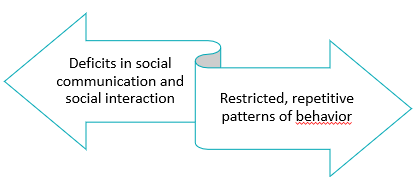
Symptoms must be present in the early developmental period.
Symptoms cause clinically significant impairment in areas of current functioning.
These disturbances are not better explained by intellectual disability or global developmental delay.
Youngest screening for autism is at 18 months.
In order to diagnose:
Observations
Questionnaire
Deficits in social communication and social interaction:
Difficult to engage in the normal ‘give and take’ of conversations and social relationships (reprocity).
Difficulty using and understanding non-verbal communication.
Difficulty developing and maintaing relationships.
Restricted and repetitive behaviors:
Repetitive movement, actions and/or speech
Stimming: Repeating a phrase or last word of a sentence.
Action: Walking around, rocking themselves, making noise.
Movement: Clapping hands, twirling, fidgeting, hand flapping.
Speech: Echolalia.
Strong need/preference for routines and sameness.
Intense and highly focused interests.
Process or experience sensory information differently.
Hyper-sensitive: Over sensitive, normal stimulation might be too much for them.
Hypo-sensitive: Less sensitive, not stimulated enough to get a reaction, they engage in sensory seeking behavior ()

Level 1 is high functioning.
Used to teach them adaptive skills they can do,
What is Asperger Syndrome:
Historically diagnosed separetely, Asperger Syndrome is now included under ASD.
Individuals generally:
Do not have significant language delays.
Experience social communication challenges
Display restricted intererests
Do not generally make eye contact