Dry Fruits
Dry fruits
Dehiscent fruits split open to release the mature seeds. These fruits have sutures or weakened seams that break to allow the fruit to open
ex: follicles, legumes, capsules
Indehiscent fruits do not break open
Dehiscent fruits
can have either 1 carpel or many carpels
1 carpel
follicle: a simple, dry, dehiscent fruit that splits along one suture (ex: milkweed, magnolia)
legume: a simple, dry, dehiscent fruit that splits along 2 sutures
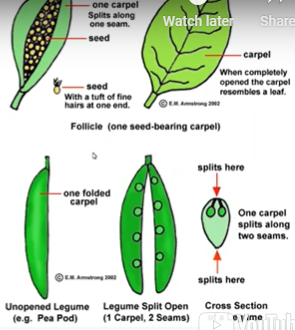
2+ carpels
capsule: a compound, dry, dehiscent fruit with 2+ carpels, the fruits typically split open along the sutures, which correspond to the number of carpels, very common fruit type in trees
Indehiscent fruits
Indehiscent fruits do not split open at maturity
Nut: has an ovary with 2+ carpels, but fruit usually one-seeded with a hard wall; sometimes partially or entirely encased in a husk; small examples include nutlets
Samrara: small, one-seeded, with a wing
Achene: small, one-seeded, unwinged; includes all members of Asteraceae
Caryopsis: very small, seeds inside and do not separate from ovary wall, only found in Poaceae
Fruit dispersal
Water
Gravity
Animals
Wind
Fruit dispersal and evolution
Why disperse?
evolutionary benefits, as well as costs, to different dispersal mechanisms, some trees have more than one dispersal method
Convergent evolution: different organisms with develop mechanisms that function in the same way. So different fruit types may have similar structures that enable them to use the same dispersal method
Gravity dispersal
Heavy fruits that fall off the tree—dispersal range in small
Advantages?
good for trees that develop best near the mother tree. shade tolerant species, good soil present, reduces uncertainty of finding suitable habitat
enhanced gravity dispersal: explosively dehiscent fruits
Animal dispersal
Animals collect the fruit for food; examples include deer, pigs, squirrels, wood ducks, and humans
animal carries off but doesn’t eat (buries or plants it)
animal eats and deposits seeds in droppings
many seeds that have been through the digestive tract have a higher germination rate!
Human dispersal of fruits and invasive species
Wind dispersal
Includes many tree species. Requires large seed production to maximize chances of success
Fruits can contain wing-liken structures that help carry it on the wind
Samaras: ovary wall grows out into a wing
Other fruit types have a bract that functions as a wing
Cone scales in pines can detach with the seed attached