Chapter 4 - Nucleic Acids and DNA Replication
RNA World Hypothesis: Proposal that at a particular stage in the evolution of life, RNA both stored genetic information and catalyzed its own replication and that RNA emerged before DNA and proteins during chemical evolution
4.1 - What is a Nucleic Acid
Nucleic Acids: A macromolecule composed of nucleotide monomers. Generally used by cells store or transmit hereditary information. Includes ribonucleic acid and deoxyribonucleic acid. Are polymers.
made up of monomers called nucleotides
Nucleotides: A molecule consisting of a five-carbon sugar (ribose or deoxyribose), one or more phosphate groups, and one of several nitrogen-containing bases. Equivalent to a nucleoside plus one or more phosphate groups
Three components of a nucleotide
1. A phosphate group —» bonded to the sugar molecule, which in turn is bonded to the base
2. Five-carbon sugar
3. A nitrogenous base (nitrogen-containing)
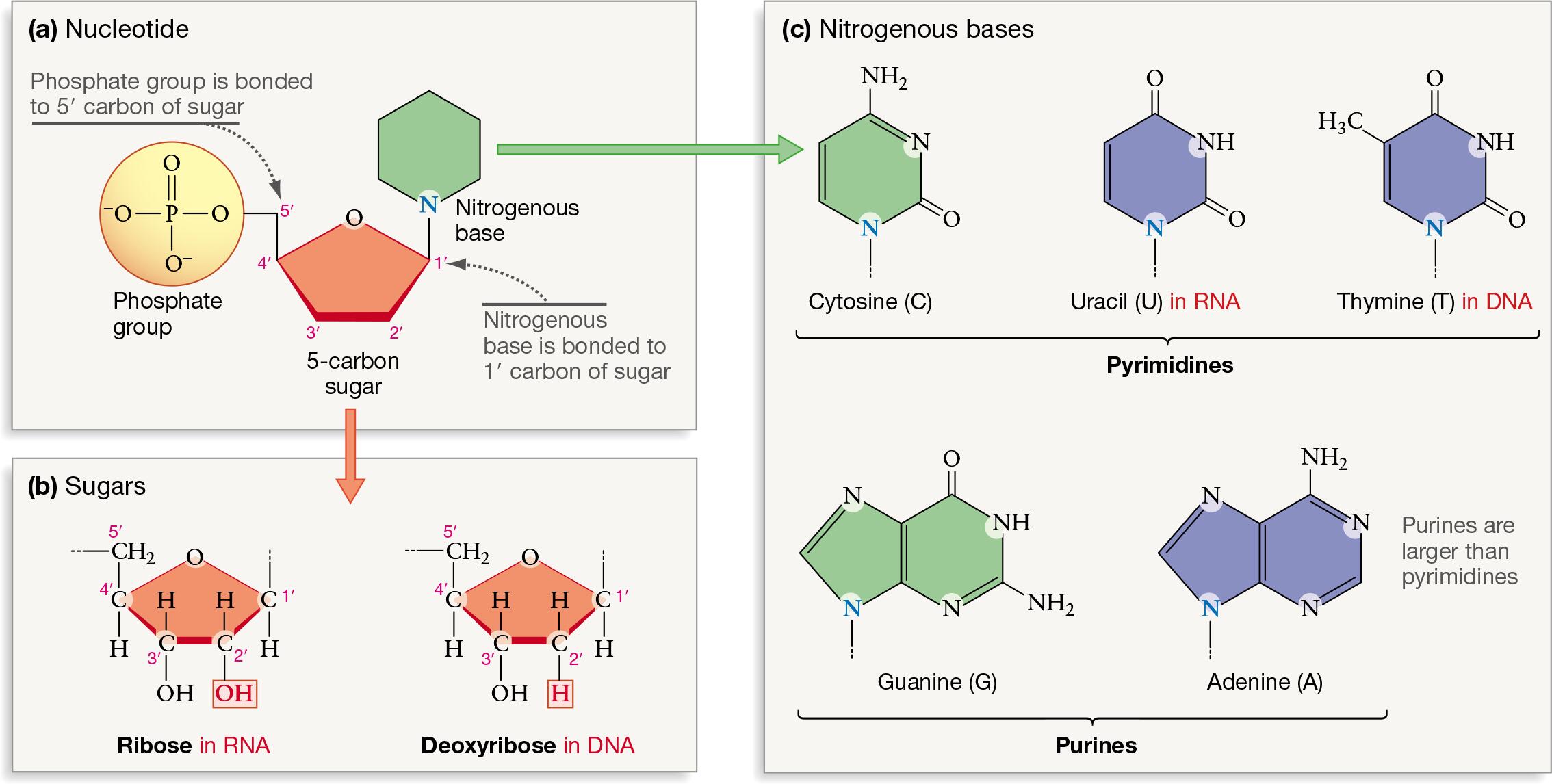
Nucleotide
Sugar is the central component the nucleotide
five carbons in this sugar are labeled with prime (‘)
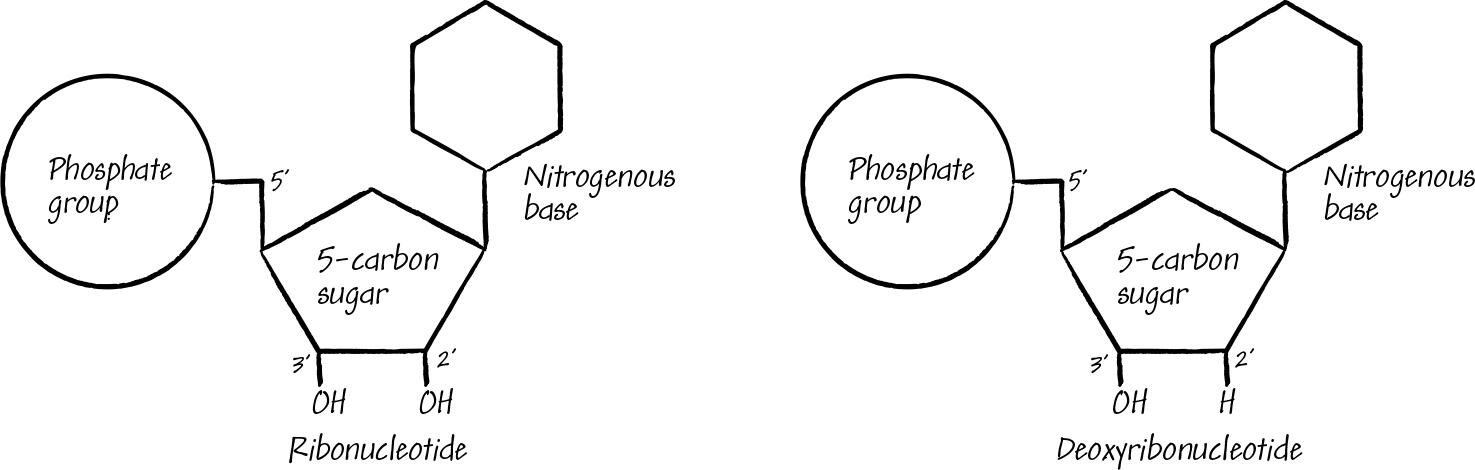
Monomers of RNA (ribonucleic acid) are ribonucleotides
Ribonucleotides: A nucleotide consisting of a ribose sugar, one or more phosphates, and one of four nitrogen-containing bases: adenine: guanine, cytosine, or uracil
Monomers of DNA (deoxyribonucleic acid) are deoxyribonucleotides
Deoxyribonucleotides: A nucleotide consisting of a deoxyribose sugar, one or more phosphates, and one of four nitrogen-containing bases: adenine, guanine, cytosine, or thymine.
In ribonucleotides the sugar is ribose; in deoxyribonucleotides the sugar is deoxyribose (deoxy means “lacking oxygen”)
Ribose and deoxyribose have an —OH group bonded the 3’ carbon, but ribose has an —OH group bonded to the 2’ carbon while deoxyribose has an H at the same location —» difference of a single O atom
Ribonucleotides and deoxyribonucleotides differ in one of their nitrogenous bases
bases belong to structural groups called purines and pyrimidines
purines: a class of double-ringed nitrogenous bases adenine (A), guanine (G), found in nucleotides —» have “nine” in name
pyrimidines: a class of single-ringed nitrogenous bases cytosine (C), uracil (U), thymine (T) found in nucleotides
Ribonucleotides are uracil (U), while deoxyribonucleotides use thymine (T)
After the different sugars and bases are taken into account, 8 different nucleotides are used to build nucleic acids—4 ribonucleotides (A,G,C,U) and 4 deoxyribonucleotides (A,G,C,T)

How do Nucleotides Polymerize to Form Nucleic Acids?
Nucleotides polymerize via condensation reactions between the hydroxyl on the sugar component of one nucleotide and the phosphate group of another nucleotide
forms new covalent bond between nucleotides, and a molecule of water is released
bridge formed by the phosphate group is a phosphodiester linkage/bond
Phosphodiester linkage: Chemical linkage between adjacent nucleotide residues in DNA and RNA. Forms when the phosphate group of one nucleotide condenses with the hydroxyl group on the sugar of another nucleotide
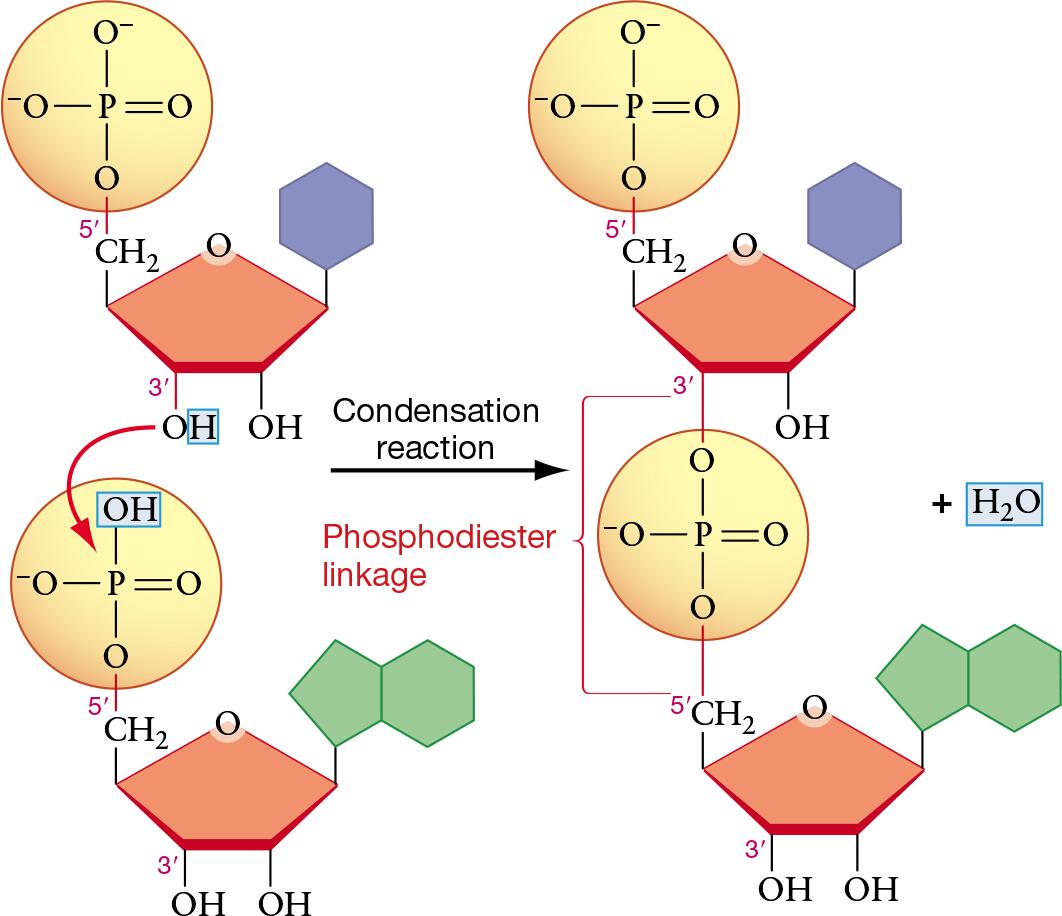
Figure 4.2 - The resulting phosphodiester linkage connects the 3’ carbon of one nucleotide and the 5’ carbon of another nucleotide. The two ester bonds connecting the nucleotides are highlighted in red
When phosphodiester linkages joined ribonucleotides together, the polymer that is produced in RNA
phosphodiester linkages between deoxyribonucleotides produce DNA
DNA and RNA Strands are Directional
Chain of linked sugars and phosphates in a nucleic acid acts as a backbone, analogous to the peptide-bonded backbone found in proteins
Sugar-phosphate backbone of a nucleic acid is directional
in a strand of RNA or DNA, one end has a unlinked 5’ phosphate while the other end has a unlinked 3’ hydroxyl —» the groups aren’t bonded to another nucleotide
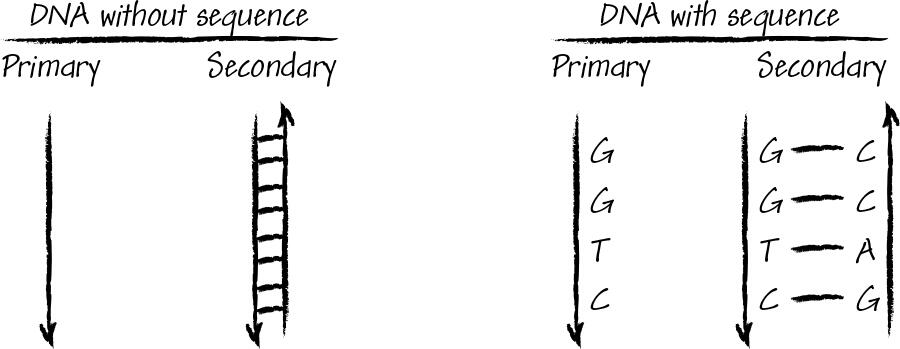
Order of different nucleotides forms primary structure of nucleic acid
shorthand = list the sequence of bases by their single-letter abbreviations
Sequence of bases found in an RNA or DNA strand is always written in the 5’—»3’ direction
RNA and DNA are always synthesized in this direction
nucleotides are added only at the 3’ end of a growing nucleic acid molecule
Polymerization Requires an Energy Source
Joining of nucleotides into nucleic acids decreases entropy and is not spontaneous
input of energy is needed to tip the energy balance in favor of polymerization
Nucleic acid polymerization can occur in cells (assisted by enzymes) since PE of the nucleotide monomers is first raised by reactions that add two additional phosphate groups to the 5’ phosphates of ribonucleoside or deoxyribonucleoside monophosphates creating nucleoside triphosphates
nucleoside triphosphates = activated nucleotides
ATP = DNA synthesis —» dATP (deoxyadenosine triphosphate)
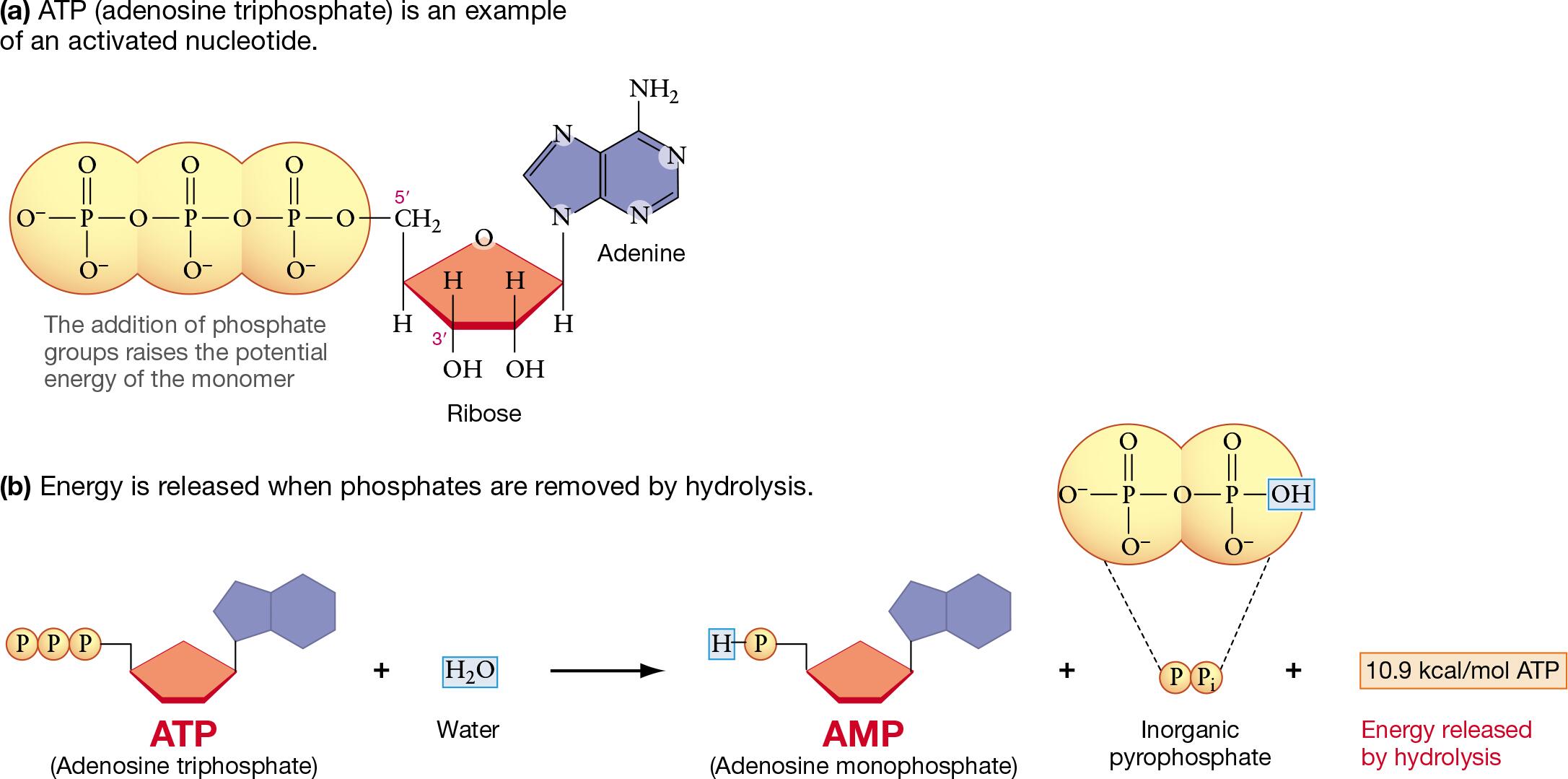
Linking two or more phosphates together generates covalent bonds that carry a large amount of PE due to strong repulsive forces
energy is released when the phosphates form new, more stable bonds with other atoms
When activated nucleotides polymerize the energy released from the condensation reaction compensates for the decrease in entropy, making the reaction spontaneous
4.2 - DNA Structure and Function
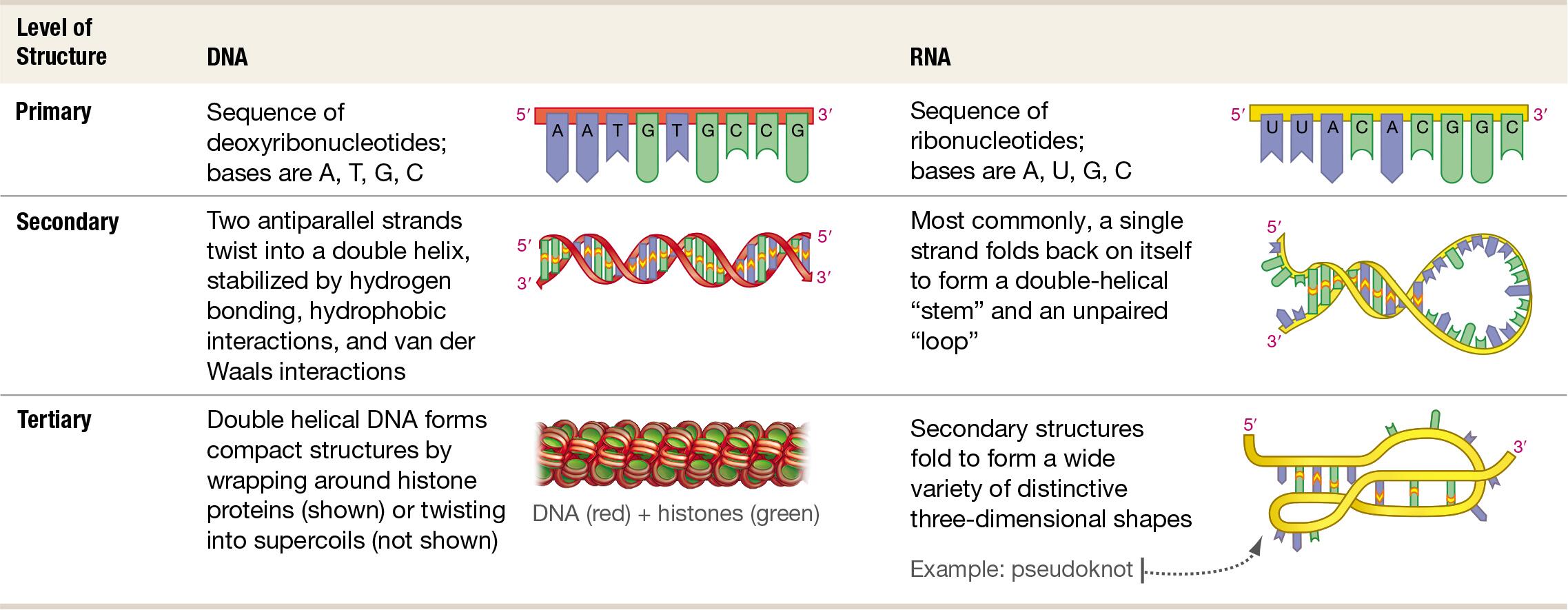
Primary structure of DNA has DNA molecules that have a sugar-phosphate backbone, created by phosphodiester linkages, and a sequence of any of 4 nitrogenous bases that extend from it
DNA has a secondary structure
What is the Nature of DNA’s Secondary Structure?
Discovery of DNA’s secondary structure —» James Watson and Francis Crick
molecule had a sugar-phosphate backbone and discovered antiparallel strands
Erwin Chargaff: had two rules: (1) The number of purines in a given DNA molecule is equal to the number of pyrimidines and (2) the DNA molecule has an equal number of T’s and A’s and it has an equal number of C’s and G’s
Rosalind Franklin and Maurice Wilkins: Used X-ray crystallography technique —» measurements repeated, inferred that DNA molecules had a regular and repeating structure —» x-ray scattering suggested that the molecule was helical or spiral
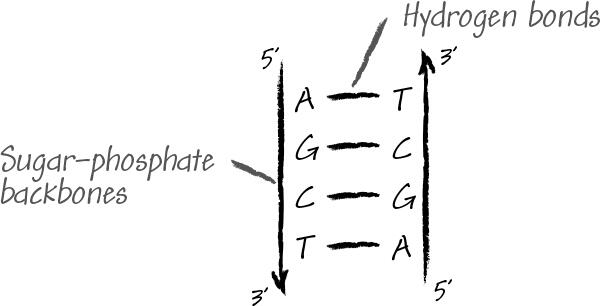
Antiparallel: Describes the opposite orientation of nucleic acid strands that are hydrogen-bonded to one another, with one strand running in the 5’ —» 3’ direction and the other in the 3’ —» 5’ direction
Double Helix: The secondary structure of DNA, consisting of two antiparallel DNA strands wound around each other. Some RNAs may also form a double helix in stem-and-loop secondary structures
What is the Nature of DNA’s Secondary Structure?
Complementary Base Pairing: The association between specific nitrogenous bases of nucleic acids stabilized by hydrogen bonding. Adenine pairs with thymine (in DNA) or uracil (in RNA) and guanine pairs with cytosine
interchangeable with Watson-Crick Pairing
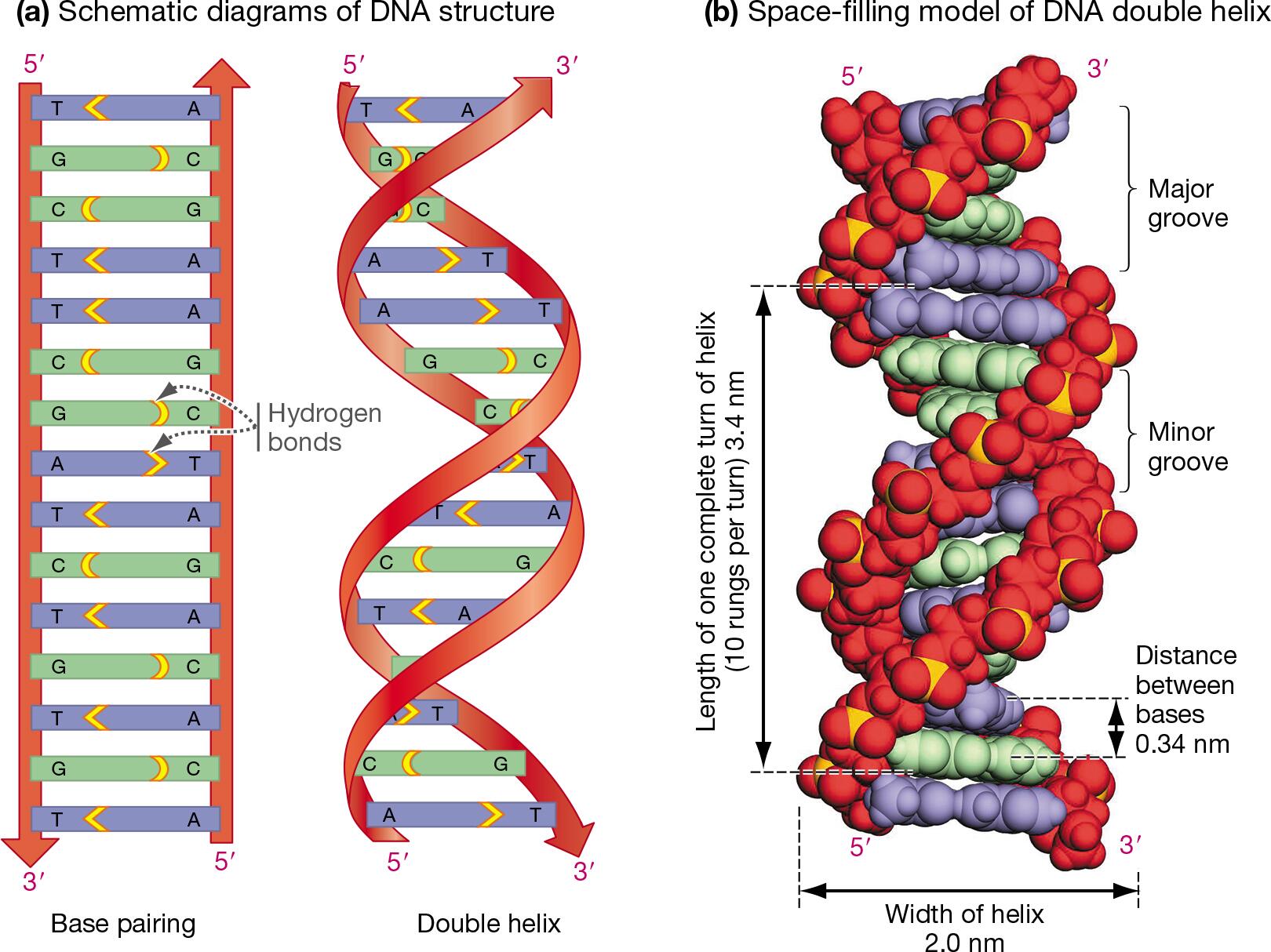
DNA is put together like a ladder
antiparallel sugar-phosphate backbones form the ladder side rails
bases attached to the sugars are rotated and pair up via hydrogen bonding to form the ladder rungs
Each base has polar groups involved in the hydrogen bonds, the bases’ carbon-nitrogen rings are nonpolar
in a aqueous solution hydrophobic interactions cause the double-stranded DNA to twist into a helix to minimize contact between the hydrophobic bases and surrounding water molecules
What is the Nature of DNA’s Secondary Structure?
Base Stacking: Describes the interactions that form between adjacent base pairs in nucleic acid strands of a double helix. Consist of hydrophobic interactions and van der Waals interactions that tightly pack and stabilize the base pairing in nucleic acid secondary structure
nonpolar interior is in between the negatively charged phosphate groups of the outward-facing backbone, which makes the double helix hydrophilic overall and soluble in aqueous solutions
Outside of helical DNA molecule forms two types of grooves
major groove - wider
minor groove - narrower
groove asymmetry is vital for granting access to proteins that bind to particular base sequences in DNA
The Tertiary Structure of DNA
Secondary structure of a protein leads to a more compact tertiary structure when the polypeptide folds on itself
DNAd in cells is also normally found in more compact 3D structures
need for compaction is evident when you consider the total length of DNA in each cell
Tertiary structure is less dependent on primary structure, so it is less variable between different sequences
Two forms of DNA tertiary structure are commonly found in cells
When DNA becomes wound too tightly or loosely with respect to the number of base pairs per helical turn, it can twist on itself to form compact, 3D structures called supercoils
DNA in the cells of eukaryotes and certain archaea will form tertiary structures by wrapping around specialized DNA binding proteins called histones
resulting DNA-protein complexes compact DNA into discrete movable units during cell division and contribute to DNA’s ability to store and transmit info
DNA Functions as an Information-Containing Molecule
WC revealed the role of DNA as a biological reservoir of information
Inside cells information consists of a sequence of nucleotides in a nucleic acid
Stores the information required for the organisms’s growth and reproduction
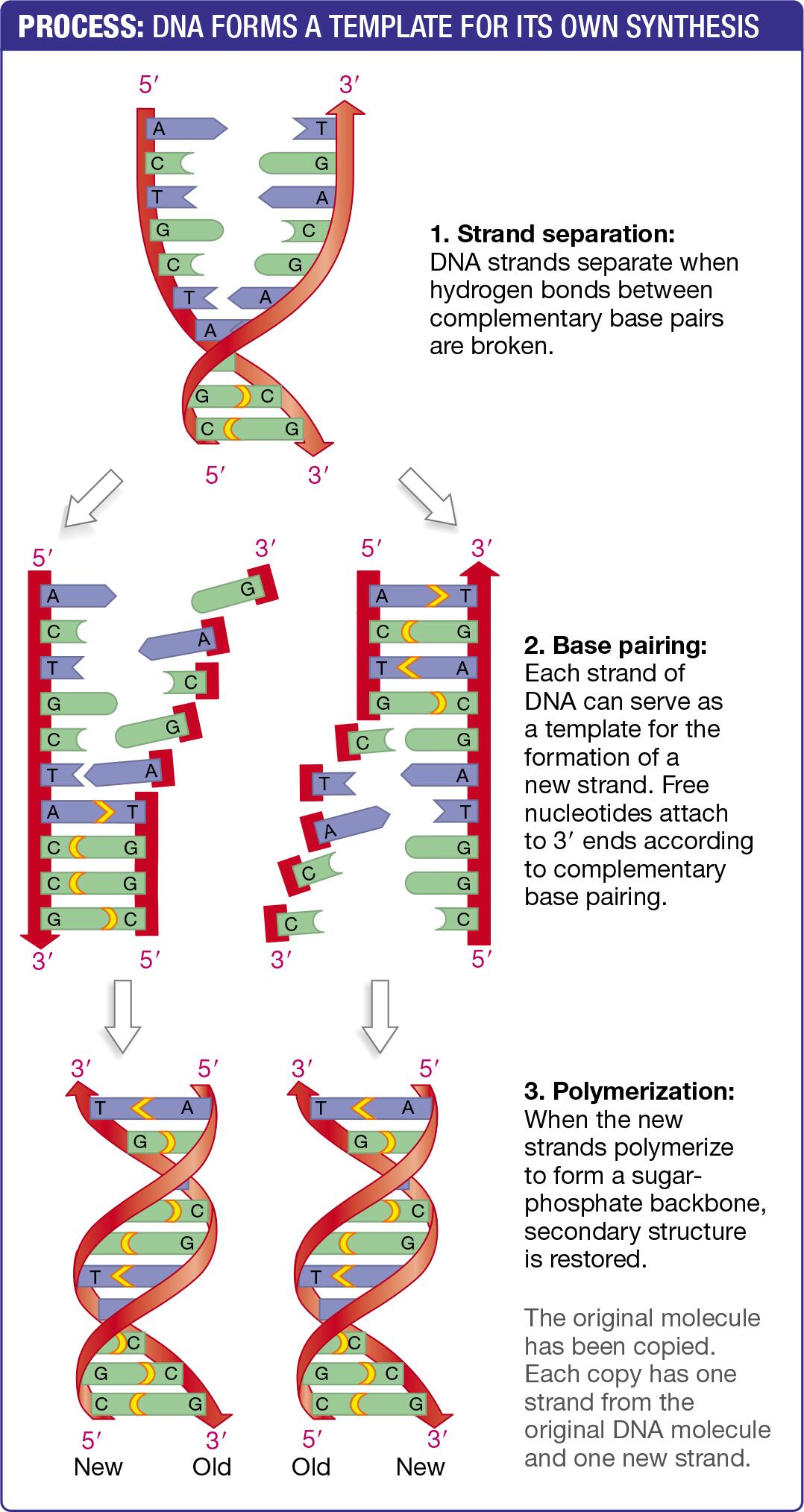
DNA’s primary structure serves as a template for the synthesis of a complementary strand, meaning the DNA contains the information required for a copy of itself to be made
1. Two strands of a DNA double helix can be separated by breaking the hydrogen bonds that hold them together using either heat or enzyme-catalyzed reactions
2. Free deoxyribonucleotides form hydorgen bonds with complementary bases on teh orignal strand of DNA — or template strand. As they do, their sugar-phosphate groups form phosphodiester linkages to create a new strand called a complementary strand. Note that the 5’ —» 3’ directionality of the complementary stand is the opposite to that of the template strand
Template Strand: a strand of RNA or DNA for direct synthesis of a new, complementary strand via complementary base-pairing
Complementary Strand: a strand of RNA or DNA with a base sequence that forms via complementary base-pairing with the template strand
3. Complementary base pairing allows each strand of a DNA double helix to be copied exactly, producing two identical daughter molecules
The DNA Double Helix is a Stable Structure
Regular, symmetric, and held together by phosphodiester linkages, hydrogen bonding, and hydrophobic interactions
Double helix has a few functional groups exposed that can participate in chemical reactions, making the molecule stable and resistant to degradation
Stability is the key to its effectiveness as a reliable information-storage molecule
DNA’s structure is consistent with its function in cells
Orderliness and stability that make DNA dependable information storage also make it a bad catalyst
structure of DNA is simple and nonreactive
4.3 - RNA Structure and Function
Structurally RNA Differs from DNA
Primary structure
4 types of nitrogenous bases extending from a sugar-phosphate backbone
differences between these nucleic acids
1. sugar in the sugar-phosphate backbone of RNA is ribose nor deoxyribose as in DNA
2. pyrimidine base thymine doesn’t exist in RNA, instead RNA contains uracil
Secondary Structure
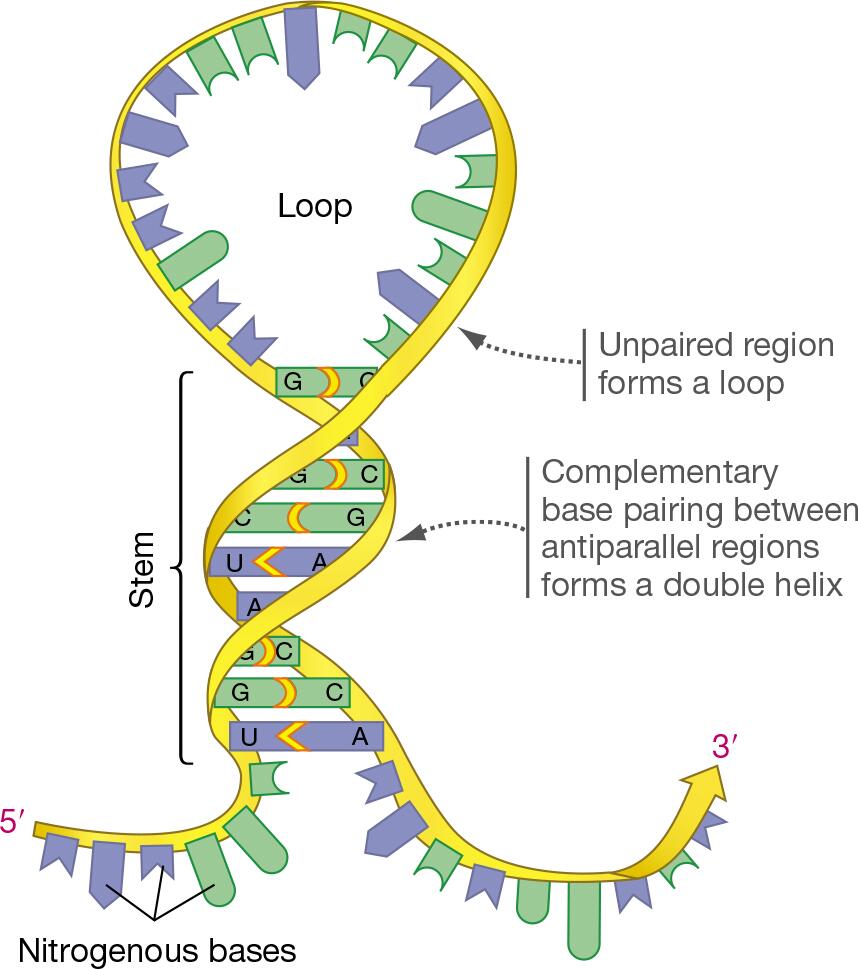
results from complementary base pairing between purine and pyrimidine bases
purine and pyrimidine bases undergo hydrogen bonding with complementary bases on the same strand rather than forming hydrogen bonds with complementary bases on a different strand as in DNA
when bases on one part of an RNA strand fold over and align with bases on another part of the same strand; the two-sugar phosphate stands are antiparallel
in this orientation hydrogen bonding between complementary bases results in a helical structure that resembles the double helix of DNA and structure forms a single nucleic acid strand
Structurally RNA Differs from DNA
Secondary structure
if the fold occurs includes unpaired bases then the stem-and-loop configuration results
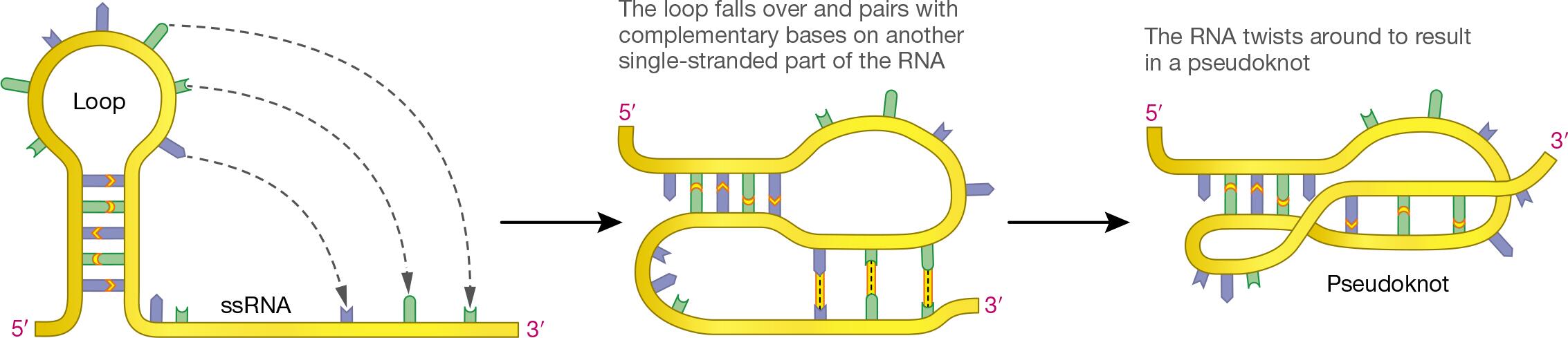
several other types of RNA secondary structures are possible
secondary structures will form spontaneously
bases are brought together by hydrophobic interactions and stabilized by hydrogen bonding and base stacking interactions
Tertiary structure
arises when secondary structure fold into more complex shapes
RNA molecules with different base sequences can have very different overall shapes and chemical properties
diverse in size, shape, and reactivity than DNA
RNA’s Versatility
Structural flexibility allows them to perform many different tasks
Central dogma introduced RNA as an intermediate between DNA and protein
intermediate called mRNA, transmits information needed to synthesizes polypeptides
RNA molecules help regulate the production of mRNA from DNA, process and edit information stored in these messages, and even catalyze the synthesis of proteins among other things
RNA Can Function as a Catalytic Molecule
In terms of diversity in shape and chemical reactivity the 4 types of nucleotides are no match for the 20 amino acid residues
RNA is capable of forming structures that catalyze a number of chemical reactions
Ribozymes: Any RNA molecule that can act as a catalyst to increase the rate of a chemical reaction (RNA enzymes)
RNA Can Function as a Catalytic Molecule
Ribozymes
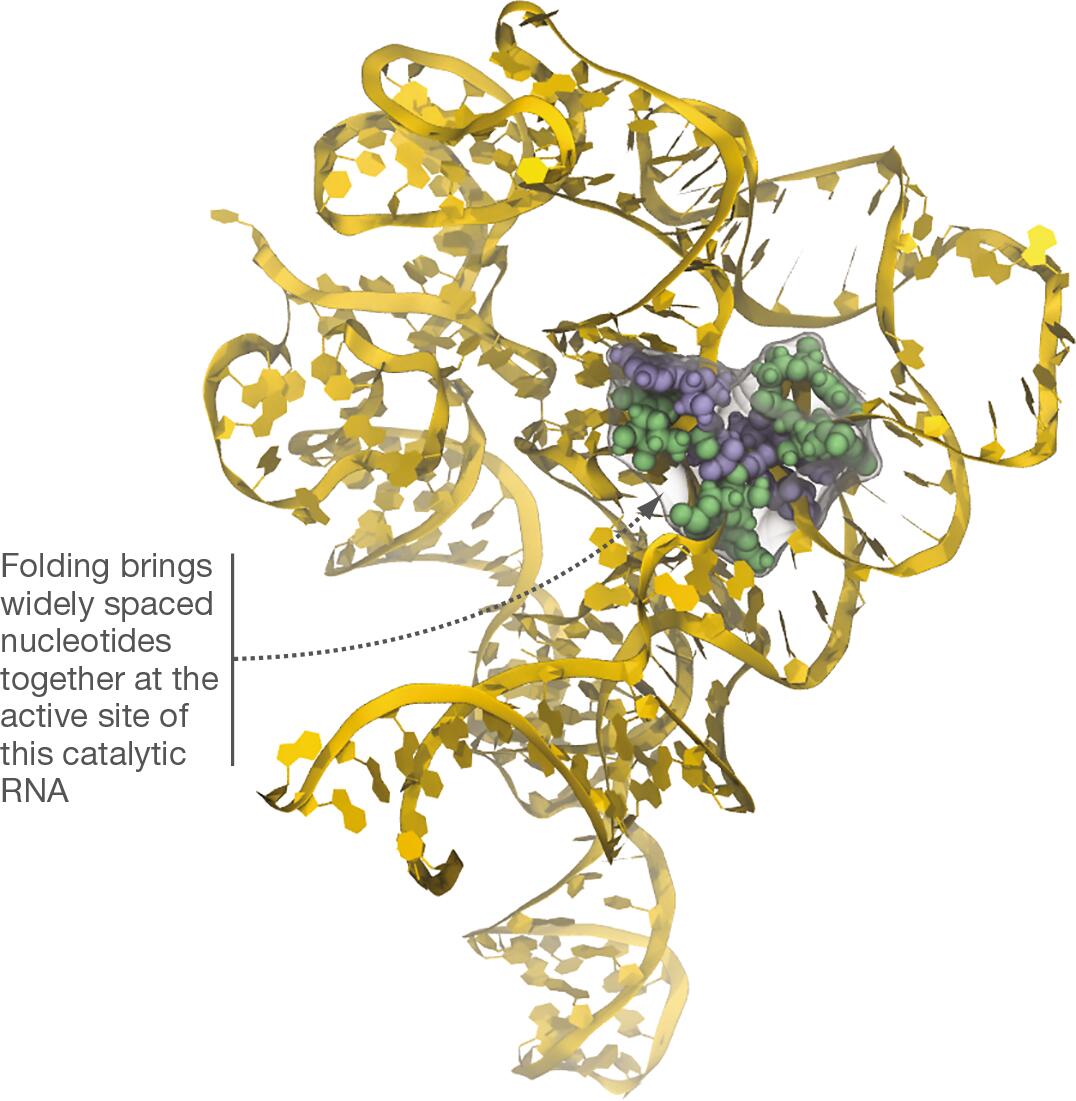
3D shape of ribozymes is vital to their catalytic activity
to catalyze a chemical reaction, substrates must be brought together in an environment that will promote the reaction
region of ribozyme that is responsible for this activity is called the active site