The Judicial Branch
Article III of the US Constitution calls for a federal judiciary. It specifically mentions a Supreme Court to settle disputes between states, and it provides Congress with the ability to establish other courts as necessary. The role and makeup of the judiciary was a hotly debated topic between the Federalists and Anti-Federalists, and Article III was the resulting compromise. After the Constitution was ratified, Federalists moved quickly to create lower federal courts.
The judicial Power of the United States, shall be vested in one supreme Court, and in such inferior Courts as the Congress may from time to time ordain and establish. The Judges, both of the supreme and inferior Courts, shall hold their Offices during good Behaviour, and shall, at stated Times, receive for their Services, a Compensation, which shall not be diminished during their Continuance in Office.
US Constitution, Article III, Section 1
The judicial Power of the United States, shall be vested in one supreme Court, and in such inferior Courts as the Congress may from time to time ordain and establish. The Judges, both of the supreme and inferior Courts, shall hold their Offices during good Behaviour, and shall, at stated Times, receive for their Services, a Compensation, which shall not be diminished during their Continuance in Office.
US Constitution, Article III, Section 1
Section 1 of Article III vests judicial power, requires a Supreme Court, and establishes judges' appointment and tenure. This "Vesting Clause" grants all judicial authority to the courts. Section 1 explicitly requires "one" Supreme Court but does not set the number of judges that may belong to it. The Supreme Court is the only federal court required by the Constitution. Congress may create inferior courts under both Article III and Article I, though only the former article refers to the power explicitly. The Article III courts are often referred to as the "constitutional courts" and were first created by the Judiciary Act of 1789.
Appointment, Tenure, and Compensation
Federal judges, appointed by the president and approved by the Senate, hold their office "during good behavior," a phrase that has been interpreted as "for life." They may, however, be impeached and, if convicted, removed from office. The compensation of judges may not be reduced during their time in office (though it may be increased).
Checks and Balances on the Judiciary
We've already discussed these checks and balances previously, but in summary, these are the ways that the other two branches check the judicial branch:
Congress has the power to impeach and remove federal judges if there is adequate cause.
Congress has the power to appropriate funds for the operation of the judicial branch.
Congress determines the number of judges and the size of the federal courts.
The president is responsible for appointing federal judges, and the Senate must approve them.
In return, the judicial branch has one major check on the other two branches. It can declare laws and executive actions to be unconstitutional through the process of judicial review. We'll go into more detail about judicial review in the next lesson.
Jurisdiction
Before moving further in our study of the judicial branch, we must define the concept of jurisdiction. Jurisdiction refers to the authority a court has to hear and decide a case. Federal courts have federal jurisdiction. In other words, they can hear and decide cases that involve federal law. There are also state courts—these courts have state jurisdiction and can hear and decide cases involving state law.
Another important aspect of jurisdiction is the division between original jurisdiction and appellate jurisdiction. Original jurisdiction refers to the authority to hear and decide a case first, while appellate jurisdiction refers to the authority to review the decision or ruling of a lower court. In other words, the first court to hear and decide a particular case has original jurisdiction. Then, if either party in the case doesn't like the ruling that was made, it can appeal the decision to a higher court in the hopes of getting the ruling changed. The higher court that hears these appeals has appellate jurisdiction.
Jurisdiction can also be classified in another way: exclusive jurisdiction versus concurrent jurisdiction. Exclusive jurisdiction refers to the authority of a court to hear and decide a case to the exclusion of all other courts. In other words, a court with exclusive jurisdiction in a particular area is the only court that can hear cases that involve that area. For instance, the Supreme Court has both original and exclusive jurisdiction involving cases between two states. This means that in court cases between two states, the Supreme Court has the authority to hear and decide the case first (original jurisdiction) and is the only court that can hear and decide the case (exclusive jurisdiction).
The opposite of exclusive jurisdiction is concurrent jurisdiction, which refers to a situation where two or more courts both have the authority to hear and decide a particular case. For example, if someone robs a bank in the state of Virginia, the robber can be tried in a Virginia state court because the crime took place in Virginia. However, the robber can also be tried in a federal court because the crime was against a federally chartered institution.
Organization of the Judicial Branch
America's court system can be quite complex. It is a dual court system: there is one national (federal) court system as well as separate court systems for each of the fifty states. The framers of the US Constitution intentionally created two parallel criminal justice systems. There are varying degrees of overlap because many crimes are covered by both state and federal law (the state and federal courts have concurrent jurisdiction in these cases).
For example, some acts, such as selling drugs, robbing a bank, or child pornography, are crimes under federal law and under the laws of most states, which means the accused could be tried in both federal court and state courts without violating double jeopardy. Furthermore, parties in state courts may make appeals to the US Supreme Court or seek federal habeas corpus (the right to be formally charged with a crime before a judge).
As stated previously, the Article III courts are often referred to as the "constitutional courts" and were first created by the Judiciary Act of 1789. This act established and set the jurisdiction of the courts in the United States court system. Although this act created lower federal courts, it was also a compromise, as the organization of the lower courts favored Anti-Federalists. This act established the following:
Boundaries were drawn along state lines so that no district encompassed more than one state.
Federal district judges were to be residents of their districts.
The lower federal courts were granted only limited jurisdiction.
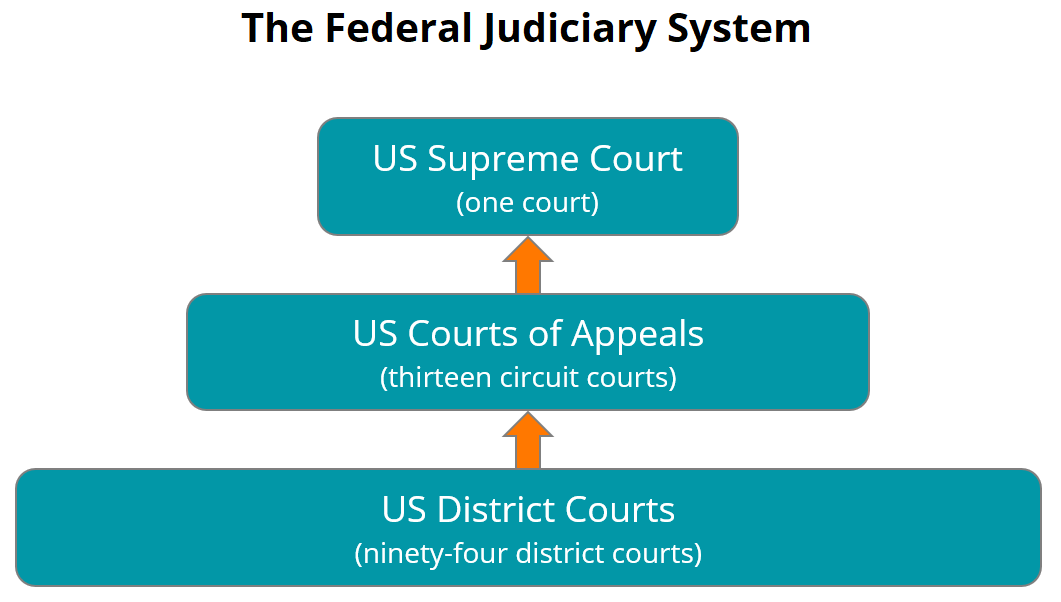
The current federal judiciary system is best described as having three layers: the district courts, the courts of appeals, and the Supreme Court.
District Courts
The district courts are the lowest layer of the federal judiciary and have original jurisdiction for most types of cases. Cases in district courts always have a judge, and they may have a jury as well, depending on the type of case.
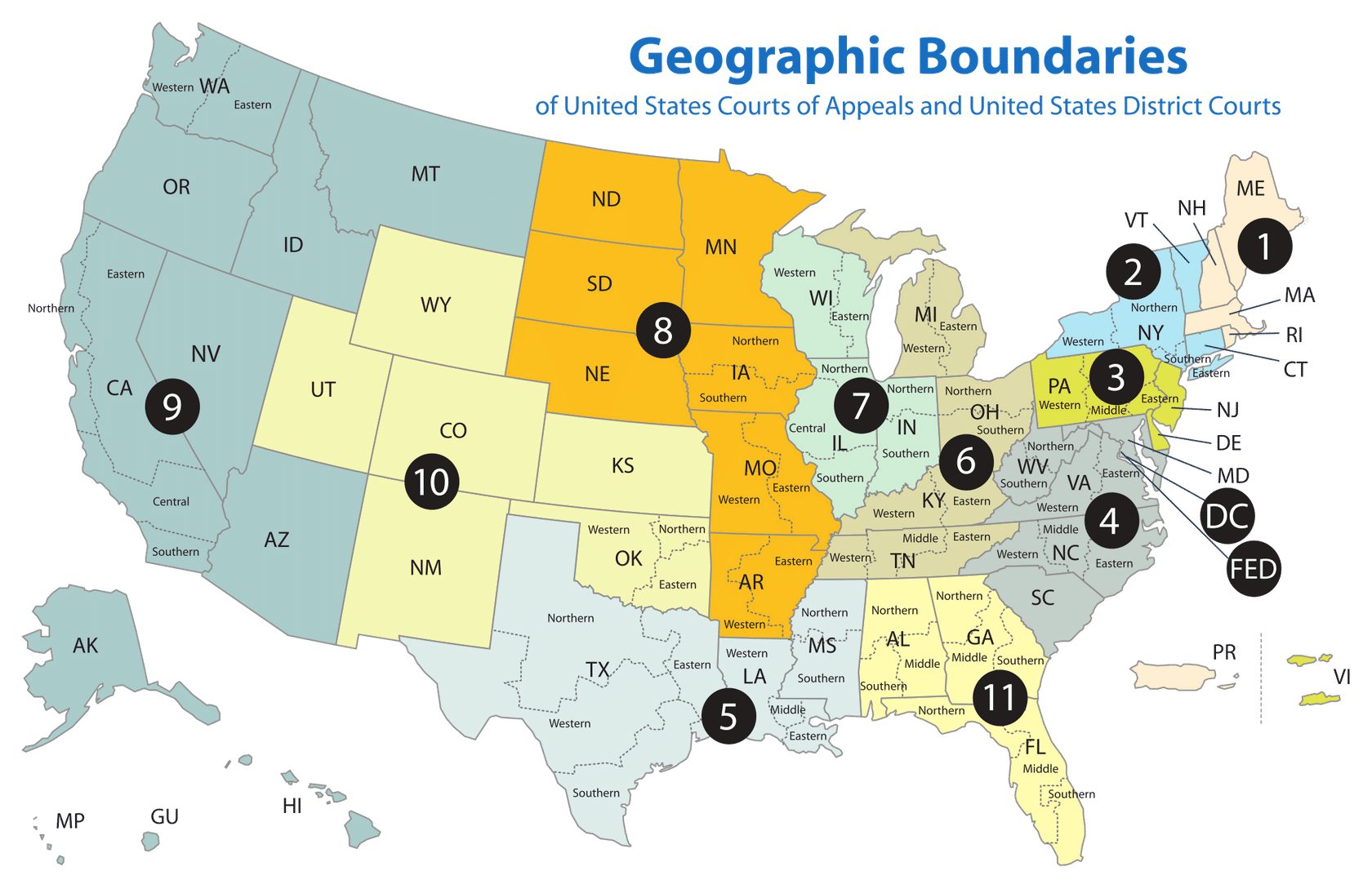
There are ninety-four US district courts—eighty-nine within the fifty states, one district court for the District of Columbia, and one territorial district court each for Guam, Puerto Rico, the Virgin Islands, and the Northern Mariana Islands. While some states have more than one district court, no district court boundary crosses state lines.
Like all Article III judges, district judges are nominated by the president, must be confirmed by the Senate, and serve for life. District court judges hear about 385,000 civil and criminal cases each year. There is also one US attorney in each district. This attorney, unlike judges, serves at the pleasure of the president and not for life. These district attorneys act as the main prosecutors for the federal government.
Magistrates
United States magistrate judges don't have their own courts but instead operate under the authority of the district courts. Magistrate judges are selected by the district court judges and are Article I—not Article III—judges. This means that they are not appointed by the president, and they do not serve for life. Instead, full-time magistrates serve eight years, and part-time magistrates serve four years. Magistrates assist district court judges with minor or preliminary proceedings. In felony cases, for example, magistrates take care of the setting of bail and the issuing of search warrants. In misdemeanor and petty cases, magistrates may preside over trials, accept guilty pleas, and impose sentences.

The US federal district court in Minneapolis, Minnesota
Courts of Appeals
The next level of courts above the district courts is the courts of appeals. Created in 1891, the courts of appeals system consists of twelve regional circuits and one federal circuit. Eleven of the regional circuits are identified by number, while the twelfth is called the DC Circuit. The US courts of appeals are staffed by 179 judges who are Article III judges, which means they are nominated by the president, confirmed by the Senate, and serve for life.
The courts of appeals normally utilize rotating three-judge panels, but they may hear a case en banc, or before all the judges of the court, with a majority vote. These courts of appeals hear approximately 57,000 cases annually, twenty percent of which come from criminal convictions in US district courts. Except for the small percentage of cases that make it to the US Supreme Court, the courts of appeals are generally the courts of last resort for most federal litigation.
The following map displays the boundaries of the thirteen circuit courts as well as the nation's ninety-four district courts.
Supreme Court
The nation's highest court, the Supreme Court, is made up of nine justices: eight associate justices and one chief justice. This hasn't always been the case, however. Remember that the Constitution does not specify how many justices should be on the Supreme Court. The first Judiciary Act initially set this number at six. Throughout the nineteenth century, the number went from seven in 1807, to nine in 1837, to ten in 1863, back to seven in 1866, and then back to nine in 1869. Since 1869, the number of justices has remained steady at nine. Like other Article III judges, Supreme Court justices are nominated by the president, confirmed by the Senate, and serve for life. The chief justice is nominated specifically to that post by the president.
The Supreme Court mostly has appellate jurisdiction, reviewing decisions from courts of appeals as well as state appellate courts. However, the Supreme Court does have original jurisdiction in two specific circumstances: cases involving foreign officials and cases involving one of the states. This means the Supreme Court has the right to hear these cases first, though in some cases, it may decide to let a lower court hear the case first. As mentioned earlier, however, there are some instances where the Supreme Court has exclusive jurisdiction (for example, in cases between two states). In these instances, no lower court may ever hear the case. We will discuss more about how the Supreme Court works in the next lesson.