Analyzing Functions
Inequality: x > -3
<, >, ≤, ≥
Set Builder: {xlx > -3}
{xl 2 ≤ x < 4} —> and
{xl 2 > x or x ≥ 4} —> or
Interval notation: ( -3, ∞ )
( ) open circle
[ ] closed circle
ALWAYS order from least to greatest
(-3,4) U [7, 12) —> or
(-3,4) —> and
Infinity: can be +∞ or -∞
* ∞ cannot have [ ] as it is infinite
All real numbers: R
Set builder: {xlx ∈ R}
Inequality: -∞ < x < +∞
Interval notation: (-∞, ∞)
No solution: ∅
Graph of an inequality:
Relation: a set of ordered pairs
EX: {(4,5), (6,5), (7,-2), (8,6)}
*This set only works for discrete functions
Domain: a set of all x coordinates, ordered from least to greatest
EX: {4, 6, 7, 8}
Range: a set of all y coordinates, ordered from least to greatest
EX: {-2, 5, -6}
Function: There is one x for one y, which will pass the vertical line test
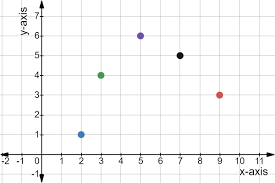
Discrete Function: A function but the values are not connected to each other
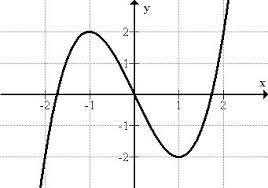
 Continuous Function: a line that continues infinitely without breaks
 y-Intercept: (0,y)
x-intercept: (x,0)
Increasing: Wherever the line is increasing on the graph
only use x values in your answer
Decreasing: wherever the line is decreasing on the graph
only use x values in your answer
End behavior:
As x —> ∞ , F(x) —> __
As x —> -∞ , F(x) —> __
Max: the largest y value of the line
Min: the smallest y value on the line
Pos: line points up
Neg: line points down
Horizontal shift (left/right) : g(x)= f(x-h)
-h is the opposite
so g(x)= f(x-7) —> +7
Vertical shift (up/down) : g(x)= f(x)+ k
Combined transformation: g(x)= f(x-h) +k
Vertical Reflections (reflects over the x-axis): g(x)= - f(x)
Horizontal Reflections (reflects over the y-axis): g(x)= f( -x)
Vertical Stretch: g(x)= af(x)
a>1
Vertical Compression: g(x)= af(x)
0<a>1
Horizontal Stretch: g(x)= f(bx)
0<b<1
b is the opposite
so 1/3 —> 3 ,and 4 —> ¼
Horizontal Compression: g(x)= f(bx)
b>1