Metabolic Dysfunction-Associated Steatohepatitis (MASH)
Lecture Objectives
Define metabolic dysfunction-associated steatotic liver disease and metabolic dysfunction-associated steatohepatitis
Identify the risk factors and signs and symptoms of metabolic dysfunction-associated steatotic liver disease and metabolic dysfunction-associated steatohepatitis
Choose a treatment strategy for metabolic dysfunction-associated steatotic liver disease and metabolic dysfunction-associated steatohepatitis
Definitions
Steatosis: abnormal storage of fat within a cell or organ
Steatotic: cell or organ containing an abnormal amount of fat
Steatohepatitis: steatosis (≥5%) plus hepatocyte injury (ballooning) and lobular inflammation
Fibrosis: excessive accumulation of extracellular matrix proteins (primarily collagen) that replaces or encapsulates injured tissue
Cirrhosis: liver dysfunction caused structural changes secondary to advanced fibrosis
Steatotic liver disease (SLD): encompasses the various etiologies causing fat to infiltrate the liver (steatosis)
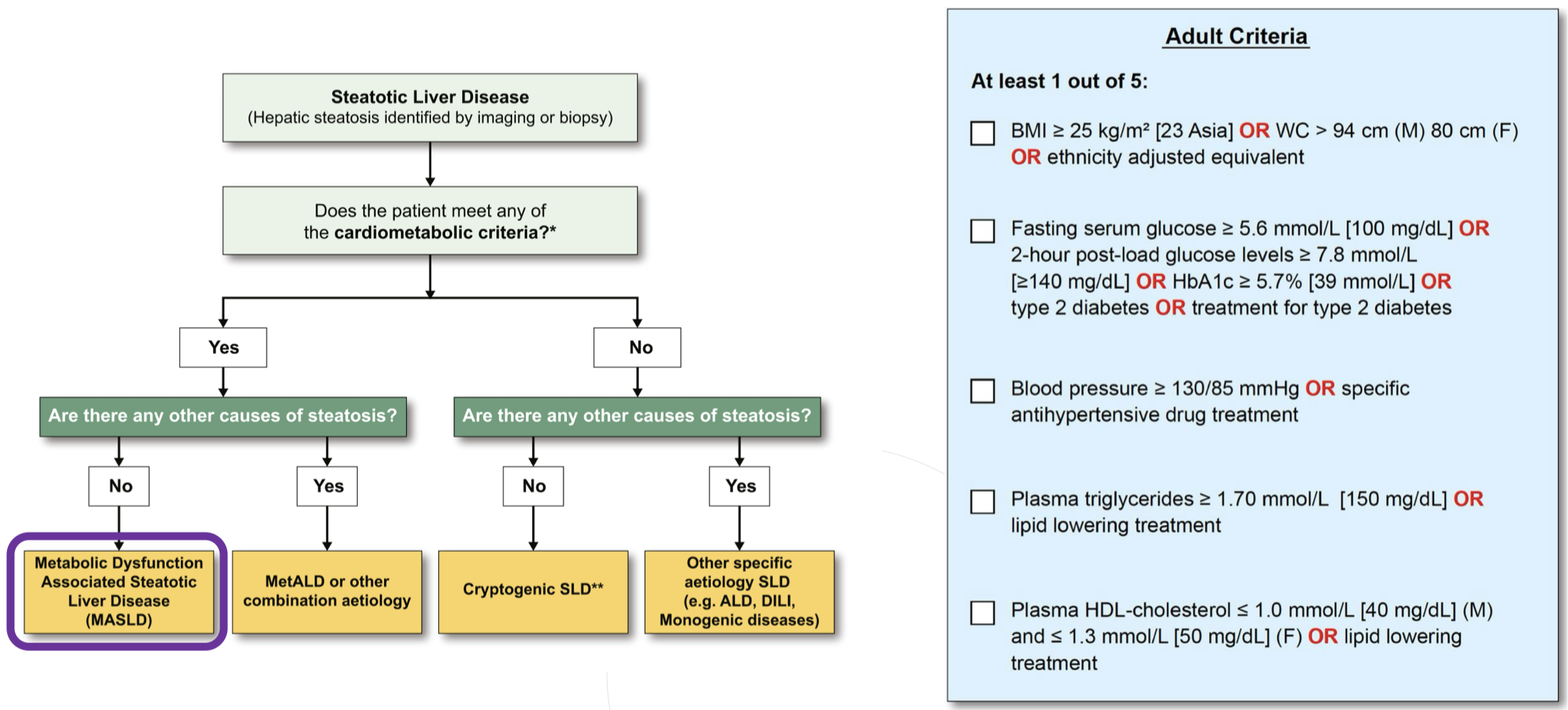
Metabolic dysfunction-associated steatotic liver disease (MASLD): hepatic steatosis (≥5%) plus ≥1 of 5 cardiometabolic risk factors, with alcohol intake below the MetALD threshold
Ranges from steatosis to steatohepatitis to cirrhosis
Inclusion of cardiometabolic risk factors
Obesity
Hyperglycemia/T2DM
HTN
Elevated TG
Low HDL
Metabolic dysfunction-associated steatotic liver (MASL): hepatic steatosis and at least one of five cardiometabolic risk factors without inflammation
Metabolic dysfunction-associated steatohepatitis (MASH): hepatic steatosis and at least one of five cardiometabolic risk factors with inflammation and evidence of hepatocyte injury with or without fibrosis
MASH Cirrhosis: liver dysfunction caused by fibrosis (cirrhosis) with evidence of steatosis or steatohepatitis
MetALD: MASLD but with greater consumption of alcohol
Females → 140-350 g/week (10-25 drinks)
Males → 210-420 g/week (15-30 drinks)
Alcohol-Related Liver Disease (ALD): steatosis with alcohol consumption above MetALD range
Females → 50 g/day
Males → 60 g/day
Specific-Etiology SLD: steatosis from defined cause (drug-induced, monogenic/metabolic disorders, HCV genotype 3, malnutrition)
Cryptogenic SLD: steatosis with no cardiometabolic risk factors and no identifiable cause
Metabolic Dysfunciton-Associated Steatotic Liver Disease (MASLD)
Most common cause of chronic liver disease
~25% of US adults → 20% of these have progressed to MASH
Less than 5% with MASLD know they have MASLD
Prevalence + severity continue to rise
Increase in obesity → MASH risk 2-3x higher
Increase in metabolic syndrome → MASH risk 2-3x higher in obesity
Most common indication for liver transplantation + top causes of liver cancer
Pathophysiology of MASLD
Metabolic dysfunction
Environmental factors such as obesity, T2DM, dyslipidemia, etc
Insulin receptors become less responsive → Increasing insulin resistance
Increase lipolysis (break down) of adipose tissue
Higher levels of free fatty acids (FFA) in bloodstream
Hepatic steatosis development
FFAs taken in liver → Liver taking more FFA than it can use or handle
Extra FFAs stored in hepatocytes (liver cells)
Lipotoxicity
Break down of FFAs → Free radical formation → Damage lipid membranes → Mitochondrial dysfunction → Hepatocyte injury → Apoptosis
Inflammation
Hepatocytes under stress → Inflammation
More inflammation = more hepatocyte injury
Hepatocytes “balloon” as a result of structural changes to cells + inflammation (hallmark feature of MASH)
Last stage where damage is reversible
Fibrosis
Persistent hepatocyte injury, inflammation, and death activated hepatic stellate cells
Stellate cells produce and lay down fibers such as collagen in liver
Fibrotic tissue = scar tissue in cirrhosis
More fibers accumulate → The more normal structure gets disrupted and dysfunctional
Damage is irreversible
Hepatocellular Carcinoma (HCC)
Chronic inflammation, hepatocyte injury, stress, fibrosis make liver an environment conducive to carcinogenesis
MASLD one of the most common causes of HCC
Shorter survival time
MASH patients with HCC are more likely to die from primary liver cancer
Risk Factors for MASLD
Cardiometabolic
Atherogenic dyslipidemia
High TG, low HDL
HTN
Insulin resistance
Obesity
Metabolic syndrome
T2DM
Others
Age > 50 years old
Hispanic
Twice as likely in females
Medications that Cause or Worsen MASLD
Some drugs effect reactions that occur to fatty-acids (FA)
FA accumulate in vesicles within hepatocytes
Weight gain may contribute to hepatic steatosis
Damage is reversible if medication is discontinued before fibrosis formation
Med examples:
Amiodarone, antipsychotics, corticosteroids, methotrexate, tetracycline, valproic acid
Signs + Symptoms of MASLD
Often asymptomatic and normal physical examination
May exhibit:
Fatigue, enlarged liver, pain in upper ight side of abdomen
Elevated liver function tests (LFTs)
ALT, AST, alkaline phosphatase, bilirubin
Elevated serum ferritin
Ascites
Bruising + bleeding
Encephalopathy
Itching
Jaundice
MASLD Diagnostic Criteria
Gold standard → Biopsy/liver histology
Invasive, costly, sampling error
Not routinely recommended
Noninvasive liver disease assessments (NILDA)
Ultrasound
CT, MRI
Magnetic resonance elastography (MRE)
MRI tech + low-frequency vibrations create “stiffness” map of liver (elastogram)
Vibration-controlled transient elastography (VCTE)
FibroScan
Commonly used method, not as accurate as MRE
Sends vibration to determine stiffness
Liver aminotransferase levels unreliable
ALT, AST
May be elevated or normal
Cannot be used to diagnose alone
Enhanced liver fibrosis (ELF) test
Blood test that evaluates scaring by measuring 3 proteins that comprise extracellular matrix
Fibrosis-4 index (FIB-4)
Fibrosis stage and hepatic cirrhosis
Determine if biopsy is needed
Age, ALT, AST, platelet count used
Model for end-stage liver disease (MELD)
Severity of end-stage liver disease
Survival over 3 months

General Management Strategy
Goals
Prevent + slow disease progresssion
Associated metabolic comorbidities
Lifestyle modifications
Mainstay of treatment
Diet
Calorie restricted
Mediterranean diet → Fruit, vegetables, olive oil, whole grains, plant-based protein, poultry, fish
Mobilizes liver fat
Exercise
> 150 min/week OR increase current activity level by > 60 min/week
Moderate intensity
Associated with decrease in LFTs
Weight loss
5% has improvement
> 10% body weight reduction has improvement in all features of MASH
Pharmacological treatments are reserved for biopsy proved MASH + fibrosis
Currently 2 new FDA approved options
Limited studies overall
Non-Pharmacologic Treatment Options
Bariatric surgery
Nonsurgical weight loss is effective
Sustained weight loss difficult to achieve
Improves/eliminates comorbid disease
Cab resolve MASH and prevent cirrhosis worsening
Improves long-term survival and death from CVD and malignancy
Consider if…
MASLD + BMI > 35 kg/m²
MASLD + BMI > 32.5 kg/m² in Asians
Liver transplant
Better transplant outcomes associated with improving pre-transplant body habitus
Post-transplant outcomes generally positive
Healthy weight + diet
Histological evidence of steatosis common post-transplant
Recurrence of MASH within 5 years post-transplant is uncommon
FDA Approved Medication Options
Thyroid hormone receptor-beta agonist → Resmetirom (Rezdiffra)
Efficacy
Increase rates of MASH resolution + improvement of liver fibrosis
MOA
Partial agonist of thyroid hormone receptor (THR-beta)
Major thyroid hormone receptor
Dysregulation leads to mitochondrial dysfunction, inflammation, lipid accumulation
Stimulation improves lipid metabolism (reduces TG and FFA) and decreases inflammation
Decreases amount of fat and inflammation in liver
ADR
Abdominal pain, hepatotoxicity, pruritus
N/V/D (usually improves over time)
Monitoring
LFTs, thyroid function tests
S/S of myalgias or rhabdomyolysis
Interactions
Avoid with strong CYP2C8 inhibitors
Maximum doses of contaminant statins
Limie rosuvastatin/simvastatin to 20 mg
Limit pravastatin/atorvastatin to 40 mg
Dosing
Daily oral
Based on actual body weight
Place in therapy
MASH with F2-F3 (biopsy) OR moderate to advance liver scarring (non-invasive testing)
Avoid in cirrhosis, concomitant active liver, uncontrollable thyroid disease, excessive alcohol use
GLP-1 Receptor Agonists
MOA
Increases glucose-dependent insulin secretion
Decreases inappropriate glucagon secretion
Slows gastric emptying
Decrease food intake
Indicated for chronic weight management
Preferred agent in MASLD with increased adiposity (BMI > 27 kg/m²)
Semaglutide (Wegovy)
FDA approval for MASH with moderate-to-advanced fibrosis
Resolved MASH and improved fibrosis
Liraglutide (Victoza)
Improved steatosis, resolved MASH, slowed liver fibrosis progression
Dulaglutide (Trulicity)
Improved steatosis but not fibrosis
ADR
Thyroid c-cell tumor risk
Constipation/diarrhea
Hypoglycemia
Injection site-reaction
N/V
Weight loss
Monitoring
LFTs
Serum creatinine
S/S of pancreatitis
TG
Place in therapy
MASH F2-F3 (biopsy) OR moderate-to-advanced liver scarring (non-invasive testing)
Not recommended in active liver disease, pregnancy, personal/family history of thyroid carcinoma
Costly, injectable
Non-FDA Approved Medication Options
Thiazolidinedione (TZDs)
MOA
Selective agonist for peroxisome proliferator-activated receptor gamma (PPAR-y)
Activation of nuclear PPAR-y influences production of gene products involved in glucose/lipid metabolism
Reverses. adipose tissue dysfunction
Decreases insulin resistance
Pioglitazone (Actos)
Benefit in MASH in diabetic + non-diabetic patients
Improves MASH + insulin sensitivity
Limited benefit on fibrosis
ADR
Cause or worsen CHF (boxed warning)
Increased fracture risk
Edema
Bladder carcinoma
Weight gain
Place in therapy
Consider in T2DM + MASH
Avoid in symptomatic HF
Affordable, oral
GLP-1/GIP Receptor Agonists
MOA
Increases glucose-dependent insulin secretion
Decreases inappropriate glucagon secretion
Slows gastric emptying
Decreases food intake
Indication for weight management
Tirzepatide (Mounjaro, Zepbound)
Greater resolution of MASH without worsening of fibrosis
Decreased hepatic steatosis
Increased insulin sensitivity
Waiting for confirmation of histological effects
Greater weight loss than GLP-1 RAs
ADR
Thyroid c-cell tumor risk
Constipation/diarrhea
Hypoglycemia
Injection site-reaction
N/V
Weight loss
Place in therapy
Off-label for MASH, still in investigational stage
Not recommended over resmetirom or semaglutide
Consider in T2DM + MASH if not taking GLP-1
Great choice for weight loss + CV risk reduction benefits
Avoid in history of c-cell tumor risk
Costly, injectable
SGLT-2 Inhibitors
MOA
Inhibits sodium-glucose cotransporter-2 in proximal tubules → Decreases reabsorption of glucose
Dapagliflozin (Farxiga), Empagliflozin (Jardiance), Canagliflozin (Invokana)
May improve steatosis, lacks histological outcomes
ADR
Dyslipidemia
Dysuria
UTI
Genitourinary fungal infections
Weight loss
Place in therapy
T2DM + MASLD
Add on therapy for diabetes management, improves MASLD features
CV + renal risk reduction
Oral
Medication Option for Non-Diabetic Patients
Vitamin E
MOA: antioxidant; protects polyunsaturated fatty acids from attack by free radicals
Improves steatosis, decreases inflammation, LFTs, ballooning
No clinically meaningful reduction in fibrosis
800 IU/day
Questionable long-term safety
Dose may increase all-cause mortality
Increased risk of CVD
Correlation with prostate cancer
May be used for MASH in nondiabetic patient

Other Considerations in MASLD + MASH
Alcohol use
Contributes to liver disease progression
Intake should be monitored
Avoid alcohol completely in significant fibrosis
Avoid heavy alcohol consumption
Men:
> 4 drinks/day
> 14 drinks/week
Women:
> 3 drinks/day
> 7 drinks/week
CVD and dyslipidemia
Strong association between MASLD and increased risk of CVD events/mortality
Proatherogenic lipid profiles
High TG
Increased LDL
High apolipoprotein B/apolipoprotein A-1 ratio
Decreased HDL
Initiate lipid-lowering therapy in eligible patients
Risk of statin-induced hepatotoxicity not higher in chronic liver disease
Serious liver injury from statins is rare
High-moderate intensity statins should be used to treat dyslipidemia in MASLD, MASH
Atorvastatin 40-80 mg, Rosuvastatin 20-40 mg
Statins should not be used when there is acute deterioration in liver function (decompensated cirrhosis)