Lesson 3: Inorganic solid fraction
Soil constituents

Mineral: Solid of homogeneous structure naturally formed by inorganic processes, with a defined chemical composition and an ordered atomic arrangement.
99% of the Earth's crust is made up of only 8 elements:
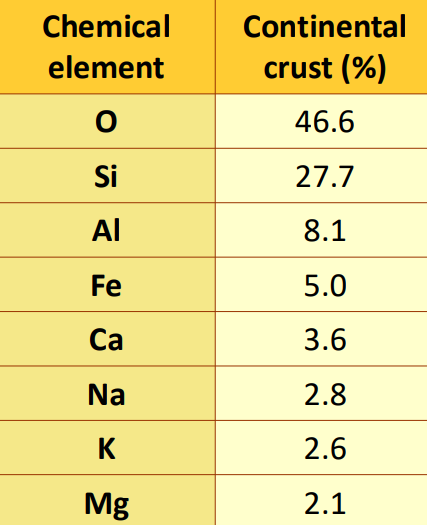
Ca, Mg, K and Na are considered exchangeable cations.
Rock forming minerals
The most abundant minerals are:
Silicates: (SiO4 ) 4- (>75%)
Oxides: O2- (17%, the main one is SiO2)
Other common mineral groups in the crust :
Carbonates: (CO3 ) 2- (2%)
Sulfates: (SO4 ) 2- (6%)
Sulfides: S2- (6%)
Phosfates : (PO4 ) 3- (6%)
Some examples are
Apetite → Ca(PO4)2
Pyrite → Fe2S3
Calcite → CaCO3
Hematite → Fe2O3
Gypsum → CaSO4 × 2H2O
Quartz → SiO2
Feldespars → Al silicates
Silicates are the most abundant elements. They are formed by a tetrahydra (tetrehedro), with 4 positive charges from the Si and 8 negative charges from the O.

The 4 positive are conected with 4 of the negative, but other 4 are still left. This charges are stabilazed when shared with other molecules of this same element. Depending of how many they share, they assamble in different types por minerals:


Most common minerals that we can find between the diffent textural fractions:
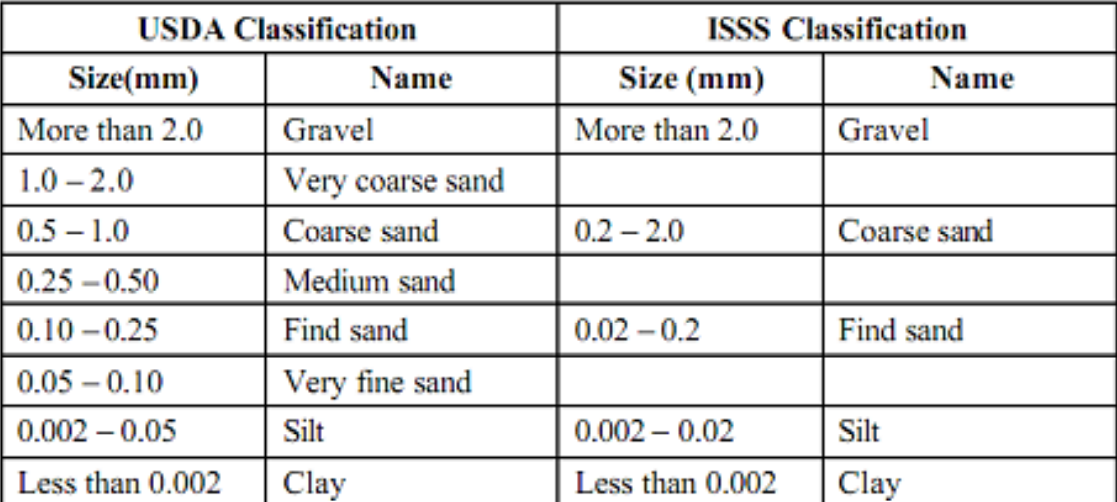
We can distinguished between:
NON-ALTERED MINERALS (coarse soil fractions), not altered by weathering
ALTERATION COMPLEX (colloidal properties), very small charged particles which are suspended inside another medium.
Gravels or stones: polyminerals normally. Particles larger than 2 mm. Undisturbed or slightly altered rock fragments

Coarse sand: Fragments of polymineral bedrock. Between 2 mm and 0.25 mm. It is studied using the petrographic microscope.
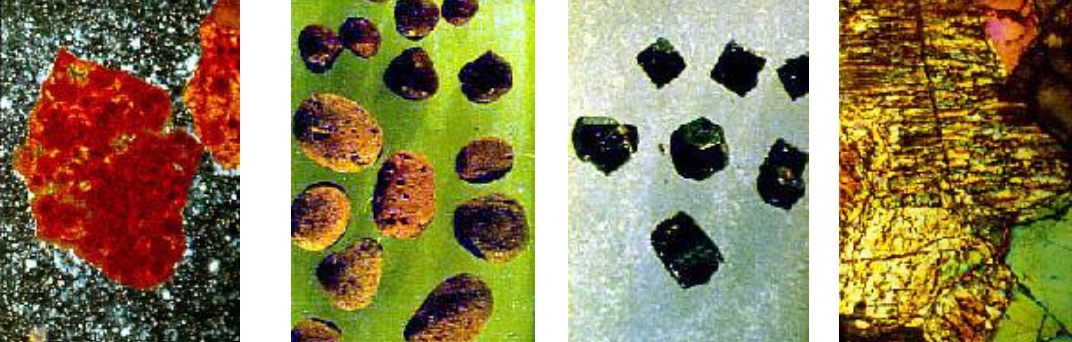
Fine sand: Rock fragments generally of a monomineral character and with a variable level of alteration. Between 0.25 and 0.05 (or 0.02) mm. It is studied using the petrographic microscope.
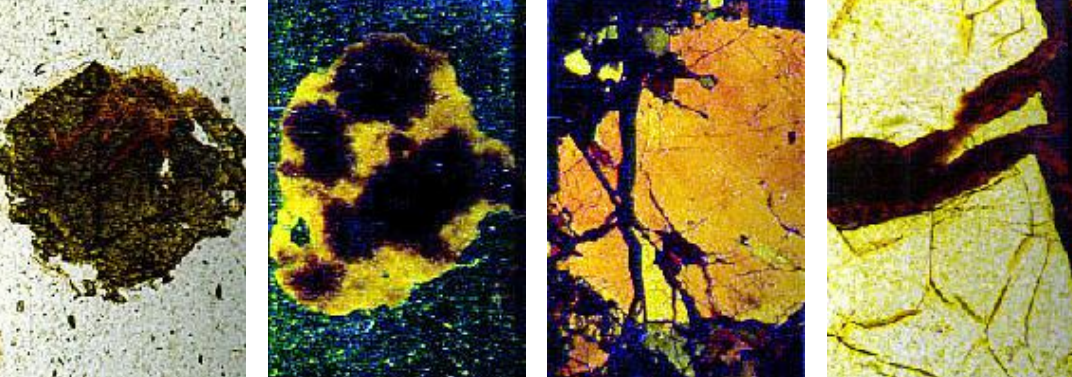
Inside the sand, we can find different types of minerals, whose abundance varies.

Silt: Made up of inherited or transformed materials but without colloidal character. Monomineral particles between 0.05 (or 0.02) and 0.002 mm in diameter. It is studied with the petrographic microscope and by X-ray diffraction.
This information can be used to evaluate the soil fertility. The index is the way we can calculate the fertility of the soil by adding the percentages of all it´s components.
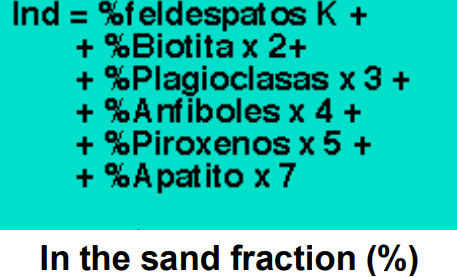
The higher the value of the indez is, the higher the richer the soil is going to be in the future.

And depending on the type of soil, the mineralogy is going to be diffent.

Luvisols are soil which are very old, and have sufferd a strong weathering process, giving the sand fractions the most stable minerals in nature (quarz and feldespart).
We can deduce how soil has evolved over time just by looking at the percentages in the sand fraction. If the soil fraction has less stable minerals, the means that is less old and stable than another soil which has more stable minerals, which indicates that the less stable minerals have already dissapeared.
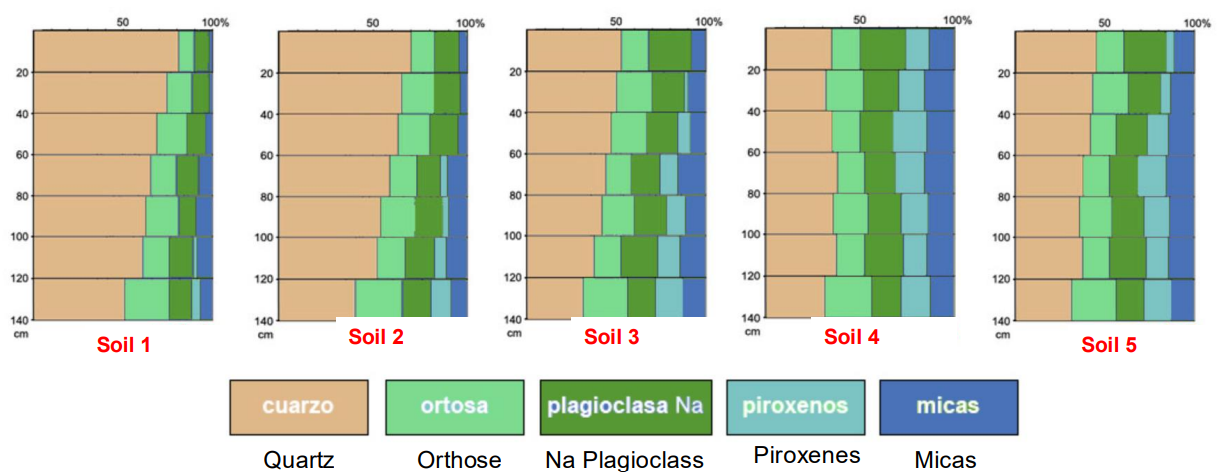
Mineralogy of the coarse sand fraction and Potential Fertility
The soil that has less potencial fertility will be the one that only has more sable minerals, because it indicates that the unstable ones have already been broken down.

Clay: Colloidal and monomineral particles. They have been formed on the ground or have undergone transformations in it. Sometimes they are inherited by microdivision. Size less than 0.002 mm. They are studied by X-ray diffraction or electron microscopy.
The clay factors can be distinguised between texture and minerology.
Inside this mineral part, we are going to see how they are formed (phyllosilicates)
In the tetrahedral layer they share oxygen, and then the octahedral layer can join to it, which is 2 of the basic units united at the base and turned on it´s side. The basic octahedral layer has 3 gaps that contains cations like Mg+2 o Al+3. On the outside vertices, they have OH- and O-, which adds up to a total of -6, and has to be equilibrated with the previous cations (2 Al o 3 Mg).
We can name the octahedral layer depending on it´s cations:
Aluminum: dioctahedral layer
Magnesium: trioctahedral layer
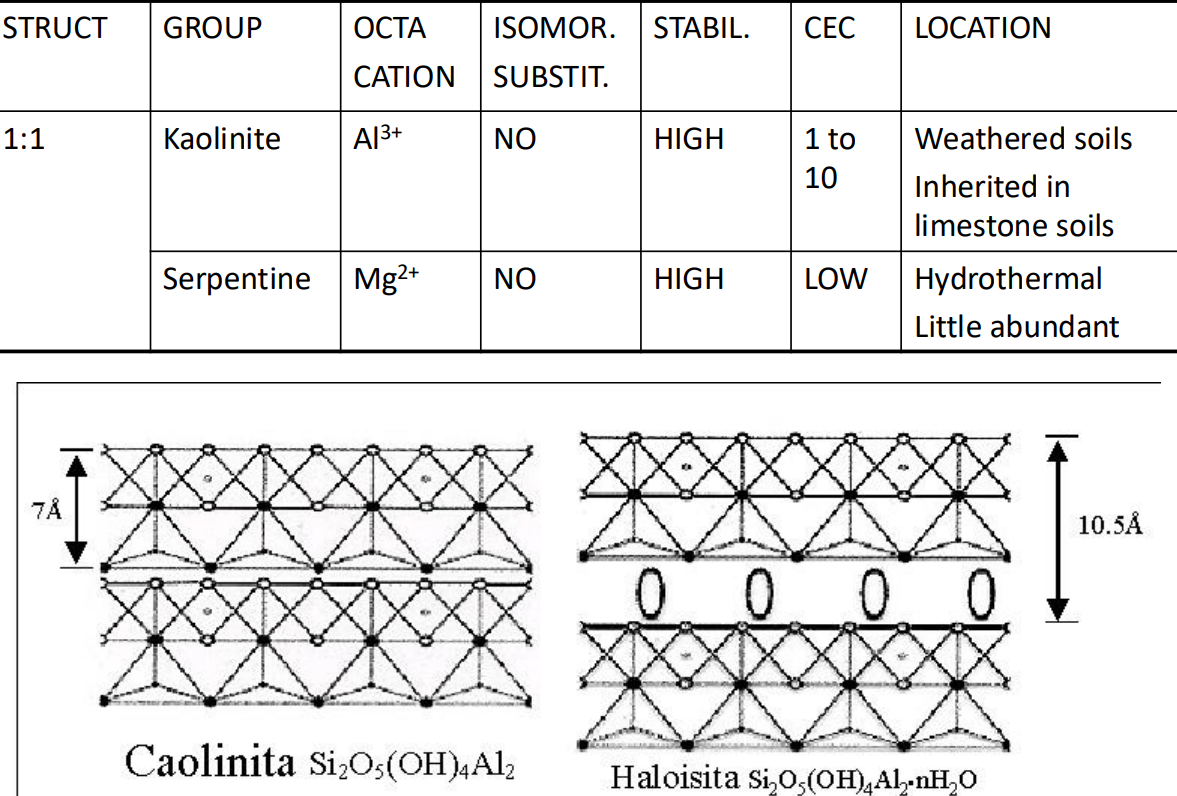
The tetra and the octa have shared apical oxigens, this is called basal spacing, and it´s always constant (7 amstrongs). The mineral has to reach a neutral and stable state where all the charges are balanced.


Types of phyllosilicates:
1 layer → Kaolinite (1:1).

2 layers → Illite, Smectite, Vermiculite (2 tetra and 1 octa). They have the property of swelling when we add water, because they increase the basal spacing.
2:1:1 → 2 of the previous and an octa. Chlorite

Ion exchange
Reversible processes by which solid soil particles adsorb ions from the liquid phase, releasing at the same time other ions in equivalent quantities, reaching a dynamic equilibrium between both phases
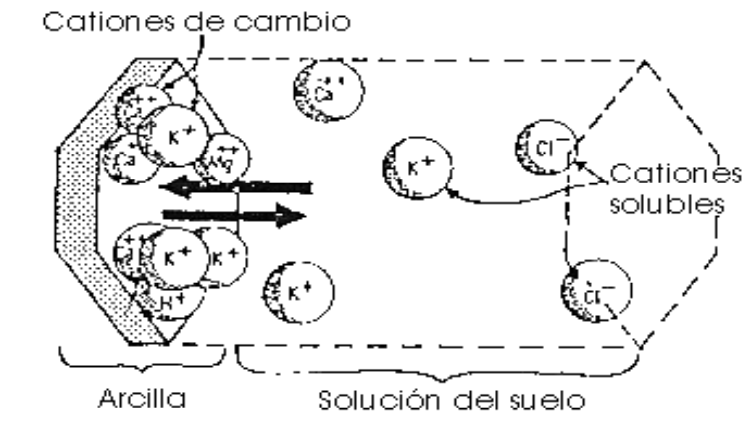
Soils can store nutrients and also release them, because they have this buffer capacity that allows them to mantain a stable pH.
The stronger the leaching process is, the less amount of souluble cations we can find on the surface.
When the particle absorb cations is because the soild fractions has negative particles.
Cation exchange: Soil-M + X+ -----> Soil-X + M+
Anion exchange: Soil-N + Y- -----> Soil-Y + N-
Negative charges: clay and organic matter
Positive charges: Fe and Al oxyhydroxides
Areas with irons and more stable minerals, are the ones the suffer a greater weathering, like volcanic, o tropical areas, with a lot of soil degradation.
Exchange complex: soil constituents involved in ion exchange. Ex: cation → clay and anion → Fe.
Exchange capacity: total charge of the solid phase affected by ionic exchange. Cation Exchange Capacity, CEC (when cations are exchanged) and Anion Exchange Capacity (when anions are exchanged).
Cation exchange capacity (CEC)
Number of moles of adsorbed positive charge ions that can be exchanged per unit of dry mass, under given conditions of temperature, pressure, composition of the liquid phase and a given mass-solution ratio.
It is measured in cmolckg-1 (formerly meq/100 g)
The CEC of a mineral depends on the surface charge density (cmolc m-2 ) and its specific surface (m-2 kg-1 )
Causes
In clays:
Isomorphic substitutions
Break zones or edges
OH-basal dissociation
Isomorphic substitutions
They are made between atoms that have similar ionic radios:
The Si4+ of the tetrahedral layer can be replaced by Al3+
The Al3+ of the octahedral layer can be replaced by Mg2+, Fe2+, Fe3+
The surface charge density increases with substitutions.
It is of greater intensity if the substitutions are placed in the tetrahedral layer
They create a deficit of charges, needing positive or negative charges to create balance.
Substitutions in one layer:
Illites → Mices: Muscovite (Al) and Biotite (Mg)
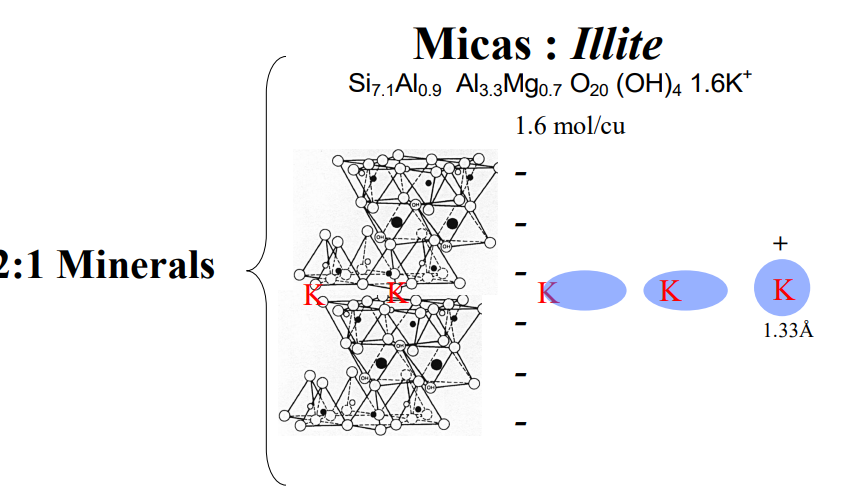
We also have substitutions in both, tetrahedral and octahedral layers, at the same time (vermiculites).
Break zones or edges
if the particles are not well cristalized at the edges they wont be electrically compensated (charges). The hardness of diamonds is due to its perfectly crystallized structure.
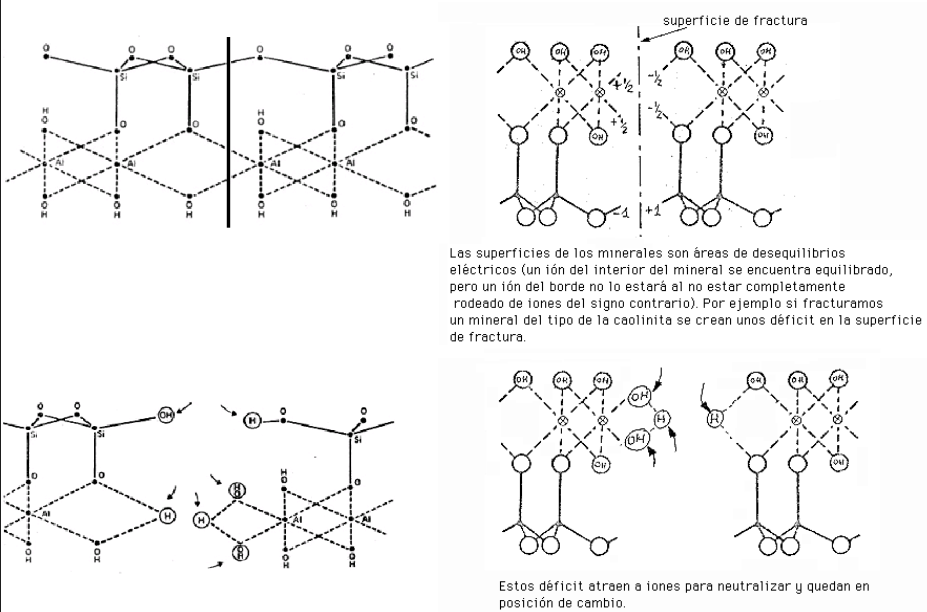
OH-basal dissociation
OH is formed by H+ and O-, the dissociation process happens inside the molecule

Clay characteristics
Permanent charges (due to isomorphic substitutions)
Variable charges (pH dependent, disociaton of OH groups, the existances of not compensated particles).
The cation exchange capacity of the clay is higher:
the higher the degree of alteration (less crystallinity). The stronger the weathering process is, the more often we are going to find the not cristalized fractions.
the smaller the size (more rupture and exchange zones). Being so small, they have a bigger specific surface than a big one.
Exchangeable cations
They come from:
Weathering of source material (hydrolisis)
Organic matter mineralization
Surface and underground external contributions (runoff, groundwater)
The cations that frequently occupy the positions of change in soils are: Ca2+, Mg2+, K+, Na+ (exchangeable bases), H+, Al3+ , Fe 3+, Fe2+, NH4 +, Mn2+, Cu2+ and Zn2+.
Depending on the medium, the exchange complex (negative charges on the surfarce, compensated by positive charges which can exchange themselves with other positive charges), is going to be saturated with diffente contents.
In neutral soils (pH → >7<9), this positive charges are mainly Ca, due to the presence of CaCo3. It´s unsoluble, but in the presence of water and CO2, it forms HCO3- (bicarbonate) and Ca2+.
In acidic soils (pH → <5,5-6 ), it contains a lot of protons and Al3+, and the higher it´s quantity, the lower it´s pH is.
In acidic organic soils, it only contains H+ as a cation, because Al is normally toxic to living beings.
In alkaline soils (pH → >9), due to the presence of Na+, which normally isn´t good for soil formantion due to it´s single charge and it´s size.
Base saturation degree (V%):

It has to do with the amount of exchangeble bases, in relation to the total charge (CEC). The CEC would be all the negative charges that surround the particle, and the Cations refer to the amount of each that is compensating the negative charges.
The CEC also contains other elements, not included above. The higher the amount of exchangeble bases, the higher the base saturtion degree is going to be.
V is very useful to know what is going on in the soil, and also to be able to classify it. If V > 50%, the soild is saturated (eutric), if it´s not, it´s not saturated (dystric → elevated leaching). It´s value can also help us determine the pH, as if the greater the amount of exchangeable bases, the higher the pH is going to be. Because the more exchangeable bases we have, the less H+ and Al3+ are present in the soil.
Clay minerals more frequently found in soils:
Kaolinite is the most importan on this one.
Smectites: they have the properties of swealling and shrinking due to their hability to absorb water.
Illites = micas


Every certain number of tetrahedral, the estrucures turns upsidedown, this creates the gaps in between.
Serpiolite every 6.
Paligorsk every 4.
This allows them to store a lot of water, which makes them be used for materials like cat litter.

Factors influencing the cation exchange capacity
Nature of the particles (composition and structure):
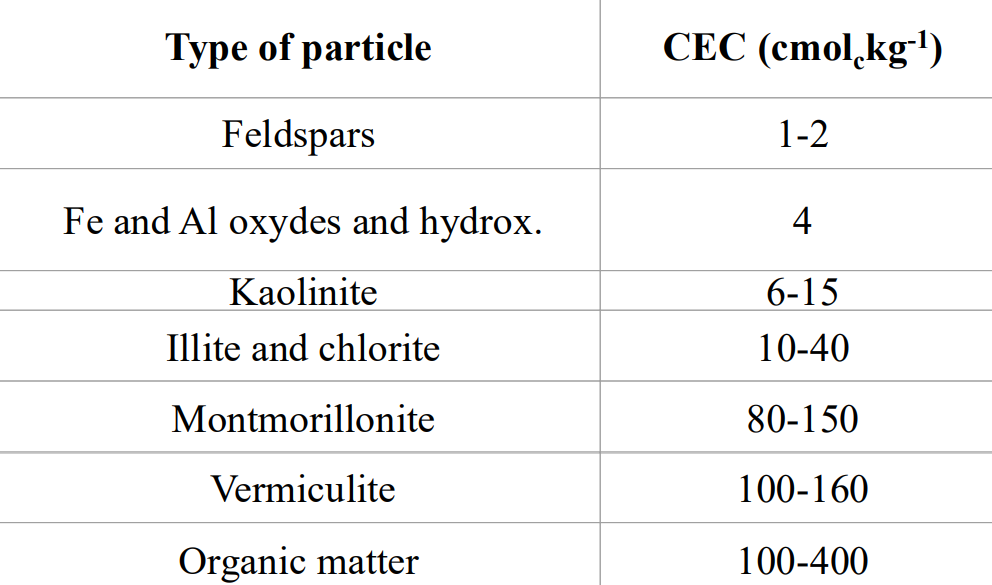
Kaoline → no isomorfic sustitution
Illite and chlorite → they have isomorphic sustitutions but they are very rare, because of the stability of it´s structure.
Montmorillonite → many isomorphic sustitutions within the octahedral layer.
Organic matter → higher range due to presence of OH (O2- + H+ pH>6) and COOH (COO- + H+ pH>4) groups, which have a disociation process, that gives it the negative charges. The stronger the humication process, the higher the degradation is going to be and therefore the higher the CEC is going to be.
Clay mineralogy

Clay properties
Its small size and electronegative character means that:
have colloidal character (clots)
can hydrate
can form suspensions
The degree of hydration determines properties such as:
Flocculation (precipitation, they stick together) and dispersion (not bonded)
Coherence
Compaction (due to their small size and porosity)
Plasticity
Flocctulation and dispersion:
Due to the electronegative character of clays (weak acids):
Alkaline medium, clays dispersed and repel
Acidic medium, flocculated clays are neutralized and compacted Ilimerization process: Eluviation and Iluviation. (also with iron oxides)
It depends on the pH and the type of ions present:
H + ions tend to flocculate clays
OH- ions tend to disperse cla
The floculation level has to do with the charge of the cations. For examen, Al3+ may floculate the clay more than Mg2+ o K+ (the higher the charge, the greater the flocculization)

Cation exchange capacity (more relevant than anion):
Clays electrically decompensated, cation entry on their surface
Clays with little charge deficit, little bond between layers and capacity to increase volume, exchange between layers
Clays without charge deficit, adsorption due to broken edges
Anion exchange capacity: -Adsorption of OHions on breaking surfaces that leave + charges. Only on the surface of the mineral (e.g.: phosphate ion, which can be substituted for OH- )
Anions are less relevant because this processes only occur in tropical or volcanic areas.
Hydration and Swelling
Impermeability
Ion adsorption
Fixation of Fe oxides
Water fixation:
On the surface, forming layers of water molecules
Within the clays, occupying the interlaminar spaces
Organic substances fixation
Influence of clays on the soil
Positive from a chemical point of view because they improve fertility
Negative from the physical point of view (they waterproof, create asphyxiating environments for plants and somewhat slow down the evolution of the soil) although they contribute to the development of the soil structure.
If there are a lot of clay minerals, the texture is gonna asfixiate the living beings in the soil. But on the other hand, a soil that lacks clay wont be as organized.
Most common minerals in soils

Oxides and hydroxides
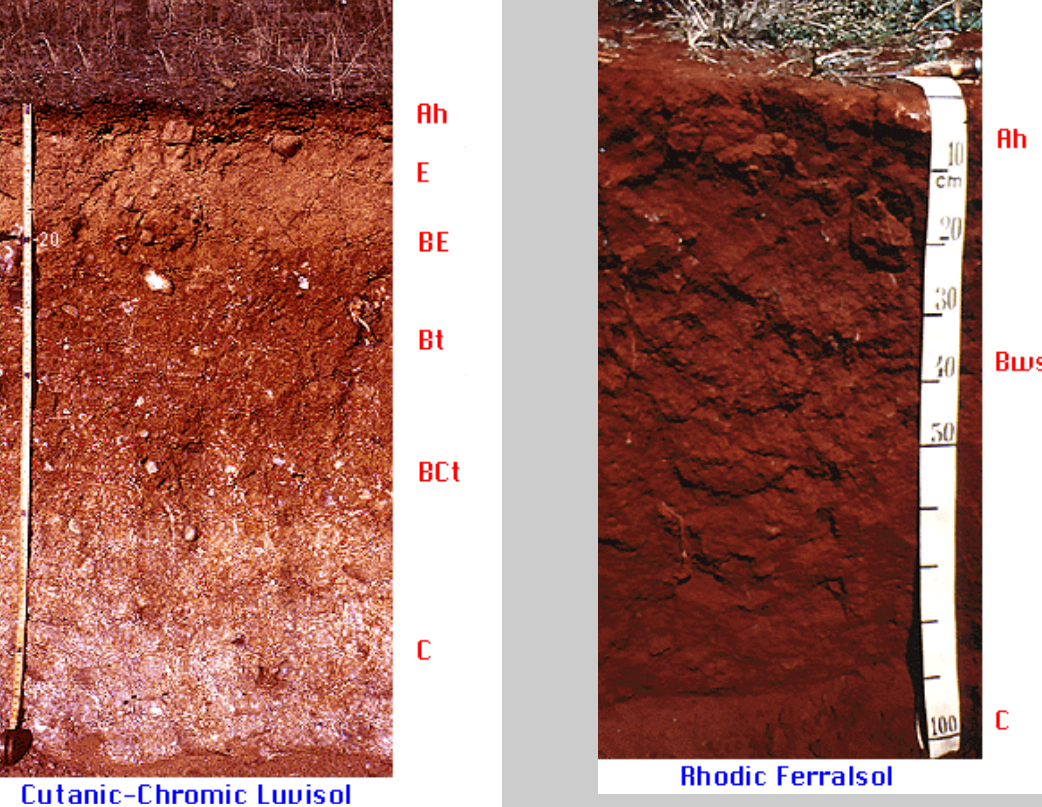
They act as chromogenic elements of the clays. The different colors depend on the oxidation state and degree of hydration. They can join the clays and form cemented layers: Petroferric contacts or ferruginous coatings.
It gets red because the clays have a lot of Fe3+.
The ones that suffer a very intense weathering process have a high presence of Fe a Al (tropical).
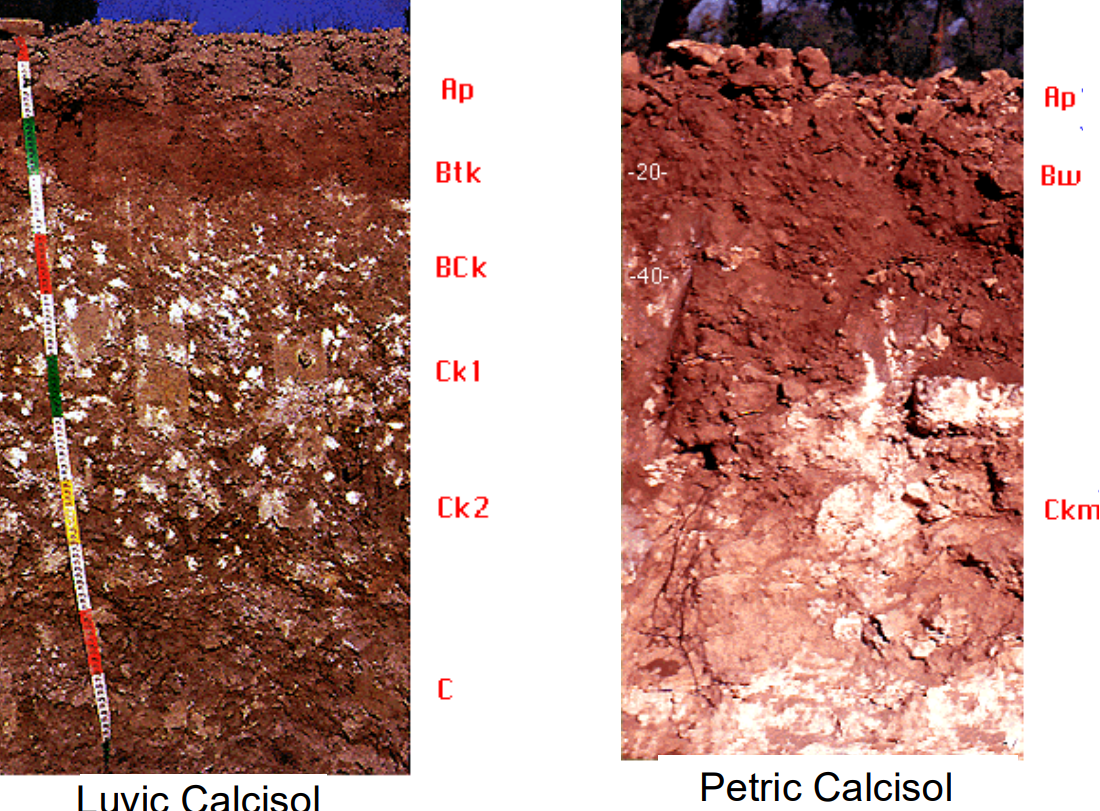
Carbonates, sulfates and soluble salts
In areas of dry climate, arid and semi-arid environments
Simple structures
They affect the cultivation and development of vegetation
Acumulation of soluble salts like Na (N). This soils have a complete destruction os the soil structure because of the big lumps os Na, that alter their prismatic structure. Ca = Bad

Acumulation of carbonate (k), it has sufferd a big dehydration which hardens the materials.
Origin of soil minerals
Primary minerals: They come directly from the original material and are in the soil mainly due to physical weathering (inherited)
Secondary minerals: They appear in the soil by processes of alteration of primary minerals (transformed, newly formed)
Factor controlling the weathering process:
Climate: the higher the temperature, the higher the constant of disolution is going to be. Also, the higher the precipitation, the more products we are going to have.
Parent material: K depends on each reaction and, thus, from the accompanying minerals (common ion). If we have a lot of products, the equilibrium is going to move towards the parent material (degradation is stopped).
Relief: The climate is related to the relief.
Time: The reactions are expressed in terms of velocity.
Microorganisms: Biological activity is conditioned by the climate and, in turn, conditions reactants.
Inorganic Solid Phase Mineral Types
Missing minerals: present in the C hor. but not in the B hor.
Inherited minerals: they have not undergone any alteration and are found in C and B hor. Primary minerals (quartz). They are concentrated in the sand and silt fractions. Found both in the parend and it´s derivated layer. They don´t change.
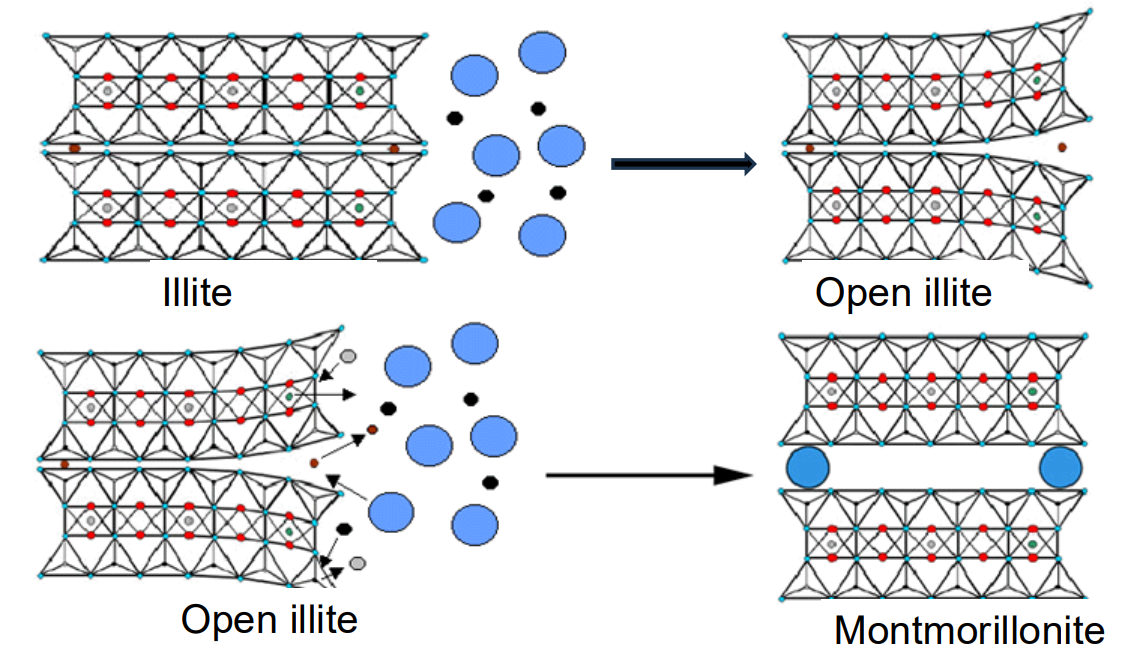
Transformed minerals: an alteration has taken place that has made them gain or lose cations and have been transformed into another mineral. Secondary minerals. (e.g.: illite (K) and exchange it´s ions with montmorillonite (Ca, Mg). They are concentrated in the clay fraction.
Newly formed minerals: the minerals of the C hor. are destroyed and recombine to form new minerals in the B hor. Secondary or edaphic minerals. They are concentrated in the clay fraction.
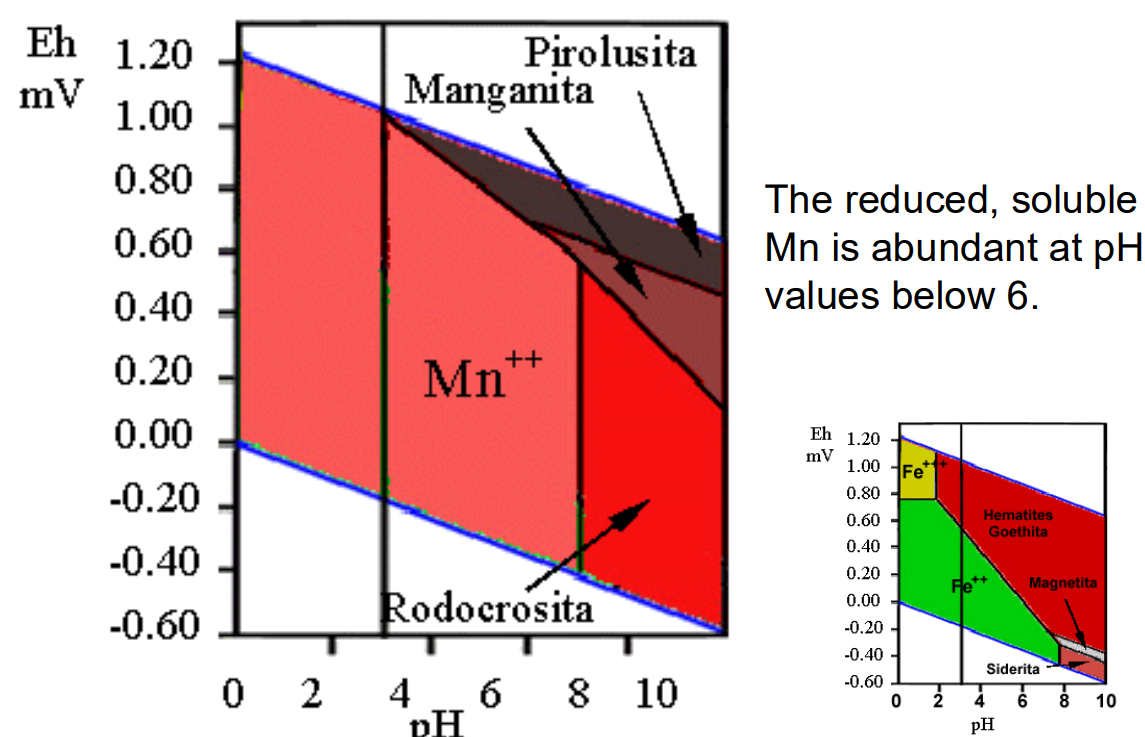
We can find diffent types of iron depending on the pH and REDOX conditions:

This are the conditions in which the iron can be found soluble
Manganese is also found commonly in soils. Mn have a wider range of conditions in which it can be soluble, so it´s more mobile than Fe.
Neoformation: we can determine it by analizing the minerals that aren´t in the rock but can be found in the other holizons.

Climate
Cold and dry
Mechanism: Inheritance minerals
Kaolinite: Typically inherited. Very stable.
Micas and Chlorites: Stable in poorly washed soils, with low chemical activity.
Smectites (Montmorillonite): Stable in lightly washed medium rich in Ca2+ and Mg2+ .
Intestratifies and vermiculite: They are typical of alteration. Only inherited in sedimentary rocks.
Temperate
Mechanism: transformation
Neutral hydrolisis: non-acidic medium rich in bases.
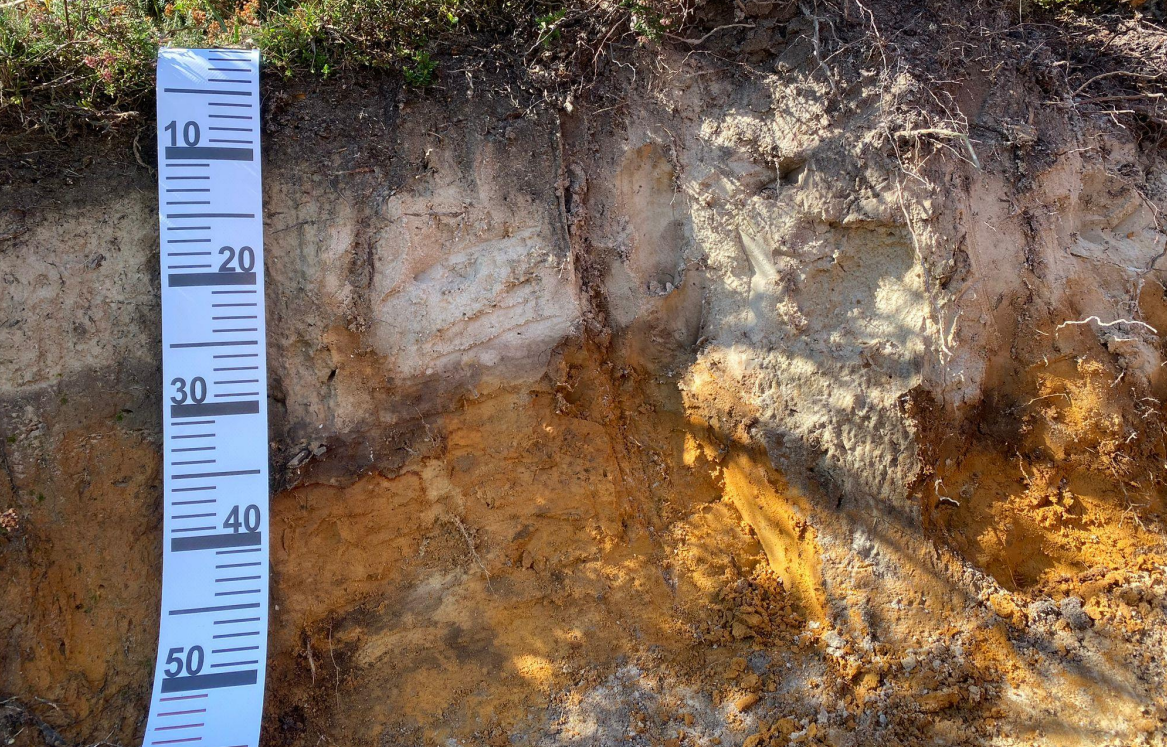
Acid hydrolisis: acid medium with active MULL. With H+ and Al

Complexolysis: Soluble organic complexes that extract iron and aluminum atoms. An organic compound gets iron and Al form the inorganic, forming complexes, and it can go downwards the soil profile.
Tropical
Mechanism: neoformation
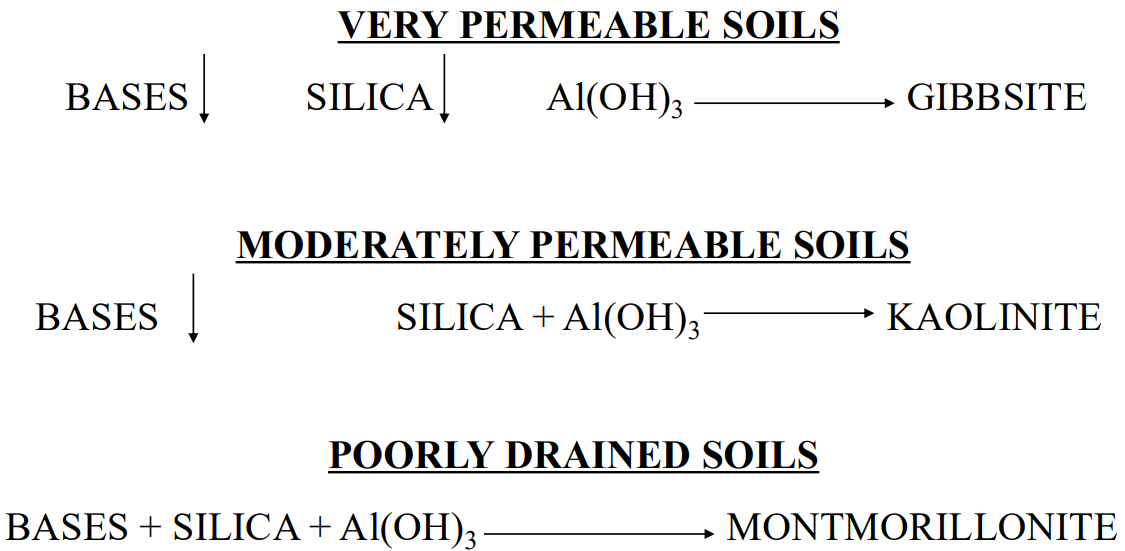
Silica is more soluble than aluminum
Methods to study the mineral phase
Optical microscopy
Polarization: Optical identification of minerals and relationships between them and the soil matrix.
Electron microscopy
SEM-EDX: morphology and microanalisys
TEM: morphology and structure.
X-ray Diffraction
Powder (total mineralogy).
Oriented aggregate (clays).
Chemical analysis
X-ray fluorescence (dominant).
Carbonate and gypsum determination.