Domain III.1a: Risk Management Approaches, Assessment Processes, and Assurance
Foundations of Risk Management and Internal Audit Assurance
Intersection of Disciplines:
Internal audit and risk management intersect at Risk Management Assurance.
Risk Management: Focuses on identification, assessment, monitoring, frameworks, data analytics, and IT risk.
Internal Auditing: Delivers independent assurance, risk-based planning, efficiency evaluation, and reporting.
These reviews can be executed at multiple levels: an individual objective, activity, project, functional department, strategic business unit (SBU), operating division, or across the enterprise as a whole.
Internal Audit - Risk Management Mandate (Standard 2120)
IA is mandated to evaluate risk management effectiveness and promote process improvement.
Effectiveness Criteria:
Organizational objectives align with the mission.
Significant risks are identified and assessed.
Selected responses align with organizational risk appetite.
Timely risk information is communicated across all organizational tiers.
Assurance evidence is accumulated across multiple engagements and can incorporate verified work from other assurance providers.
Risk Management Lifecycle & Assurance Dimensions:
Risk management is an end-to-end organizational system designed to protect and enhance value, build resilience, and support informed decision-making. It functions across six interconnected stages:

Lifecycle Stages:
1. Objectives: Protecting organizational value, ensuring sustainable success, building resilience, and optimizing risk structures and resources.
2. Inputs: Strategic vision, leadership commitment, company-wide awareness, funding, technical systems, specialized talent, standardized frameworks, and cross-organizational coordination.
3. Processes: Identifying, analyzing, prioritizing, and responding to risks through horizon scanning, continuous monitoring, reporting, escalation protocols, and ongoing improvements.
4. Outputs: Tangible deliverables such as risk reports, executive attestations, predictive insights, assurance evidence, and deficiency/remediation tracking.
5. Outcomes: Direct operational results including better decision-making, efficiency gains, loss prevention, competitive advantage, regulatory compliance, and ethical behavior.
6. Impacts: Long-term organizational success, sustainability, and increased stakeholder and investor confidence.
Assurance Dimensions:
Economy: Cost-effectiveness and acquisition of inputs (tools, resources, technological capital)
Operations: Day-to-day execution and integrity of risk processes.
Efficiency: Evaluates the relationship between inputs consumed and outputs generated (e.g., timeliness, productivity, and analytical yield of risk assessments).
Effectiveness: Evaluates whether risk management objectives successfully produce the intended organizational outcomes and strategic impacts.
The Multi-Staged Risk Assessment Architecture
Assessment Sequence:
Step 1: Risk Identification: Discovering, recognizing, and describing risk exposures.
Step 2: Risk Analysis: Understanding the nature, sources, causes, and characteristics of identified risks.
Step 3: Risk Categorization: Grouping risks logically to facilitate structured evaluation and ownership.
Step 4: Risk Measurement: Quantifying or qualifying risk magnitudes using established criteria.
Step 5: Risk Assessment Documentation: Recording findings systematically within registers and visual maps.
Risk assessment is never a "once-and-done" task because organizational operating conditions evolve continuously.
Drivers of Changing Risk Profiles:
Internal: Financial standing, leadership transitions, workflow modifications, and corporate restructurings.
External: Competitor behavior, demographic shifts, macroeconomic conditions, regulatory legislation, climate events, and supply chain dependencies.
Step 1 - Risk Identification:
Parties Involved in Identification:
Board & Senior Management: Enterprise strategic viability risks.
Operational Managers & Frontline: Tactical risks, control failures, and workflow bottlenecks.
Second Line Functions: Specialized oversight (compliance, legal, security, environmental).
Internal Audit: Independent identification during audits and facilitation of self-assessments.
External Bodies: Statutory regulators, inspectors, and external consultants.
Modalities: Executed along spectra of formal/informal, cyclical/ad hoc, proactive/reactive, manual/automated, and self-directed/facilitated.
Approaches to Risk Identification:
Formal or Informal: Guided by documented protocols versus unstructured, intuitive observations.
Cyclical or Ad Hoc: Recurring on a scheduled periodic basis versus initiated immediately in response to trigger events.
Proactive or Reactive: Anticipating emerging threats via forward-looking scanning versus responding after incidents occur.
Manual, Semi-Automated, or Automated: Relying entirely on human evaluation, blended analytic platforms, or real-time continuous algorithmic tracking.
Self-Directed or Facilitated: Executed autonomously by operational managers versus moderated by internal audit or risk advisors.
Risk Identification Methodologies and Tools
Core Techniques:
Checklists: Baseline inventories of historical risks; useful as starting points but never definitive or comprehensive.
Benchmarking: Compares processes and controls against industry peer data.
Scenario Planning: Models plausible future environments to evaluate emerging risks and systemic disruption.
Vulnerability Assessments: Locates single points of failure (SPOFs) and bottlenecks (e.g., Ishikawa/fishbone diagrams).
Brainstorming: Rapid, uninhibited ideation to generate broad risk catalogs.
Control Self-Assessment (CSA) / Control Risk Self-Assessment (CRSA): Structured workshops and surveys engaging cross-functional staff to evaluate controls and risk exposures.
Questionnaires & Surveys: Scalable tools for collecting broad quantitative and qualitative data.
Horizon Scanning: Monitors macro trends to detect weak signals of emerging threats.
Documenting Risk Identification - Risk Universe
The Risk Universe is a formal catalog articulating the impact of uncertainty on organizational objectives by linking root causes, trigger conditions, and operational impacts.
It serves as the foundation for the risk register.
Step 2 - Risk Analysis
Risk analysis begins by separating relevant, significant exposures from purely theoretical, irrelevant, or nonmaterial events.
Significant Risks: Realistic probability of causing material damage.
Relevant Risks: Directly tied to organizational purpose, active strategy, and operational priorities.
Broad Risk Classifications:
Inherent vs. Residual: Gross risk in the absence of mitigation vs. net risk remaining with controls in place.
Pure Risk (Downside Risk) vs. Speculative Risk (Upside Risk):
Events that offer exclusively destructive, adverse outcomes with no upside potential (e.g., physical fire, structural equipment collapse) vs. events that carry the dual potential for either financial gain/strategic advantage or economic loss (e.g., capital investment, entering new geographical markets).
Familiarity: Well-known (deep historical data), hypothetical (incomplete data), and unknown (novel/emerging).
Predictability: Foreseeable (knowable through intelligence) vs. unforeseeable (statistical anomalies, black swan events).
Theoretical vs. Significant: Improbable/negligible risks but mathematically possible vs. critical strategy-impacting exposures.
Black Swan Dynamics:
High-impact, rare events frequently dismissed beforehand as unimaginable, yet often possess historical precedents and warning signals —> not entirely unforeseeable.
Types of Risk Categorization
There are many different ways to categorize risk. Categorization enables risk aggregation, reveals structural risk concentrations, and facilitates targeted allocation of risk ownership.
Business vs. Nonbusiness Risks:
Business Risks (Internal Environment):
Risks stemming directly from operations where management can treat both likelihood and impact:
Strategy: Flawed business strategies or poor implementation.
Enterprise: Exposures tied to executing core operational activities.
Product: Demand fluctuations, lifecycle shifts, and design defects.
Economic: Internal operating cost variations.
Technology: IT failures, obsolescence, and process inefficiencies.
Property: Misuse, physical damage, or depreciation of facilities and physical assets.
Nonbusiness Risks (External Environment):
Risks arising externally where management generally cannot control event likelihood,and primarily on impact mitigation:
Financial:
Liquidity: Cash flow shortfalls preventing debt settlement.
Gearing: Insolvency vulnerability driven by excessive debt relative to equity ().
Default / Credit: Counterparty non-payment or restricted borrowing access.
Market / FX / Interest Rate: Fluctuations in securities values, exchange rates, or debt servicing costs.
Event: Disaster (acts of nature, sabotage), regulatory risks, reputational damage, and systemic supply chain failures.
Operational: Fraud (intentional deception for gain) and IT risk (threats to data confidentiality, integrity, and availability).
Criteria for Risk Measurement and Evaluation
Evaluation Dimensions (ISO 31000):
Impact: The effect or consequence that a risk event has on resources, activities, and the achievement of organizational objectives.
Likelihood: The probability or possibility that a risk event will occur —> often expressed as a percentage
Vulnerability: The susceptibility of the organization to an impact, taking into account recovery speed and financial or operational costs.
Volatility: The degree of variability or fluctuation inherent in the risk source over time.
Velocity (Speed of Onset / Proximity): The speed at which a risk impacts the organization after it is triggered; includes speed of reaction and speed of recovery.
Interdependency: Simultaneous compounding of distinct risks with unrelated root causes exceeding individual sums.
Correlation: Causative linkage between distinct risks sharing related root causes.
Interaction Mapping: Evaluated on square matrices to identify compounding dependencies and systemic failure nodes.
Measuring Risk Severity, Prioritization, and Heat Mapping
Severity Calculation:
Calculating Risk Severity
Definition: A combined metric used to rank, compare, and prioritize risks.
Baseline Formula: Severity = Likelihood (L) x Impact (I)
Unweighted Equivalence Issue:
Organizations typically weight impact higher than likelihood, prioritizing rare catastrophic risks () over frequent minor nuisances () —> if two risks have the same score, the one with the higher impact would be ranked riskier
Monetary Severity (Expected Loss): Risk can be calculated in dollars instead of a numbered scale.
Formula: Expected Severity = Probability x Financial Impact
Example: 50% chance x $3,000 loss = $1,500
Ordinal Scales and Priority Tables
Qualitative Ranking: Assigning simple numeric ranks (e.g., for Low, Medium, High) to descriptive risk terms creates a matrix with clear priority levels (strata) to guide decision-making.
Qualitative Tiers:
Impact: Catastrophic (threatens solvency/reserves), Disruptive (threatens of earnings), Problematic (threatens of earnings).
Frequency: Likely ( occurrence per year), Possible (occurs every few years), Unlikely (occurs once in a working lifetime).
Heat Maps & Limitations:
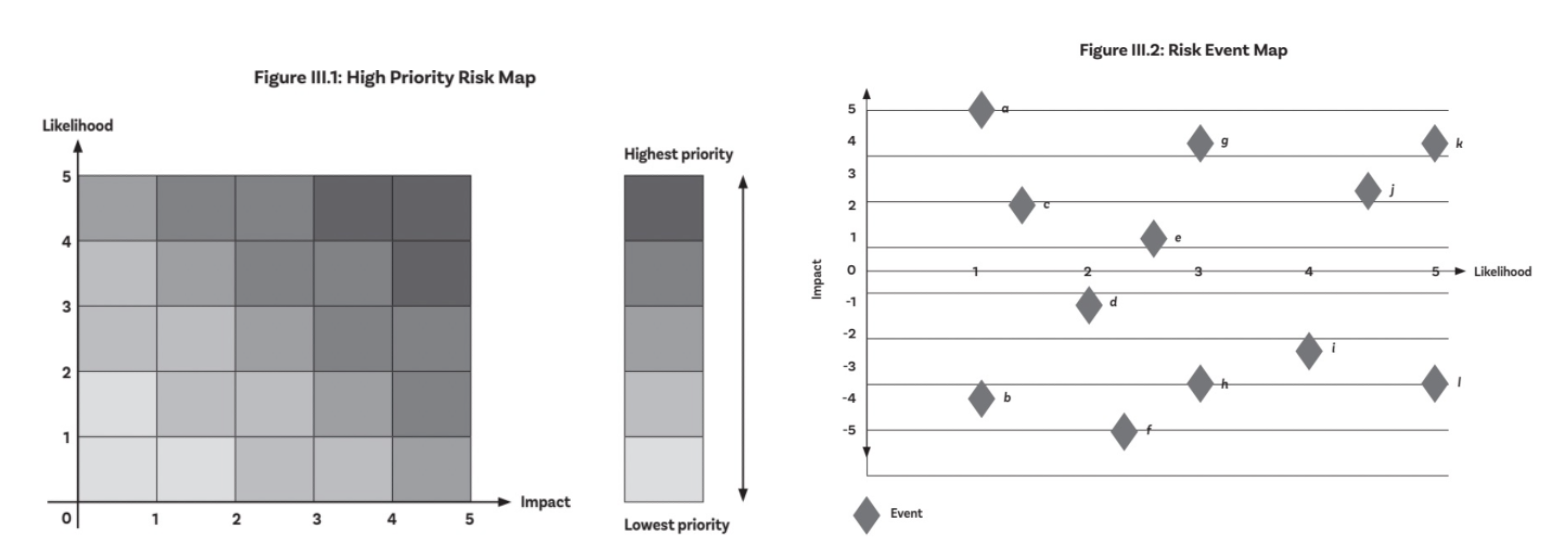
High-Priority Heat Map: Plots likelihood against impact to highlight exposures requiring executive action.
Bilateral Risk Event Map: Balances downside threats against upside opportunities relative to total risk capacity.
Limitations: Scoring grids risk oversimplifying multidimensional realities, creating an illusion of precision while obscuring qualitative narratives and rapid velocity shifts.
Psychological and Behavioral Dimensions of Risk Assessment
Perceptual Biases & Subjectivity:
Subjective scoring stems from variations in personal risk appetite, cognitive framing, and operational lenses.
Aviation vs. Automobile Paradigm: Individuals often perceive flying as more dangerous than driving despite higher statistical traffic risks, driven by emotional vividness (catastrophic plane crashes) and lack of locus of control (surrendering control to pilots).
Mitigating Groupthink:
Unmoderated sessions tend to conform to dominant leaders; mitigated through anonymized polling, voting keypads, and independent self-assessments.
Control and Risk Self-Assessment (CRSA / CSA):
Control and Risk Self-Assessment (CRSA / CSA)
Core Methodology and Principles:
Operational managers and frontline teams are responsible for evaluating risk exposures and control effectiveness within their areas.
Internal auditing serves as a facilitator, methodology provider, and objective analyst —> does NOT take ownership of the risks, controls, or self-assessment conclusions.
Significant unmitigated exposures must be escalated by the CAE to executive management and the board.
Comparative Evaluation of Self-Assessment Techniques:
Technique | Advantages | Disadvantages |
Facilitated Workshops | Fosters organizational dialogue, builds shared ownership, validates understanding, and captures qualitative depth. | Time-consuming, requires skilled facilitators, and risks peer conformity. |
Surveys | Inexpensive, rapidly scalable across large workforces, anonymous, and limits groupthink. | Cannot probe underlying rationale, lacks nuanced context, and depends heavily on clear, unambiguous question design. |
Structured Interviews | Allows for targeted follow-up inquiries, capturing technical operational detail. | Highly labor-intensive, resource-constrained sample size, and lacks respondent anonymity. |
Risk Documentation and Register Architecture
Risk Register
Central tool for risk governance, documenting risk evolution, establishing operational ownership, tracking controls, and demonstrating managerial diligence.
Internal audit must maintain its own independent view of risk.
Core Architectural Components:
Alphanumeric Risk ID, Category, Detailed Description (causes, triggers, impacts).
Designated Risk Owner, Identification Timestamp, and Review Freshness Date.
Risk Appetite and Tolerance thresholds.
Inherent Risk Scores (Likelihood, Impact, Severity) and Dynamic Metrics (Velocity, Volatility, Vulnerability).
Chosen Risk Response (Avoid, Reduce, Transfer, Accept).
Residual Risk Severity (net level with controls).
Action Plans: Designated remediation owners, implementation deadlines, status tracking, and audit cross-references.
Continuous Monitoring and IT Risk Management
Continuous Monitoring vs. Continuous Auditing:
Continuous Monitoring: Operational management responsibility; involves real-time automated oversight of workflows and controls.
Continuous Auditing: Internal audit duty; leverages automated extraction and analytics testing to assess risk and audit coverage independently.
Robust management monitoring allows internal audit to reduce routine testing; weak monitoring requires expanded direct testing. It involves:
Data Collection: Software automatically pulls live transaction data from internal systems.
Screening: Algorithms scan data for errors, policy violations, and unusual trends.
Validation: Continuously verifies internal safeguards are working (e.g., daily segregation-of-duties checks).
Escalation: Automatically flags issues and alerts managers to fix them.
NIST SP 800-37 Architecture (IT Risk Management Framework)
Uses clear organizational risk tolerance to guide consistent choices across all levels.
Involves automated metrics to track baseline security health, continuous control validation and ongoing compliance, and an inventory of all IT assets,
Monitors system updates and control environment changes and tracks emerging cyber vulnerabilities and risks in real-time
Risk Management Maturity Models
Purpose:
o Maturity Models help to identify structural weaknesses and sets improvement targets not just a score
o It helps leadership set goals for risk culture, analytics, and governance.
o It provides internal auditors with audit criteria (objective standards) to support recommendations
Characteristics of High Maturity:
o Proactive Culture: Leadership promotes transparency, ethics, and open reporting of bad news.
o Strategic Integration: Embeds risk assessment into long-term planning and daily operations.
o Clear Governance: Defines roles and authority across the three lines model without creating bottlenecks.
o Consistent Methodology: Uses standardized, company-wide policies and risk terminology.
o Broad Ownership: Involves staff at all levels to prevent isolated silos.
o Adaptive Monitoring: Uses real-time tracking to adjust risk profiles as conditions change.
o Tech Enablement: Leverages data analytics, machine learning, and automated risk registers.
o Framework Adaptation: Tailors global standards (e.g., ISO 31000, COSO ERM, NIST) to fit the organization's specific needs.