Baylor REL 1310 Christian Scriptures - Unit 1
Mowry
Canon of the Bible
The canon of the bible refers to which books made it into the bible and which books didn’t, why, and if the excluded books (“apocrypha”) are considered “true” or fictional. The books included change through denominations. Most books are the same, but some of the inter-testiment-al historical books and prophetic books are disputed.
Scripture - The texts by which people govern their lives
Criteria used for canonization:
Time
Connection to an authoritative figure
Consistency of message
Corroboration from other sources
Old Testament Canonization
Hebrew Bible: Canonization of the Hebrew Bible was slow and somewhat obscure. The first set of writings to function as authoritative scripture was the Torah, aka the Pentateuch. Next included was the “former prophets” and “latter prophets” called the Nevi’im. the final set of writings to be added as authoritative scirpture called the Ketuvim, or Writings. The Jewish Bible is called the TaNak for Torah, Nevi’im, Ketuvim. The hierarchy of the texts follows the same order. Hebrew bible is organized by the degree of authority.
Septuagint LLX: The Greek Translation of the Hebrew Bible (definitely on test!!)
Protestant/Catholic Bible: The Christian bible believes all texts are equal. The Catholic Old Testament includes writings not found in the Protestant Old Testament. The catholic old testament follows the Septuagint including those extra books not found in the hebrew bible, but recognize their contested status as “deuterocanonical”(second canon) while protestants call these the apocrypha and do not include them. The old testament is organized by genre.
New Testament Canonization
The time frame for the writing and canonization of the new testament is much smaller than that of the Hebrew Scriptures, but the process was very similar.
Textual Criticism
Old Testament
We have no autographs of any biblical book (original copies), we just have copies. Because of this, all biblical readings have small “reading variants.” Often, these are accidents, but they are sometimes intentional changes motivated by theological concerns. Textual Criticism is the study of those textual variants. Text critics and translator use the Masoretic text (MT) as the “base” text for reconstructing the old testament. MT is the oldest complete copy of the Hebrew Bible in its original language (hebrew).
The Dead Sea Scrolls are the oldest (incomplete) manuscripts of the old testament we currently have. However, they are incomplete and fragmentary. Still, they demonstrate a lot of variant readings. (Ex: Don’t need to know, but “Sons of God” vs “Angels of God” vs “Sons of Israel”)
Because less Jews spoke Hebrew, translations of the bible into greek/etc provide some of the oldest copies of the old testament.
New Testament
the manuscript evidence for the new testament is much larger and is generally divided into two groups, Codices (4-5 Centuries AD, but more complete) and Papyri (Fragmentary, but 2-3 centuries AD)
Translating the Bible
Formal correspondence - literal word-for-word translation, meaning the grammatical forms of each translated word
Dynamic equivalence - focuses on the meaning of the text and tries to recreate the meaning using contemporary language; works better for outdated metaphors
The Historical Books (Christian)
Joshua, Judges, Ruth, 1-2 Sam, 1-2 Kings, 1-2 Chron, Ezra, Nehemiah, Esther
The Nevi’im (Jewish)
Former and Latter Prophets
The Former Prophets
Joshua, Judges, 1-2 Samuel, 1-2 Kings
The Primeval History
Genesis 1-11
Structure:
Can be split into pre-flood and post-flood
Genealogies splitting narratives
Structure
A
B
X
B’ (event similar to B)
A’
This structure emphasized event X
Adam and Eve
Cain and Able
The flood
Tower of Babel
Abram
Purpose (not meaning)
Why the text came to be, the meaning when it was created, even though it may have many meanings throughout time.
Ex: Sinister = evil, but it originally meant left-handed
The purpose of Primeval history is the tell the history of mankind to the father of the Israelite people: Abraham
It also explains/establishes the divide between the divine realm and the human realm.
In these stories, God is concerned with keeping the separation between earth and the divine
Genesis 1-2:4
Everything after this is narrative, but not this
Repetitive, “let there be x, it is good, etc”
Day 1-3
Give form to the Formless
1: distinction Light and dark
2: water and sky
3: sea and land/plants
Day 2-3
Put stuff in the empty
4: add stars to morning and night
5: creatures in the ocean/sky
6: creatures that live on land
Given the mirror/poetic structure, its likely this was a poetic song— more metaphorical than literal
Created by a group of Jews who were separated and felt alone, and were influenced by the ordered structure of the Babylonian creation story, so they wrote it in a similar structure.
The “dark waters” and “wind” described are a rhetorical device to make an impact in the historical context— its referencing the popular Babylonian creation myth with water and air
Its a bit like telling cinderella but then having her grab her fallen slipper— it grabs attention as now something known has become unknown. What will happen next?
Vs Genesis 2:5-3:24
Tells the same story as 1-2:4, but in a narrative instead of the structured way.
Emphasizes God is with them, anthropomorphic
Created by the group of Jews who remained in Jerusalem and felt God was with them
The Ancestral Stories (Genesis 12-50)
Focuses on the Matriarchs and Patriarchs of Israel
Introduction of the Ancestral Stories
God promises Abram he will make his children a great children, bless him, and curse those who curse him
Genesis 1:2-3, The meeting of God and Abram introduces a central point of tension that will drive the narrative of the rest of Genesis
The book keeps questioning if Abram be the father of a great nation, or will he loose it/fail?
NOTE: Abram → Abraham and Sarai → Sarah
Things that threaten Gods promise (examples, don’t need to know)
As travelers, they kept going into strange places, and all the kings want Sarai, his wife, as their concubine.
For protection, he pretends Sarai is his sister.
They had no legal rights to protect them
Sarai is infertile
Sarai tells Abram to have a child with a slave woman, Hagar, and that child, Ishmael, would be legally Sarai’s.
However, this God tells them this doesn’t count
Sarai and Abram have a miracle kid and send away Hagar and her child
Child Sacrifice
God tells Abraham to sacrifice his kid, Isaac, but stops it at the last moment
Isaac needs a wife, but she cant be an Canaanite, so they need to travel
Isaac’s wife is nearly taken as a concubine
Esau is the rightful heir, but Jacob needs to be the inheritance
he tricks Abraham to give him the inheritance
Jacob works for 7 years to marry Rachael, but is tricked to marry Leah. He works for 7 more years to marry Rachel
Jacob gives birth to many sons and one is Joseph, who is favored, and gets sold into slavery by his brothers.
Joseph becomes powerful in Egypt, and when a famine causes his brothers to seek aid in Egypt, they end up before Joseph who forgives them.
The story of Joseph and his brothers is a novel/Diaspora Literature
Hagar and Ishmael and very central to the story
Hagar is not a name, it means “the foreigner”
The idea is “treat the foreigner well, as you (jewish people) were once a foreigner” (in Egypt)
By the beginning of the next book, Exodus, Israelites are a great nation, fulfilling God’s promise.
The Exodus from Egypt
Exodus & Leviticus
History and The Bible
There is no archaeological evidence for the Exodus from Egypt as it is described in the biblical text. (There isn’t any conflicting evidence either, nothing has been found) The earliest record of Israel outside of the bible is the Merneptah Stele. It is not the most reliable as it was made as propaganda for an emperor.
However, there is some evidence that this exodus occurred and was transmitted orally. In the 14th and 15th century, a Semitic people known as the Hyksos rose to power in Egypt.
During the same time, there are records of nomadic people in the Near East known as the Habiru/Apiru. Some of these people worshipped a god named YHWH, which is very similar to the Jewish God Yahweh.
Clues that the text is correct
Place names are correct
Moses is an Egyptian name
Corroborated elsewhere in the bible in some of the earliest texts available.
There is a collective memory of Semitic people living/working in Egypt before fleeing to Canaan.
Exodus as a Narrative
The story of Moses being sent off into a river parallels a powerful king (Sargon)’s story, who founded a nation. This story works more as foreshadowing, as Moses did the same. The basket Moses was in also parallels the Ark.
Moses kills an Egyptian for mistreating Israeli slaves, so he flees to Sinai where he lives as a shepherd until he sees the burning bush. God gives him a mission to free the Israelites. Moses confronts the Egyptian Pantheon (Pharaoh). The plagues are very poetic in structure and end with the passover narrative. Throughout the story, Pharaoh’s heart is hardened
Pentateuchal Law
Decalogue
Apodictic Law - “Though shalt not”
Made entirely of the 10 Commandments
Covenant Law
Casuistic Law - Sets punishments for actions
Ex: Pay 10 gold if you steal
made to serve as a model/precedent for questions of justice
Kashrut Laws (“Laws of Kosher”)
Designed to prevent diseases
Designed to distinguish themselves from others
Created ethics of consumption and sustainability, preventing self-indulgent
Tradition/moral regulation - rules for the sake of remaining disciplined and give life structure to the chaos of life.
Wanderings and Deuteronomy
Deuteronomy & Numbers
Henotheism - Worship of a single, supreme God while not denying the existence of other deities
Israelites did not initially have true Monotheism, they simply viewed God as their patron Deity, and didn’t care much for the others— not that God was the only true God.
Deuteronomy
Sermons, including reflections on Israel history
Laws
Ritualistic Laws
Conclusion
The Book of Deuteronomy is a series of sermons formally resembling a vassal treaty. A vassal treaty is a covenantal agreement between unequal parties (Ex: army and small village) The stronger party is the suzerain and the lesser party is the vassal.
Hittite vassal treaties - include a lengthy historical prologue recounting the gracious deeds of the suzerian.
Asyrain vassal treaties- Include a lengthy list of curses for non-compliance
These parallel Deuteronomy.
According to 2 Kings 22-23, the priests of King Josiah discovered a book of the
law (Deuteronomy) in the Temple in 621 BCE. Josiah proceeded to enact a series of religious and political reforms according to the contents of that book. (follow the rules in Deuteronomy)
Each year, Judah had to read the vassal treaty with Assyrian
So, the book of Deuteronomy can be seen as an anti-Assyrian polemic (anti-vassal treatment) arguing they didn’t need to pledge to Assyrian, but instead to God.
Two Major Themes of Deuteronomy
Worship YHWH only, He is the only God
Worship in the Jerusalem Temple only
If you follow the rules YHWH sets, you will be blessed, but if you dont, you will be cursed. This theology is seen in other books and is called “Deuteronomistic”
Joshua, Judges, Samuel, Kings, and Jeremiah
The Deuteronomistic history is a history of Israel from its entrance into the land to its exist, compiled from various sources, and told through the lens of Deuteronomistic Law to explain its failure.
Entry Into The Promised Land
Joshua & Judges
History of the Bible in Joshua
As with the Exodus event, there is little evidence to suggest the conquest occurred exactly how it is described in the Bible. However, there is good evidence to show the collapse of all Canaanite civilization at the end of the Late Bronze age (but we have no idea why) and the emergence of Israel in Judea shortly after.
The Book of Judges
The “judges” in the book of Judges are not judges in the modern sense, but charismatic ad hoc (appearing when needed) military leaders who deliver Israel and “rule” after.
The “Judges Cycle”
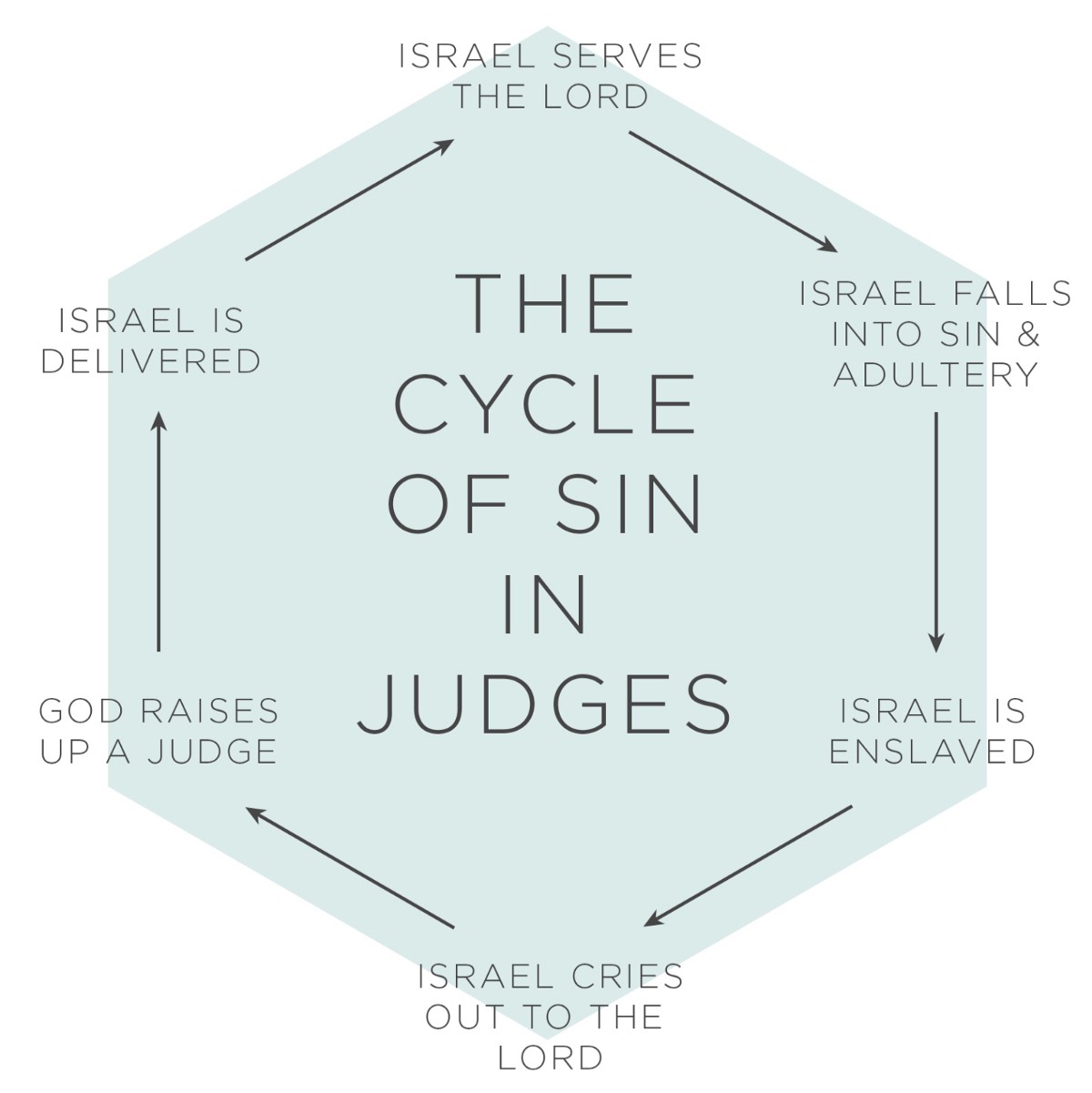
Judges wasn’t just a cycle, but a downward spiral. Each new Judge was worse than the last. Things have gone from tribal unity to horrific violence due to the Israelites own actions.
The Israelite Monarchy
Samuel & Kings
**586BC is the destruction of the Jerusalem/Judah
Samuel
Despite the name, Samuel (1 & 2) focuses more on King David than on the prophet Samuel. Most of the story is Saul then Absalom trying to kill David.
Social Roles in Ancient Israel
Judge
King
Priest
Prophet
Very different from “prophets” in other lands, didnt work for the king and instead told off the king
Often acted as a divine spokesperson against the King
Primary function was not to tell the future, but holding the king accountable and reminding him of the covenant promise and potential futures
Kings
The book of Kings contains similar narratives to Samuel, but it also has lengthy, formulaic passages, reporting the reigns of kings in an “administrative” style. It’s like a record of all the kings. It tells the story of Solomon’s reign, the split of the kingdom, Elijah and Elisha, the divided monarchy, and ends with the fall of Judah.
Solomon enslaves his people to build stuff and his son makes it worse when he comes to power, so 10 of the 12 tribes ceed from Judah and form Israel in 922 BC. All of the Israeli kings sucked because they broke the rule of only worshipping in Jerusalem. After the Israelites stopped paying tribute to the Assyrians, the Assyrians killed them and took over Israel entirely in 721 BC. Then Babylon took over Assyrian and gives them a warning, then kills them all and ends Jerusalem in 586 BC.
They got killed 4 times in a row after stopping paying tribute. Kinds dumb.
At the end of Kings, the imprisoned final king of Judah (line of David) is freed and lives a nice life. Ends with hope.