How cells set their resting membrane potential (RMP)
Quick summary
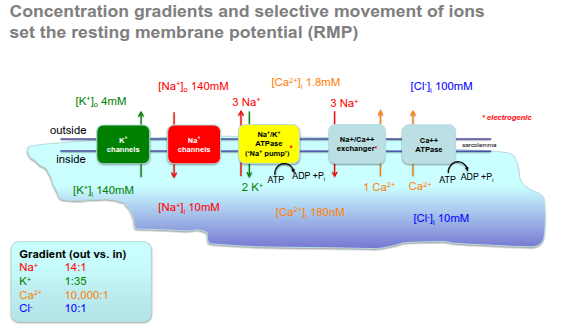
RMP is created by (1) concentration gradients of ions (set by pumps), (2) selective membrane permeability (channels/leaks) that lets some ions flow more than others, and (3) steady active transport that keeps the gradients from collapsing. Most of the resting negativity comes from K⁺ leaving the cell; small Na⁺ leaks and electrogenic pumps modify that value.
Given concentrations (from the diagram)
Outside / Inside
Na⁺: 140 mM / 10 mM → gradient ≈ 14 : 1
K⁺: 4 mM / 140 mM → gradient ≈ 1 : 35
Ca²⁺: 1.8 mM / 0.00018 mM (180 nM) → gradient ≈ 10,000 : 1
Cl⁻: 100 mM / 10 mM → gradient ≈ 10 : 1
Step-by-step explanation
Step 1 — Pumps create and maintain the concentration gradients
Na⁺/K⁺ ATPase (the “sodium pump”): For each ATP it moves 3 Na⁺ out and 2 K⁺ in. That both creates the Na⁺ and K⁺ gradients and is electrogenic (net +1 charge moved out each cycle) → contributes a small hyperpolarizing effect.
Ca²⁺ ATPases and the Na⁺/Ca²⁺ exchanger: keep intracellular Ca²⁺ extremely low. The exchanger typically brings 3 Na⁺ in for 1 Ca²⁺ out (electrogenic), helping clear Ca²⁺ after activity.
Step 2 — Selective membrane permeability (channels / leaks)
At rest the membrane is much more permeable to K⁺ (many K⁺ “leak” channels) than to Na⁺. Therefore K⁺ moves out down its concentration gradient, leaving behind negative charge and making the inside negative.
Small Na⁺ leak into the cell partially offsets that negative charge; the balance sets the actual RMP.
Cl⁻ movement depends on the cell: often it passively distributes until its equilibrium is near RMP.
Step 3 — Equilibrium potentials (Nernst) — what each ion would set the membrane to if it were the only permeable ion
Use the Nernst equation at 37 °C:
Eion=61.5 mVzlog10 ([out][in])E_{ion} = \dfrac{61.5\ \text{mV}}{z} \log_{10}\!\left(\dfrac{[{\rm out}]}{[{\rm in}]}\right)Eion=z61.5 mVlog10([in][out])
(z = ionic charge)
Calculate with the diagram concentrations:
K⁺ (z = +1)
ratio = 4 / 140 = 0.028571…
log10(0.028571) = −1.544068…
EK=61.5×(−1.544068)≈−94.96 mVE_K = 61.5 \times (-1.544068) \approx \mathbf{-94.96\ mV}EK=61.5×(−1.544068)≈−94.96 mVNa⁺ (z = +1)
ratio = 140 / 10 = 14
log10(14) = 1.146128…
ENa=61.5×1.146128≈+70.49 mVE_{Na} = 61.5 \times 1.146128 \approx \mathbf{+70.49\ mV}ENa=61.5×1.146128≈+70.49 mVCl⁻ (z = −1) — you can use the formula as ECl=61.5log10([in]/[out])E_{Cl} = 61.5\log_{10}([{\rm in}]/[{\rm out}])ECl=61.5log10([in]/[out]):
ratio = 10 / 100 = 0.1
log10(0.1) = −1
ECl=61.5×(−1)=−61.5 mVE_{Cl} = 61.5 \times (-1) = \mathbf{-61.5\ mV}ECl=61.5×(−1)=−61.5 mVCa²⁺ (z = +2)
ratio = 1.8 / 0.00018 = 10,000
log10(10,000) = 4
factor = 61.5 / 2 = 30.75
ECa=30.75×4=+123 mVE_{Ca} = 30.75 \times 4 = \mathbf{+123\ mV}ECa=30.75×4=+123 mV
Interpretation: each ion has its own “favorite” membrane voltage. If the membrane were only permeable to K⁺, the membrane would be ~–95 mV; if only to Na⁺ it would be +70 mV.
Step 4 — The real resting potential: weighted by permeability (GHK concept)
The actual RMP is a weighted average of the equilibrium potentials, with weights equal to the membrane permeabilities (P). The Goldman equation (simplified idea):
Vm≈61.5log10PK[K]out+PNa[Na]out+PCl[Cl]inPK[K]in+PNa[Na]in+PCl[Cl]outV_m \approx 61.5 \log_{10}\frac{P_K[K]_{\rm out} + P_{Na}[Na]_{\rm out} + P_{Cl}[Cl]_{\rm in}} {P_K[K]_{\rm in} + P_{Na}[Na]_{\rm in} + P_{Cl}[Cl]_{\rm out}}Vm≈61.5log10PK[K]in+PNa[Na]in+PCl[Cl]outPK[K]out+PNa[Na]out+PCl[Cl]in
Typical resting relative permeabilities often used (example numbers from textbooks):
PK:PNa:PCl≈1:0.04:0.45P_K : P_{Na} : P_{Cl} \approx 1 : 0.04 : 0.45PK:PNa:PCl≈1:0.04:0.45.
Plugging the diagram concentrations in (showing the arithmetic):
Numerator = PK⋅4+PNa⋅140+PCl⋅10=1⋅4+0.04⋅140+0.45⋅10=4+5.6+4.5=14.1P_K\cdot4 + P_{Na}\cdot140 + P_{Cl}\cdot10 = 1\cdot4 + 0.04\cdot140 + 0.45\cdot10 = 4 + 5.6 + 4.5 = 14.1PK⋅4+PNa⋅140+PCl⋅10=1⋅4+0.04⋅140+0.45⋅10=4+5.6+4.5=14.1
Denominator = 1⋅140+0.04⋅10+0.45⋅100=140+0.4+45=185.41\cdot140 + 0.04\cdot10 + 0.45\cdot100 = 140 + 0.4 + 45 = 185.41⋅140+0.04⋅10+0.45⋅100=140+0.4+45=185.4
Ratio = 14.1/185.4=0.076076...14.1/185.4 = 0.076076...14.1/185.4=0.076076...
log10(ratio) = −1.119…
Vm=61.5×(−1.119)≈−68.8 mVV_m = 61.5 \times (-1.119) \approx \mathbf{-68.8\ mV}Vm=61.5×(−1.119)≈−68.8 mV
That matches the common RMP value (~−70 mV). So: because membranes are much more permeable to K⁺ than to Na⁺, the RMP is close to E_K but shifted toward E_Na by the small Na⁺ permeability.
Step 5 — Role of the electrogenic pumps (Na⁺/K⁺ ATPase, Na⁺/Ca²⁺ exchanger)
The pump maintains the gradients (without it gradients would dissipate and RMP would drift to 0).
Because the Na⁺/K⁺ pump exports 1 net positive charge per cycle (3 out, 2 in), it produces a small additional hyperpolarization (a few mV). So the pump both establishes gradients and contributes a small direct electrical effect.
Step 6 — Dynamic consequences (how changes produce signals)
Opening more Na⁺ channels (increasing P_Na) → membrane moves toward E_Na → depolarization → can trigger action potentials.
Opening more K⁺ channels → membrane moves toward E_K → hyperpolarization → cell less excitable.
Opening Cl⁻ channels: effect depends on E_Cl relative to RMP. If E_Cl ≈ RMP, Cl⁻ opening is shunting (stabilizing). If E_Cl is more positive or negative than RMP, Cl⁻ opening can depolarize or hyperpolarize respectively.
Blocking the Na⁺/K⁺ pump (e.g., ouabain) gradually collapses gradients and depolarizes the cell.
Bottom line (one-line)
The resting membrane potential (~–70 mV) is a steady-state voltage created mainly by K⁺ gradients and high K⁺ permeability, fine-tuned by small Na⁺ permeability and electrogenic pumps that maintain the ionic gradients.