GU6 Court Case Comparison
1.0 Court Cases
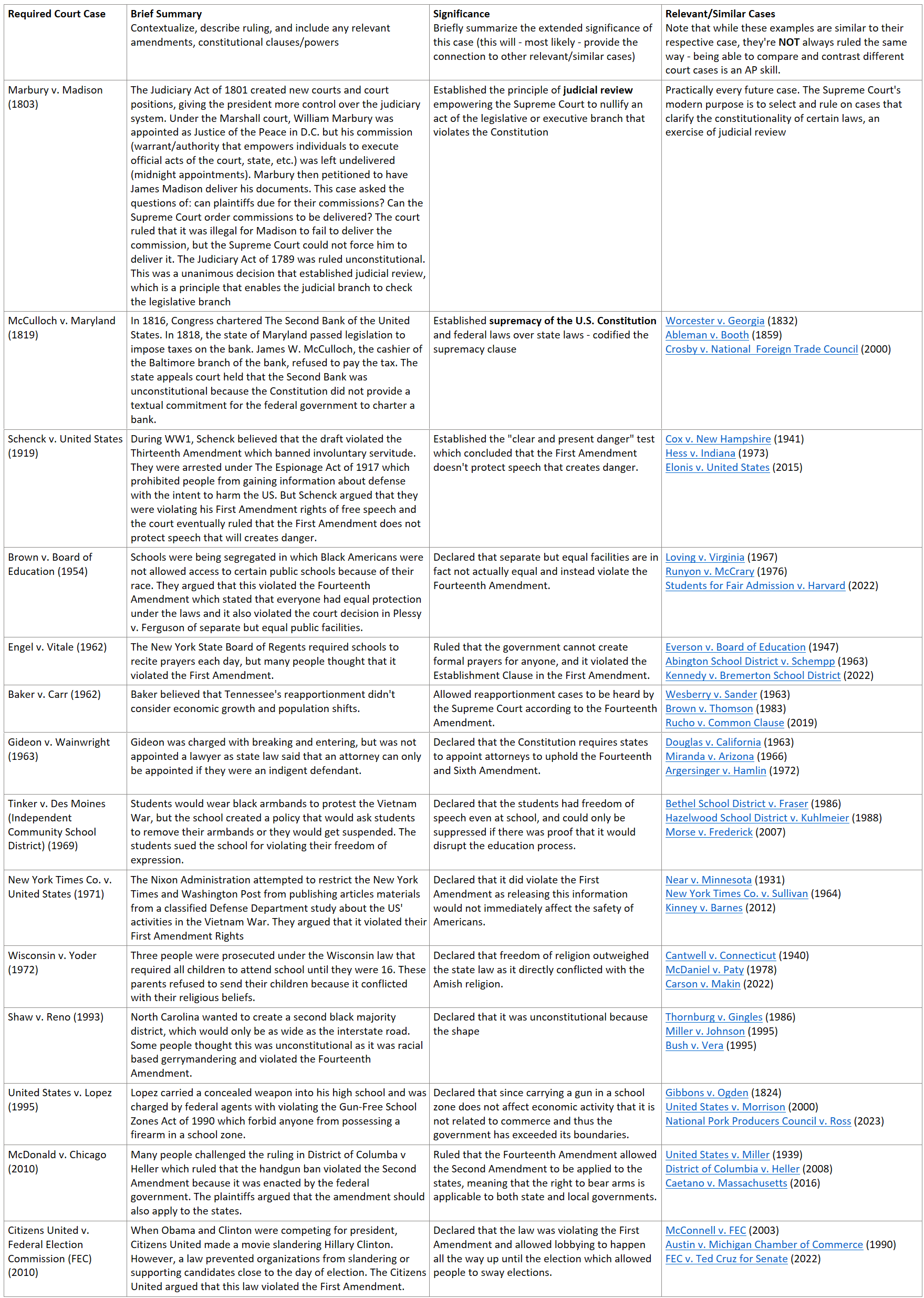
Marbury v. Madison (1803)
established judicial review, where courts could strike down legislation as unconstitutional
McCulloch v. Maryland (1819)
established supremacy clause of the U.S. Constitution and federal laws over state laws, as the law of the land
Engel v. Vitale (1962)
government can’t create formal prayers for schools, as it violates the establishment clause in the 1st Amendment
Wisconsin v. Yoder (1972)
declared that freedom of religion outweighed state law
Schenck v. United States (1919)
established the clear and present danger test, which concludes that the 1st Amendment doesn’t protect speech that creates a clear and present danger to national security
Tinker v. Des Moines (1969)
declared that students had the right to free political speech in schools, and it could only be suppressed if it interrupted the educational process
New York Times Co. v. United States (1971)
government censorship even about U.S. war activities violated 1st Amendment rights
Gideon v. Wainwright (1963)
declared that the Constitution requires states to appoint attorneys to people accused of criminal offenses if they can’t afford one, under the 6th Amendment, incorporated by the 14th Amendment
McDonald v. Chicago (2010)
ruled that the 14th Amendment incorporated 2nd Amendment to the states, so the right to bear arms is applicable to both federal and state governments
Brown v. Board of Education (1954)
overturned “separate but equal” from Plessy v. Ferguson, by stating that separate educational facilities were inherently unequal, violating the 14th Amendment
Baker v. Carr (1972)
allowed reapportionment cases to be heard by the Supreme Court under the 14th Amendment, regarding gerrymandering malapportionment
Shaw v. Reno (1993)
declared that racially-based gerrymandering was unconstitutional and violated the 14th Amendment
United States v. Lopez (1995)
federal government can’t restrict guns in school zones because it extends beyond the commerce clause rights given to the federal government
Citizens United v. Federal Election Commission (2010)
declared that the law preventing organizations from slandering or supporting candidates close to the day of election violated the 1st Amendment and allowed lobbying to happen all the way up to the election, which allowed people to sway elections
Roe v. Wade (1973)
legalized abortion
overturned in 2022 >:(
2.0 Constitutional Articles and Amendments
Article 1
Congress, legislative branch, bicameral legislature House and Senate
Article 2
Executive branch
Article 3
Judicial branch
1st Amendment
protects freedom of religion, speech, the press, assembly, and petition
2nd Amendment
the right to keep and bear arms
3rd Amendment
no forced quartering of troops in homes
4th Amendment
protects against unreasonable search and seizure, establishes right to have warrants issued before arrest or search, any information gathered without a warrant can’t be used to convict
5th Amendment
right to grand jury indictment in criminal cases, protection against double jeopardy and self-incrimination (right to remain silent), right to due process of law, right to just compensation when private property is taken for public use
6th Amendment
protections during criminal prosecutions for a speedy and public trial by an impartial jury, right to confront witnesses, right to compel favorable witnesses to testify in one’s defense, right to assistance of defense counsel (Gideon v. Wainwright)
7th Amendment
right to trial by jury in certain civil suits
8th Amendment
protections against excessive bail, excessive fines, and cruel and unusual punishment
9th Amendment
rights protected extend beyond those explicitly listed in the Constitution
10th Amendment
powers not delegated to the federal government nor prohibited by it to the states are reserved to the states or to the people
13th Amendment
abolishment of slavery
14th Amendment
equal protection of all citizens under the law, incorporation of most of the Bill of Rights to state governments
15th Amendment
protects voting rights regardless of race, color, ethnicity, or previous status of slavery
17th Amendment
switched from indirect, state representatives nominations of senators, to direct elections of senators
19th Amendment
protects voting rights regardless of gender
24th Amendment
no poll taxes or poll fines allowed
25th Amendment
established order of presidential succession (president → vice president → Speaker of the House) in the event of death, removal, resignation, or incapacitation
26th Amendment
reduced minimum voting age from 21 to 18
5.0 Bill of Rights and Incorporation
The Antifederalists were worried that the absence of a Bill of Rights would allow the federal government to infringe upon the rights of individuals. Protecting civil liberties involves placing restrictions upon the ability of the government to limit individual freedoms. The Bill of Rights enumerates a list of fundamental freedoms that the federal government cannot infringe upon. The protections set out in the Bill of Rights initially applied to the actions of the federal government and not of the state governments. In Gitlow v. New York (1925), the Supreme Court began the process of selective incorporation. On a case-by-case basis, most (but not all) of the rights in the Bill of Rights apply to actions by the states.
civil liberties - fundamental rights and freedoms of citizens protected from infringement by the government
civil rights - protections from discrimination as a member of a particular gropu
bill of rights - a list of fundamental rights and freedoms that individuals possess (first ten Amendments to the Constitution)
due process clause - the clause in the Fourteenth Amendment that restricts state governments from denying citizens life, liberty, or property without legal safeguards
selective incorporation - the piecemeal process through which the Supreme Court affirmed that almost all of the protections in the Bill of Rights also apply to state governments
The Anti-Federalists were concerned that the absence of [Bill of Rights, enumerated rights] would allow the federal government to infringe upon the rights of individuals.
Protecting civil liberties involves placing restrictions upon the [power] of the government.
The protections set out in the Bill of Rights initially applied to the actions of the federal government and not of the [state governments].
In Gitlow v. New York (1925), the Supreme Court began the process of [selective incorporation]. On a case-by-case basis, most, but not all, of the rights in the Bill of Rights apply to actions by the states.
6.0 Religion
The first two clauses in the First Amendment to the Constitution both involve religion; they prevent the federal government from establishing or favoring a religion and protect Americans’ rights to exercise their religious beliefs.
establishment clause - First Amendment protection against the government requiring citizens to join or support a religion
free exercise clause - First Amendment protection of the rights of individuals to exercise and express their religious beliefs
In the landmark case of Engel v. Vitale (1962), the Supreme Court ruled that the recitation of a [state-led prayer, state-sponsored prayer, state-composed prayer] in public schools was unconstitutional, as it violated the Establishment Clause of the First Amendment.
In the case of Employment Division v. Smith (1990), the Supreme Court held that neutral and generally applicable laws were [constitutional], even if they incidentally burdened the exercise of religion, without violating the Free Exercise Clause of the First Amendment.
7.0 Expression and Guns
Political speech and expression are considered particularly important fundamental freedoms. Expression may be limited if it presents a clear and present danger to national security, or is defamatory or obscene. In McDonald v. Chicago (2010), the Supreme Court incorporated the Second Amendment, ruling that individuals have the right to possess firearms. The government balances freedom under the First and Second Amendments with ensuring a secure and orderly society.
freedom of expression - a fundamental right affirmed in the First Amendment to speak, publish, and protest
clear and present danger test - legal standard that speech posing an immediate and serious threat to national security is not protected by the First Amendment
prior restraint - the suppression of material prior to publication on the grounds that it might endanger national security
symbolic speech - protected expression in form of images, signs, and other symbols
libel - an untrue written statement that injures a person’s reputation
slander - an untrue spoken expression that injures a person’s reputation
obscenity and pornography - words, images, or videos that depict sexual activity in an offensive manner and that lack any artistic merit
In Schenck v. United States (1919), the Supreme Court established the [clear and present danger test] to evaluate whether restrictions on political speech are legitimate, emphasizing that the context of expression must be taken into account.
In Tinker v. Des Moines Independent Community School District (1969), the Supreme Court ruled that restrictions on students’ right of expression could not be sustained unless engaging in the forbidden conduct would “materially and substantially interfere with the requirements of appropriate discipline in the operation of the school.” This set a high bar for justifying limitations on students’ rights to express their [political] beliefs.
The Supreme Court, in New York Times v. United States (1971), also known as the “Pentagon Papers case,” concluded that the government did not demonstrate a sufficient interest to justify [prior restraint], emphasizing the importance of protecting the free press from censorship.
8.0 Defendants
The Bill of Rights guarantees a set of protections for those accused of, tried for, and convicted of crimes. The exclusionary rule prohibits the use of evidence obtained without a warrant in court, although there are exceptions to this rule. Police are required to read Miranda rights to those in custody accused of crimes. In Gideon v. Wainwright (1963), the Supreme Court incorporated the Sixth Amendment, ruling that defendants have a right to an attorney provided by the state if they cannot afford one.
ex post facto laws - laws criminalizing conduct that was legal at the time it occurred
bill of attainder - a law passed by Congress punishing an individual without a trial
writ of habeas corpus - a document setting out reasons for an arrest or detention
procedural due process - a judicial standard requiring that fairness be applied to all individuals equally
warrant - a document issued by a judge authorizing a search
probable cause - reasonable belief that a crime has been committed or that there is evidence of criminal activity
exclusionary rule - a rule that evidence obtained without a warrant is inadmissible in court
grand jury - a group of citizens who, based on the evidence presented to them, decide whether or not a person should be indicted for criminal charges and subsequently tried in court
double jeopardy - protects an individual acquitted of a crime from being charged with the same crime in the same jurisdiction
Miranda rights - the right to remain silent and to have an attorney present during questioning; these rights must be given by police to individuals in custody suspected of criminal activity
bail - an amount of money posted as a security to allow the defendant to be freed while awaiting trial
The [exclusionary rule] prohibits the use of evidence obtained without a warrant in court, although there are exceptions to this rule.
In Gideon v. Wainwright (1963), the Supreme Court incorporated the [Sixth Amendment], ruling that defendants have a right to an attorney provided by the state if they cannot afford one.
9.0 Privacy and Other Rights
The Supreme Court, drawing upon several amendments, ruled that the Constitution establishes a right of privacy in areas such as reproductive rights and sexuality. The Supreme Court’s decision in Roe v. Wade legalized abortions, although states may impose some restrictions on abortions, but Roe v. Wade was overturned in 2022. The Ninth Amendment provides that individuals have rights in addition to those expressly listed in the Bill of Rights.
In Griswold v. Connecticut (1965), the Supreme Court overturned a Connecticut law that prohibited the provision of contraceptives and medical advice about contraceptive techniques, citing affirmations of privacy in several amendments to the Constitution, including the [First, Third, Fourth, Ninth] Amendment.
In Lawrence v. Texas (2003), the Supreme Court struct down a Texas law, stating that the "[penumbra]" of privacy in the Constitution protects the right of consenting adults.
In [Roe v. Wade] (1973), the Supreme Court ruled that the Constitution protects the right of a woman to obtain an abortion during the first three months of pregnancy, drawing on the Court’s previous ruling in Griswold. Justice Harry Blackmun stated that the right of privacy, whether founded in the Fourteenth Amendment or the Ninth Amendment, is broad enough to encompass a woman’s decision.