L2: Psychodynamic Perspectives
Intro: Psychodynamic Perspectives.
Emphasises the central role of the unconscious mind, early developmental experiences, and internal conflict in shaping mental health.
Highlights why this perspective remains influential despite modern critiques:
provides a rich, coherent framework for understanding psychological suffering beyond symptom-level explanations.
Lecture Objectives
To gain an understanding of:
The topographical model and its implications for the development of psychological problems from a psychodynamic POV
The structural model (ego, id and superego) and its implications for the development of psychological problems from a psychodynamic POV
The significance of childhood developmental history in psychodynamic explanations of psychological problems
how psychoanalytic theory gives rise to principles of psychodynamic practice (e.g., free association, working with resistance, understanding tolerance, interpreting and developing insight)
The strengths and weaknesses of the psychodynamic approach
Reading: Rieger (2017), pp. 12-17.
Myths + Evidence about Psychoanalysis
Freud made it about Sex, Oedipus complex, etc = people have ‘weird’ views on what psycho analysis is.
People see it as old-fashioned and out of date.
→ MYTH: There is no evidence for psychoanalytic therapy; this is entirely incorrect, and it can be an effective and evidence-based therapy technique.
The American Psychological Association (APA) says…
Counters the myth that psychodynamic therapy lacks evidence: APA recognises its empirical support.
According to Shedler (2010), psychodynamic therapy:
It is effective for a range of disorders (e.g., depression, anxiety).
Has lasting benefits due to its focus on self-reflection and relationship dynamics.
Encourages depth over surface-level symptom relief.
This evidence legitimises the therapeutic value of the approach in modern clinical contexts.

Further Evidence for Psychodynamic Therapy:
Leichsenring et al. (2015 & 2023).
“We identified 64 randomised controlled trials that provide evidence for the
efficacy of PDT in common mental health disorders....These results were
corroborated by several meta-analyses that suggest PDT is as efficacious as treatments established in efficacy.”
Yakely (2018)
“The integration of the contemporary instrumentalist approaches of modern
medicine with a person-centred psychoanalytic viewpoint that embraces
subjectivity, finds meaning in symptoms and behaviour, and tolerates
ambiguity and uncertainty, could provide inspiration and hopefulness in our endeavours to further understand and treat the human psyche.”
Kandel- 2000 Nobel Prize Winner for Physiology & Medicine
“Still the most coherent and intellectually satisfying view of the mind”
So…Why Psychodynamic Therapy?
→ Resists the ‘quick’ fix mentality within medicine and modernity; rejects the idea of a quick treatment that is often governed by economic concerns.
→ Instead seeks to contextually understand, work with and break down with the patient for their best long-term treatment.
→ asserts continuity between ‘normal’ and ‘abnormal’ behaviour, rather than categories with strict boundaries or labels.
→ Goes beyond symptom removal or focused treatment— development of positive capacities and relationships is recognised as critical and central towards treatment.
Anna: Lecture’s Case Study
Uni psych student
chatting with a guy (Joe) from class
going up north with her friend (Julia)’s bach, in the spur of the moment, asks the Joe if he wants to join
deep conversations, then introduce Julia and Joe
Turns out Julia and Joe are very close connection-wise, don’t know one another directly, but have very close mutual friends, school histories, family friends, etc.
Anna is initially happy with Julia + Joe (guy); great! means weekend will go smoothly- right?
wakes up next day and feels really low, like in a deep ‘kind of hole’; where life feels bleak.
Becomes very withdrawn, spends the weekend reclusive and away from Julia + Joe.
→ Anna feels like she’s on the outside
→ Anna feels like she’s the third wheel, like she’s in the way or ‘at risk’.
Anna’s story continued
Julia + Joe get concerned; Julia goes to Anna’s room
Anna expresses how she feels about herself, insecurities etc
cries it out; feels better afterwards, showers + comes down for dinner.
Review: Psychotherapy
Anna is able to work out her feelings; she analyses and expresses her feelings and uncovers them together
she is accepted and relieved of her stressors;
→ understand the things that make you feel, reflect on them, comfort yourself about them, express them and lighten the load
→ insight, coming into know why we feel the way we do
= Allows for a deeper understanding of our emotional responses, facilitating personal growth and healthier coping mechanisms.
Origins of Psychoanalysis: Freud, a neurologist in Vienna.
Since then, thousands of academic and clinical papers have been written in this area; the development of many additional theories and approaches has sprung forward from Psychoanalysis.
Explore various dimensions of human behaviour and their role in shaping our psyches, including:
The role of unconscious processesearly childhood experiences
Defence mechanisms
From reading:
Psychoanalysis dominated the mental health field
for more than half a century.
It was especially influential in psychiatry between the 1940s and 1970s. By 1945, most chairs of departments of psychiatry in medical schools
schools in the United States were psychoanalysts and
The standard training of psychiatrists included extensive
instruction in psychoanalytic therapy techniques.
By the end of the 1970s, the number of
Psychoanalysts acting as the chairs of psychiatry
departments had been reduced to near zero.
Psychiatry as a profession returned largely to the biological
perspective.
As a consequence, psychiatrists now receive only a relatively limited training in psychological therapies and concentrate more on biological therapies (Horwitz, 2003).
As a therapy, psychoanalysis was applied mainly to neurotic symptoms such as general anxiety, depression or various phobias, and foresaw the current emphasis of the mental health field on such symptoms and disorders.
Key Concepts of Psychoanalysis: P1
Psychoanalysis is both a theory to explain normal and abnormal human functioning, and a therapeutic technique to uncover the causes of (and thus, alleviate) abnormal/deviant functioning.
The Topographical model of the mind
This model posits that the mind is divided into three distinct areas: the conscious, preconscious, and unconscious.
The Conscious: That which we know
you are aware of at a given moment (your thoughts, your perceptions)
function: is immediate- deliberate and intentional processing + thoughts/behaviours.
importance: Limited in scope; represents only the ‘tip’ of the iceberg (the iceberg = yourself)
The Preconscious: That which we can bring to mind
information and memories that we are not currently aware of, but with effort can be retrieved and brought forward into the mind.
Function: acts as a buffer between the unconscious and the conscious self.
Importance: allows for integration of stored knowledge into current awareness (consciousness) when needed.
The Unconscious: that which we do not know
Psychoanalytic theory affirms that the reason for human behaviour lies hidden in the unconscious self; our repressed thoughts, feelings, forgotten memories, and desires.
Function: Operates outside our awareness, influencing thought and behaviour indirectly.
Importance: Source of many psychological symptoms and conflicts, requires interpretation (psychoanalysis) for therapeutic intervention.
Psychoanalysts interpret surface behaviours (or manifestations; jokes, dreams, mistakes, choices, etc) to understand the true meaning, the true motivations or foundations behind surface thoughts/retrievable thoughts.
Key: thoughts and experiences that make us feel vulnerable, uncomfortable, scared, frustrated, stressed, etc;
Feelings and thoughts we do not like or that enforce states of being we do not accept for ourselves.
How these affect behaviour on the surface (on the ‘conscious)
Unconscious Dominance
ICEBERG METAPHOR
iceberg metaphor visually emphasises the dominance of the unconscious.
Reminds us that psychological problems may stem from unseen origins.
Validates the psychodynamic goal of uncovering underlying causes rather than focusing solely on surface-level symptoms.
The unconscious is not directly observable but manifests through symbolic forms:
Dreams, slips of the tongue, compulsive symptoms, and play or art.
These expressions are crucial entry points for therapists seeking to understand and interpret unconscious meaning.
→ Free association: always encouraged by psychoanalyst
The patient is encouraged to say freely what comes to mind, without attempting to keep any conscious control over the content of his/her speech.
This technique is thought to provide insight into the unconscious parts of the mind.
‘Listens’ to below-surface for unconscious meanings.
Explore these meanings with the patient.
use interpretation, develop ‘insight’ about the patient’s unconscious motives
Insight brings catharsis & relief: understanding and control?
awareness and possibility of CHOICE and CHANGE.
Dream Analysis: ‘ the royal road to the unconscious’
Take elements of the dream
Free-association, where these elements of the dream might have come from
Parapraxes.
e.g., calling your lecturer ‘dad’ or when you try so hard not to say something, you say it.
Freudian slips are errors in speech or action that reveal hidden thoughts.
Their value lies in spontaneity and emotional leakage, bypassing ego defences
One doesn’t actively/consciously mess up their words/slips in speech; 99% of the time, these unconscious slips in speech leak through as emotional ‘leakage’.
In clinical work, these are seen not as trivial errors but as windows into unconscious conflict.
Symptoms: OCD & Hand-washing with Psychoanalytic POV
reveals unconscious fear of being ‘contaminated’; these are Compromise Formations.
These ‘compulsions’ express repressed conflicts, thoughts, experiences and fears in disguised form.
E.g., obsessive handwashing may symbolise a deeper fear of internal contamination.
Highlights that symptoms have psychological meaning, not just behavioural or biochemical causes.
Art and Play: What does this mean (working with children)
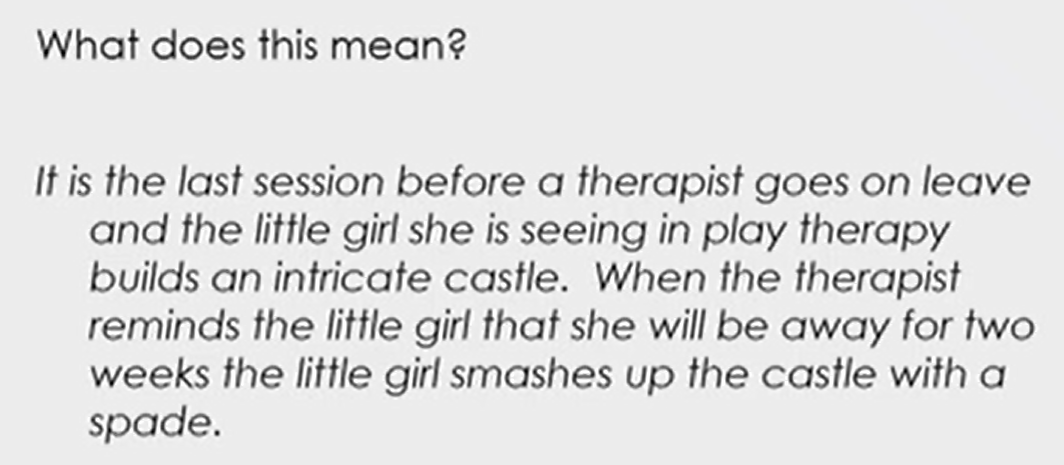
Children communicate symbolically through play.
Example: smashing a castle reflects the child expressing her anger and anxiety about the therapist leaving by abusing her sandcastle, not just an impulsive action.
Symbolic behaviours are therefore clinically significant, revealing unconscious fears and desires.
Separation & Free association >
The response of the psychoanalyst must remain contextual and on a patient-specific basis.
Incremental explorations over time; understanding and insight are key.
Use the free-association technique to provide insight into the unconscious parts of the mind.
‘Listens’ to below-surface for unconscious meanings.
Explore these meanings with the patient.
use interpretation, develop ‘insight’ about the patient’s unconscious motives
→ Insight brings catharsis & relief: understanding and control?
→ Awareness and possibility of CHOICE and CHANGE.
→ Thus, facilitating a deeper understanding of their experiences, patients can begin to see patterns in their thoughts and behaviours, leading to transformative personal growth.
Key Concepts of Psychoanalysis: P2
Structural model of the mind: Id, Ego, & Superego.
The complex interaction amongst the id, ego, and the superego drives people’s behaviours— influencing their thoughts, emotions, and actions in both conscious and unconscious ways.
The id
A person’s most primitive desires,
According to Freud’s original psychoanalytic theory, Human beings have two drives that operate on a ‘pleasure’ principle:
The Sexual drive— Freud believed this more important drive, as the energy (libido) stemming from the sexual drive supposedly motivates most of human behaviour.
The Aggressive Drive.
→ The Id operates on a ‘Pleasure Principle’
The Id is driven by a need for instant gratification of its desires without any reference to logic, reality, morality or the needs of others
The Ego
The Ego comprises higher cognitive functions, such as learning, memory, language, problem-solving and planning, enabling individuals to make informed decisions while balancing desires and societal expectations.
When the Id signals its desire, the Ego locates a potential gratifier of the Id’s desire within the environment, assessing the best ways of realistically meeting such desires.
The ego operates on a reality principle.
Involves considering the practicalities of the environment and the potential consequences of actions.
Allows the Ego to mediate between the impulsive demands of the Id and the constraints imposed by reality.
→ The Ego is a mediator for desires & social norms.
Mediates between the other parts of the mind & external world; operates according to ‘reality principle’ (balancing Id desires + social norms + acceptable ‘moral’ standards)
The Superego
Develops last; The Superego operates on a morality principle that is rooted within values, moral standards and social norms within a society.
The Superrego strives for perfection and judges our actions, leading to feelings of pride or guilt depending on whether we adhere or not to these internalised rules.
The superego understands that our values + societal standards and norms around morality are mostly always in conflict with the sexual and aggressive drives within our Id.
The Superego serves as the ethical component of personality, providing guidelines for making judgments and striving for moral goodness/perfection.
→ Superego negotiates for the moral demands of society
Develops last, operates according to a ‘morality principle’ of what is most morally righteous, and or socially acceptable (adheres to learned social norms/expectations).
Conflict of the Id, Ego, & Superego.
The Id makes shouty/uncontrolled demands, the Superego judges socially/morally, and the Ego finds the realistic balance/compromise between the two extremes.
how to satisfy both; how to compromise- poor Ego (the Mediator).
→ The conflict between the Id, Ego and Superego illustrates unacceptable feelings/thoughts that are held back from consciousness.
The Ego & Defence Mechanisms
Unconscious conflict causes anxiety; We use the Ego’s defence mechanisms against the unconscious material emerging into our awareness/consciousness.
(compromises between Id & Superego)
Denial:
Avoids anxiety by refusing to acknowledge an aspect of external reality
Projection:
attributes unacceptable feelings towards other people
Displacement:
Direct impulses towards a ‘target’
Isolation:
Disconnects an idea from the feelings attached to it
Reaction Formula:
Acts in the exact opposite way of the impulse the person is afraid to acknowledge or consciously accept.
Intellectualisation:
Overly rationalises and uses overly extensive logic as a distancing response
Sublimation:
Expresses unacceptable wishes in a socially acceptable way (Art, music, etc)
Intra-jection:
Turning feelings that would other be expressed external onto people or objects, inwards at oneself (e.g., I am a terrible person, I am not smart, I am not a good friend; beating oneself up, etc).
KEY: While Defence mechanisms are initially adaptive, strict, rigid or overused defences can distort perception, as well as limit one’s resilience and psychological growth.
Implications of Defences for Psychodynamic Therapy:
It can create resistance to therapy.
Poor coping & dependence on defence mechanisms that can distort perception and limit growth.
Set up a ‘working alliance’ with the client
BOTH of you have a goal and work towards it together.
You are a team, you are uncovering the truth and understanding together.
A therapist is a guide; equal power dynamics and no professional hierarchy.
Work close to what the client can tolerate
Foster a safe & accepting environment where both the therapist and client can explore underlying emotions and patterns without fear of judgment.
Take things at the client’s pace: slowly, respectfully, insightfully, and with kindness.
Recognise and point out defences used within therapy
E.g., if a client uses jokes when talking about traumatic experiences- gently ask, ‘I’m curious about your joke, what’s that about for you?’
Allow time for the client and therapist to work through issues
allow more space, more time- the pace is determined by the client.
The Role of Development & Childhood.
a person’s past helps to create their particular sets of unconscious associations (Phantasy/ Phantasies)
Personal history gives clues about what experiences may have been seen as painful or difficult.
→ Not just THINGS or WHAT happens in the unconscious, but also WHEN they happen.
Events are seen as experienced through the eyes of a child.
Children interpret experiences from their developmental perspective, which can distort emotional meaning.
These distorted meanings become entrenched unconscious beliefs/thoughts/ ‘templates’ that guide adult behaviour, beliefs, and relationships.
Children’s ‘Phantasies’.
Common childhood beliefs could include:
Seeing parents as all-powerful, as heroes or ‘perfect’ people.
Believing abandonment equals death.
A child losing their mum in a mall is traumatising (Especially at a younger stage of development).
Assuming personal responsibility for all events.
E.g., many children think a parent’s divorce or misfortunes is due to their own personal actions or fault.
These internalised beliefs can cause long-term guilt, fear, or relational anxiety in adulthood if not resolved.
Application to therapy:
ask people about their past/history
Determine whether there are unconscious anxieties related to particular developmental levels
explore relationship patterns
Transference:
the ‘transfer’ and repetition of early relationships in the therapy relationship
Therapists own early relationships; opening the space for therapy.
This initial power must be transferred back to the client, allowing them to explore and understand their own emotional responses and relational dynamics within the therapeutic setting.
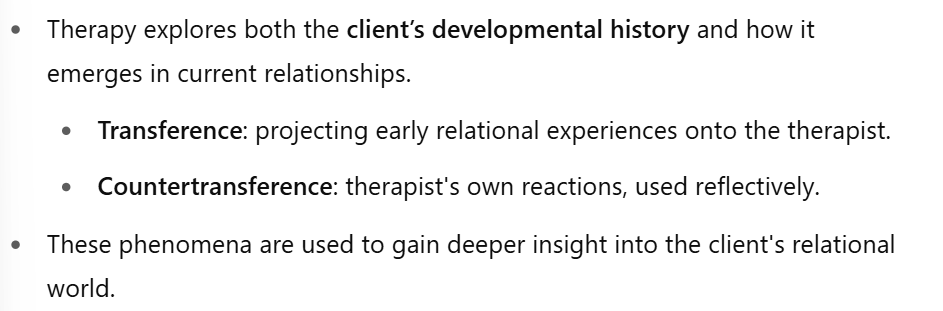
Countertransference:
A therapist relating back to their client is called ‘Counter-Transference’.
Therapists (like everyone) will always have their own beliefs & biases from their own experiences and development.
Psychoanalysts have a reputation for being very impartial and non-biased therapists who are not particularly leaning towards overly kind/nurturing or factual/structured treatment.
→ Psychoanalysts strive to maintain a neutral stance to facilitate an open therapeutic environment, where clients can explore their thoughts and feelings without fear of judgment or influence from the therapist's personal biases.
→ How does psychodynamic analysis explain the development of psychological problems?
How does it explain the development of psychological problems?
The ‘divided’ self creates the potential for conflict, which in turn creates anxiety.
Conflicts are shaped by the interaction of childhood/early experiences and our developmental needs.
Defence mechanisms try to push away conflicts and deal with anxiety; however, these can also create ongoing problems and distorted perceptions.
We end up with patterns of behaviour, thought, and feelings which as unconsciously motivated and that which we CONSCIOUSLY do not fully understand.
Intra-jection: Anna’s case.
Aka: turning feelings that would other be expressed external onto people or objects, inwards at oneself (e.g., I am a terrible person, I am not smart, I am not a good friend; beating oneself up, etc).
How does Psychodynamic Therapy work?
→ Seeks to access and resolve unconscious conflict; create catharsis and relief.
Encourages free association to gain access to unconscious material.
Uses transference as a real-time manifestation to understand relationship patterns.
Behaviours, beliefs, etc, as they are expressed in the therapy relationship.
Use Interpretation and questioning
Goal → Make the unconscious > conscious.
Allowing clients to regain agency, control and flexibility over how they think, feel, overcome, and relate.