Chapter 6: Estrous Cycles
Study Notes
Definition
Estrous Cycle
Progressive accomplishment of alterations in genital tract characteristic of estrus, metestrus, diestrus and proestrus produced by changes in ovarian hormones
Occurs in non-primate females
Period from beginning of estrus to beginning of next estrus
Estrous Period or estrus
Period of sexual receptivity in female Commonly called "heat".
Therefore:
Estrous = adjective describing the action "cycle"
Estrus = noun describing the event "standing heat"
Species
Estrus
Estrous
ewe
24-36 hours
16-17 days
goat
32-40 hours
21 days
sow
48-72 hours
19-21 days
cow
18-24 hours
20-22 days
mare
4-7 days
19-25 days
Phases of estrous cycle
Proestrus (FOLLICULAR PHASE)
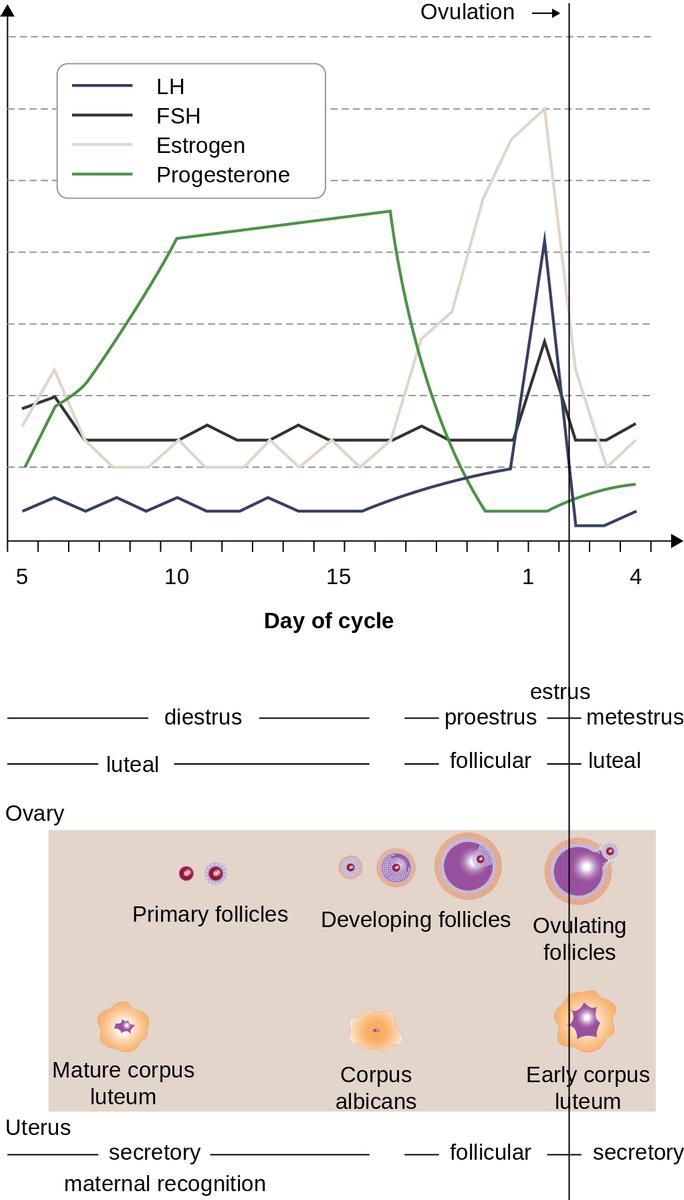
Days 17 to 21 of estrous cycle of cow
Ovarian follicles are growing rapidly
Increase in E2ß secretion by growing follicles
Decrease in P4 from corpus luteum (CL)
Mucosal layers of vagina and uterus multiply
Estrus (END OF FOLLICULAR PHASE)
Day 1 of estrous cycle of cow Period of sexual receptivity -- Standing Heat
Surges of FSH and LH from anterior pituitary gland
Sow, ewe and mare ovulate during this phase
Metestrus (LUTEAL PHASE)
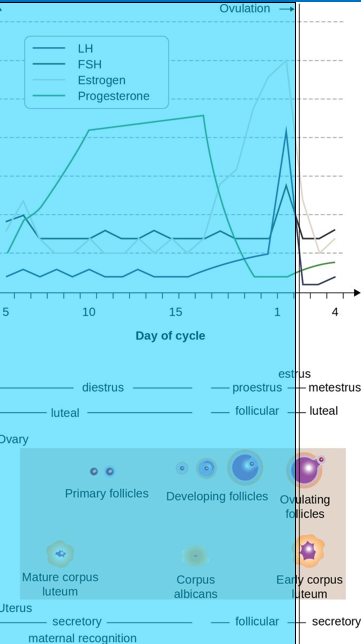
Days 2 to 4 of estrous cycle of the cow
Short transitional phase after ovulation with decreasing E2ß and increasing P4 concentrations
Recently ruptured follicle is reorganizing into a CL
Cow ovulates during this phase
Diestrus (LUTEAL PHASE)
Days 5 to 16 of estrous cycle of the cow
Continuation of luteal phase in species with long estrous cycles
Absent in animals with short cycles
CL becomes fully developed, and P4 exerts a dominant influence on oviducts, uterus, vagina, pituitary, and hypothalamus
CL remains functional for about 13 days in ewe and 15 to 17 days in sow, cow and mare
CL regresses at the end of diestrus
Anestrus
Not a phase of estrous cycle
Period between diestrus and proestrus in monoestrous and seasonal polyestrous animals
Nonbreeding season of ewe and mare
Varies in length
Characterized by quiescence of reproductive tract
Ends when proestrus begins
Types of estrous cycles
Continuous estrus
Occurs in rabbits and other induced ovulators LH release is induced by mating
Ovulation occurs 8 to 12 hours after mating
Monoestrous cycle
Occurs in bears, wolves, foxes and some dogs
Only one estrous cycle per year
A long anestrous period separates each cycle
Polyestrous cycles
True polyestrous cycles
Two or more estrous cycles per year unless interrupted by pregnancy
Composed of proestrus, estrus, metestrus, and diestrus merging into proestrus
Seasonal polyestrous cycles
Same as above except the last diestrus of breeding season would proceed into anestrus
Characteristic of ewe and mare
PROPOSED MECHANISM:
The retina of the eye is the sensor for light signals
Impulses travel by way of the optic nerve to the pineal gland
The pineal gland releases melatonin
Melatonin serves as the mediator between photoreceptors, hypothalamus and/or anterior pituitary
Episodic surges of LH occur as breeding season begins
Short estrous cycles
4 to 6 days in duration
Characteristic of rat, mouse, hamster, and gerbil
If mating does not occur, they become follicular cycles
If sterile mating occurs, pseudopregnancy begins and lasts about two weeks
Mating is needed to induce the functional activity of CL (i.e., P4 secretion)
Long estrous cycles
Duration of 15 to 16 days or longer
Characteristic of cow, ewe, sow, mare and guinea pig
Does not require mating to produce functional CL
Sterile mating does not shorten or lengthen cycle
Divided into two phases
Follicular phase
Follicles growing, estrogenic phase
Luteal phase
The secretory phase of CL, progestational phase
Types of estrus
Post-partum estrus
Estrus that occurs within a few days after parturition
Rarely observed in ewe and cow
Sow
Occurs 3 to 10 days after farrowing Ovulation rarely occurs
Non-fertile estrus
Mare
Called "foal heat"
Begins about 5 to 15 days after foaling and lasts 1 to 10 days
Mares usually ovulate, but fertility may be lowered if abnormal reproductive tract exists
Silent estrus
Also called "quiet estrus" or "quiet ovulation"
Absence of psychological behavior of estrus
Occurs in all farm animals
Ovulation occurs
Split estrus
Initial estrus interrupted by a period of non- receptivity followed by another period of estrus
Frequently seen in mares, occasionally in cows
Anovulatory estrus
Estrus without ovulation
Occurs in all farm animals
Best example is postpartum estrus in sows
Nymphomania
Characterized as a continuous psychological desire to mate
Ovulation rarely occurs
Occurs most commonly in cows, less commonly in mares and rarely in ewes or sows
Cystic ovaries usually accompany the nymphomaniac condition
However, not all individuals with cystic ovaries display nymphomania
Types of ovulation
Spontaneous ovulation
Repeated ovulation at regular intervals except during pregnancy
LH release is cyclic and independent of mating stimulus
Increasing concentrations of E2ß trigger LH release
Occurs in cow, ewe, sow, mare, rat, hamster & guinea pig
Induced ovulation
Ovulation occurs after stimulation of vagina and/or cervix
LH release occurs only after mating stimulus
Estrus persists for a variable length of time
Occurs in rabbit, cat, mink, and llama
ENDOCRINE REGULATION OF ESTROUS CYCLE
Hormonal interactions
Hypothalamus secretes GnRH into blood vessels connecting to AP
GnRH acts on specific cells of AP to release FSH and LH
FSH secreted into circulation, transported to ovary, and stimulates follicular development
LH secreted into circulation and acts synergistically with FSH to stimulate secretion of E2ß by follicle
E2ß has a (+) and (-) feedback on hypothalamus and AP to control release of FSH and LH
Peak concentrations of FSH and LH secreted at estrus are responsible for rupture of follicle and release of ovum (ovulation)
After ovulation, LH transforms follicle into a CL which secretes P4
LH stimulates P4 secretion by CL
P4 has (-) Feedback on hypothalamus and AP to decrease FSH and LH secretion
Section 1. What Are Mammalian Reproductive Cycles and Why Does It Matter to the Producer?
reproduction as a series of physiological and psychological events that must be properly timed
definition of reproduction from a production standpoint would be we need a functional male and a willing female
Functional or intact males will normally be driven hormonal to mate
the rate-limiting factor in farm animals, and most of the mammals, is a female who will allow herself to be mated; what we would commonly call “standing heat.”
In mammals, there are basically two major breeding patterns, those species which exhibit a once per cycle desire to mate (i.e., those who exhibit a “standing heat”) versus those who breed whenever they want; what is termed an Ab Libitum breeding pattern
Ab Libitum: at will
Domestic mammalian species fall into the standing heat category or what is more properly termed Estrus
and are said to have Estrous Cycles
.
Section 2. The Estrous Cycle
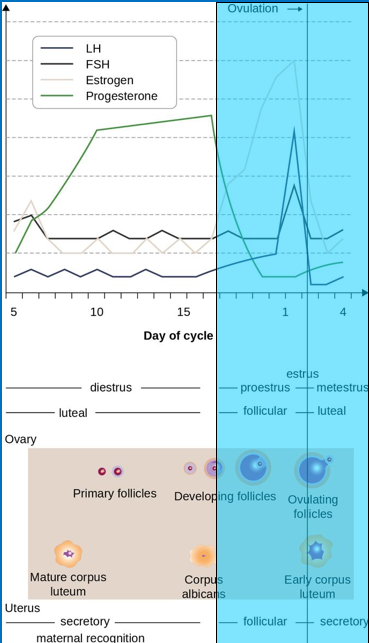
estrous cycles as a progressive accomplishment of alterations in genital tract characteristic of estrus, metestrus, diestrus, and proestrus produced by changes in ovarian hormones.
estrous cycles is they are the growth of follicles, the ovulation of follicles around the time of standing heat, and the formation of a corpus luteum, which will supply progesterone that will be necessary to maintain pregnancy if the animal becomes pregnant and if the animal is not pregnant, the process will start over again.
this is a continuous physiological process, we have assigned sections to the cycle based upon what is happening.
These are the periods of estrus, metestrus, diestrus, and proestrus, which are based upon the major events occurring during that period
By convention, cycles begin at estrus. Because this is also usually the time of ovulation, physiologically it might seem a weird place to start
depending on species, we assigned the first day an animal will stand as either day 0 or day 1 of the estrus cycle.
The length of estrus and the overall length of the cycle will vary significantly between species
because the animal will ovulate sometime during or just after estrus, the ovary will switch gears and go from growing follicles to creating a corpus luteum.
The first step in this process is the formation of the corpus hemorrhagicum, which is the major anatomical feature on the ovary during metestrus.
As the corpus hemorrhagicum matures into a fully functional corpus luteum, we enter the longest phase of the cycle, diestrus.
Finally, once diestrus ends, we will grow new follicles in what is termed proestrus (pro here meaning before).
In some species, there may be a period between diestrus and proestrus when nothing is happening.
We term this period anestrus.
It is not part of the cycle and is a period when the ovary and hormones are quiescent (quiet) like they were before puberty
Species | length of heat | length of cycle |
ewe | 24-36 hours | 16-17 days |
goat | 32-40 hours | 17 days |
sow | 48-72 hours | 19-21 days |
cow | 18-24 hours | 20-22 days |
mare | 4-7 days | 19-25 days |
Section 2.1: Proestrus
begin our journey through the estrous cycle at proestrus
proestrus and estrus together are termed the follicular phase of development, proestrus begins as the corpus luteum from the previous cycle becomes atretic
In species like the cow, which have no seasonality proestrus begins as the corpus luteum from the previous cycle becomes atretic because it has quit functioning, progesterone levels drop.
As soon as progesterone levels drop to a point they no longer have negative feedback on the hypothalamus and anterior pituitary, gonadotropin-releasing hormone (GnRH), follicle stimulating hormone (FSH), and luteinizing hormone (LH) are made and primary follicles on the ovary begin to grow due to the presence of estrogen.
Over the course of 3–4 days, some follicles rapidly advance from primary, to secondary, to tertiary, and estrogen levels rise to the peak causing the animal to transition from proestrus to estrus
In addition to changes in the ovary, there will be some increase in the number of cells in both the uterus and the vagina, and the uterus is also said to be in the follicular phase.
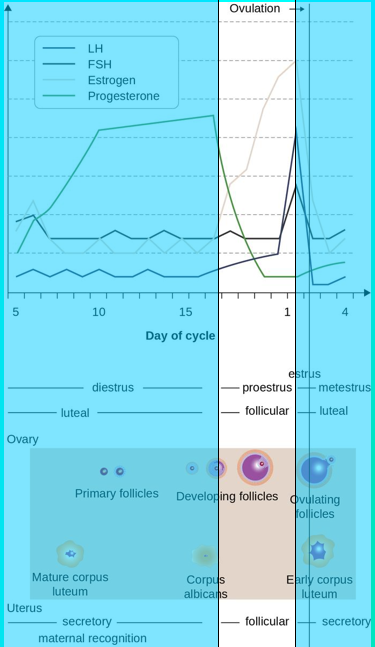
Further, as estrogen climbs the mucus in the uterus, vagina, and cervix will begin to thin out and become more watery.
In general, in the cow, proestrus is generally thought to be occurring between days 17 and 21.
Section 2.2: Estrus
various publications list the first day of estrus as either day 0 or day 1.
For consistency in the book, we will list the first day an animal stands (estrus) as day 1.
Estrus is the end of the follicular phase as ovulation will occur either during estrus or a few hours after it ends, and the follicle will begin conversion to a corpus luteum.
the animal will stand and allow herself to be mated; or what can be referred to as the period of Reproductive Receptivity
Reproductive Receptivity: time period in which a female estrus animal will allow herself to be mated
due to extremely high estrogen levels
Because the estrogen thins out the mucus in the reproductive tract, sperm can move through the cervix and into the uterus.
Estrogen-induced contracts will then move the sperm up the tract to the ampullary–isthmic junction and the site of fertilization
In most species, the high levels of estrogens will lead to both an LH and FSH surge.
we are uncertain of the purpose of the FSH surge, the LH surge triggers ovulation and begins the transformation of the theca and granulosa of the follicle into the progesterone-producing luteal cells of the corpus luteum
The uterus will remain in the follicular phase until ovulation occurs.
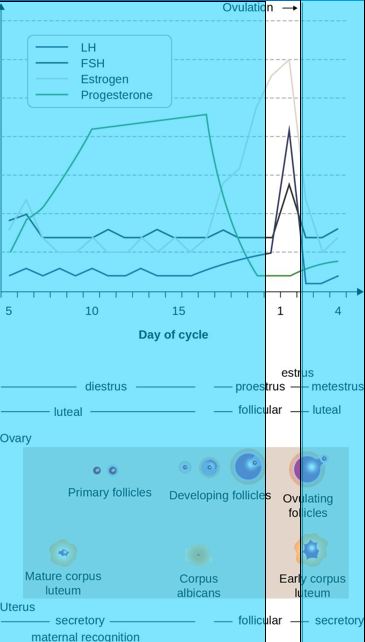
Mares, ewes, and sows will ovulate during the period
Section 2.3: Metestrus
After ovulation, the reproductive tissues switches gears.
The ovary will enter the luteal phase, while the uterus enters the secretory phase of development.
Metestrus is that short transition period within the luteal phase that transforms the reproductive system from an estrogen-dominated system growing follicles to a progesterone-dominated system attempting to support a pregnancy.
First, let us focus on the ovary: after ovulation, the follicle collapses into a corpus hemorrhagicum.
In the beginning, the corpus hemorrhagicum is little more than a blood clot with a few functional luteal cells.
However, over the next few days, the blood clot is replaced by more and more functional cells making more and more progesterone so that by day 5 the corpus hemorrhagicum has transformed to a fully functional corpus luteum.
As progesterone levels rise and estrogen levels drop, the tract will become quiescent.
Rising progesterone concentrations will induce the tissues of the endometrium to become more organized and trigger them to start producing produces needed by the embryo.
Rising progesterone will also have a negative feedback on GnRH, FSH, and LH (especially LH) preventing maturation and ovulation of any other follicles
In the cow, this will be the period of ovulation, occurring a few hours after the animal finishes standing heat.
Section 2.4: Diestrus
As the corpus luteum becomes fully functional, we progress from metestrus to diestrus, and the two together are the luteal phase of the estrus cycle.
If everything is progressing as designed, diestrus will be the longest period of the estrous cycle in the domestic species however, there are species, called short cycle animals that lack this phase completely if they are not pregnant
This period of the cycle is characterized by rising or high levels of progesterone.
Because progesterone levels are high, GnRH, FSH, and LH are inhibited; meaning any follicles trying to grow cannot mature, and estrus is inhibited.
However, the progesterone continues to induce the uterus to create and secrete compounds a developing embryo would need.
A very important physiological event must occur in this time frame if an animal is pregnant and the pregnancy is to survive.
The mother’s reproductive system must physiologically recognize she is pregnant.
This is a signal, which we will discuss in detail in later chapters, from the embryo to the mother to maintain the corpus luteum; what is termed Maternal Recognition
Maternal Recognition: physiological recognition of pregnancy by the female adult’s system due to a chemical signal from the embryo
The corpus luteum is then converted from a corpus luteum of cycle to a corpus luteum of pregnancy.
If the maternal recognition signal is not received, biochemical changes will lead to the release of PGF2α, which will regress the corpus luteum and cause one of two responses.
If the animals have repeated cycles unless pregnant (think cow or pig), they will go immediately into the next proestrus.
If the animal has an anestrus period between cycles (either in horses and sheep at the end of breeding season, on in species like dogs that cycle only one or twice per year—to be discussed below), the animal will leave the estrous cycle from diestrus, go through the anestrus period, and reenter the next cycle at proestrus.
Section 3. Types of Estrous Cycles
estrous developed in this species; rabbits exhibit what is termed Continuous Estrus
Continuous Estrus: estrous animals with a constant desire to mate and whose ovulation is triggered by the act of mating
Their system is constantly developing, then regressing, new mature tertiary follicles without entering the luteal phase.
rabbits lack receptors for estrogen on the LH-producing cells of the anterior pituitary.
While the lack of receptors prevents the normal feedback loop leading to ovulation, estrogen still induces all other effects, including a willingness to mate.
The act of mating sends a nervous impulse that triggers the LH surge (what will be described as an induced ovulator below).
Because the introduction of sperm into the tract occurs at the same time as ovulation, species that have continuous estrus have extremely high conception rates.
animals that have a single cycle per year, or what are termed Monoestrous animals.
Monoestrous: estrous animal species that exhibit a single estrous cycle per year
Some common species that exhibit this type of cycles are bears, wolfs, foxes, and a number of breeds of domesticated dogs.
The single cycle is separated by an extremely long anestrus period lacking any hormonal stimulation or desire to mate.
Animals that have two or more cycles per year are termed Polyestrous
Polyestrous: estrous animal species that exhibit two or more estrous cycles per year
Animals with these type of cycles fall into two categories.
True polyestrous animals have complete cycles consisting of proestrus, estrus, metestrus, and diestrus that then merges into proestrus of the next cycle unless interrupted by pregnancy.
Species best representing this type of cycles would be the bovine and porcine.
Alternatively, are those animals such as the equine and ovine, which have seasonality.
When animals of this type are in season, their cycles are exactly like true polyestrous animals, having of proestrus, estrus, metestrus, and diestrus that then merges into proestrus of the next cycle.
However, when the season ends, the animal will complete the curing cycle ending with diestrus.
In short-day and long-day breeder, the animal will then enter an anestrus period due to the effects of melatonin suppression GnRH
When daylight returns to the right length, GnRH will return, and the animal will enter proestrus and begin growing follicles again.
Section 4. Specialized Types of Estrus
different types of estrus
An extremely specialized form of estrus occurs just after birth, what is termed postpartum estrus
very specific to species; being rarely seen in either cattle or sheep, which instead have an extended postpartum anestrus period to allow repair of the reproductive tract.
sows exhibit a postpartum estrus approximately 3–10 days after farrowing, they rarely ovulate; meaning the cycle is sub- or infertile.
Mare also shows a postpartum estrus, which normally occurs between 5 and 15 days after foaling. Because of its relationship with foaling, it is often called foal heat
can ovulate and become pregnant on these cycles, they usually have lower fertility due to the damage to the reproductive tract that has not been prepared.
A physiological word of caution here. Think of the energy demands of the mare.
She has her own physiology to maintain, a foal to feed, and a potential new pregnancy to maintain. If you chose to breed an animal back at this time, you need to make sure there is sufficient energy for all three, meaning you must watch the feed balance to ensure proper nutrition for all.
silent or quiet estrus or quiet ovulation.
ovulation occurs, but there are none of the psychological signs of standing heat.
The lack of the normal patterns of standing is due to a lack of receptors for estrogen in the brain, which form in response to having “seen” progesterone from a previous cycle
seen in farm animals on the cycle before their first standing heat, and in some animals after a long anestrus period because the animal will not stand and allow herself to be mated, it has little production value.
Anovulatory Estrus
Anovulatory Estrus: estrus without ovulation
As the name implies, this form of estrus does not result in an ovulatory event, and like silent estrus, would be of little value to producers.
An example of this type of estrus is postpartum estrus in the sow, where ovulations are rare; meaning small to no litters.
Nymphomania: a female animal with a constant desire to mate versus her normal estrus cycles
Nymphomania is characterized by a continuous urge to mate.
It is a fairly common condition in cattle and is often associated with cystic ovaries and anovulation.
However, not all nymphomaniac animals will have cystic ovaries, and not all animals with cystic ovaries will demonstrate nymphomania.
The condition is less common in horses than in cattle and is rarely seen in pigs and sheep.
Section 5. Different Types of Ovulation and the Influence of Mating
different types of ovulation
Spontaneous Ovulation: ovulation due to hormonal influence regardless if the animal is mated or not
most common
triggered by an estrogen-induced LH surge independent of mating
animal grows follicles, has her LH surge, ovulates, and then forms a corpus luteum type structure on every cycle.
Induced Ovulators: ovulation triggered by the act of mating
require the act of mating to trigger ovulation
lack the receptors for estrogen on the cells that release LH however, there is a nerve connection
When mated, nerves are set off in the vagina, which gives feedback to the anterior pituitary to trigger the LH surge and ovulation.
Absent of the act of mating, the follicles do not ovulate; meaning mating is needed to trigger ovulation and formation of the corpus luteum.
Continuous estrus animals (such as the rabbits we discussed earlier) are also induced ovulators.
Other examples would include the cat, mink, and llama.
Mating can also sometimes be needed to trigger corpus luteum function.
The normal pattern is that animal grows follicles, have their LH surge, ovulates, forms the corpus hemorragecum and the fully functional corpus luteum.
once the cycle is complete, it forms the corpus albicans. Animals with this pattern are said to have long cycles however, there are those species (mainly small rodents with extremely fast metabolisms) that have developed a physiological strategy that works well for their overall metabolism by saving the energy normally associated with diestrus.
Their nonpregnant cycles consist of growing follicles, ovulating, forming a corpus hemorrhagicum, but if not pregnant, skipping formation of the corpus luteum and returning to the follicular phase of the cycle
Their systems require the physical stimulation of the vagina to send a nervous signal, which triggers corpus luteum formation and progesterone production.
Without the signal, progesterone levels are too low to have the negative feedback on the hypothalamus and anterior pituitary, and the animal goes right back to metestrus.
Estrus Type | Growing Follicles | Ovulation | Corpus Luteum Function |
Induced Ovulators | Spontaneous | Mating Induced | Mating Induced |
Short Cycle Animals | Spontaneous | Spontaneous | Mating Induced |
Long Cycle Animals | Spontaneous | Spontaneous | Spontaneous |
Section 6. The Hormone-Producing Cells of the Follicle/Corpus Luteum
hormones are driving the estrus cycle and that at the level of the ovary, these hormones originate from the follicle/corpus luteum over the course of the cycle
mature follicle consists of three cell types: the oocyte or egg cell and the two hormone-producing cells, the theca and granulosa
Hormonally it takes both of these cells for a follicle to make estrogen; what is termed the two-cell theory.
In this model, theca take cholesterol, and under the influence of the hormone LH, convert it to the compound pregnenolone, then progesterone and finally some form of androgen.
This is done as LH turns on a set of enzymes that clip carbons off of the original cholesterol molecule.
The androgens then cross the basement membrane into the granulosa where, under the influence of FSH, the enzyme aromatase removes the last carbon and causes the formation of the organic ring in the estrogen molecule.
Once ovulation has occurred, the follicle is retooled into a corpus luteum by converting the remaining theca and granulosa into luteal cells.
For theca, the conversion is rather straightforward, simply turn off the enzyme that converts progesterone to androgens, and you go from a theca to a luteal cell.
However, granulosa are also retooled to luteal cells. Their conversion takes a few days to reorganize and become fully functional.
The immediate conversion of theca takes place during metestrus and diestrus is reached as both cells transform into the luteal cells and accelerate progesterone production.
Section 7. How Are the Estrous and Menstrual Cycle Similar and Different?
major events we find in reproductive cycles of estrous animals also occur in the human menstrual cycle
both cycles are based upon the growth of follicles, followed by ovulation, and then a luteal period characterized by a corpus luteum, there are significant differences in the two cycle types.
The most obvious difference is the day 1 designation. Day 1 of estrous cycle is characterized by standing heat, the period of maximum sexual receptivity.
Menstrual species, have no “standing heat” as we are ad libitum breeders (engaging in sexual activity at will instead of in response to hormonal levels).
for menstrual species, day 1 is characterized as a bleeding event (menstruation) representing a sluffing of the endometrium of the previous cycle, or cast-off tissue from a failed cycle and a period of minimal sexual activity (again, long before there were hormone tests or ultrasounds you could see a young lady bleed).
While both have follicular and luteal phases, menstrual cycles have no equivalent designation for estrus, metestrus, diestrus, and proestrus.
The follicular phase of the menstrual cycle is significantly longer than that of the estrous animals.
In menstrual animals, this phase not only represents the period of growing follicles but a period of rapid endometrial thickening to potentially support a luteal phase pregnancy that will embed deep into the tissue, unlike estrous animals, which have a more surface-based connection to the mother
reproductive scheme is better? Neither, both serve the reproductive schemes of the species in which they developed. Estrous cycles appear to maximize pregnancy development and rapid increase in animal numbers. However, menstrual species spend significant time nurturing the offspring maximizing the survival of the individual rather than the estrous approach of making lots of copies so a few might survive to reproduce.