Lecture 2: PICO
PICO: Asking Good Clinical Questions
The PICO Model for Clinical Questions
Asking the right question is a difficult skill to learn yet is fundamental to evidence-based practice.
The process almost always begins with a patient question or problem.
A “well-built” question should include four parts, referred to as PICO, that identify the
patient or population (P) problem
Intervention (I)
comparison (C)
outcome(s) (O).
Effectively Using PICO
Detailing Each PICO Component:
P: Patient or Population
Describe a group of patients similar to your patient.
I: Intervention
Identify main intervention, prognostic factor, or exposure considered.
C: Comparison
Determine the main alternative for comparison.
O: Outcome
Clarify what you hope to measure, improve, or affect.
Types of Questions Based on PICO:
Diagnosis, Etiology/Harm, Therapy, Prognosis, Prevention
Case Study: Gail
During examination, you find that:
There is no infection or oral lesions and verify that she doesn’t have Sjogren syndrome.
Gail’s medical history and discuss her most recent medication regimen.
Her current medication is the most accurate evidence-based treatment appropriate for her conditions.
You conclude that the dry mouth is caused from the side effects of her antidepressants and pain medications.
Knowing she cannot discontinue the use of her current medications and that she has already tried gum and lozenges, you set out to find a solution for Gail.
Defining a clinical question in terms of the specific patient problem will help you finding clinically relevant evidence in the literature and gather the information needed to make the right decision at the right time. That’s when PICO becomes your best friend
Guidelines for PICO Questions
Relevance to patient's problem.
Phrase for precise online search.
Focused articulation.
Inclusion of all four PICO elements.
Background and Foreground Questions
Background Questions
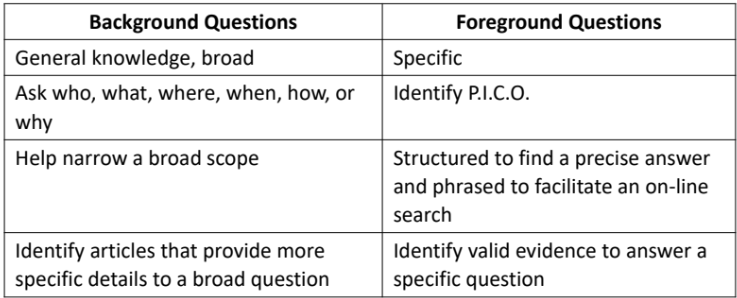
Background questions are general knowledge inquiries that ask who, what, where, when, how, or why.
They’re used to help narrow a broad scope and search about a topic
Background questions are helpful in identifying articles that provide more specific details that can be used in developing foreground (PICO) questions.
Finding a good article that reviews the management of a problem often provides the necessary details to structure a well-built question
They may be necessary to identify specific interventions for a disease or problem or to learn more about one particular disorder, intervention, or drug therapy that you may not be familiar with.
Example of background questions for Gail’s specific situation include:
What causes xerostomia?
What minimizes drug-induced dry mouth?
What are saliva substitutes?
What are saliva stimulants?
What are specific saliva substitutes that are effective for decreasing dry mouth?
What are specific saliva stimulants that are effective for decreasing dry mouth?
How are xerostomia patients managed?
What are the suggested therapies for drug-induced xerostomia?
Often these questions can best be answered by consulting a research data base (e.g., PUBMED, GoogleScholar) or using a textbook.
Foreground Questions
Foreground Questions – Arises from an observed problem, a patient question, to explore a new material or procedure, to clarify differences, or compare cost-effectiveness.
They are normally specific question that are structured in such a way to find a precise answer that may affect clinical decisions.
These are the questions that generally require a search of the medical literature and are best suited for the PICO format.
A foreground question in Gail’s case may be:
“For a patient with drug-induced dry mouth, will saliva substitutes as compared to saliva stimulants increase salivary flow and decrease dry mouth?”
Although saliva substitutes and saliva stimulants are very broad topics, the fact that you started your search by looking at background information/questions will make it easier to narrow down the terms to specific therapy (as in the question above).
Summary: Background vs. Foreground Questions
The PICO Process
One of the greatest difficulties in developing each aspect of the PICO question is providing an adequate amount of information without being too detailed.
It is important to stay focused on the main components that directly affect the situation.
The formality of using PICO to frame the question serves three key purposes:
It forces you to focus on what the patient believes to be the most important single issue and outcome.
It facilitates the next step in the process, the on-line search, by selecting language or key terms that will be used in the search.
It forces a clear identification of the problem, results and outcomes related to the specific care provided to that patient. This, in turn,
helps to determine the type of evidence and information required to solve the problem and to measure the effectiveness of the intervention.
PICO Components: Gail's Examples
Asking the right question is perhaps the hardest skill to learn, and yet it is fundamental to the EBD process
Detailed PICO Component Analysis
P: Patient/Population
The first step in developing a well-built question is to identify the patient problem or population.
This is done by describing either the patient’s chief complaint or by generalizing the patient’s condition to a larger population.
It’s helpful to consider the following when identifying the P in PICO:
How would you describe a group/population with a problem similar to your patient?
How would you describe the patient/population to a colleague?
What are the most important characteristics of this patient/population?
Primary problem underlying patient chief complaint
Patient’s main concern or chief complaint
Disease (including severity) or health status
Age, race, gender, previous ailments, current medications
Should these characteristics be considered as a search for evidence?
Medical condition
For some questions, it may be most appropriate to identify a general population instead of focusing on a patient or chief complaint.
Example of populations that may be investigated for a specific case are dental educators, dentists, menopausal women, pregnant women, etc.
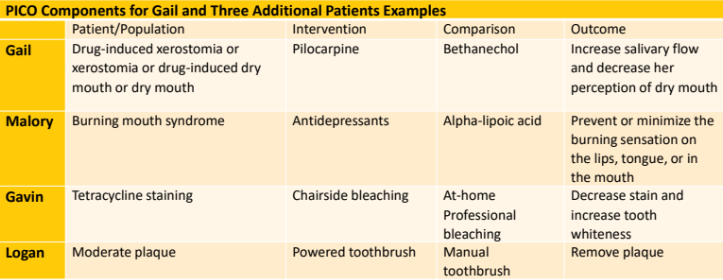
In Gail’s case, with a specific question, we do want to be specific. The P in PICO, on this situation, will stand for “Patient Problem,” which can be described as “drug-induced xerostomia,” “xerostomia,” “drug-induced dry mouth,” or “dry mouth.”
The P phrase could be more detailed if the added information influences the results of the search. Additional items may include age, gender, health history, or medications.
For example, it may be necessary to define the patient as an adult in the case of periodontitis or a middle- aged female if the results are regarding postmenopausal women.
I: Intervention
It is important to identify what you plan to do for a patient.
This may include the use of a specific diagnostic test, treatment, adjunctive therapy, medication, or the recommendation to the patient to use a product or procedure.
The intervention is the one main consideration for that patient.
In Gail’s case, the main intervention to consider could be pilocarpine based on the findings from the background question.
C: Comparison
It’s the main intervention/alternative being considered.
It should be specific and limited to one alternative to facilitate an effective on-line search.
The comparison is the only optional component in the PICO question.
Often, one may only look at the intervention without exploring alternative.
The comparison can be the golden standard, specially if a new therapy is being considered.
For Gail, a comparison could be bethanechol.
O: Outcome
The outcome specifies the result(s) of what you plan to accomplish, improve, or affect.
Outcomes should be measurable and may consist of relieving or eliminating specific symptoms, improving or maintain function, or enhancing esthetics.
Specific outcomes also will yield better search results.
When defining the outcome, “more effective” is not acceptable unless it describes how the intervention is more effective (e.g., more effective in decreasing caries incidence or more effective in preventing tooth fractures).
The outcome that we are hoping to achieve for Gail is to increase salivary flow and decrease her perception of dry mouth.
Constructing the PICO Question
Patient/Population: Identify patient condition (e.g., drug-induced xerostomia).
Intervention: Main intervention to be evaluated (e.g., Pilocarpine).
Comparison: Stated in "compared to" format (e.g., Pilocarpine compared with Bethanechol).
Outcome: Phrase expected result (e.g., increase salivary flow and decrease dry mouth).
Types of PICO Questions
Identifying the type of question being asked facilitates understanding the type of research studies that will best answer the question.
Therapy/Prevention questions look for an answer that determine the effect of treatments that avoid adverse events improve function and are worth the effort and cost. Gail’s question is an example of a therapy question.
Diagnosis questions look for evidence to determine the degree to which a test, intervention or diagnostic method is reliable and useful. The selection and interpretation of diagnostic methods or tests that establish the power of an intervention to differentiate between those with and without a target condition or disease is the aim of diagnosis questions
Ex.: In a 55-year-old woman with pain, swelling, and stiffness in the hands and wrists, will a red blood cell test that measures erythrocytes sedimentation rate as compared with C-reactive protein test most accurately identify rheumatoid arthritis (RA)?
Harm, etiology, causation questions are used to identify causes of a disease or condition including iatrogenic forms and to determine relationships between risk factors, potentially harmful agents, and possible causes of a disease or condition.
Ex.: In a woman with RA, does cardiovascular disease increase the likelihood of death?
Prognosis questions look for studies that estimate the clinical course or progression of a disease or condition over time and anticipate likely complications (and prevent them).