Operant Conditioning
Definition (#f7aeae)
Important (#edcae9)
Extra (#fffe9d)
Learning Outcomes:
E.L Thorndike: What the occasion demanded.
B.F Skinner: Types of operant learning.
Kinds of reinforcers.
Variables affecting Operant learning.
Mechanics of Operant Conditioning.
Edward L. Thorndike (1874-1947):
Author of the law of effect (1911).
Behaviors with favourable consequences will occur more frequently.
Behaviors with unfavourable consequences will happen less frequently.
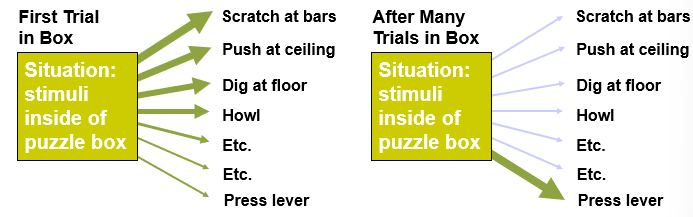
Created puzzle boxes for research on cats.
Thorndike effect: Responses that produce a satisfying effect in a particular situation become more likely to occur again in that situation, and responses that produce a discomforting effect become less likely to occur again in that situation.
Instrumental responses:
Actions which function as tools to work some change in the environment; also called operant responses.
Ex: flipping a switch to light a room; rats pushing a lever to
receive food.
Operant conditioning:
Learning process by which the consequence of an operant response affects the likelihood that the response will occur in the future.
Research on cats:
The cat is placed in the box with the food reward outside.
The box has a lever in front of the box, which is attached to a pulley system.
The hungry cat eventually learns that pressing on the lever will result in getting out of the box and being able to get the food.
Satisfying state of affairs: escape.
Annoying state of affairs: stuck inside.
The trial and error process through which the animals learned the way to trip the latch was what Thorndike called his law of effect.
B.F Skinner (1904-1990):
Believed that internal factors like thoughts, emotions and beliefs could not be used to explain behavior. Instead said that behaviors were actively chosen by the organism.
Looked at ‘operants’ or active behaviors that are used on the environment to generate consequences.
Developed the fundamental principles and techniques of operant conditioning and devised ways to apply them in the real world.
Designed the Skinner Box or operant chamber.
Comparison:
Thorndike’s Law of Effect:
Positive outcomes strengthen behavior.
Negative outcomes weaken behavior.
The Skinner Box:
Controlled conditions to study operant conditioning.
Operant (Lever pressed by rat) → Consequences (food).
Shaping:
Rewarding approximations of desired behaviors.
Principles of Reinforcement:
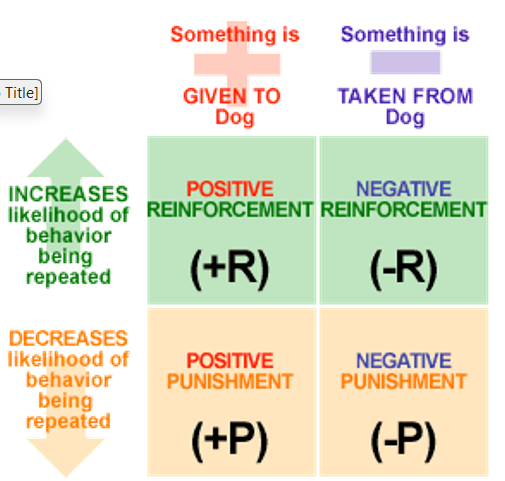
Reinforcement increases probability of behavior.
Positive reinforcement:
Presentation (Adding) of something pleasant.
Negative Reinforcement:
Removal of something unpleasant.
Avoidance learning, learned helplessness.
Primary Reinforcer:
Innately satisfying (unconditionally)
Secondary Reinforcer:
Acquires positive value through experience (conditional)
Avoidance learning: Escaping punishment.
Learned helplessness: Failed in negative reinforcement.
Punishment:
Punishment decreases the likelihood of behavior.
Positive Punishment:
Presentation (adding) of something unpleasant.
Negative Punishment:
Removal of something pleasant.
Generalizations:
Performance reinforcement behavior in different situations.
Discrimination:
Responding to signal that behavior will (or will not) be reinforced.
Extinction:
Behavior no longer reinforced decreased in frequency.
Variables Affecting Operant Learning:
Contingency
Contiguity
Reinforcer characteristics (Big? Small?)
Behavior characteristics (easy? hard?)
Motivating operating (hungry, not hungry?)
Schedules of Reinforcement:
Continuous Reinforcement:
Behavior is reinforced every time it occurs.
Partial Reinforcement:
Reinforcer follows behavior only a portion of the time.
Partial Reinforcement Schedules:
Ratio (no. of behaviors) vs Internal (time elapsed)
Fixed (predictable) vs Variable (Unpredictable)
Fixed Ratio:
Based on set number of behaviors.
Ex: Get a sticker after coloring each session, participation marks.
Variable Ratio:
Based on average (unpredictable) number of behaviors.
Ex: Children will be given a sticker after coloring a no. of picture, gambling.
Fixed Interval:
Rewarding behavior after fixing amount of time passes.
Ex: Children will be given sticker at the end of each day.
Variable Interval:
Rewarding after variable amount of time passes.
Ex: Children will be given sticker at the end of some days.
Operant Conditioning: Timing
Immediate vs Delayed Reinforcement:
Waiting for delayed, but more highly valued reinforcer.
Immediate vs Delayed Punishment:
Immediate more effective, but delayed can have effect.
Ex: not completing assignments on time.
Immediate Reinforcement vs delayed Punishment:
Immediate consequences usually win.
Ex: taking a new job; immediate punishment, delayed reinforcement.
Binging: immediate reinforcement, delayed punishment.
Applied Behavior Analysis:
Called behavior modification.
Use of operant conditioning principles to change behavior.
Identifies reinforcers that may be maintaining unwanted behaviors and enhance rewards for appropriate behavior.
All human behavior understood as being influenced by rewards and punishments (consequences of action).