Hassett et. al
Aims:
Psychologists aimed to investigate whether male and female rhesus monkeys showed different preferences for certain types of type, the same way male and female children do.
The MAIN aim of the study is to investigate whether rhesus monkeys exhibit gender-specific preference for human stereotyped '“masculine” and “feminine” toys.
Background:
Investigation to discern the origins of gender related toy choices.
Societal norms influence toy choices and how these work to conform to gender roles.
Methods:
Subjects & Sampling Technique-
Study involved 135 rhesus monkeys (Macaca Mulatta)
They lived in a multi male and female social structure at the Yerkes National primate Research Center Field Station
Have lived together for 25 years
14 monkeys were excluded due to prior hormonal treatment
39 newborns were not coded because of identification issues
Potential subjects were 61 females and 21 males
Housed in a 25m x 25m outdoor enclosure
Materials
Two types of toys that were categorised by physical properties, ‘Wheeled’ & ‘Plush’
Wheeled category was masculine
Stuffed toys were feminine
Experimental Design & Controls-
Design with 25 minute trials
Before each trial, they were sequestered indoors and one toy of each, both wheeled and plushed, was placed 10 meters apart outdoors.
Monkeys were then released, these interactions were videotaped.
Data Collection:
All interactions were recorded and behaviors shown were coded
Social rank and age of the monkeys were also included as variables for analysis
Data was entered into Palm Pilots equipped with Handobs (two observers ensured consistency when coding behaviors)
Variables:
Measured variables- Interactions with toys, specific behaviors, social rank, and age.
Manipulated variables- Type and placement of toys
Data Analysis:
Raw frequencies and durations of behaviors were used
23 females and 11 males for analysis
Ethical Considerations:
Primarily an observational study that did not involve experiments
Followed the guidelines by the NIH
Quantitative Findings:
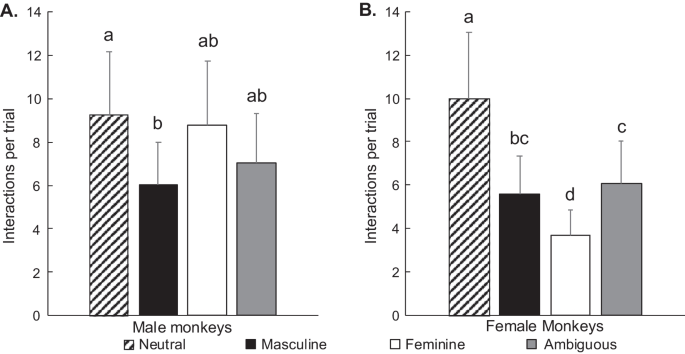
Interaction between toy type and sex - The king of toy, either plushed of wheeled, interacted differently with the gender of the animal
Within sex comparison - Males showed a significance preference with wheeled toys over plushies while females showed no significant preference.
Between sex comparison - Both males and females did not differ significantly in their interactions with wheeled toys but males interacted less with the plush toys compared to females.
Duration of interaction - Similar patterns were observed when it came to the total time spent with each type of toy
Magnitude of preference - Males showed a significantly stronger preference for wheeled toys than females did for plush toys
Qualitative Findings:
Rank and toy preference - The study found that social rank did not have a significant impact of toy preference when it came to sex but had a positive correlation with females.
Age and toy preference - No significant differences were found regarding this.