Energy changes in a system, and the ways energy is stored before and after such changes
Energy stores and systems
A system is an object or group of objects.
When a system changes, the way energy is stored also changes.
A closed system is one where no energy can escape to or enter from the surroundings. The total energy in a closed system never changes.
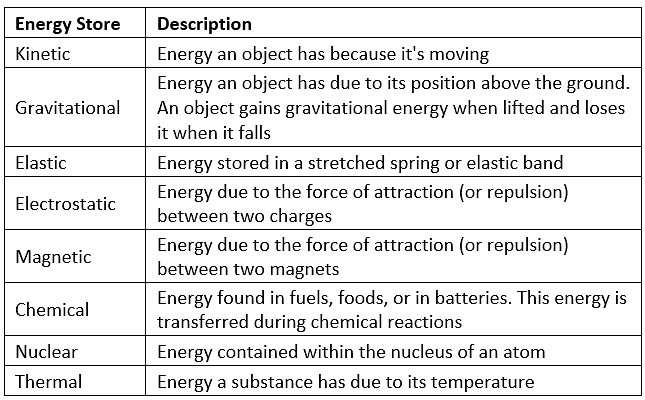
Energy transfers
Heating-energy is transferred from one object to another object with a lower temperature.
Waves-waves can transfer energy by radiation.
Electricity-when an electric current flows, it can transfer energy.
Forces-energy is transferred when a force moves or changes the shape of an object.
Changes in energy
Kinetic energy(J) = 0.5 × mass(Kg) × speed2 (m/s)
Elastic potential energy(J) = 0.5 × spring constant(N/m) × extension 2 (m)
G . P . E (J) = mass(Kg) × gravitational field strength(N/Kg) × height(m)
Energy changes in systems
change in thermal energy(J) = mass(Kg) × specific heat capacity(J/Kg/c) × temperature change(C)
The specific heat capacity of a substance is the amount of energy required to raise the temperature of one kilogram of the substance by one degree Celsius.
REQUIRED PRACTICAL 1
Power
Power is the rate at which energy is transferred or the rate at which work is done.
1 watt=1 joule of energy transferred per second.
Work is done whenever energy is transferred from one store to another.
work done(J)=Force(N)*Distance(m)
NEWTONS=KG*9.8
power(Watts)=work done(J)/time(S)