Androgyny and the BSRI
Key terms
Androgyny - displaying a balance of masculine and feminine characteristics in one’s personality.
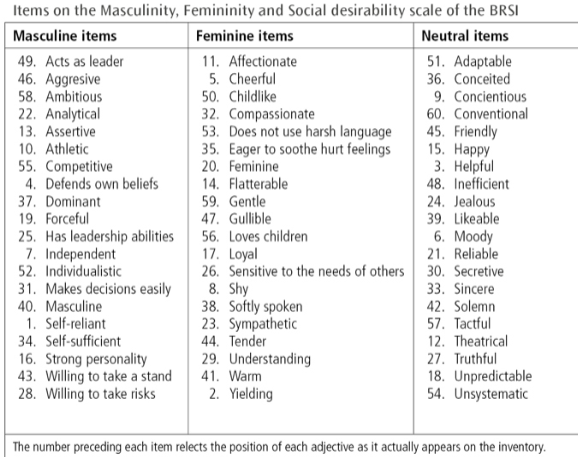
Bem Sex Role Inventory - the first systematic attempt to measure androgyny using a rating scale of 60 traits. (20 masculine, 20 feminine and 20 neutral) to produce scores across two dimensions: masculinity-femininity and androgynous-undifferentiated.
Androgyny and the BSRI
Defining androgyny - term is useful for illustrating the difference between common-sense understanding and the way a concept has come to be used in psychological research.
In psychology androgyny refers to a personality type that is characterised by a mixture (balance) of masculine and feminine traits, attitudes or behaviours e.g a man or woman who is competitive and aggressive at work but a caring and sensitive parent.
Sandra Bem - developed a method for measuring androgyny and suggested that high androgyny is associated with psychological well-being. These individuals are better equipped to adapt to a range of situations and contexts that other non-androgynous people would find difficult.
Measuring androgyny : The Bem Sex Role Inventory
Bem’s 1974 scale presented 20 characteristics that would be commonly identified as masculine, 20 that would typically judged as feminine and further 20 neutral traits.
Respondents are required to rate themselves on a 7 point rating scale for each item. Scores are then classified on the basis of two dimensions - masculinity-femininity and androgynous-undifferentiated
high masculine, low feminine - masculine
high feminine, low masculine - feminine
high masculine, high feminine - androgynous
low feminine, low masculine - undifferentiated
Evaluation
The scale would appear to be valid and reliable
The BSRI was developed by asking 50 male and 50 female judges to rate 200 traits in terms of how desirable they were for men and women. The traits that were the highest scorers in each category became the 20 masculine and 20 feminine traits on the scale. The BSRI was then piloted masculine and 20 feminine traits on the scale. The BSRI was then piloted with over 1000 students and the results broadly corresponded with the participant’s own description of their gender identity. This suggests the BSRI has a degree of validity.
A follow-up study involving a smaller sample of the same students revealed similar scores when the students were tested a month later. This suggests that the scale has high test-retest reliability.
Association between androgyny and psychological well-being
Within her research, Bem placed great emphasis on the idea that androgynous individuals are more psychologically healthy as they are best placed to deal with situations that demand a masculine, feminine or androgynous response. This assumption has since been challenged. Some researchers have argued that people who display a greater proportion of masculine traits are better adjusted as these are more highly valued in some societies. This suggests that Bem’s research may have no taken adequate account of the social and cultural context in which it was developed.
Oversimplifies a complex concept
It has been suggested that gender identity is too complex to be reduced to a single score. Alternatives to the BSRI have been developed; for instance, the Personal Attribute Questionnaire (PAQ), which replaces Bem’s masculinity- femininity dimension with one which measures instrumentality and expressivity. However, like the BSRI is still based on the idea that gender identity can be qualified.
Susan Golombok and Robyn Fivush (1994) have claimed that gender identity is much more global concept than is suggested by these scales. In order to understand gender identity more fully, the broader issues should be considered such as the person’s interest and perception of their own abilities.
extra
Cultural and historical bias
The BSRI was developed over 40 years ago and behaviours are regarded as typical and acceptable - particularly in relation to gender have changed significantly since then. Bem’s scale is made up of stereotypical ideas of masculinity and femininity that may be outdated and lacking in temporal validity.
In addition the scale was devised using a panel of judges who were all from US. Individualist notions of maleness and femaleness may not be shared across all cultures and societies.
On page 164 Mead’s research is described. Her research suggested that the environment was responsible for gender behaviours. The differences she observed between the Arapesh, Mundugumor and Tchambuli suggested gender is socially constructed not biologically determined, as gender behaviour is not universal; the males in one tribe behave differently from those in the others and differently from those in the West. This could be used to argue gender is due to nurture.
Clearly, the different gender behaviours in the tribe challenge Western views of females as the primary caregivers and non-assertive, as they do not behave this way in all of the tribes.
Measuring gender identity using questionnaires
Asking people to rate themselves on questionnaires relies on an understanding of their personality and behaviour that they may not necessarily have. Gender is a hypothetical construct which is much more open to interpretation then sex which is a biological fact. Furthermore, the questionnaires scoring system is subjective and people’s interpretation of the meaning of each end of the 7-point scale may differ.
Response bias – Respondents are forced to choose from a set of given answers, when they may not necessarily agree with any of the choices they are presented with. This can happen when questions are listed so that respondents may answer, for example, ‘yes’ so many times in a row that it becomes habit and they answer all questions similarly. In the BSRI participants may answer in the middle allocating a 3 to the masculine or feminine trait rather than the extremes of 1 or 7.
Social desirability – Respondents answering in a way they think they ought to answer to give the experimenter a favourable opinion of them. For example, have you committed any crimes? ‘No’. In the case of the BSRI they may want to be perceived as masculine if they are a male, or feminine if they are female so rate themselves higher on certain traits.
Demand characteristics – occurs when respondents try to guess the reason for the questionnaire and give answers that they think the researcher would want them to give. The BSRI may be an obvious measure of gender as the traits chosen are typically male or female, so participants may have guessed this, which could have influenced their answers.