3.10 Shaping a New Republic
LEARNING OBJECTIVE 1: Explain how and why competition intensified conflict among peoples and nations from 1754 to 1800
LEARNING OBJECTIVE 2: Explain how and why political ideas, institutions, and party systems developed and changed in the new republic.
INTRODUCTION
The new nation's existence was still not guarenteed.
Republic dealt with multiple challenges, both foreign and domestic
- Under leadership of first two presidents, George Washington and John Adams.
WASHINGTON'S PRESIDENCY
Members of the first congress under the constitution were elected 1788 and began their first session 1789
People assumed George Washington would be the electoral college’s unanimous choice for president (he was).
ORGANIZING THE FEDERAL GOVERNMENT
Washington took the oath of office as first US president (April 30th, 1789)
Constitution and its systems of checks and balances would be determined by day to day decisions of congress, the president, and supreme court.
EXECUTIVE DEPARTMENTS
Washington’s first task was to organize new department of executive branch
Constitution authorizes president to appoint cheifs of departments
- Chief of departments must be approved by senate
- Chiefs made up the President’s cabinet (met to regularly discuss major policy issues, and obtain advice and information).
Washington appointed four heads of department
- Thomas Jefferson (Secretary of state)
- Alexander Hamilton (Secretary of treasury)
- Henry Knox (Secretary of war)
- Edmund Randolph (Attorney general)
FEDERAL COURT SYSTEM
The only federal court in constiution was the Supreme Court
Congress was given power to create other federal courts (with lesser powers) and determine justices who made up the supreme court.
Congress enacted the Judiciary Act of 1789
- Established supreme court with one chief justice and five associate justices
- Highest court was empowered to rule on constitutionality of decisions by state courts.
- Also provided system of 13 district courts and three circuit court appeals.
HAMILTON’S FINANCIAL PROGRAM
One of the most pressing problems was the gov’s financial issues
Alexander Hamilton presented congress plan for putting US finances on a stable foundation.
Included 3 main actions
- Pay off national debt and have the federal gov take responsibility for state debts
- Protect the nation’s new and developing industries, and impose high tariffs on imported goods while collecting adequate revenues
- Create a national bank for depositing gov funds and printing banknotes to provide stability.
Northern merchants mainly supported this program
- would gain directly from high tariffs and stabalized currency.
Anti-federalist feared Hamilton’s plan
Thought states would lose power, while central gov gained
- Thomas Jefferson led a faction of southern Anti-Federalist
- Thought Hamilton’s plan only benefited the rich at the expense of indebted farmers
Congress finally adopted plan in slightly modified form
- One modification was that tariffs were not as high as Hamilton wanted.
DEBT
Jefferson and his anti-federalist supporters agreed to Hamilton’s insistence that the gov should pay off national debt and take responsibility to war debts of states—→
Hamilton agreed to Jefferson’s idea for nation’s capital to be in the south (later named Washington, D.C.
NATIONAL BANK
Jefferson argued that Constituion did not give congress power to create bank
Hamilton took a broader view of the constitution
- Argued that the doc’s “necessary and proper" clause authorized congress to take necessary action to carry out its established powers.
- Washington supported Hamilton and bank was voted into law.
Bank was charterd by the federal gov, but privately owned
- Federal gov could print paper currency and use federal deposits to stimulate business (as a major shareholder).
FOREIGN AFFAIRS UNDER WASHINGTON
Washington’s first term as president (1789-1793) coincided with French Revolution (touched off a series of wars between French Republic and moarchies of Europe)
Questions surrounded who to support during this revolutionary period, and took up Washington and Adams’ terms.
FRENCH REVOLUTION
American generally supported French aspirtation to establish republic
Were horrified by mob hysteria and mass executions
- To further complicate issues, US-French alliance remained between French Monarchy, not revolutionary republic.
Jefferson and anti-federalist sympathized with revolutionary cause.
- argued that because Britian was seizing American merchant ships bound for French ports, US should join France in war against Britain.
PROCLAMATION OF NEUTRALITY (1793)
Washington believed US was not stong enough yet to engage in European war
Resisted popular clamor by issuing proclamation of neutrality
- Jefferson resigned from Washington’s cabinet due to disagreement with policy.
“CITIZEN” GENET
Citizen Edmond Genet, French minister to the US, broke all rules of diplomacy by appealing to directly to American people to support the French cause.
His conduct was so outrageous, Jefferson approved of Washington’s request to remove Genet to the French gov
- Genet was recalled by remained in the US
THE JAY TREATY (1794) WITH GREAT BRITIAN
Washington sent cheif justice, John Jay, to Britian to talk about 2 issues
-One was Britian’s continued occupation of post on the US western frontier
- Other was Brtiain’s paratice of seizing American ships and impressing sailors into the British navy
Jay brought back treaty after a year of negotiations (Jay Treaty)
- Britian agreed to evacuate post, but included nothing about impressment
- Was narrowly ratified by the Senate
- Angered American supporters of Britian, but followed Washington’s policy of neutrality (kept US at peace).
THE PINCKNEY TREATY (1795) WITH SPAIN
The Jay Treaty had an effect on Spain’s policy toward its territories in the Americas
Spain saw the treaty as a sign that the US might be drawing closer to Britian (enemy of Spain)
- Spain decided to consolidate its holdings in North America.
- Spanish influence in west was strengthend by series of Catholic missions
- Spanish were worried about their colonies in the southeast
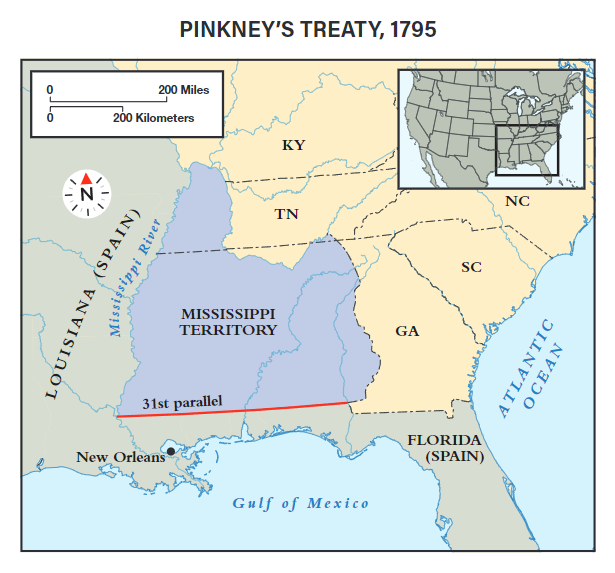
Thomas Pinckney, US minister to Spain, negotiated new treaty
- Spain opened lower Mississipi River and New Orleans to American trade
- Right of deposition was granted to Americans for transfer of cargoes w/o paying duties to Spanish gov
- Spain accepted US claim that Florida’s northern boundary should be at a 31st parallel (not north of that line).
DOMESTIC CONCERNS UNDER WASHINGTON
Washington faced a number of domestic problems and cirises (besides foreign challenges, stabalzing national credit, and organzing new government)
AMERICAN INDIANS
During the final decades of the 18th century, settlers moved westward into the Ohio Valley and beyond
Tribes formed the northwest (or western) confederacy
- Made in an effort to resist enroachment by settlers
- Shawnee, Delaware, Iroquios, and other tribes allied under Miami war chief Little Turtle.
- Initially, won series of battles over settler militias,
Brtish were supplying Native with arms and encouraging them to attack srttlers—→
- enraged settlers
- US army, led by Anthony Wayne, defeated the confederacy at Battle of Fallen Timbers
- Cheifs of defeated tribes agreed to the Treaty of Greenville (surrendered claims to the ohio territory and opened it up for settlement).
WHISKEY REBELLION (1794)
Hamilton persuaded congress to pass excise taxes on whiskey (made up for lower taxes than he wanted).
Refusal of farmers to pay federal tax on whiskey posed challenge to viability of gov under constitution
- reblling farmers couldn’t afford to pay tax on whiskey
- defended their liberties by attacking revenue collectors
Washington responded to crisis by placing state militas under Hamilton
- demonstrated stong force of 15,000 soldiers
- rebellion collapsed and federal gov solidified its authority
- americans appluaded washington’s actions (contrasted against shay’s rebellion)
- military actions was also resented and condemned by westerns (unwarrented force against common people)
- Thomas Jefferson gained popularity among western farmers
WESTERN LANDS
Jay’s treaty and Battle of Fallen Timbers gave government control of lands.
Congress encouraged rapid settlement through Public Land Act (1796)
- Established procedure for dividing and selling federal land at moderate prices
- Process for adding new states to union went smoothly
- country had a push westward (Vermont—→ Kentucky and Tennessee)
THE FIRST POLITICAL PARTIES
Washington’s unanimous vote in electoral college underscored popular belief that political parties were not needed
Constitution did not mention political parties
- Constitution did not mention political parties, and drafters thought non would arise (proven wrong)—→
Debates between federalist and anti-federalist
- First indication of two-party system emerged as core feature American politics
ORIGINS
Groups legislators commonly formed temporary factions and voted together for or against specific policies
Dispute between federalist and anti-federalist over ratification of constitution closely resembled factional disputes of earlier period
- was organized across state lines and prefigured the national parties that emerged soon afterwards (at least by federalist)
The 1790s, were known as the federalist era
- dominated by federalist policies
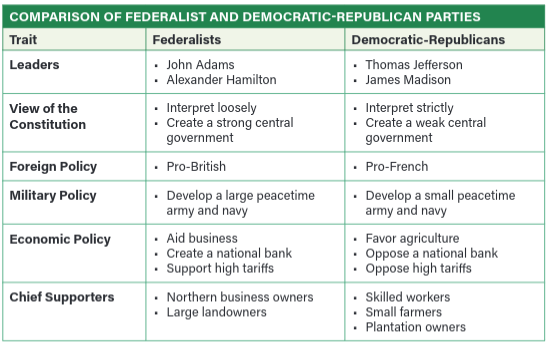
Political parties began to form around Hamilton and Jefferson.
- Federalist party supported Hamilton and his financial program
- Democratic-Republican party supported Jefferson and tried to elect candidates who opposed Hamilton’s program.
French revolution further solidified the formation of national parties
- Americans were divided whether to support France
- Large number followed Jefferson’s lead to challenging neutrality
DIFFERENCES BETWEEN THE PARTIES
Federalist were stongest in northeastern states and advocated growth of federal power
Democratic-Republicans were strongest in southern states and the western frontier, advocated for states’ rights.
The two major political parties were taking shape and become better organized (1796)
- Washington retired at the end of his second term the same year.
WASHINGTON’S FAREWELL ADDRESS
George Washington wrote his farewell speech (assisted by Alexander Hamilton)
Message had enormous influence due to Washington’s prestige, he spoke against politices and practices he considered unwise
- Do not get involved in European affairs
- Do not make “permanent alliances” in foreign affairs
- Do not form political parties
- Do not fall into sectionalism (ephasizing region instead of whole)
Future presidents mostly heeded Washington’s first two warnings against foreign entanglements
Poltical parties were well on their way of becoming part of American political system (sectional differences were only becoming stronger).
Washington’s presidency established two-term tradition
Constitution placed no limit on president’s time in office
- 22nd Amendment made the two-term limit a part of the constitution.
JOHN ADAMS’ PRESIDENCY
Political parties were working to gain majorties in the two houses of congress
John Adams was federalist candidate, Thomas Jefferson was the Democratic-Republicans candidate.
- Adams won and Jefferson became vice president (constitution gave vp position to candidate with 2nd highest electoral votes).
- 12th amendment made president and vp to run as team.
THE XYZ AFFAIR
Problems related to French Revolution caused trouble during Adams’ presidency
Americans were angerd by French warships and privateers seizing us merchant ships.
- Adams sent delegates to Paris to negotiate
- French delegates (X, Y,Z) requested bribes for entering negotiations
- Amerian delegates refused, and demands of XYZ—→
- Infuriated Americans (clamored for war against France)
Faction of the federalist part hoped to gain French and Spanish lands by going into war
- Adams resisted sentiment for war (recognized that the US was no strong enough to fight as a major power), and sent new minister to Paris
THE ALIEN AND SEDITION ACTS
Anger against France strengthend federalist enough to win congressional elections
Federalist took advantage of the victory by enacting laws to restrict Democratic-Republicans
Most immigrants voted for republicans—→ federalist passing naturalization act
- increased years required for immigrant to qualitfy for citizenship
Alien Acts
- authorized the president to deport and detain “dangerous” aliens in time of war
Sedition Act
- made it illegal for newspaper editiors to criticize the president or congress
- imposed fines or imprisonment for editors who violated the law
THE KENTUCKY AND VIRGINIA RESOLUTIONS
Republicans argued that the Alien and Sedition acts violated rights of the first amendment
Supreme court had not established judicial review (idea that court could overturn a law that was unconstitutional)
Republican leaders challenged the legislation of federal congress by enacting nullifying laws of their own state legislatures
- Kentucky legislature adopted resolution by Jefferson
- Virginia adopted resolution adopted by Madison
- Both resolutions declared states entered into a compact (if any act of federal gov broke compact, state could nullify federal law)
- Didn’t pass, but that would be used widely in future nullification controversy
Crisis over Alien and Sedition acts faded when Federalist lost control of congress in election of 1800
Republican majority allowed acts to expire or repealed them
Supreme court later asserted its power to rule laws unconstitutional