Organic Reactions
Addition reactions, substitution reactions, and elimination reactions are the three main types of organic reactions. Most organic reactions can be classified as one of these three types.
Addition Reactions'
In an addition reaction, atoms are added to a double or triple bond. One bond of the multiple bond breaks so that two new bonds can form. To recognize an addition reaction, remember that two compounds usually react to form one major product. (Sometimes two isomers are formed). Here is an example of an alkene undergoing an addition reaction to form an alkane:

Other examples of addition reactions:

Substitution Reactions
In a substitution reaction, a hydrogen atom or a functional group is replaced by a different functional group. Usually two compounds react to form two different products (one is normally water or an acid which needs a hydrogen atom)

Example 1: Hydroxyl group is replaced with Iodine from hydroiodic acid, because there are oxygen atoms the hydrogen taken away from the acid combines with hydroxyl group to form water (H2O).
Example 2: Bromine atom is replaced with NH2, no oxygen atoms so one hydrogen atom is taken from ammonia and added with bromine to form hydrobromic acid.
Example 3: No pre-existing functional groups, so Nitrous acid takes the first slot of benzene’s hydrogen atoms. there is an oxygen atom and a hydrogen atom, so they take the hydrogen atom that NH2 replaced, combine it with the two atoms to form H2O.
Elimination Reactions
In an elimination reaction, atoms are removed from a molecule to form a double bond. This type of reaction is the reverse of an addition reaction, where a double bond is broken to form two new bonds. One reactant usually breaks up to give two products. The structure looks like this:

Alcohols often undergo elimination reactions when they are heated in the presence of strong acids, such as sulfuric acid, H2SO4, which acts as a catalyst. Alkyl halides also undergo elimination reactions to produce alkenes. Here are some examples:
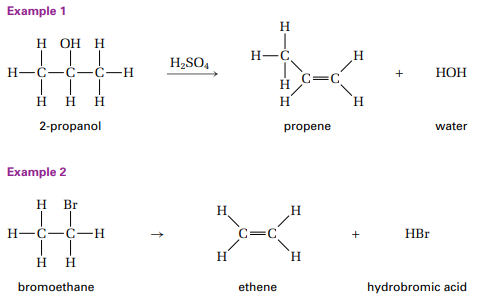
Example 1: Here the strong acid, H2SO4, does not count as a reactant. It is not directly involved in the reaction. It is a catalyst: a compound that speeds up a reaction but is not consumed by it.
The hydroxyl group in 2-propanol and one of the hydrogen atoms break off to let two carbon atoms form a double bond, with the third carbon filling the spot of the missing hydrogen since the carbon still has one more spot for a bond now (two taken by double bond, one by a pre-existing hydrogen). The one hydrogen atom bonded to the hydroxyl group forming water.
Example 2: The bromine atom and one hydrogen atom break off to form hydrobromic acid and they let the carbon atoms double bond.
SO quick summary: Addition reactions break double bonds for more atoms on a single product, substitution reactions replace functional groups and form byproducts (acids or water), elimination reactions break single bonds to form double bonded products and byproducts (acids or water).
Combustion Reactions
A combustion reaction occurs when a compound reacts with oxygen to form oxides, heat, and light (burning). For example, sulfur reacts with oxygen to produce sulfur dioxide
Combustion reactions are common for compounds that are composed of carbon and hydrogen atoms. These compounds are called hydrocarbons.
Complete combustion of a hydrocarbon occurs when the hydrocarbon reacts completely in the presence of sufficient oxygen. The complete combustion of a hydrocarbon produces only water vapour and carbon dioxide gas as products.
For example of propane, C3H8(g) + 5O2 → 3CO2(g) + 4H2O
Incomplete combustion of a hydrocarbon occurs when there is not enough oxygen present for the hydrocarbon to react completely. The incomplete combustion of a hydrocarbon produces water, carbon dioxide, carbon monoxide, and solid carbon in varying amounts. More than one balanced equation is possible for the incomplete combustion of a hydrocarbon. One possible equation for the incomplete combustion of propane is shown below:
2C3H8(g) + 7O2(g) → 2CO2(g) + 8H2O(g) + 2CO(g) + 2C(s)
There are also an important reaction that occurs when there is a change in the number of hydrogen or oxygen atoms that are bonded to carbon. One reactant is oxidized while the other reactant is reduced, so oxidation and reduction always occur together.
Oxidation Reactions
Oxidation is defined as a reaction in which a carbon atom forms more bonds to oxygen, O, OR less bonds to hydrogen, H. An oxidation that involves the formation of double C=O bonds may also be classified as an elimination reaction.
Oxidation occurs when an organic compound reacts with an oxidizing agent. Common oxidizing agents include acidified potassium permanganate, KMnO4, acidified potassium dichromate, K2Cr2O7, and ozone, O3. The symbol [O] is used to symbolize an oxidizing agent.
To identify an oxidation, count and compare the number of CH and CO bonds in both the reactant and product. In the example of ethanol, it reacts with an oxidizing agent to form ethanal. Ethanol has five C-H bonds and one C-O bond, but ethanal has four C-H bonds and two C-O bonds in the form of one double bond C=O. So because of the decrease in C-H bonds and the increase in C-O bonds, this can be classified as an oxidation reaction.
Reduction Reactions
Reduction is defined as a reaction in which a carbon atom forms fewer bonds to oxygen, O, or more bonds to hydrogen, H. Often, a double C=O bond or C=C bond is reduced to a single bond by reduction. A reduction that transforms double C=C or C=O bonds to single bonds may also be classified as an addition reaction.
Reduction occurs when an organic compound reacts with a reducing agent. Common reducing agents are lithium aluminum hydride, , and hydrogen gas over a platinum catalyst, H2/Pt. The symbol [H] is used to symbolize a reducing agent.
To identify a reduction, count and compare the number of CH and CO bonds in both the reactant and the product. For the example of propanone, it has six C-H bonds and two C-O bonds in one double bond C=O. After added to a reducing agent, it becomes 2-propanol, which has seven C-H bonds and only one C-O bond. As the number of C-H bonds has increased, and the C-O bonds decreased, this can be classified as a reduction reaction.
Condensation Reactions
A type of substitution reaction, in a condensation reaction a smaller molecule, usually water, is produced as a byproduct of a reaction with two organic molecules combining to form a single molecule.

Hydrolysis Reactions'
Another type of substitution reaction, in a hydrolysis reaction, water is added to a bond which splits it in two, making this the opposite of a condensation reaction. Water can add to an ester or amide bond (among other bonds), so if an ester bond is hydrolyzed, a carboxylic acid and an alcohol are produced as shown in the example below. If an amide bond is hydrolyzed, A carboxylic acid and an amine are produced instead.
