Week 2A Notes
Nervous System Communication
Neuroconduction = electrical, within neurons
Electrical excitation of the neurons and the combination of excitation and inhibitory signals
Neurotransmission= chemical, between neurons
The release of neurotransmitters
Measuring Electrical Changes
Use the voltmeter: V= C+ - C-
Placing the positive lead into the positive area and the reference into the regular solution
Measuring voltage between two locations which is the voltage potential between two locations
Intracellular Patch Clamp Recording: Putting the positive lead into the neuron (axon) and reference lead into the extracellular fluid (Na+)
We would see a -60mv membrane resting potential of a neuron!
It is typically -50 and -80 V resting potential
All cell are usually negative in the body
Membrane Bilayer and Structures
Proteins spanning the phospholipid bilayer allowing charged ions to pass through
Ion Channels (pores) : A channel of proteins which allow ions to pass through the cell
Selectively Permeable to selective ions
Important ions
sodium, potassium, calcium → positively charged cations
chloride, proteins→ negative anion
Why is the Interior Negative?
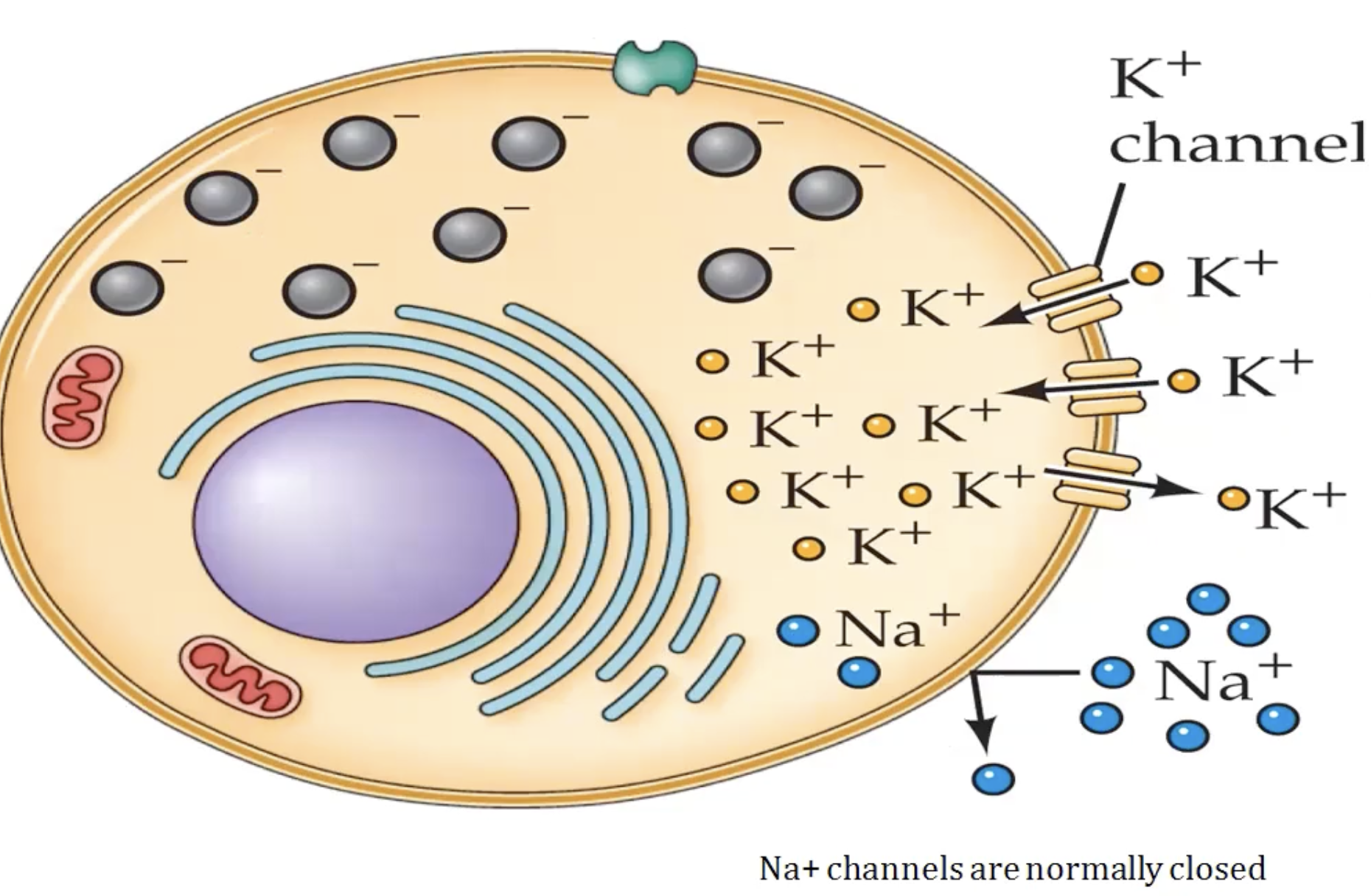
More positive Na+ outside of the cells with a closed channel to enter in
Sodium Potassium Pump
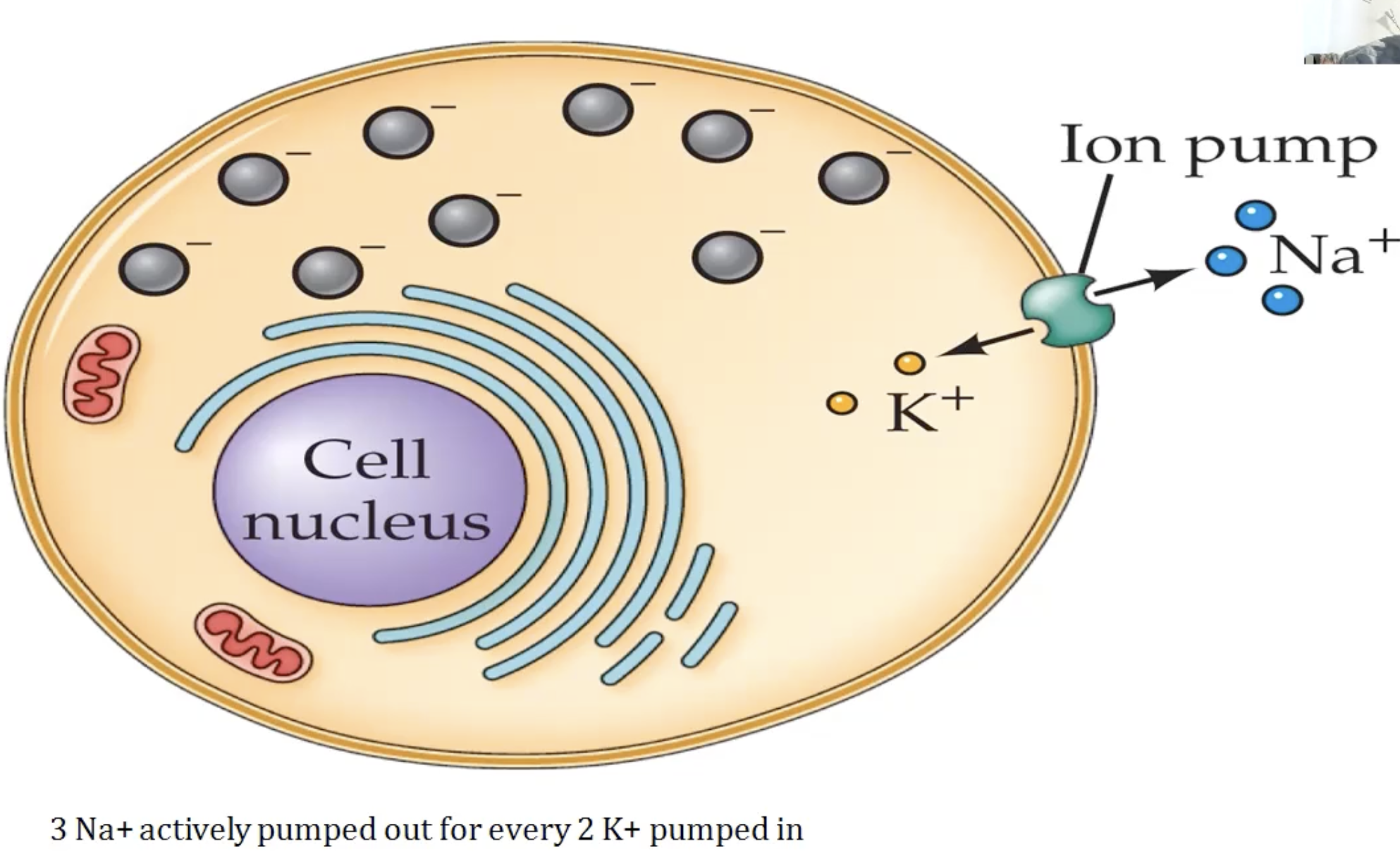
More sodium outside, more potassium inside
3 sodium out and 2 potassiums inside (NOKIA) which decrease the positive charge
Leak Potassium Channels → Open at all Time
The accumulation of potassium inside of the cell cause more positively charged potassium to exit
Will reach an equilibrium
Negatively Charged Protein in the interior of the cell
Chemical “Force” → Diffusion and Electrostatic Forces
Diffusion
Particles will diffuse through the solution until they are evenly distributed
An imaginary force that pushes the particles to low concentration
Semipermeable Membrane
Only will allow certain particles to travel through and diffuse in certain regions
Electrostatic Forces
Causes ions to flow towards oppositely charged areas
ex. Positive wants to be with a negative and not another positive charge
Potassium Dillem a → Two opposing forces in Different Directions
Is attracted to the negative proteins in the inside
Is also wanting to exit out and diffuse on the outside of the cell
Driving Force on an Ion
Electrical: Forces an ion to the side of the opposite charge
Membrane Potential (positive or negative)
Ionic Charge (cation and anion)
Diffusion: Will want to travel to the side of a lower concentration
Concentration Gradient
Driving Force: sum of the two forces
Determined by magnitude and direction of electrical and diffusion forces
Depends on intensity of the two forces to determine the direction of an ion
Equilibrium Potential
Potassium
Electrical Force and the Chemical Force go in opposite directions which allows for the concentration of potassium to be maintained
Sodium
Electrical Force and chemical force towards the inside of the cell
Membrane isnt permeable to sodium so thats why the sodium can’t enter into the cell
Electrochemical Equilibrium:
Occurs when the driving force is 0
When both forces are zero or there is a net of 0
There will be no net change in the direction of flow
Equilibrium Potential: Stable Membrane voltage (reversal potential, nerst potential)
When the driving forces of the membrane potential are of equal size and in opposite directions
If the membrane is permeable to only one ion then the membrane potential will pertain to only that ion
If there is permeability to more than one then it will average out to the relative permeability to each ion
Since there is more permeability for potassium then the resting membrane potential is close to the equilibrium potential for potassium rather than for sodium
Calculated from the nerst equation which considers concentration and charges of ions
Spatial and Temporal Summation
Types of Ion Channels
Leak Channels: channels that are always open; ungates
Ligand Gated Channels: open when a specific molecule binds to them
Voltage Gated Channels: open when the cell membrane open a voltage range
Crucial for action potential
Mechanically Gated Channels: open due to mechanical pressure; physical touch, vibration
Like for the sense of touch
Optical Gated Channels: open in the presence of light
Ion Channels in the Neuron
Dendrite: Neurotransmitters are received
The voltage gated channel opens with the binding of the neurotransmitters to
Excitatory Postsynaptic Potential (EPSPs)
Most Common Excitatory Neurotransmitter: Glutamate
From the glutamatergic synapse, allows sodium to enter the cell by opening up the ligand gated sodium channel (depolarization)
The sodium potassium pump will eventually pump out the excess sodium and bring the potential down again
Inhibitory Postsynaptic Potentials (IPSPs)
Most Common Inhibitory Neurotransmitter: GABA
Opens up the ligand-gated chloride channel, decreasing the membrane potential (hyperpolarization)
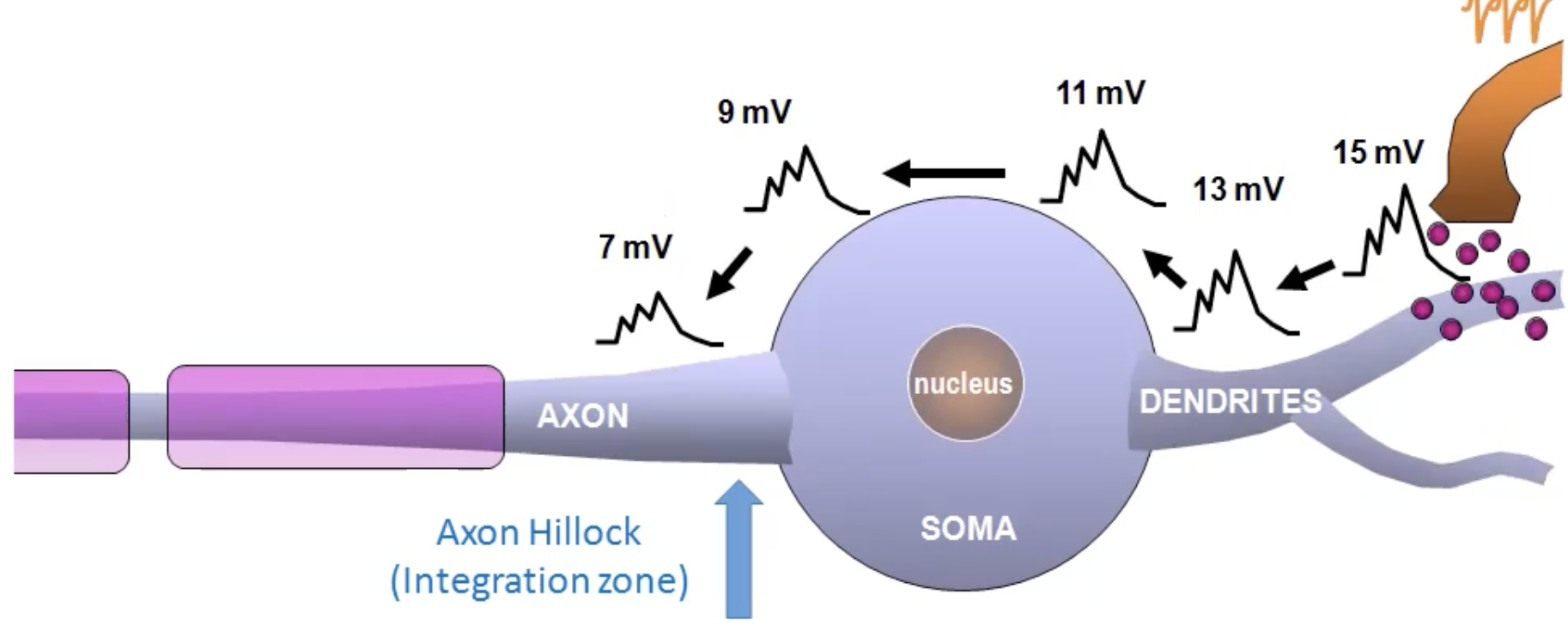
Passive Propagation
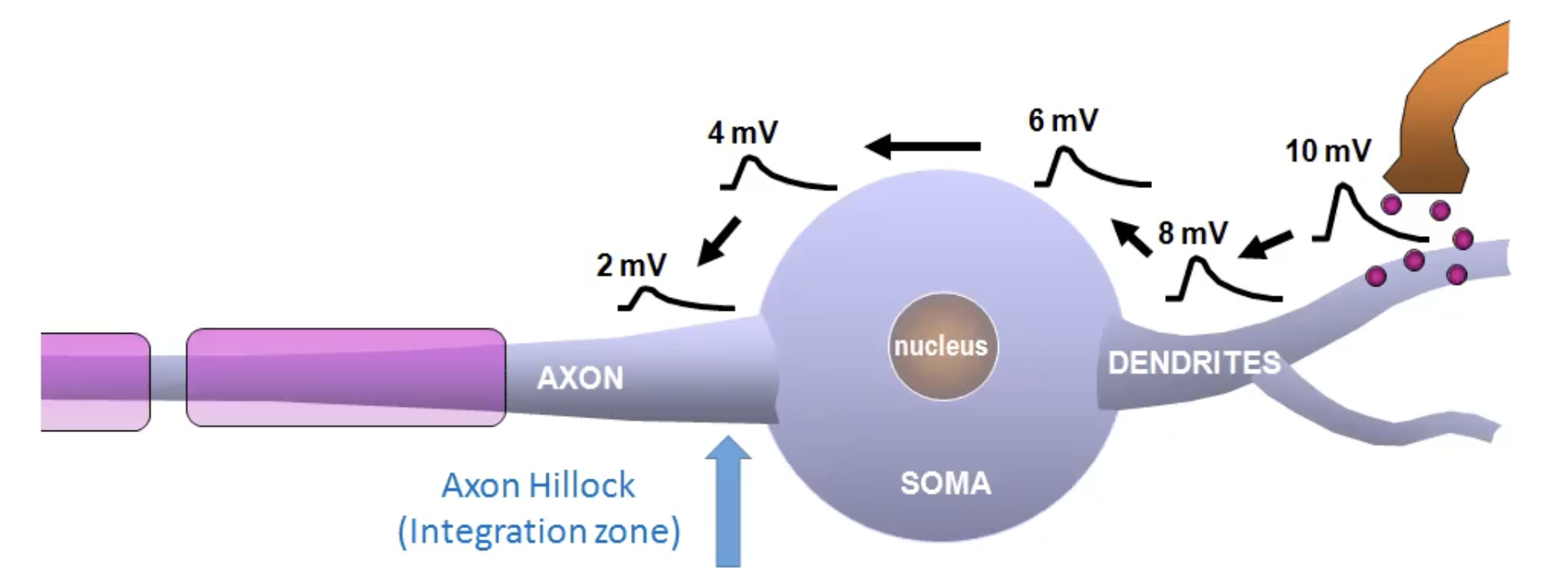
The cytoplasm (electrolyte) conducts electricity and propagates rapidly and will decrease electricity through travel because of electrical resistance
At the axon hillock the IPSPs and EPSPs are accumulated
Summation
Spatial Summation: The creation of a large EPSPs from different synapses onto twos dendrite of a cell
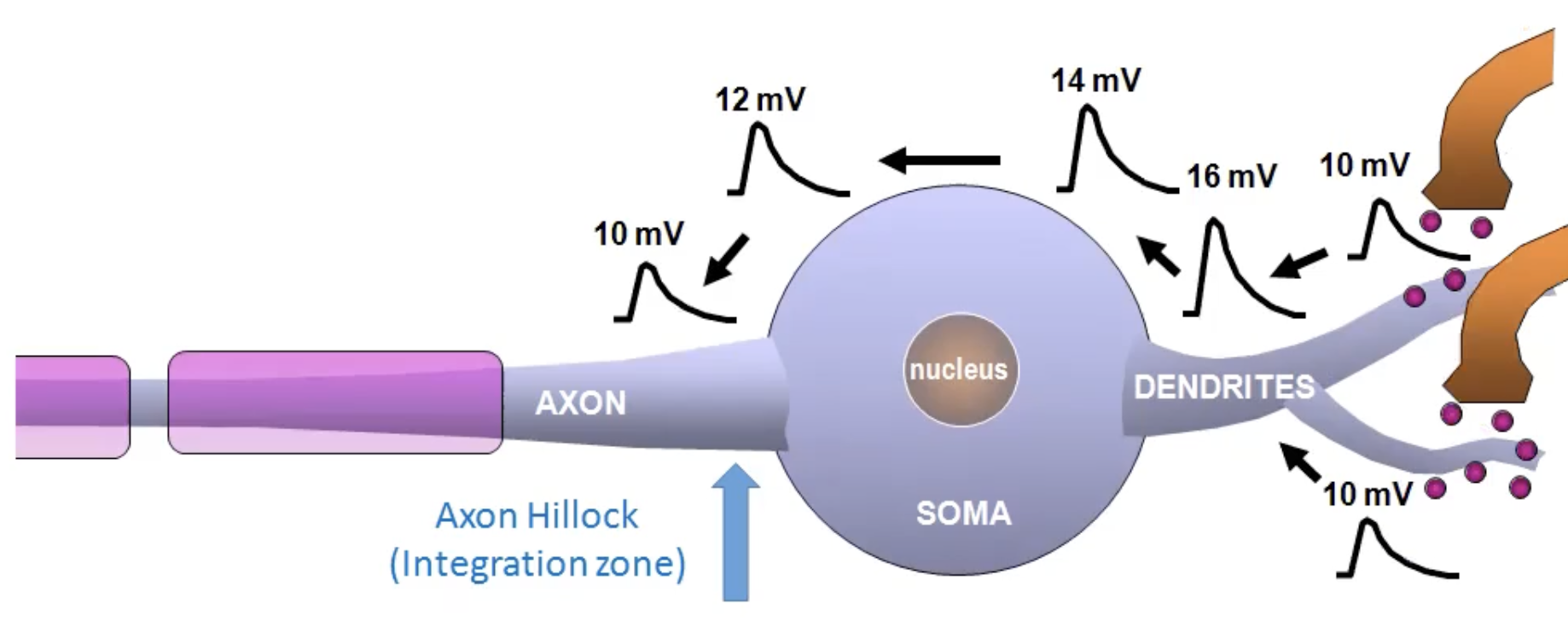
Will still propagate but the EPSP will be larger at the integration zone
Temporal Summation: A single postsynaptic cell firing multiple EPSPs in successive amounts to the same dendrite
The action potential is not allowed to go back to the baseline amount and will increase the signal
Both summations will trigger an action potential at the -55mV threshold that could reach a peak voltage of +60mV