AP BIOLOGY UNIT 2.1
Cell Theory
• Definition: The cell theory is a fundamental principle in biology stating that:
• All living organisms are made up of one or more cells: This means that cells are the basic building blocks of life, whether the organism is unicellular (like bacteria) or multicellular (like humans).
• The cell is the basic unit of life: Cells are the smallest units of structure and function in an organism. All physiological processes take place within cells.
• All cells arise from pre-existing cells: This principle rejects the idea of spontaneous generation and emphasizes cell division (mitosis and meiosis) as the method of generating new cells.
Importance: Understanding this concept helps explain the continuity of life and the importance of cellular functions in maintaining life.
Prokaryotic vs. Eukaryotic Cells
• Prokaryotic Cells:
• Characteristics: Do not have a nucleus or membrane-bound organelles. Their genetic material (DNA) is located in a region called the nucleoid.
• Organisms: Examples include bacteria and archaea.
• Size: Generally smaller (1-10 µm).
• Structure:
• Cell membrane: Similar to eukaryotes, it regulates what enters and exits the cell.
• Ribosomes: Smaller than eukaryotic ribosomes, they are responsible for protein synthesis.
• Plasmids: Small circular DNA molecules that often carry genes for antibiotic resistance.
• Eukaryotic Cells:
• Characteristics: Have a true nucleus, where genetic material is enclosed within a nuclear membrane. They also contain membrane-bound organelles.
• Organisms: Examples include animals, plants, fungi, and protists.
• Size: Larger than prokaryotes (10-100 µm).
• Organelles: Eukaryotes have specialized structures like the nucleus, mitochondria, and endoplasmic reticulum that carry out specific functions.
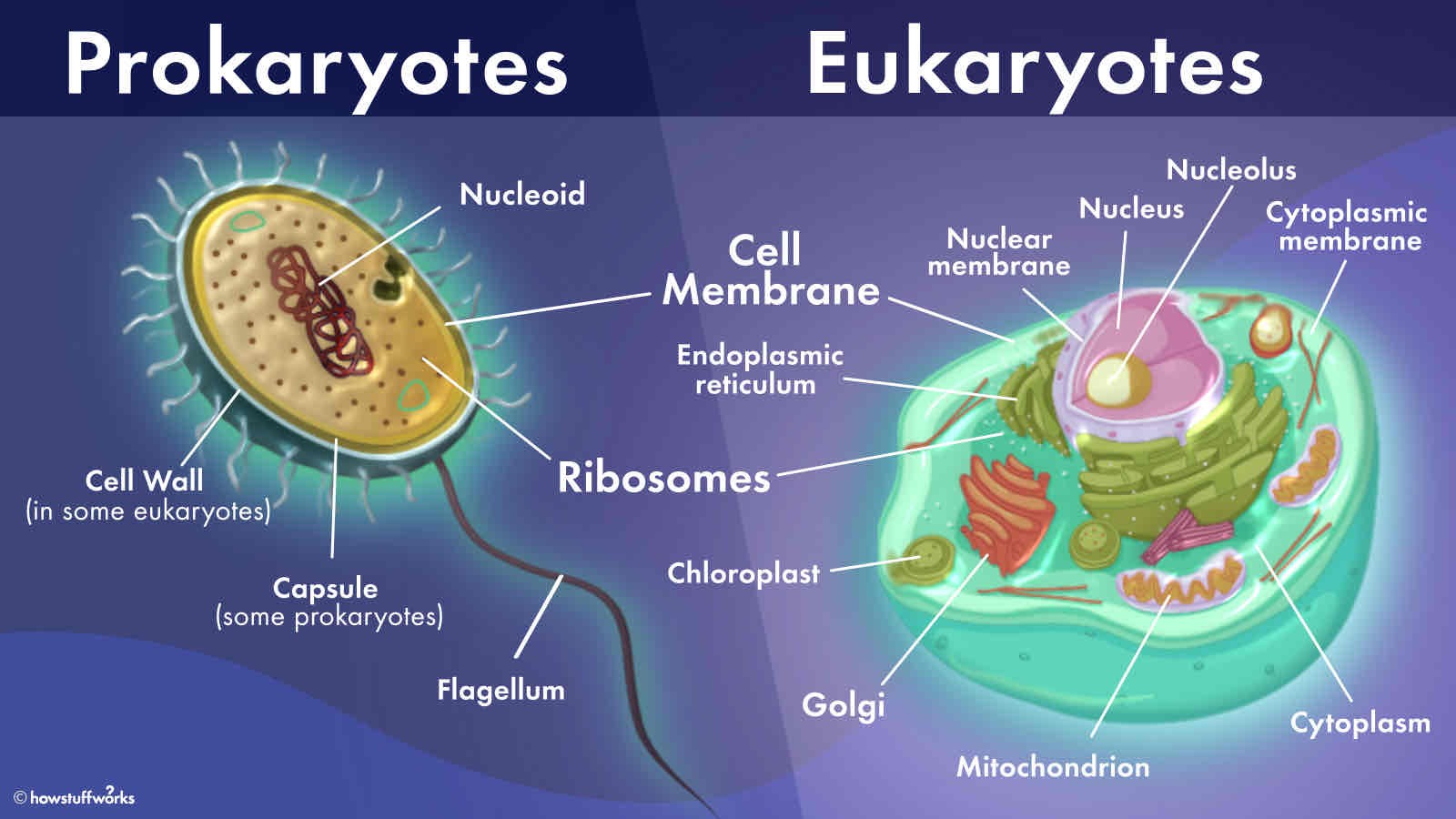
Key Differences:
• Prokaryotes are simpler and smaller, while eukaryotes are more complex with specialized organelles.
• Eukaryotes have a membrane-bound nucleus, while prokaryotes do not.
Cell Organelles and Their Functions
• Nucleus:
• Function: Contains the cell’s genetic material (DNA), which controls cell functions and reproduction. It is the “control center” of the cell.
• Structure: Surrounded by a nuclear envelope with pores that regulate material exchange between the nucleus and cytoplasm.
• Mitochondria:
• Function: Known as the “powerhouse” of the cell. They convert chemical energy from food into ATP (adenosine triphosphate), which is used for cellular energy.
• Structure: Double membrane with inner folds called cristae that increase surface area for ATP production.
• Chloroplasts (in plant cells):
• Function: Conduct photosynthesis, converting light energy into chemical energy stored as glucose.
• Structure: Double membrane with internal structures called thylakoids, where chlorophyll captures light energy.
• Ribosomes:
• Function: Sites of protein synthesis. They translate mRNA into amino acid sequences to form proteins.
• Structure: Composed of RNA and proteins; found either floating in the cytoplasm or attached to the rough endoplasmic reticulum (rough ER).
• Endoplasmic Reticulum (ER):
• Rough ER: Has ribosomes attached to its surface. It synthesizes and transports proteins that will be secreted or inserted into membranes.
• Smooth ER: Lacks ribosomes and synthesizes lipids, detoxifies harmful substances, and stores calcium ions.
• Golgi Apparatus:
• Function: Modifies, sorts, and packages proteins and lipids for secretion or delivery to other organelles.
• Structure: Stack of membrane-bound sacs where processing and packaging of macromolecules occur.
• Lysosomes:
• Function: Contain digestive enzymes that break down macromolecules, worn-out organelles, and foreign invaders (like bacteria).
• Structure: Membrane-bound vesicles that are acidic inside, helping to digest material.
• Cytoskeleton:
• Function: Provides structural support and shape to the cell, facilitates movement (of the cell or within the cell), and plays a role in cell division.
• Components: Microtubules, microfilaments, and intermediate filaments.
• Peroxisomes: Involved in breaking down fatty acids and detoxifying harmful substances.
• Vacuoles: Store nutrients, waste products, and help maintain turgor pressure in plant cells.
Surface Area to Volume Ratio
• Importance for Cell Size: As a cell grows, its volume increases faster than its surface area. A large cell has a smaller surface area relative to its volume, which limits its efficiency in exchanging materials (nutrients, waste, gases) with the environment.
• Smaller cells are more efficient at this exchange because their surface area-to-volume ratio is higher.
• Adaptations: Many cells are small or have adaptations like folds (e.g., microvilli in the intestine) to increase surface area, allowing for efficient nutrient and gas exchange.
Plasma Membrane
• Structure:
• Phospholipid Bilayer: The plasma membrane is primarily composed of a double layer of phospholipids. Each phospholipid has a hydrophilic (water-attracting) head and two hydrophobic (water-repelling) tails. The heads face outward toward the aqueous environment, and the tails face inward, forming a hydrophobic core. This arrangement creates a semi-permeable barrier that regulates the movement of substances into and out of the cell.
• Integral Proteins: These proteins span the phospholipid bilayer and are embedded within it. They function as channels or transporters, allowing specific molecules to pass through the membrane. Some act as receptors that bind to signaling molecules.
• Peripheral Proteins: These proteins are found on the inner or outer surface of the membrane and are not embedded in the lipid bilayer. They interact with the cytoskeleton or extracellular matrix and play roles in cell signaling, support, and shape maintenance.
• Cholesterol: Cholesterol molecules are interspersed within the phospholipid bilayer. They help stabilize membrane fluidity by preventing it from becoming too rigid in cold conditions or too fluid in hot conditions.
• Carbohydrates: Carbohydrates are attached to proteins (glycoproteins) and lipids (glycolipids) on the extracellular side of the membrane. These structures are involved in cell-cell recognition and communication.
• Function:
• Selective Permeability: The plasma membrane controls the passage of substances into and out of the cell. It allows small, nonpolar molecules like oxygen and carbon dioxide to pass freely while blocking large or charged molecules unless specific transport proteins are present.
• Transport:
• Passive Transport: This process does not require energy. Molecules move from an area of high concentration to an area of low concentration. This includes diffusion, osmosis, and facilitated diffusion (using protein channels).
• Active Transport: Requires energy (usually ATP) to move molecules against their concentration gradient, such as in the sodium-potassium pump.
• Cell Signaling: Integral proteins (receptors) receive signals from the environment (e.g., hormones, neurotransmitters), triggering a cascade of events inside the cell to produce a specific response. This process is known as signal transduction.
• Cell Recognition: Carbohydrates on glycoproteins and glycolipids act as cell markers, allowing the immune system to recognize foreign cells or allowing cells to interact with each other.
• Structural Support: The plasma membrane maintains the shape of the cell and anchors the cytoskeleton to provide mechanical support. It also helps with cell adhesion, which is critical for tissue formation and maintaining cellular integrity.