Chapter 12
The Work of Gregor Mendel
A trait is a specific characteristic of an individial
Hybrid: created from a cross of true:breeding individuals
True breeding plants will produce offspring that were the same
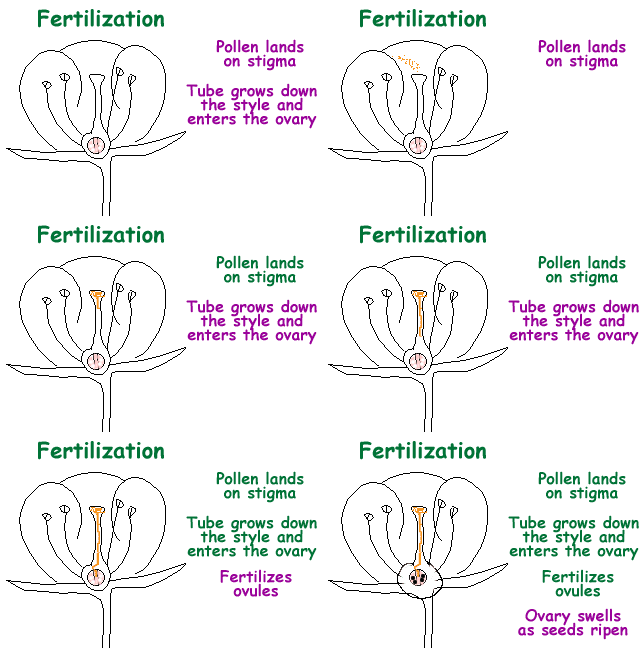
Plants can have male and female parts or they could have both
- pollen are plant sperms
- fruit are plant ovaries
- \
 \n
\n
Genes: passed from one generatino to the next; determine an individials characteristics
Alleles: the different forms of a gene
- Some alleles are dominant and some are recessive
- An organism with a recessive allele with exhibit the trait only in absence of a dominant allele
Seperation: separation of alleles during gamete formation
\
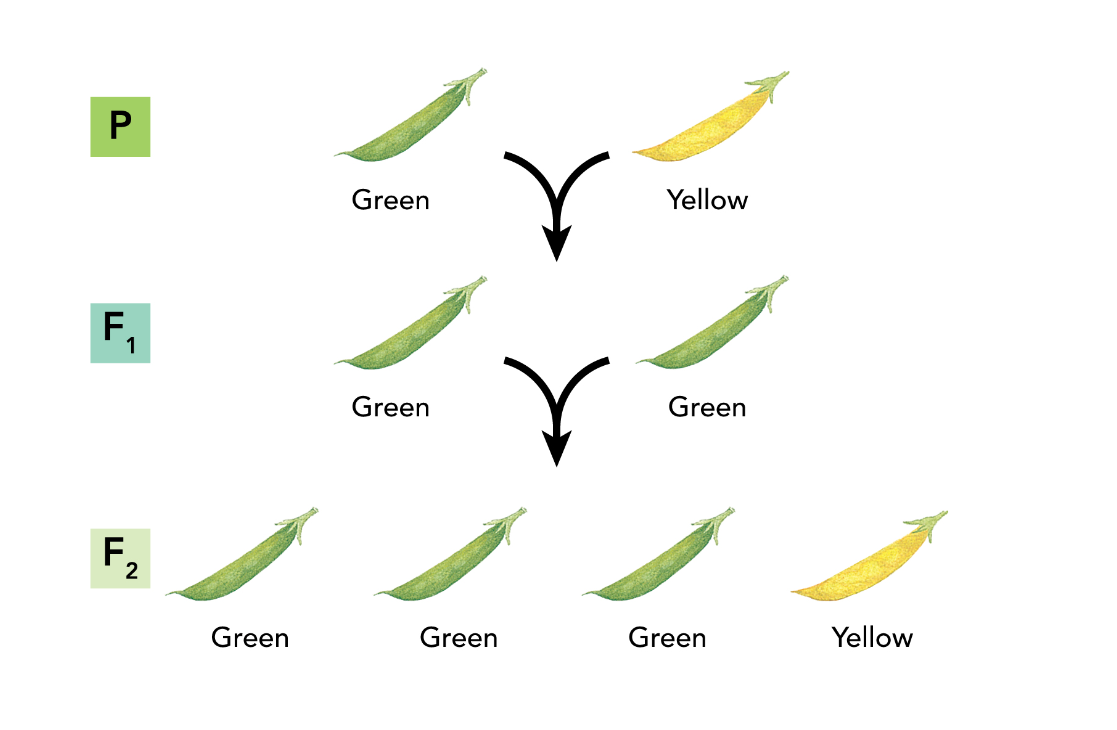
During gamete formation, the alleles for each gene segregate from one another so that each gamete carries only one allele for each gene.
Applying Mendels Principles
- Probability is the likelihood an event will occur
- It can be found using a punnett square
- A genotype is the genetic make up
- Phenotype is physical traits
- Homozygous had 2 identical alleles for a gene
- Heterozygous had 2 different alleles for a gene
- INheritance is determined by units called genes which are passed from parents to offspring
- Where more than one form of a gene for a single trait exists some alleles may be dominant and other recessive
- Each aduly has 2 copies of each gene: one for each parent and are segregated form each other once gametes are formed
- Alleles for different genes usually segregate independently of each other.
Meiosis
Heredity is the transmission of traits from one generation to the next
Variation occurs when offspring differs in appearance from parents and siblings
Genetics is the study of heredity and herediary variation and is studied at 3 levels
- organism
- cell
- molecule
Genes are hreditary units that are found in DNA
Genes are segments of DNA that are a squence of nucleotides
- genomes are all of the genetic information you inherit from your parents
- Cells translate genetic sequences into traits
There are 2 types of reporduction:
- Asexual Reproduction:
- 1 parent
- offpsring look exactly like the parent
- Genetic differences due to changes in DNA
- Take form as mitosis in unicellular organisms with a nucleus
- Binary fission happens in organisms without a nucleus
- Sexual Reproduction:
- combines genetic material from 2 parents (sperm and eggs)
- Offspring are genetically different from parents
- Geonomes: unique combinations of genes inherited form parents
Asexual vs Sexual
- Asexual Reproduction
- Pros:
- Can make offspring faster
- dont need a partner
- Cons:
- All cells are alike
- a disease could wipe out all of the population
- Sexual Reproduction
- Pros:
- Allows for variation within a population
- Individuals can be different
- Provides foundation for evolution
- Allow species to adapt to changes in their enviornment
- Cons:
- Must find a partner to mate with (slower time to reproduce)
Parents of sexual reproduction givbe their children 46 chromosomes EACH meaning the child has 92 which is too many chromosomes in a human
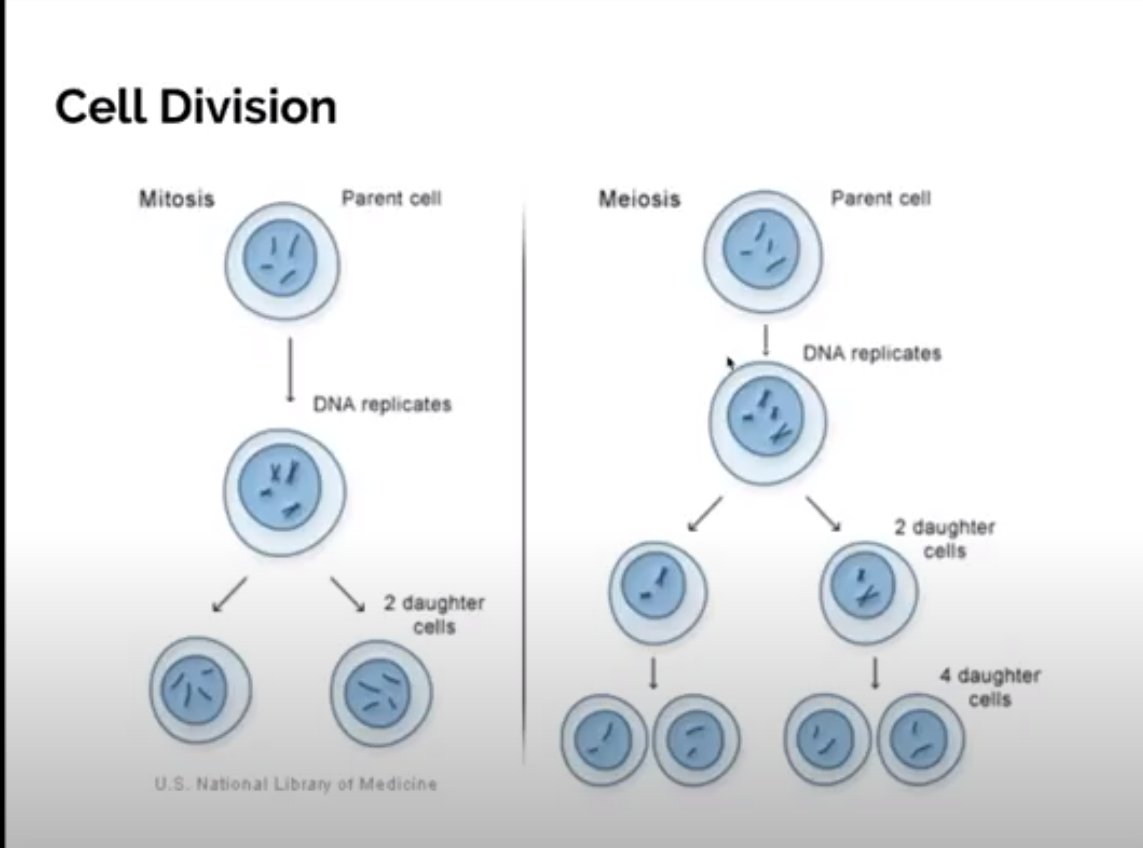
Meiosis makes cells with 1/2 the number of chromosomes for sexual reproduction
Chromosomes are found in the nucleaus of all eukaryotic cells
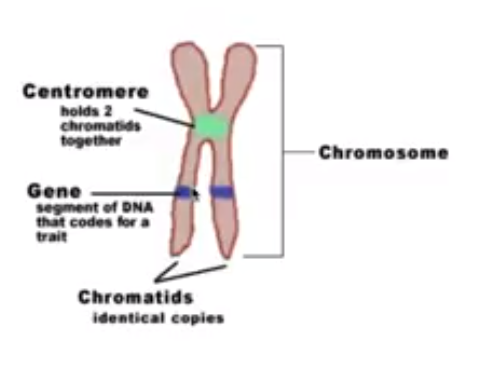
Chromosome is one very long, condensed DNA molecule
Genes are located on specific positions on chromosomes called loci
Diploid Cells (2n)
- Represented by 2n with n meaning chromosomes and 2 meaning double the chromosomes
- A cells that contains both sets of homologous pairs (or homologs) is a dilpoid
- Somatic cells: body cells that are everything except for your sex cells (sperm and egg)
- Cells such as muscle, skin, blood
- And contain a complete set of chromosomes (one set from mom and one from dad)
Humans
- Humans have 23 pairs of chromosomes (23 from mom and 23 from dad)
- A diploid is 2 sets of homologous chromosomes
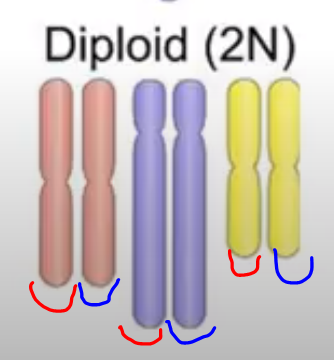
Homologous Chromosomes are like a matching set but they are not alike
- Homologous chromosomes have the
- same size
- same shape
- carry genes for the same traits
- but have different alleles
- alleles are different forms of the same gene
Chromosomal Theory of Inheritance
- Chromosomes and genes are present in pairs in diploid cells
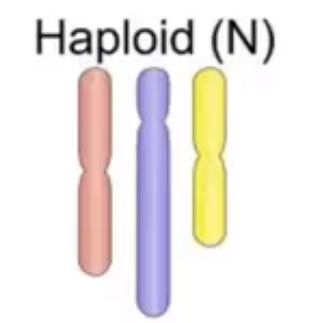
- Homologous chromosomes witll seperate during MEISOSIS to form haploid cells
- Fertilization will restore chromosomes number to the diploid condition
Meiosis vs Mitosis
Stages of Meiosis
Interphase I
- Same as mitosis
- Cells undergo a round of DNA replication
- forms duplicate chromosomes to prepare for meiosis
Meiosis I
Homologous pairs of chromosome seperate
- Prophase I: Chromosomes condense and pair up, forming homologous pairs. Crossing over occurs, where genetic material is exchanged between the chromosomes.
- Homologous chromosomes replicate
- Homologous chromosomes pair up to form tetrads a group of 4 chromatids and this process is calles synapsis
- Crossing over (or homologous recombination) alters the linkage bwteen genes on the same chromosomes
- The location where the chromosomes cross over is called a chiasmata
- Crossing over is a type of genetic variation
- Metaphase I: Tetrads line up at the equator of the cell.
- Each pair aligns independently of one another (independent assortment)
- Anaphase I: Tetrads separate into homogous form of a gene and move to opposite poles of the cell. (segregation)
- Telophase I: Chromosomes reach the poles and the cell divides, resulting in two daughter cells.
Meiosis II
Essentially just mitosis at this point
- Interphase II: DNA is not replicated during Interphase II of Meiosis, often this phase is not recognized or simply recognized as a preparation period for Meiosis II
- Prophase II: Chromosomes condense again and the nuclear envelope breaks down.
- Metaphase II: Chromosomes line up at the equator of the cell.
- Anaphase II: Sister chromatids separate and move to opposite poles of the cell.
- Telophase II: Chromosomes reach the poles and the cell divides, resulting in four haploid daughter cells.
Gametogenesis
Gametes are haploid celled produced by meiosis 2
- Males: sperm
- Females: egg
Spermatogenesis
Making of mature sperm which is achieved from the processes of mitosis and meiosis
- Miotic divisions turn a primordial germ cell in embroyo to a spermatogonial stem cell
- Miotic divisions turn a spermatogonial stem cell to a spermatogonium
- Miotic divisions turn a spermatogonium to a primary spermatocyte
- Meisosis occurs and puts the primary