Price Elasticity of Supply and Demand
Demand: a measure of how responsive quantity demanded is to a change in price.
Supply: a measure of how responsive quantity supplied is to a change in price.
If something is relatively inelastic, than there is no change. If something is relatively elastic, then there is a change.
Factors influencing price elasticty of demand (PED):
whether a good is luxury (elastic) or a necessity (inelastic)
existence of a close substitute (closely substituted goods are more elastic)
whether the good is habit forming (inelastic) or not (elastic)
length of time since price increase (longer the length of time = more elastic)
proportion of Y (income) spent on a good
Perfectly Elastic Demand:
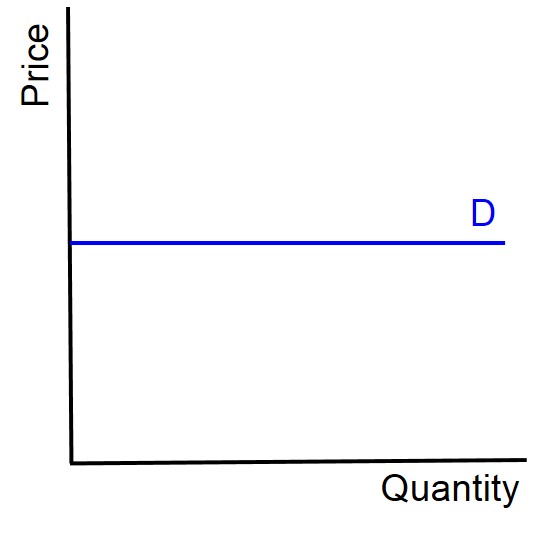
At any price above P1 (price at D), demand is zero. any price below, demand is infinite.
EX: Market with identical products and many sellers→ no seller that is selling above P1 will sell any products and the price will then be lowered to sell.
Calculatin PED using the total outlay method:
D is elastic when revenue moves in the opposite direction to the price change.
D is inelastic when total revenue move in the same direction as the price change.
D is unit elastic if there is no change in total revenue.
Perfectly Inelastic Demand:

Change in price (total) will not changge the quantity demanded, there is no relationship between price and demand.
EX: life-saving medicine.
Factors influencing price elasticity of supply (PES):
length of time since price increase
ability to hold and store stock
excess production capacity
Perfectly elastic supply:
Suppliers will supply any amount above P0.
At P0, the market supply = Qd.
Suppliers will not supply a product for less than P0.
Perfeclty Inelastic supply:
At Q0, the amount supplied is fixed and there is no relationship to a change in price.
E: rare items, one-of-a-kind artworks (fixed supply)
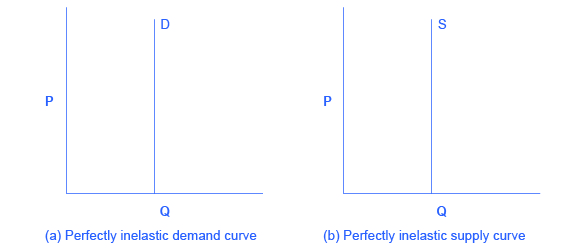
*Note: aggregate supply is inelastic with no relaitonsip in the long run.