greenhouse gases→gases found in the atmosphere such as water vapour, carbon dioxide, methane and nitrous oxides, that contribute to the greenhouse effect
water vapour→water found in the atmosphere in a gaseous form. It is the most abundant greenhouse gas
carbon dioxide→a gas found in the atmosphere that is a main greenhouse gas. carbon dioxide enters the atmosphere by respiration and decomposition as well as burning of biomass and combustion of fossil fuels. It is taken out of the atmosphere by the process of photosynthesis and absorption by water.
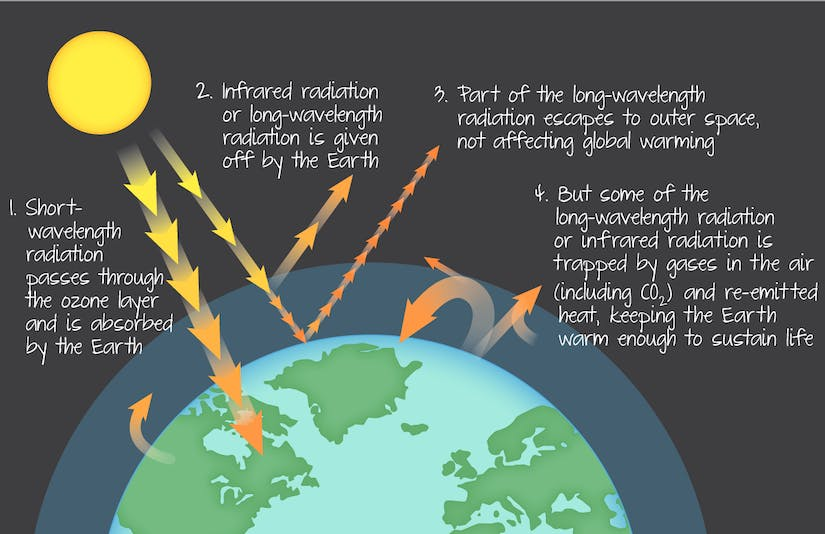
for a gas to contribute to the greenhouse effect, it needs to be able to absorb a longer wavelength or infrared raditation.
all greenhouse gasses combined make up less than 1% by volume of the Earth's atmosphere
Certain gases in the atmosphere absorb radiation and retain heat, causing Earth's atmosphere to be warmed.
Sources of GHGs
Methane
emmited from marshes and other waterlogged habitats
landfill sites
extraction of fossul fuels
melting ice in polar regions
Nitrous Oxide
released by bacteria in some habitats
agriculture
vehicle exhaust
Greenhouse Gases and the Wavelength of Radiation
Summary of the four steps that explain the greenhouse effect:
SolarRadiation
solar radiation from the sun passes through the ozone layer (the layer of the atmosphere which blocks UV radiation)
only short-wavelength radiation from the sun reaches the Earth's surface -
Without greenhouse gases, the Earth's temperature would be about -18 degrees Celsius.
Greenhouse Gases: atmospheric concentrations
Implications of increase in global temperatures:
Climate change
rising sea levels
loss of habitat
biotic factors
frequent and stronger storms
precautionary principle→also known as the burden of proof, this principle states that even without concrete evidence of a causal relationship, precautionary measures should be taken to ensure that humans are not causing detrimental harm to the environment or human health.
Carbon Dioxide and the Coral Reefs
coral reefs→a ridge in the ocean where living coral polyps attach and secrete calcium carbonate. Coral reefs are typically very diverse places found in warm shallow waters.
Due to the large amounts of carbon dioxide dissolved in oceans, the average pH level of oceans has decreased to about 0.11, causing ocean acidification.
Due to ocean acidification, the solubility of calcium carbonate increases (as it is soluble in acids/low pH solutions), decreasing the amount of calcium carbonate available to organisms.
marine organisms such as crustaceans, molluscs and corals require calcium carbonate to build their exoskeletons and shells, through calcification
without a sufficient supply of calcium carbonate, the speed at which coral reefs are built will slow down and they will also become more brittle, thus they become less resilient to other factors influencing their survival.
Many of the organisms affected by ocean acidification and a rise in temperature are important food sources for corals. Their destruction disrupts the food chain.
acidification of ocean > low carbonates > marine animals can't make exoskeleton > decrease in aquatic diversity