Chapter 8
PRODUCTION AND SUPPLY
Production
production is the process that transform inputs (factors of production) in outputs (goods or services)
production function is the relationship that describes how input are transformed into outputs
Q=F(L, K) where K is capital and L is labour
Fixed and variable inputs
long run —> the shortest period of time required to alter the amounts of all inputs used in a production process (we consider the long run since the moment when a firm can used all their inputs)
Short run —> the period of time during which at least one one of the inputs used in a production process can not be varied
Variable input: an input that can be varied in the short run
fixed input: an input that can not vary in the short run
Law of the diminishing returns: if other inputs are fixed, the increase in output from an increase in the variable input must eventually decline
in this graph it is shown how additional units of the variable input give rise to smaller and smaller increments in output, before getting to the point where the total production decreases as units of variable input are added
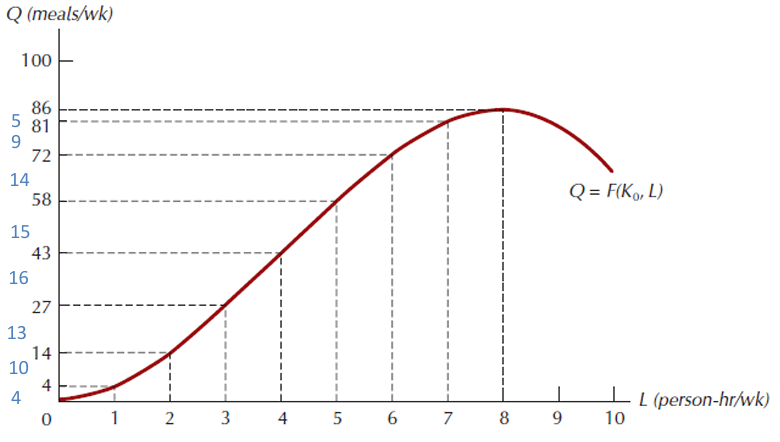
Short-run production function components
total product curve —> a curve showing the amount of output as a function of the amount of variable input
marginal product —> change in total product due to a 1-unit change in the variable input
average product —> total output divided by the quantity of variable input
Relationship among total, marginal and average product curves
When the marginal product curve lies above the average product curve, the average product curve must be rising
When the marginal product curve lies below the average product curve, the average product curve must be falling.
The two curves intersect at the maximum value of the average product curve.
Production in the long run
Isoquant: the isoquant is the set of all input combinations that yield a given level of output
MARGINAL RATE OF TECHNICAL SUBSTITUTION (MRTS): the MRTS is the rate at which one input can be exchanged for another input for another without altering the total level of output
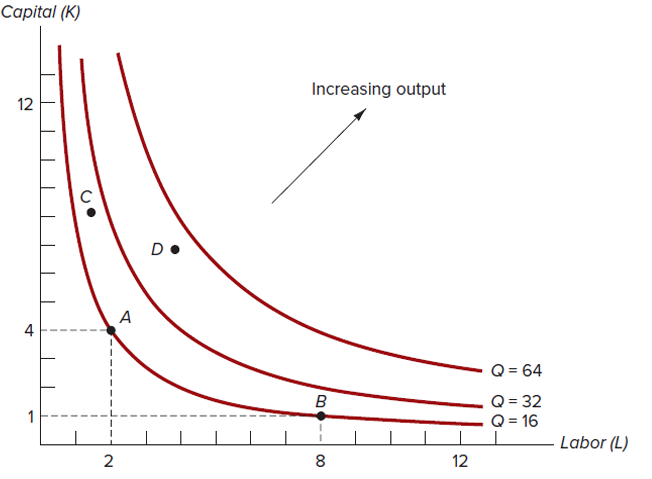
Returns to scale
increasing returns to scale: the property of a production process whereby a proportional increase in every input yields a more than proportional increase in output.