Homeostasis
Required Reading: Vander’s Human Phys
3.1. Microscopic Observation of Cells
Prokaryotic cells lack membrane bound organelles
Intracellular fluid refers to all the fluid inside the cell, including that which is inside the organelles
3.2 Membrane Structure
Major membrane lipids are phospholipids
They are organized with nonpolar FA chains facing eachother and polar heads facing the surfaces of the membrane (inside and out)
Chemical bonds do not link the phospholipids, thus they can move around like oil on water. They do not resist tearing
Plasma membranes contain a small ammount of cholesterol, whereas intercellular membranes dont.
Cholesterol is slightly amphipathic due to a singular hydroxyl group
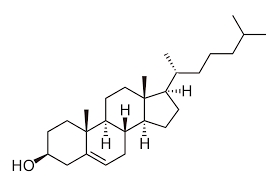
“The close association of the non-polar rings of cholestrol with the fatty acid tails tends to lmit the ordered packing of FAs in the membrane”
So basically thanks to cholesterol the membrane retains some of its fluidity (also a temp thing but this is not mentioned)
Integral membrane protiens cannot be extracted from the membrane without disruption
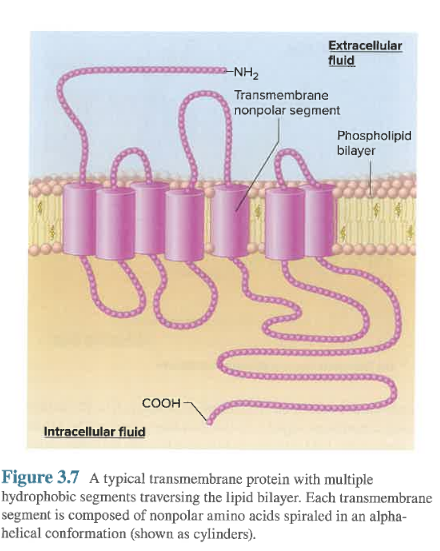
Transmembrane proteins are integral protiens that span the entire membrane
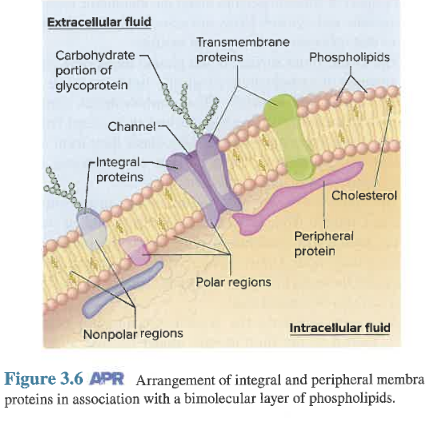
Peripherial membrane proteins are NOT amphipathic and thus associate with the polar regions of the integral membrane proteins. Most of these remain on the cytosyolic side
Membrane Junctions
Integrins are responsible for binding to specific protiens in the extracellular matrix and linking them to membrane protiens on adjacent cells.
Desmosomes are accumulations of dense plaques along the cytoplasmic surface of the plasma membrane
Cadherins are proteins that extand from the cell into the extracellular space
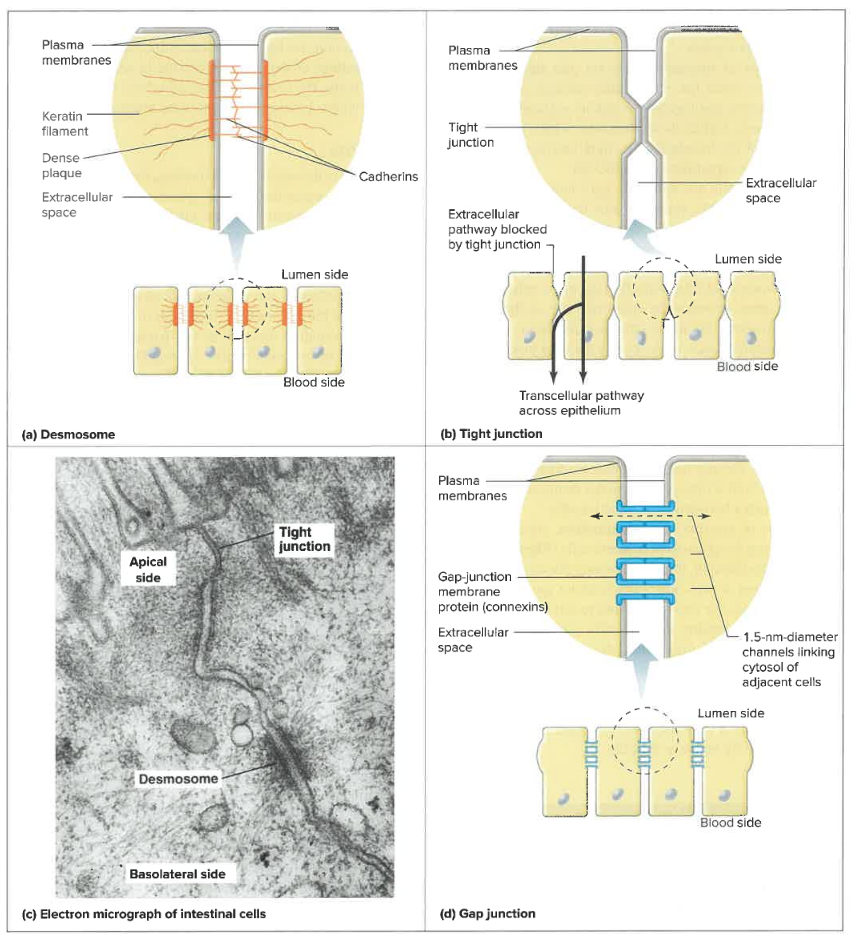
Tight junctions form when the extracellular surfaces of two adjacent plamsa membranes join together so that there is no space. This goes around the circumfrence of the cell (rather it CAN)
Gap junctions are protien channels that link the cytosol of adjacent cells, You could move Na+ and K+ but not large proteins
3.3 Cell Organelles
Nucleus is surrounded by a nuclear envelope with openings or pores that allow RNA to move out once its been sythnezied and allow for proteins that modulate gene expression in.
Nucleolus is a dense filamentous region that contains the genes for forming the particular type of RNA found in ribosomes
Ribosomes are the cites of protien synthesis. They can be free floating or attached to rough ER
Rough ER packages proteins that ar then sent to eh Golgi to be distributed to other cell organells
Smooth ER has no ribosomes and is where lipids are synthesized, Ca2+ is stored, and detoxification occurs
Golgi Appartus sorts and pacakges protiens to be moved around or out of the cell
Endosomes are membrane bound vesicular and tubular strucutres that pinch off from the membrane to transport things
Mitrochondria produce ATP with inner membrane cristae and the compartment the matrix. Many of these exist in some type of reticulum
Lysosomes contain digestive (usually acidic) enzymes to break down damaged cell and other debris
Peroxisomes remove H from organic molecules including lipids, alcohol, and ingested toxins. Also involved in conversoin of FAs into ATP
8/13/25 Slides Preview
1.Insulin Dependent Glucose Homeostasis
Inc in blood glu results in inc glucose uptake via B-cells through GLUT2 transporter
Intracellular Glu is converted to ATP
Inc ATP inhibits ATP-sensitive K+ channels, depolarizing the membrane
Depoarization causes influx of Ca2+
Ca2+ influx stimulates insulin secretion into the extracellular fluid, and thus into the bloodstream
Insulin in the liver INHIBITS glucose production
Insulin in the fat and muscles cells INCREASES glucose uptake and storage as glycogen
1.1 Control of artieral pressure by arterial baroreceptors
Increased arterial pressure increases nerve impules to baroreceptors to the medulla of the brain
Imput is compared with reference point in medulla
Error signal decreasing SNS is generated
Decreased SNS dilates blood vessles and reduces pumping activity of the heart
Arterial pressure returns to normal
2. Homeostatic Control
Sensors or receptors deterct specific changes in the environment
Inegrator, comparator, or control center recieves infromation and initiates the response to maintain homeostasis
Effector performs the appropriate response
Nervous system is fast and targeted respomces to changes in external and internal environment
Endocrine is for changes in internal milieu and is slow and diffuse
yeah im good