HERITABILITY OF INTELLIGENCE: (WK34):
CONTROVERSIAL HISTORY:
Galton (1883) introduced an area of intelligence besides individual differences
eugenics = the study of how the ‘stock’ of a society can be improved
traits such as health, energy, ability
‘positive’ eugenics = encouraging the higher class to marry and reproduce responsibly
‘negative’ eugenics = encouraging the undesirable sections of society not to reproduce
example: the Kallilak family
HEREDITARIANISM AND IQ:
Gould (1981, 1995) describes the contribution of hereditarian theories of intelligence
low IQ associated with criminality
conflated idea of innateness with fixedness
prejudice and discriminatory according to class/race/social group
influenced social policies
example: case of Buck vs. Bell (1927)
17 yr old Carrie Buck picked as first person to be sterilised in Virginia
resident in asylum, had a baby despite being unmarried → her family was said to be part of the ‘ignorant and worthless class of anti-social whites of the South’
the judge then agreed that Carrie should be sterilised because… ‘it is better for all the world … degenerate offspring of crime … society can prevent those who manifest as unfit from continuing their crime’
THE RISE AND FALL (AND RISE) OF EUGENICS:
1907 Eugenics society founded n the UK
1917 restricted immigrants
1910s-1970s over 60,000 people sterilised enforcibly
1912, 1921, 1932 held International Eugenics conferences
1930s association of eugenics with Nazism
1939 the ‘euthanasia program’
1933, 1945 genocide of 6 million due to Nazis
WHAT IS HERITABILITY?
heritability = the proportion of population variance in a trait that can be attributed to genetic factors
basics:
we all have 46 chromosomes in 23 pairs
22 pairs are XX, the last is either XX or XY
20,000-25,000 total genes, with each one having different possible variants (alleles)
CONCORDANCE RATES:
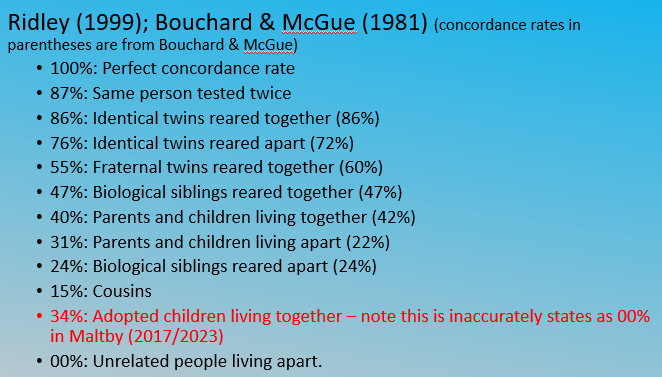
how similar on average the scores are for a kind of relationship
can vary from 0-100%
can only be calculated for groups
twin studies
mz = .86
dz = .55
we typically use twins because of their genetic similarity, meaning any differences would be environmental
adoption studies also provide the same explanation, not entirely genetic influence
HERITABILITY OF IQ:
many researchers have gotten numbers like: 40-80%, 30-75%, 50-80%
this suggests that iq definitely has a heritable component
a group difference can be entirely environmental even if a trait has high heritability
limits:
assumes all family members share the same environment
no allowance for situations like adoption