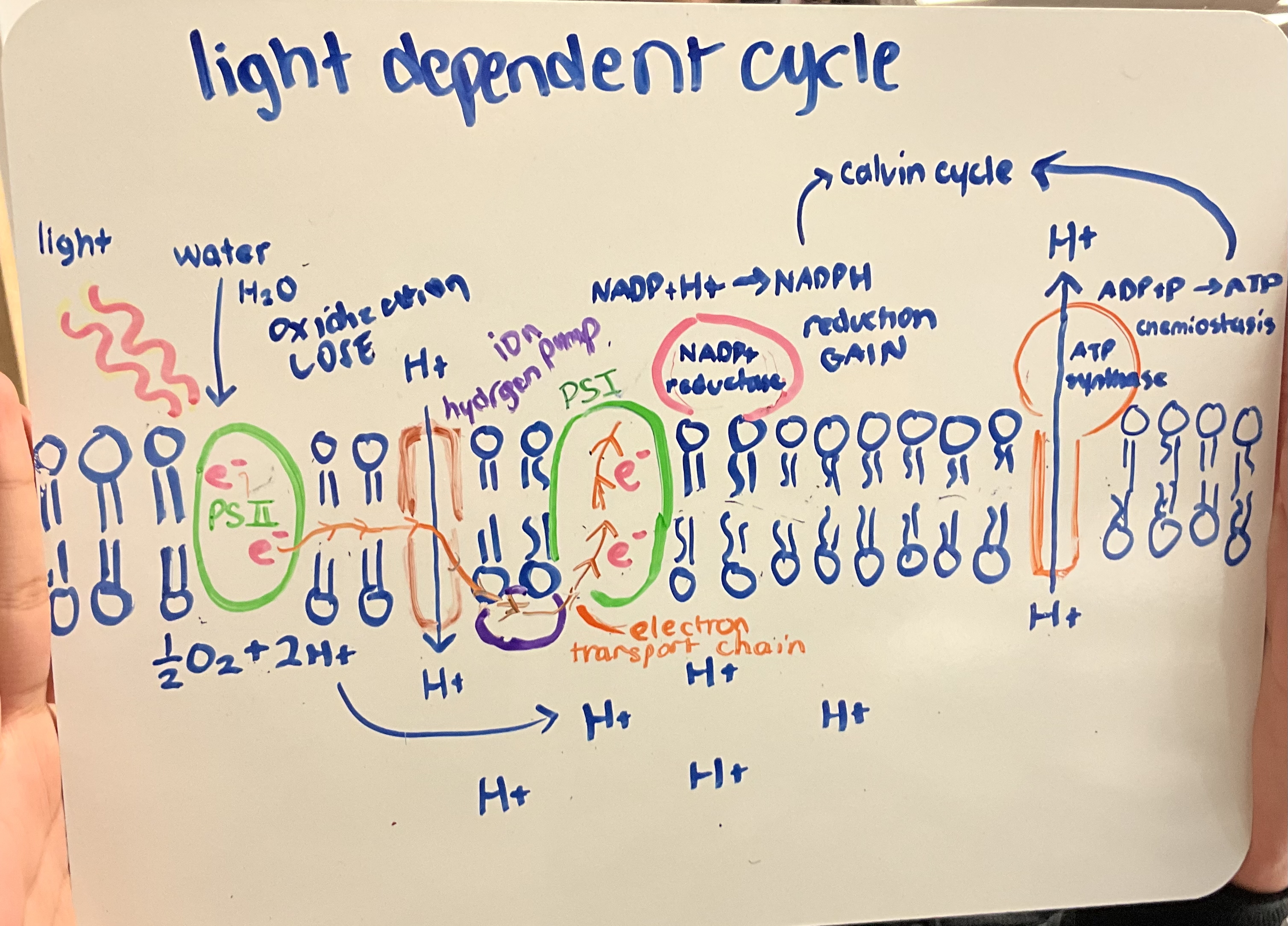
Light Dependent
When light is absorbed by chlorophyll in the thylakoid membranes of the chloroplasts, electrons in the photosystems become energized. Electrons from photosystem Il are transferred to a series of proteins called the electron transport chain and are re-energized in photosystem I. The enzyme NADP+ reductase adds high energy electrons to NADP+ to form NADPH. In other words, a reduction reaction occurs with a GAIN of electrons.
To replace electrons lost by the photosystems, water is split in a process known as photolysis. Because water is LOSING electrons (and H+), it is being oxidized. The product, oxygen is also created during this process and released to the environment.
Electron energy is used to PUMP H+ into the small interior of the thylakoids. This active transport creates a HIGH concentration of H+ ions inside the thylakoids. The enzyme ATP synthase allows H+ to flow from high to low into the stroma by facilitated diffusion. The flow of H+ powers the creation of ATP by the process known as chemiosmosis.
Light is absorbed by the chlorophyll in the thylakoid membranes and its electrons are energized. These electrons travel through the electron transport chain and re-energized in photosystem I. These electrons are used when NADP+ reductase performs a reduction reaction in which NADP+ GAINS electrons and transforms into the product NADPH.
Furthermore, the water is split through photolysis to utilize the H+ due to the electrons lost. An oxidation reaction occurs as it LOSES electrons. Oxygen is created as a byproduct and released to the environment.
H+ is actively transported into the thylakoid through a proton pump resulting in a HIGH concentration of H+. As H+ then moves from high to low concentration into the stroma with the enzyme ATP synthase by facilitated diffusion, a phosphate group is added to ADP forming ATP through chemiostasis.