Exam Review
What is Disease?
The meaning of “Disease” is “without ease” (uneasiness). It’s either a Physiological or Psychological dysfunction.
Illness
Not only the presence of disease but also the involvement of an individual’s perceptions and behavior in response to disease are included. Diseases are very subjective.
Sickness
Includes a state of social dysfunction, too. For example, the role and individual assumes when ill.
Environmental Related Diseases
This refers not only to the environment but also to the person who lives in it. Various environmental factors are categorized as follows.
1. Physical Environment
Physical aspects of the environment, like air, water, light, heat, radiation, gravity, pressure, and chemical agents, etc. Man tries a great deal to control these factors.
2. Biological Environment
Certain diseases do not occur in some areas because agents or vectors can not exist in that environment due to biological reasons.
3. Social Environment
The social factors relevant to health include socio-economic status, social customs, traditional believes and, etc.
Natural History of Disease
Refers to the course of a disease over a period of time, unaffected by treatment.
Disease occurrence is usually insidious. Chronic diseases evolve over a long period and have their own progression. The history and time period that it spread is different from disease to disease.e Most of the diseases pass through the following pattern.
1. Stage of Susceptibility
Risk factors that favor the occurrence of a disease are operating in this stage.
Host Factors: Age, sex, race, family history, nutritional status
Environmental factors: Exposure to infectious agents, (infectious) obesity, (HT, DM, coronary artery diseases)
During this stage, the person remains free of clinical diseases
2. Stage of pre-symptomatic disease
Three important factors, i.e.. Host, agents, and environment interact to initiate pathogenic changes that are adequate to cause a disease. Still, the disease does not clinically manifest.
3. Stage of clinical disease
In this stage, the particular signs of symptoms develop. During this stage, a disease can be sub-classified into its own severity grades.
E.I. Cancers
Stages:
Localized
Local Lymph nodes are involved
Involvement of other organs within the same region
Distant metastases
4. Stage of terminations
Disease terminates and follows the following trend:
Spontaneous resolution - No sequels
Settles down but with some sequels
Result in the death of the patient
5. Stage of sequels
Disease may extinct, but the aftermath that remains may be an impairment. ——> Disability ——→ Handicap.
Sequence of events
Disease —> Impairment —> Disability —> Handicap
Impairment: “Any loss or abnormality of psychological, physiological, or anatomical structure or function.” For example, loss of a foot, defective vision, mental retardation.
All patients must have effective pain management
Appropriately screening and pain assessment
Documentaion
care and treatment
Pain education
Patient self-report of pain must be a source of assessment whenever possible
The patient’s acceptable level of pain must guide treatment.
Determination of Pain
Patient self-report of pain must be a source of assessment whenever possible
Patient’s acceptable level of pain must guide treatment
If the patient is unable to self-report, assessment strategies should include:
Observable behaviors (facial expression, body movements, crying)
Physiological measures (heart rate and blood pressure)
What is Pain?
“An unpleasant sensory and emotional experience associated with actual or potential tissue damage, or described in terms of such damage.”
International Association for the Study of Pain (Merskey, 1979)
Pain is always subjective.
The patient's self-report of pain is the single most reliable indicator of pain.
The clinician must accept the patient’s self-report of pain.
Acute Pain
Acute pain typically presents with a clear cause, is relatively brief in duration, and subsides as healing progresses.
Acute pain is often accompanied by observable, objective signs of pain.
Increased pulse rate
Increased blood pressure
Non-verbal signs and symptoms such as facial expressions and tense muscles
Chronic Pain
Pain that is persistent and recurrent
When pain persists, it serves no useful purpose and can dramatically decrease the quality of life and function.
Chronic pain rarely has any observable or behavioral signs, although persons may appear anxious or depressed.
Pain Mangementment Aooroach
Should be interdisciplinary and multimodal
Care is indivduzalized
Pain source and intensity
Patient’s age
Deleopmental, physical, andcognitiveestatuss
Cultural beliefss
Treatment preferences
Concurrent medical condition
A well-known comprehensive approach to the management of persistent pain is the Five A’s of Pain Management: analgesia, activities of daily living, adverse effects, affect, and aberrant drug-related behaviors.
Multimodal Analgesia
This term describes the use of multiple modalities that are used to provide pain relief, with various parts of the pain pathway targeted.
Decreased dependence on the single modality agents decreases the risk of side effects.
May Include:
Pharmacological opioids, NSAIDS, gabapentinoids)
Relaxation techniques (biofeedback, deep breathing)
Regional anesthesia (nerve blocks, epidural catheters)
Treatments May Include
Non-pharmocolgic Methods
Heat/cold
Relaxation
Distraction
Guided Imagery
Acupressure/Acupuncture
Repositioning
Pharamoclgic Methods
Anti-seizure meds
NSAIDS
Anti-depressants
Opioid analgesics
Local anesthetics
Neurolytics
Acute vs. Chronic Pain Management
Acutue Pain
Most often treated with:
NSAIDS
Opioids
Locaanestheticscs
Spliniting
Postioting changes
Ice
Chronic Pain
Most often treated with:
Anti-seizure meds
anti-depressants meds
NSAIDS
Implantable device
Psychological therapy
Accupunture
When all else fails and the benefits outweigh the risks
Opioids
Patient and Family Education
All patients and family must receive education on their right to effective pain management, which may include:
How to report pain using the pain scales
importance of reporting pain as accurately and promptly as possible
Use of pumps and other technologies used in pain control.
Use of non-pharmacologic and pharmacologic methods of relieving pain.
Importance of notifying staff of unrelieved pain.
Identification of an acceptable functional pain level that will allow them to participate in their prescribed activity level.
Patients and family are given specific instructions before discharge regarding:
Pain control
Pain medications
Management of potential side effects
In Review
What are the 4 A’s of pain management?
What are the basic principles of pain management?
What adoes the pain scale help with
The Process of Infection
Infection: a disease or condition caused by a microorganism.
Microorganisms are the tiniest living organisms on earth that eat, reproduce, and die.
Infection is considered an illness or disease if it interferes with your usual lifestyle or shortens your life.
The process often follows a typical course, with the length of each stage depending on the pathogen, an infectious agent capable of causing disease.
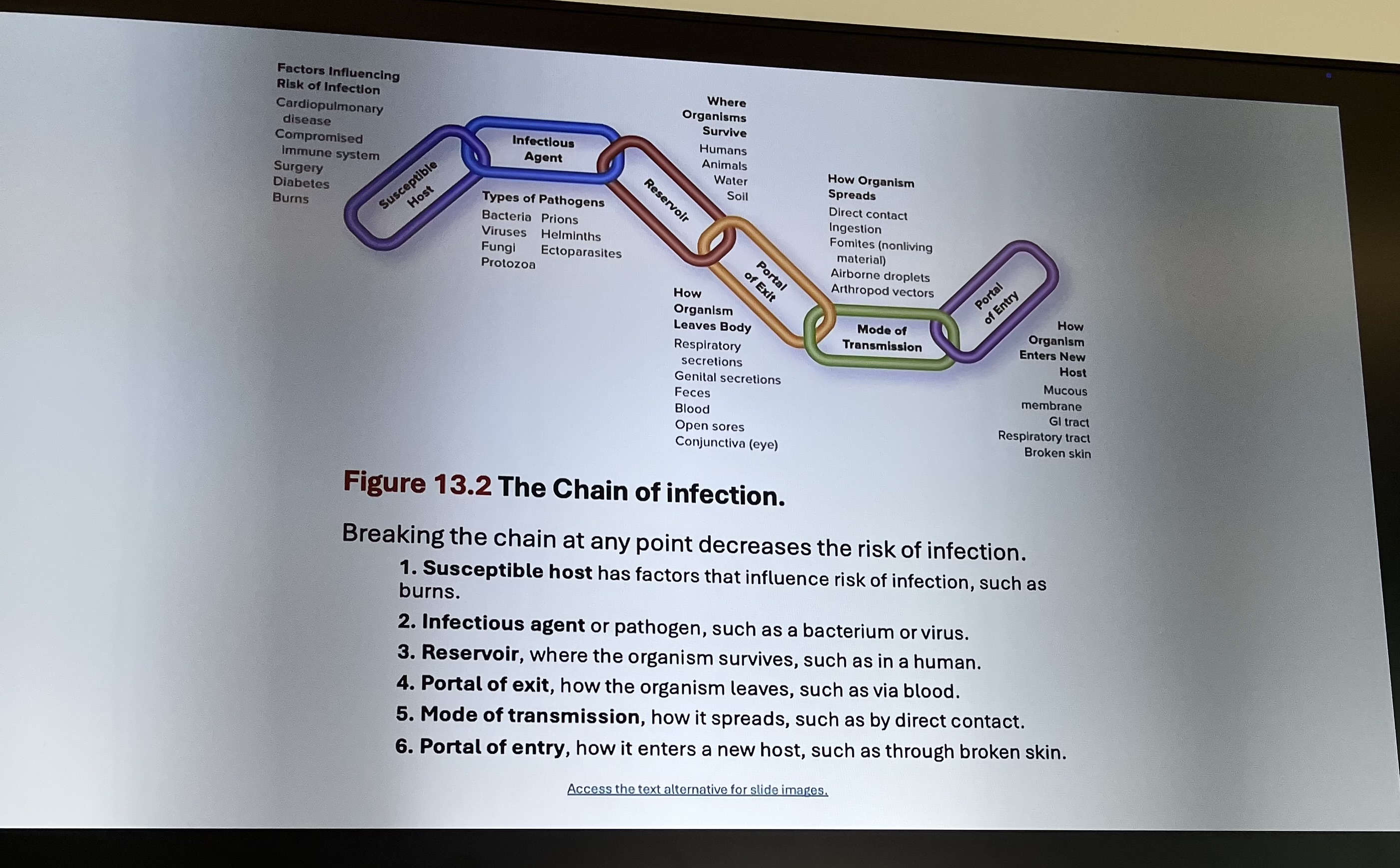
The Chain of Infection
Chain of infection: the process by which an infectious agent, or pathogen, passes from one organism to another.
Pathogens often live in large communities, called reservoirs.
• Some cannot survive in the environment and require a living host.
• To cause infection, they must have a portal of exit from the reservoir or host, and a portal of entry into a new host.
•If the transfer from the reservoir or host is carried out by an insect or animal, that organism is called a vector.
Breaking the chain of infection at any point can either increase or decrease the risk of infection.
Virulence: speed and intensity with which a pathogen is likely to cause an infection.
Epidemic: widespread outbreak of a disease that affects many people.
Communicable disease: a disease that can be spread to a person from another person, an animal, or an object. Ex: common cold, influenza, mononucleosis, etc.
Non-communicable disease: a disease that can NOT be spread from person to person. Ex: cancer, heart disease, asthma, etc.
Disease: Any condition that interferes with the proper functioning of the body or mind.
Germs: Disease-causing organisms that are so small they can only be seen through a microscope. Also known as Pathogens
Infection: A condition that occurs when germs enter the body, multiply, and cause harm.
Four Types of Germs:
Virus: the smallest and simplest life form. Not alive, and causes upper respiratory infections and many other types of diseases.
Bacteria: simple one-celled organisms. They are everywhere. Not all bacteria are bad.
Viruses and Bacteria are what I NEED to know
Fungi: more complex than bacteria, but cannot make their own food. Thrive in warm, moist environments
Protozoa: one-celled, animal-like organisms.
How do Pathogens (Germs) Spread??
• Direct contact with others; EXAMPLE: Shaking hands with someone or kissing an infected
person.
• Indirect contact with others; EXAMPLE: Shari drinking glasses or eating from the same spoon or fork as an infected person.
Contact with contaminated food and water;
EXAMPLE: Undercooked foods or water that doesn't look very clean.
• Contact with animals and insects; EXAMPLE: A tick bite, which can spread Lyme disease.
Mosquitos and other bugs.
The Body's Defenses: The Immune System
Immune system: a complex set of cells, chemicals, and processes that protects the body against pathogens when they succeed in entering the body.
Innate immune system: part of the immune system designed to rapidly dispose of pathogens in a nonspecific manner.
Acquired immune system: a highly specialized response that recognizes specific targets.