COMD 461- Masking
Why do we mask
If a signal (Ac or BC) is loud enough in one ear (test ear, TE), the signal can travel across and be heard by the other ear (non-test ear, NTE)
Danger of cross hearing occurs usuallt when the other ears hears better than the test ear
When the intensity is at a high enough level, AC
Masking
Cross hearing can lead to
Original responses being obtained through NTE, not through TE
Not obtaining tru threshold of TE
When cross hearing is suspected, use masking to stop NTE from hearing the T'E’s stimulus
Masking nosie is introduced to NTE while presenting stimulus such as pure tones to TE
Narrowbad noise is used when masking PT
Critical band of frequencies surround the PT to provide maximumu masking with minimal sound presuure
Speech noise is used when masking speech
SPeech noise is shaped so that white noise is filtered to be similar to the overall spectrum of speech
When masking AC threshold, insert is preferable transducer
Inserts decrease occlusion effect
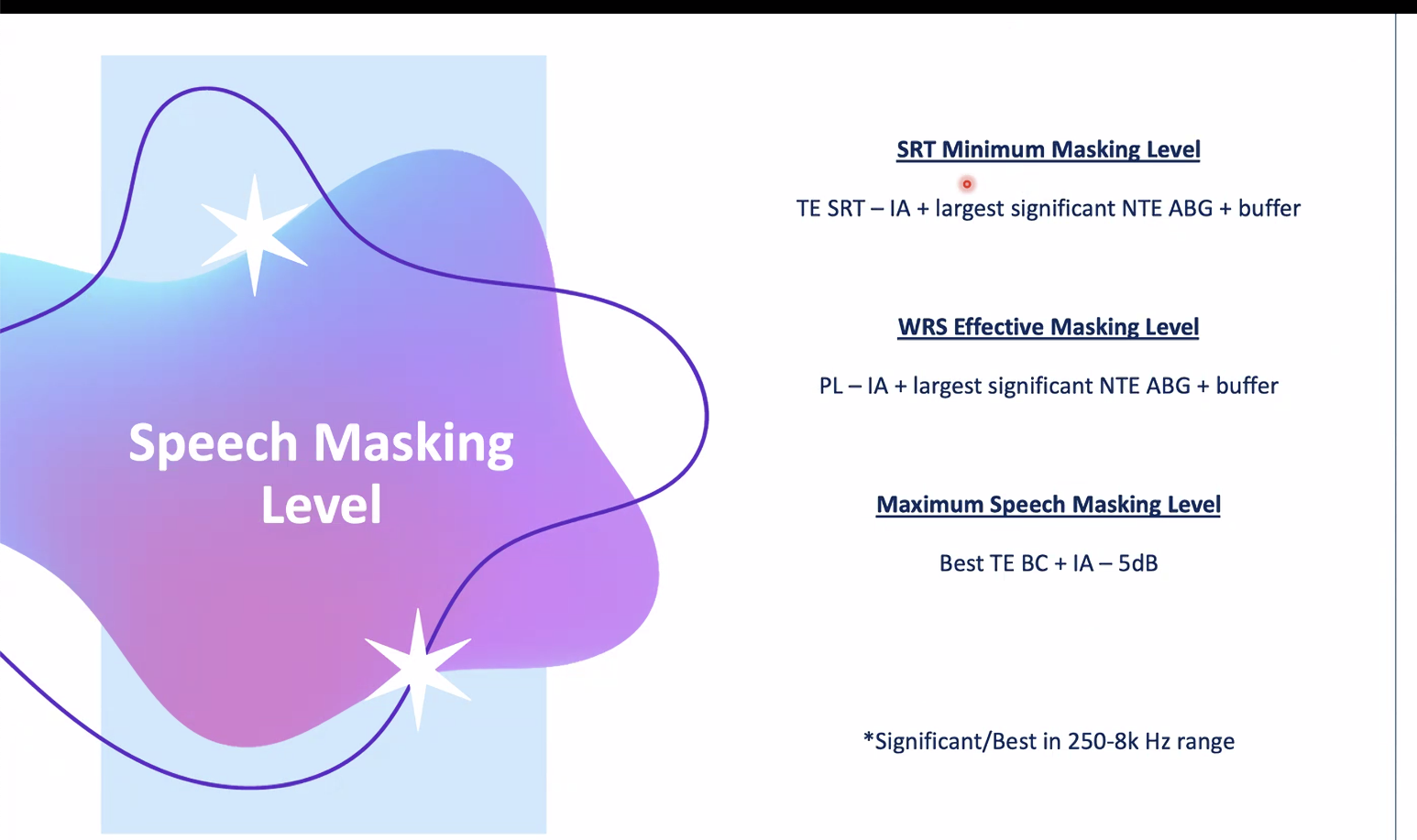
Masking level
Minimum Masking level
TE presentation level - IA + NTE ABG + buffer
(buffer - 10 dB)

Maximum masking level
BC threshold of TE + IA - 5 dB