D1.1 DNA Replication
DNA Structure
Deoxyribonucleic Acid contains genetic information important for the development & growth of cells + organisms in multicellular organisms.
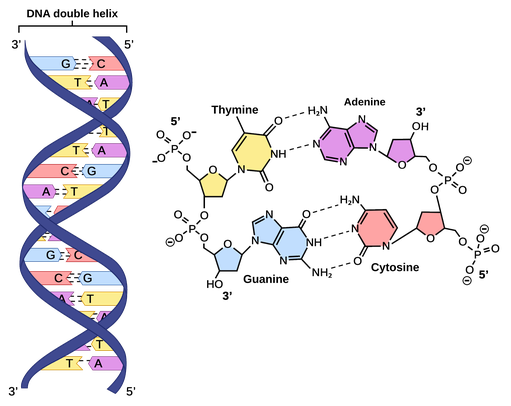
Double helix- twisted ladder
Sides of ladder-sugar (deoxyribose) and phosphate groups.
Rungs= nitrogenous bases (Adenine, Thymine, Cytosine, Guanine)
Sugar+Phosphate= Covalent (stronger) bonds
Complimentary base pairs= hydrogen (weaker) bonds.
DNA Replication
The production of identical copies of DNA
New copes will have identical nucleotide sequences to each other and OG DNA molecule
Occurs before mitosis and meiosis in Eukaryotic cells -Eukaryotic cells are complex cells that contain a nucleus and membrane-bound organelles, distinguishing them from prokaryotic cells.
Mitosis-required for growth and tissue replacement
Meiosis- required for reproduction
Enzymes
Helicase- Breaks down hydrogen bonds and unwinds (separates) the two strands
Gyrase- Relieves the tension and supercoiling ahead of the replication fork caused by the unwinding of the DNA strands.
DNA Primase- Adds a RNA Primer to the strands and provides a starting point for DNA synthesis
DNA Polymerase III- Attaches to RNA Primer. The main job is to add nucleotides to the growing DNA strand (synthesizing) in the 5’-3’ direction. ALSO proofread for correct base pairings.
moves toward the replication fork on the leading strand (continuous), and moves away on the lagging strand(discontinuous).
can only add nucleotides in 3’ end of Primer/chain
Ligase- Joins Okazaki fragments on lagging strand by forming covalent bonds btwn sugar-phosphate backbones
DNA Polymerase I- removes RNA primers and replaces them with DNA Nucleotides (Adenine-Thymine, Guanine-Cytosine- apples in the trees, cars in the garage)
Polly (P) Helps (H) Lisa (L) Prime (P) Her (H) DNA
P: Polymerase I - Removes RNA primers and replaces them with DNA.
H: Helicase - Unwinds and separates the double-stranded DNA.
L: Ligase - Joins Okazaki fragments on the lagging strand and seals breaks in the DNA.
P: Primase - Synthesizes RNA primers to provide a starting point for DNA synthesis.
H: Polymerase III - Main enzyme that synthesizes new DNA strands.
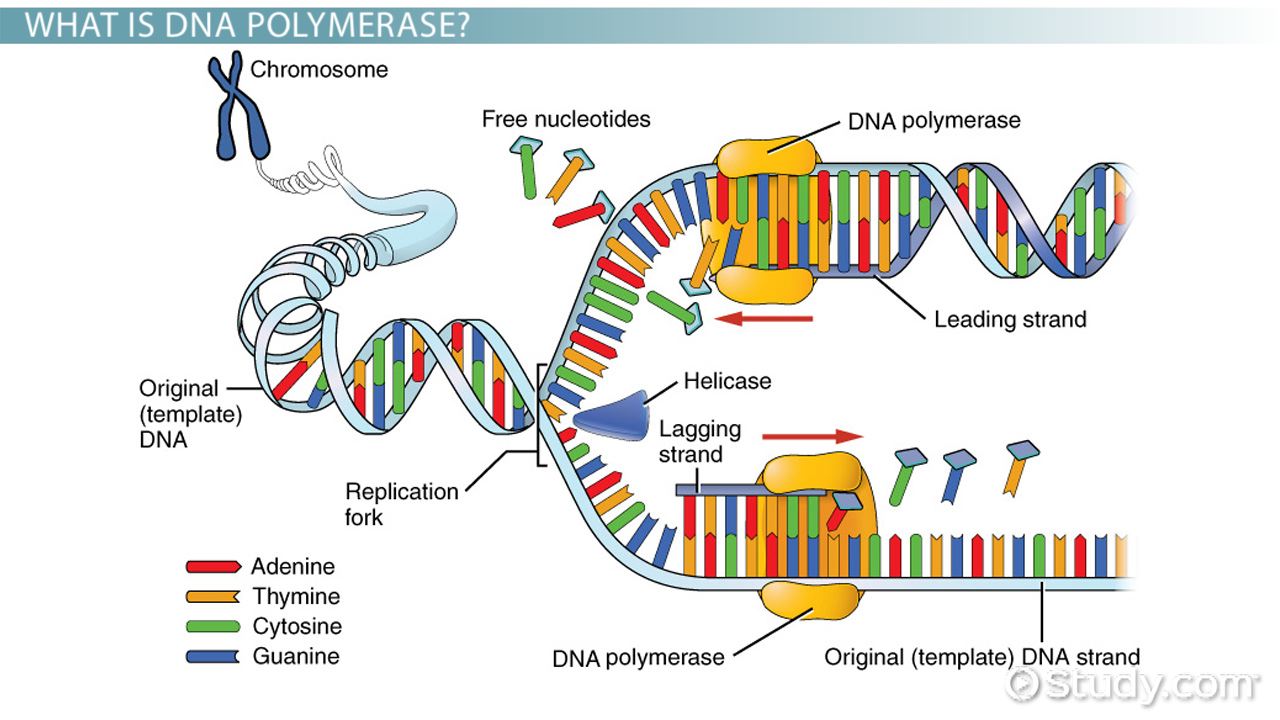
Semi- Conservative
DNA replication is semi-conservative because the new DNA molecules will have 1 parent strand + 1 newly synthesized strand. The complimentary base pairings make it highly accurate.
Polymerase Chain Reaction (PCR)
Method to make many copies of DNA using a small sample using cycles of heating and cooling
Denaturation- DNA sample is heated (95 C) to break down the hydrogen bonds and separate the two DNA strands
Annealing- Temp. is reduced (54C) this allows DNA primers to bind to both strands of DNA to be copied next to the sequence.
The temp goes up (72C) Allowing TAQ Polymerase to replicate both strands beginning at the primer and producing two identical double-stranded DNA
WHY TAQ DNA POLYMERASE???
obtained from a bacterium adapted to living in hot springs → will not denature in the PCR process.
Human DNA Polymerase would denature in the high temp. and not catalyse the reactions to produce new DNA Strands.
Gel Electrophoresis
Used to separate charged molecules like DNA/Proteins used to produce DNA profiles.
DNA is an acid that dissociates and becomes negatively charged in water. Restriction endonuclease enzymes cut DNA into many neg. charged fragments
Gel electrophoresis is a method used to separate pieces of DNA, RNA, or proteins by size. You put the samples in a gel and run an electric current through it, which makes the smaller pieces move faster than the bigger ones
After the run, the separated bands can be visualized, allowing for analysis of the sample composition, such as in DNA fingerprinting.
DNA markers are used in DNA profiles to increase the reliability of the profiles
Direction(rip liam payne)ality

Carbon-1 (1’)= This carbon is attached to the nitrogenous base in the DNA structure, forming the bond that defines the base's position in the nucleotide.
Carbon-5 (5’)= This carbon is bonded to the phosphate group, which is crucial for forming the backbone of the DNA strand
The DNA strands are anti-paralell one runs 5’ to 3’ and the other 3’ to 5’. DNA strands have directionality, typically referred to as 5' to 3'. This notation indicates the direction in which the DNA strand is synthesized and read, with the 5' end having a free phosphate group, and the 3' end having a free hydroxyl group
Quizlet Review- https://quizlet.com/952024995/d11-ib-biology-hl-flash-cards/