CIE IGCSE Biology 8.1 Transport in Plants Notes
8.1 Transport in Plants
8.1.1 Xylem & Phloem
Function of Xylem and Phloem
Plants utilize two primary transport vessels:
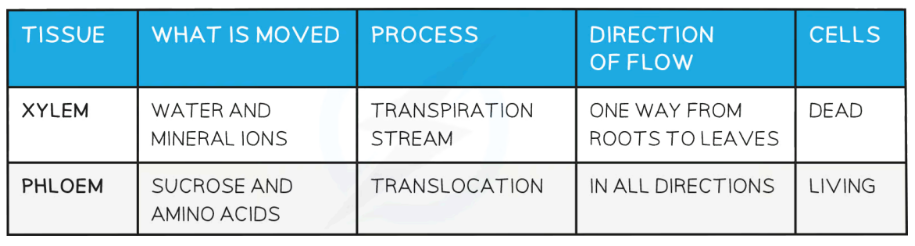
Xylem vessels: These transport water and minerals from the roots to the stem and leaves.
Phloem vessels: These transport food materials, mainly sucrose and amino acids, produced by photosynthesis in the leaves, to non-photosynthesizing regions such as the roots and stem.
These vessels are organized in groups called vascular bundles throughout the root, stem, and leaves.
Vascular Tissue
In a cross-section of a root, stem, or leaf, xylem is always located on the inside, while phloem is on the outside.
8.1.2 Xylem Function
Function
Xylem serves as the primary transport tissue for water and dissolved mineral ions.
Adaptations
Cells are joined end-to-end without cross walls, forming a long continuous tube.
Cells are essentially dead and lack cell contents, allowing for the free passage of water.
Outer walls are thickened with lignin, providing strength to the tubes and aiding in plant support.
Xylem cells lose their top and bottom walls to create a continuous tube, facilitating water movement from roots to leaves.
8.1.3 Root Hair Cells
Root Hair Cells
Root hairs are single-celled extensions of epidermis cells in the root, growing between soil particles. They absorb water and minerals from the soil.
Water enters the root hair cells via osmosis because soil water has a higher water potential than the cytoplasm of the root hair cell.
Structure and Function
The root hair significantly increases the surface area of the cells, which enhances the rate of water absorption by osmosis and mineral ion absorption by active transport.
8.1.4 Pathway Taken by Water
Water Movement
Water moves into the root hair cells through osmosis, then passes through the root cortex and into the xylem vessels.
The pathway is:
root hair cell → root cortex cells → xylem → leaf mesophyll cells
Investigating Water Movement
The pathway can be observed by placing a plant (e.g., celery) in a beaker of stained water (food coloring works well). After a few hours, the leaves will turn the color of the dyed water, demonstrating water uptake.
Cutting a cross-section of the celery stalk reveals that only certain areas are stained, indicating that water is carried in specific vessels (xylem).
8.1.5 Transpiration
Transpiration Defined
Transpiration is the loss of water vapor from plant leaves through evaporation at the surface of mesophyll cells, followed by diffusion of water vapor through the stomata.
Water travels up the xylem from the roots to the leaves to replace water lost during transpiration.
Xylem Adaptations
Cells joined end to end with no cross walls to form a long continuous tube
Cells are essentially dead, without cell contents,to allow free passage of water
Outer walls are thickened with a substance called lignin, strengthening the tubes, which helps support the plant
Movement in the xylem is unidirectional: from roots to leaves.
Functions of Transpiration
Transporting mineral ions.
Maintaining cell turgidity to support plant structure.
Providing water to leaf cells for photosynthesis.
Cooling the leaves through the heat energy required for water to water vapor conversion.
8.1.6 Investigating Temperature & Wind Speed
Investigating Transpiration Rate Factors
To investigate environmental factors affecting transpiration:
Cut a shoot underwater.
Set up the apparatus, ensuring it is airtight, using Vaseline to seal gaps.
Dry the leaves.
Introduce an air bubble.
Set up the environmental factor being investigated.
Allow the plant to adapt for 5 minutes.
Record the initial bubble location.
Record the final bubble location after a set time.
Change the wind speed or temperature.
Reset the bubble and repeat the experiment.
The further the bubble travels in the same time, the faster the transpiration rate.
Environmental Factors
Environmental factors can be investigated as follows:
Temperature: As temperature increases, the transpiration rate also rises because at higher temperatures, particles have more kinetic energy so transpiration occurs as a faster rate as water molecules evaporate from mesophyll and diffuse away faster than at lower temperatures. Additionally, elevated temperatures can lead to wider opening of stomata for gas exchange, which further promotes water loss.
Wind speed: As wind speed increases, the transpiration rate increases because faster winds removes water vapour from the air surrounding the leaf more quickly which sets up a stronger concentration gradient between the leaf and the air, increasing water loss
Humidity: As humidity increases, the transpiration rate decreases because when the air is saturated with water vapour the concentration gradient is weaker so less water is lost
Light intensity: As light intensity increases, the transpiration rate increases, due to the stomata opening wider to allow for more photosynthesis, which in turn leads to higher water loss.
8.1.7 Transpiration Stream: Extended
Water Vapour Loss
Evaporation occurs from the surface of spongy mesophyll cells. The interconnecting air spaces between these cells and the stomata create a large surface area, facilitating rapid evaporation when stomata are open.
Transpiration Stream
Water molecules are attracted to each other by cohesion, forming a continuous column of water up the plant.
Water moves through xylem vessels in a continuous stream from roots to leaves via the stem.
Transpiration creates tension or a ‘pull’ called the transpiration pull* on the water in the xylem vessels of the leaves. Cohesive forces between water molecules cause each molecule to pull on the one below it, drawing water up through the plant.
If the transpiration rate increases, water molecules are pulled up the xylem vessels more quickly.
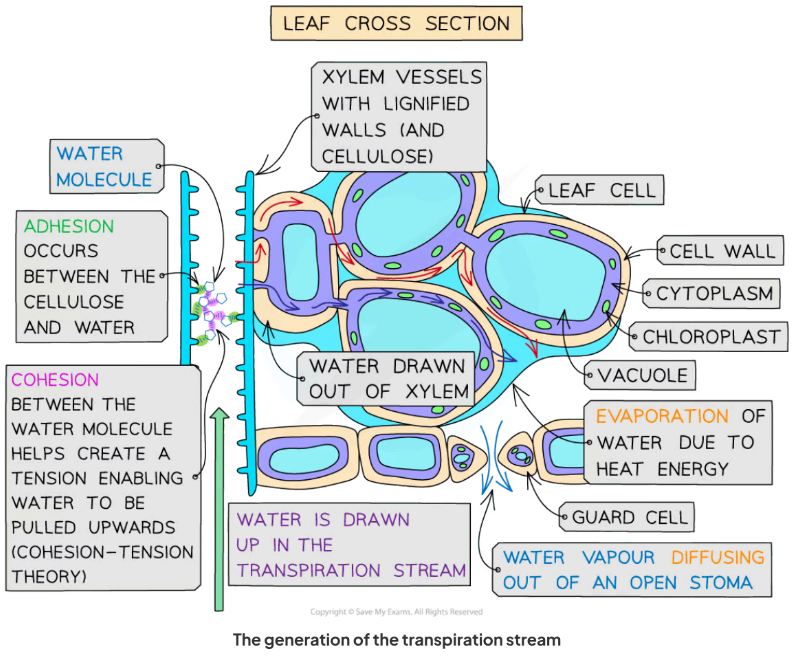
*Transpiration pull is the force produced by the loss of water vapour from a leaf, which reduces the pressure at the top of xylem vessels
Wilting
If water loss from leaves exceeds water uptake by roots, wilting occurs. Cells lack sufficient water, and cell walls cannot support the plant, leading to collapse.
8.1.9 Translocation: Extended
Translocation Defined
Translocation is the transport of sucrose and amino acids in the phloem, from regions of production (source) to regions of storage or use (sink).
Phloem Structure and Function
The soluble products of photosynthesis, mainly sucrose and amino acids, are transported in phloem tubes made of living cells.
Cells are joined end-to-end with sieve plates, which facilitate the easy flow of substances from one cell to the next.
Transport can occur in multiple directions, depending on the plant’s development stage or time of year. Dissolved food is transported from source to sink.
Winter: Phloem tubes transport dissolved sucrose and amino acids from storage organs for respiration.
Spring: Storage organs (e.g., roots) are the source, and growing areas are the sinks.
Summer: Leaves are the source, producing sugars, and roots are the sinks, storing sucrose as starch.
Translocation through the phloem
Comparison between Xylem and Phloem Tissue Table