Enzymes II: Kinetics, Inhibition, and Metabolic Regulation
Course and Lecture Fundamentals
Course Code: 4BBY1013 Biochemistry
Module Title: Enzymes II
Institution: Faculty of Life Sciences & Medicine, Department of Biochemistry
Lecturer: Dr. Gian De Nicola
Enzyme Inhibition and Kinetic Parameters
Michaelis-Menten Equation: The velocity of an enzyme-catalyzed reaction is expressed by the formula:
: Velocity of the reaction.
: The maximum velocity attained by the system at saturating substrate concentrations.
: The Michaelis constant, representing the substrate concentration at which the reaction velocity is half of .
: Concentration of the substrate.
Lineweaver-Burk (Double-Reciprocal) Plot: This linear representation of the Michaelis-Menten equation is used to determine kinetic constants graphically:
The y-intercept is equal to .
The x-intercept is equal to .
The slope of the line is equal to .

Competitive Inhibition
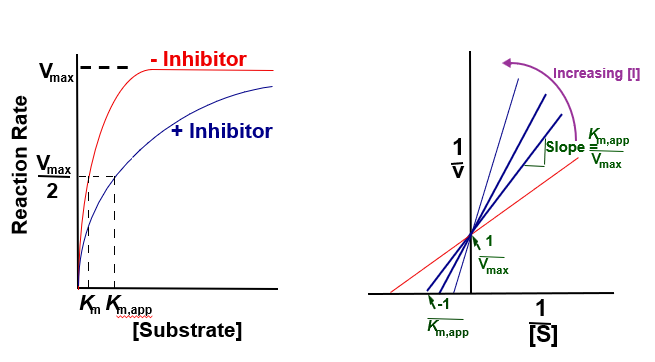
Mechanism: Competitive inhibitors compete directly with the substrate for binding to the enzyme's active site.
perturbing the recognition between the substrate and the enzyme
doesn’t change the rate at which the substrate s converted into the correct product when the enzyme recognises the correct substrate
Effect on Kinetics:
Apparent (): Competitive inhibitors increase the apparent value of
: Competitive inhibitors do not alter the . If the substrate concentration is increased sufficiently, the inhibitor can be displaced, and the enzyme can still reach its maximal catalytic rate.
Lineweaver-Burk Characteristics:
The slope increases () as inhibitor concentration () increases.
The lines for different inhibitor concentrations intersect at the same y-intercept () but have a larger Km.
Non-Competitive Inhibition

Mechanism: Non-competitive inhibitors do not bind to the active site. Instead, they interfere with the catalytic mechanism in another way, often by binding to an allosteric site or a different region of the enzyme, regardless of whether the substrate is bound.
Effect on Kinetics:
: These inhibitors decrease the . Even at infinite substrate concentration, the enzyme cannot reach its full catalytic potential because the catalytic machinery itself is impaired.
: Non-competitive inhibitors do not alter the . The substrate's affinity for the active site remains unchanged.
Lineweaver-Burk Characteristics:
The y-intercept () increases as inhibitor concentration increases.
The x-intercept () remains constant, meaning all lines intersect at the same point on the x-axis.
Example: Cyanide:
Cyanide inhibits Cytochrome c oxidase.
It functions by interfering with the transport of electrons within the enzyme machinery.
Irreversible Inhibition
Definition: Irreversible inhibitors bind so strongly (often through covalent bonds) that the enzyme is permanently inactivated.
Example: Acetylcholinesterase (AChE) Inhibitors:
Natural Function: AChE breaks down the neurotransmitter Acetylcholine (ACh) into Choline and Acetic Acid.
Organophosphates: These act as irreversible inhibitors of AChE.
Applications: They are used in insecticides and as chemical warfare agents (nerve agents).
Specific Nerve Agent: Novichok is cited as a notable example of a potent irreversible AChE inhibitor.
Allosteric Regulation and Kinetics
Kinetic Curve Comparison:
Michaelis-Menten Enzymes: Exhibit a hyperbolic curve on a plot of reaction velocity () versus substrate concentration ().
Allosteric Enzymes: Exhibit a sigmoidal (S-shaped) curve.
Kinetics of Allosteric Enzymes:
They are usually multi-subunit proteins with several domains, regulatory chains, etc.
don’t follow Michaelis Menten behaviour
They exhibit co-operative substrate binding, combining two Michaelis Menten enzymes, one with a high value of Km another with low Km
The sigmoidal response is modelled as the combination of two states:
T-state (Tense): Characterized by a high value of (lower affinity) not good at carrying out catalysis reactions.
R-state (Relaxed): Characterized by a low value of (higher affinity) good at carrying out catalysis reactions.

Allosteric Modulators:
Positive Allosteric Modulator (Allosteric Activator): Lowers [S] needed to reach half Vmax, shifts the curve to the left, decreasing the apparent (the allosteric equivalent of ) and making it easier to reach .
Negative Allosteric Modulator (Allosteric Inhibitor): Increases [S] needed to reach half its Vmax, shifts the curve to the right, increasing the apparent and requiring higher substrate concentrations to achieve reaction velocity.
Modulators change the velocity without necessarily changing the absolute , though they drastically change the activity at physiological substrate concentrations.

Feedback Inhibition: A specific form of allosteric regulation where the end product of a metabolic pathway acts as an inhibitor for an enzyme acting earlier in the pathway (usually Enzyme 1). This prevents the over-accumulation of products.
cascade of signalling evens where several enzymes work on each others products to create whatever metabolites are needed for the metabolic pathway
end product of the metabolic pathway works as a negative modulator of some of the enzymes that are upstream in the metabolic pathway
already reached sufficiently high concentration of product therefore the pathway cant slow down
therefore the end product is a negative regulator of the enzymes at the beginning of the signalling cascade

Mechanisms for Regulation of Enzyme Activity
Major Regulatory Strategies:
Allosteric enzymes: Instantaneous control via non-covalent binding of modulators.
Covalent modification: The chemical alteration of the enzyme by other enzymes.
Induction or repression of enzyme synthesis: Regulating the actual amount of enzyme present in the cell.
Regulation by Covalent Modification
Phosphorylation/Dephosphorylation:
Involves the reversible addition or removal of a phosphate group () onto a specific amino acid residue such as ser, thr, tyr, his, regulated by kinase and phosphatase regulatory enzymes. Can activate or deactivate the enzyme, enzyme specific
Kinases: Add phosphate groups to enzymes.
Phosphatases: Remove phosphate groups.
Residues involved: Phosphorylation typically occurs on the side chains of Serine (Ser), Threonine (Thr), Tyrosine (Tyr), and Histidine (His) residues.
Activity Effects:
Activation: Some enzymes, such as MAPK kinase, become active when they are phosphorylated. causes catalytic site to be more active
Inactivation: Some enzymes, such as Glycogen synthase, become inactive when they are phosphorylated.
Regulation of Enzyme Synthesis
Insulin Example:
The hormone insulin is a small protein produced in the pancreas.
High blood glucose levels stimulate an increase in insulin production.
Insulin increases the rate of synthesis (induction) of key enzymes involved in glucose metabolism, specifically:
Glucokinase
Phosphofructokinase
Pyruvate kinase
Summary of Enzyme Regulation Events
Regulator Event | Typical Effector | Time Required for Change |
|---|---|---|
Substrate availability | Substrate | Immediate |
Product inhibition | Product | Immediate |
Allosteric control | End product within the pathway | Immediate |
Covalent modification | Another enzyme (Kinase/Phosphatase) | Immediate to minutes |
Synthesis or degradation | Hormone or metabolite | Hours to days |