NMBDs + Reversals
THE NMJ
The NMJ contains three main sites of nicotinic receptors:
Presynaptic: motor nerve terminal; facilitates replenishing of Ach
Ach is exocytosed into the synaptic cleft, traveling a short distance across the NMJ until it binds to the postsynaptic nicotinic receptors (specifically the two alpha subunits) on the motor neuron endplate
at the same time, while Ach is diffusing down the NMJ, there is a positive feedback loop with some Ach molecules binding to presynaptic nicotinic receptors. This mobilizes more Ach vesicles to be ready/let go.
Postsynaptic: motor end plate; contains alpha subunit binding sites for Ach
The MATURE/NORMAL (adult) nicotinic receptor consists of 2 alpha-1 beta-1 epsilon-1 delta
Ach immediately diffuses away (to prevent tetany), being eliminated by acetylcholinesterase (aka, true cholinesterase, type 1 cholinesterase, specific cholinesterase) WITHIN the NMJ
**Acetylcholinesterase is NOT made by the liver, but released via vesicle in the NMJ. This is DIFFERENT than vec being significantly prolonged with liver disease.
Extrajunctional (fetal): immature receptor sites located throughout the entire skeletal muscle cell
Akin to fetal nicotinic receptors as they resemble those present in early fetal development. The nicotinic receptor STAYS as an alpha 2-beta 1-delta 1-gamma 1 (instead of being replaced by an Epsilon) OR the alpha7 subtype consists of 5 alpha subunits in certain conditions.
Tip: gamma = get out
Denervation later in life of prolonged immobility allow for the return of both these types of extrajunctional receptors d/t upregulation (think of the cell being starved and developing more receptors in search of potential Ach). EX:
burns >24 hours (may persist for several years after original injury)
SCI
severe sepsis
upper/lower motor neuron injury (stroke/CVA, GB, Parkinson’s, MS, ALS, Huntington’s)
muscular dystrophy
hyperkalemic periodic paralysis
Charcot-Marie-Tooth
prolonged chemical denervation (magnesium, long term NMB agent infusion, clostridum toxin)
Extrajunctional receptors are dangerous d/t their ability to predispose the patient to hyperkalemia following sux administration. Basically, it results in nicotinic receptors remaining open for a longer period of time after sux. Thus, avoid sux in the above patients, who have an excess amount of them!
alpha2-beta1-delta1-gamma1 is depolarized by sux, while alpha7 is depolarized by both sux and its metabolite choline (choline stimulation is the most likely contributor to hyperkalemic response)
Summary: upregulation causes increased sensitivity to depolarizers (you need less or avoid), but increased resistance to non-depolarizers (you need more for desired effect)
NMBDs
Classifications:
All NMBDs are Quaternary Ammonium Compounds (resembling the structure of Ach molecules), with at least one positively charged nitrogen atom that can bind to the alpha subunit of nicotinic receptor.
They do NOT cross the BBB or placenta
They initially block smaller, rapid muscles first, followed by larger, slower muscles.
1) Depolarizing NMBD: only Succinylcholine
Structure: two ACh molecules linked by methyl groups; the long, slender, flexible structure allows it to bind to and activate the postsynaptic nicotinic receptor. These are agonists, which cause sustained depolarization.
2) Non-depolarizing NMBDs: Bulky, rigid molecules that are similar to Ach but do not activate the nicotinic receptors. These are competitive antagonists, which only need to bind to ONE alpha subunit to produce neuromuscular blockade. They prevent depolarization.
Sux
Elimination: plasma cholinesterases (also called false cholinesterase, Type II, butyrylcholinesterase, pseudocholinesterase) are located only in the plasma, and NOT in the NMJ; produced from the liver.
Pathway: succinylcholine —> succinylmonocholine + choline —> succinic acid + choline
succinylmonocholine is considered an active metabolite
Elimination begins as sux travels TO the NMJ (and is 90% is rapidly metabolized; only <10% of sux ever actually reaches the NMJ). Then after 5-10 minute duration, diffuses away and is finished being metabolized FROM the NMJ
Intubating dose: 1-1.5 mg/kg (used for RSI or to break a laryngospasm)
Onset 30-60 seconds
Duration 5-10 minutes
If a defasciculating dose of non-depolarizer is given beforehand to prevent postop myalgia (1/10th ED95), the intubating dose of sux needs to be increased by 70%. Typically 5% of the intubating dose?
Factors decreasing plasma cholinesterase function (which would increase the duration of action of sux):
Liver failure
late-stage pregnancy (not clinically significant?)
old age
malnutrition
Neoplasms
Meds: etomidate, metoclopramide, MAOIs, oral contraceptives, cyclophosphamide, esmolol
also timolol, bambuterol, aminoglycoside abx (-mycin or -micin endings)
Anticholinesterases can SIGNIFICANTLY reduce cholinesterase activity (extending sux muscle relaxation up to 3 hours). This is why you do not administer Neostigmine for sux reversal. Remember that sux has NO REVERSAL other than time to pass.
Atypical plasma cholinesterase (cannot effectively hydrolyze sux, so duration of action will be prolonged)
Dibucaine Test: Uses dibucaine, which is an amide local anesthetic that inhibits NORMAL functioning plasma cholinesterase; it has no effect on atypical plasma cholinesterase (aka, quality of it vs the quantity). **If dibucaine test not available, then you can also order a fluoride test; 60 would mean normal pseudocholinesterase activity, while 36 is consistent with homozygous atypical pseudocholinesterase deficiency
80: Typical homozygous, aka normal enzyme activity is present (80% inhibition). Interpretation: succ administration would last the normal duration of 5-10 minutes
50-60: Heterozygous atypical, aka 1 abnormal allele. Interpretation: succ would lead to a slightly prolonged block, usually 20-30 minutes
20: Homozygous Atypical, aka 2 abnormal alleles. Interpretation: succ would lead to an extremely long block, usually 4-8 hours (requiring mechanical ventilation and sedation, NOT FFP/blood which some people think will replace the plasma cholinesterases)
Physiological effects
Histamine release
Increased ICP (transient rise 10-15 mmHg for 5-8 minutes secondary to increased CBF and muscle spindle afferent activity, aka neck fasciculation muscles that cause JVD). Can be prevented with defasciculating dose.
Increased IOP (transient rise of 5-15 mmHg for up to 10 minutes secondary to increased central venous pressure; this inhibits flow of aqueous humor through the canal Schlemm, so use cautiously in patients with an open globe injury)
Bradycardia: stimulates M2 receptors in the SA node. This effect is common in children (d/t increased baseline vagal tone) or after a second dose in adults. Its primary metabolite succinylmonocholine is the most likely cause. Always give atropine BEFORE a second dose of sux.
Tachycardia: more common in adults (vs bradycardia occurring); by mimicking Ach action at the sympathetic ganglia
Potassium release: sux increases serum K+ levels by 0.5-1 mEq/L for up to 10-15 minutes. This is normally well tolerated by healthy individuals, but can cause cardiac arrest in individuals with poorly managed renal disease.
Black box warning: sudden death secondary to hyperkalemia in children with undiagnosed duchenne muscular dystrophy. This is an x-linked recessive disease resulting in absence of the dystrophin protein (critical in skeletal/cardiac muscle cells, causing sarcolemma destabilization). Depolarization = creatinine phospholipase and myoglobin allowed to enter systemic circulation + free calcium movement activates proteases which cause inflammation/fibrosis/cell death. Also results in extrajunctional receptors = hyperkalemia likely. Only use in pediatric situations for emergencies to break a laryngospasm if necessary
**prodigy says that it is linked to rhabdomyolsis in a pediatric patient after receiving sux, NOT indicating MH
tx for sux-related hyperkalemia:
#1: stabilizing the myocardium: Calcium (chloride at 20 mg/kg, gluconate at 60 mg/kg)
Shifting K back into cells: insulin, albuterol, hyperventilation, sodium bicarb (1-2 mEq/kg)
Enhancing potassium elimination: furosemide (1 mg/kg), volume resuscitation, HD
Increased gastric pressure: abdominal muscle contraction increases intragastric pressure while also raising the lower esophageal tone (effectively canceling out each other, so no increase in aspiration risk).
Triggers MH (masseter spasms may be normal, in which case surgery does not need to be canceled, or indicate MH, if other MH s/s are present)
Postop myalgia: uncoordinated muscle contractions —> flaccid paralysis —> myalgia (neck, shoulder, trunk muscle soreness 24-48 hours postop). High risk for young females with low muscle mass (aka, do not engage in strenuous activity), and undergoing ambulatory surgery. Pregnant, elderly, and very young patients seem to be at reduced risk of postop myalgia
May be minimized, but not totally eliminated using a de-fasciculation dose. This would be 1/10th of ED95 of the nondepolarizer drug, administered 3-5 minutes before sux. Increase sux dose to 1.5-2 mg/kg (70%). Patients may be distressed by muscle weakness, dyspnea, dysphasia, and diplopia.
additional preop aids may include lidocaine, NSAIDs, and higher dose of sux
NON-DEPOLARIZING NMBDs
Types:
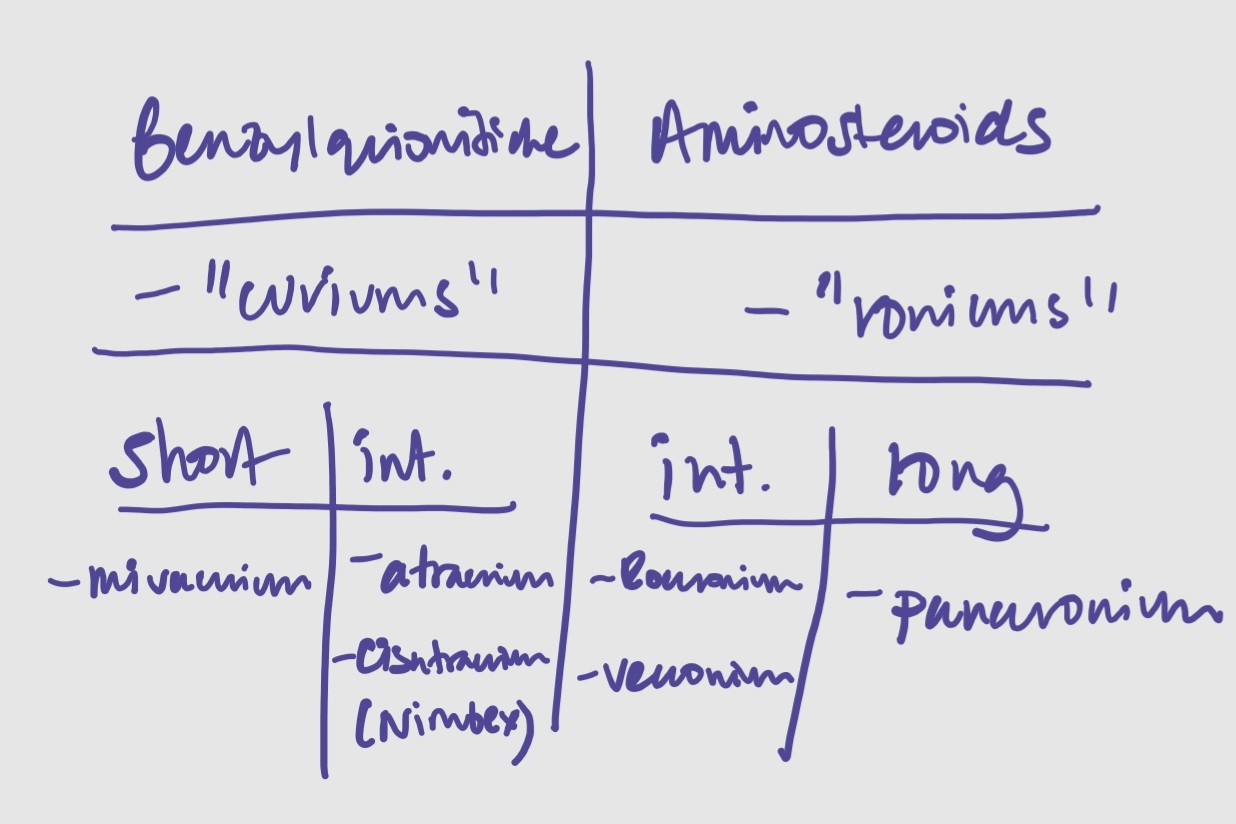
Benzylisoquinolinium compounds: Mivacurium, atracurium, cisatracurium.
Aminosteroid compounds: Rocuronium, vecuronium, pancuronium.
Mivacurium:
Marketed as the first short acting non-depolarizing NMBD. Composed of 3 different isomers.
ED95: 0.08 mg/kg
Tip: Intubating dose is typically 2-3x the ED95
ED95 is mostly important to compare potencies. From most to least potent: cisatracurium > vecuronium > mivacurium > pancuronium > atracurium > sux > roc
“Can very many people act super rad?”
Higher ED95 = lower potency = faster on/off
Onset 2-3 minutes.
Duration: 12-20 minutes
Intubation dose: 0.2 mg/kg
Metabolism: plasma cholinesterase (similar to sux, do not give to anyone with atypical plasma cholinesterase)
Caution: profound Histamine release potential causing tachycardia and hypotension (seen more with rapid dosing).
ROCURONIUM
ED95: 0.3 mg/kg
intubating dose 0.6-1 mg/kg. RSI: 1.2 mg/kg
Onset: 2 minutes (typical), 45-90 sec (RSI)
Duration: 20-35 minutes (typical), 60-90+ minutes (RSI)
Excretion: primarily biliary excretion (feces), only 30% renal excretion (no active metabolites; aka, basically excreted as an unchanged molecule)
Considerations: Prolonged effects in liver/kidney disease. 6x less potent than vecuronium.
VECURONIUM
Potent Intermediate-acting NMBA.
ED95: 0.03-0.05 mg/kg
Intubating dose: 0.1 mg/kg
onset 3-5 minutes.
Duration: 20-35 minutes (dose dependent)
Excretion: 40-80% taken up by liver and excreted in bile. Hepatic deacetylation creates metabolite 3-desacetylvecuronium (50% potency). 30% renal excretion, so be Cautious with renal patients.
ATRACURIUM
ED95: 0.1-0.25 mg/kg
onset 2-3 minutes.
intubating dose: 0.5 mg/kg
Duration: 20-35 minutes; some debate on duration being longer.
Elimination: 2/3 via nonspecific ester hydrolysis with 10-40% spontaneous degradation by hoffman elimination into laudanosine
faster with alkalosis and hyperthermia
slower with acidosis and hypothermia
laudanosine is an active metabolite that can cross the BBB and stimulate CNS to cause seizures
Causes histamine release
At room temp, atracurium degrades at 5%/month (loses potency) and has a recommended unrefrigerated shelf life of 14 days
CISATRACURIUM
Characteristics: Intermediate-acting NMBA with good potency (5x more potent than Roc, but even though both are intermediate acting it is longer than Roc). It is an isomer of atracurium.
intubating dose: 0.1 mg/kg
ED95: 0.05 mg/kg
onset 2 minutes; however, max block effect is 2-5 minutes
Duration: 30-60 minutes
elimination: mainly hoffman elimination (does undergo minor ester hydrolysis) and laduonsine metabolite is produced to a lesser degree than with atracurium
does not cause histamine release or cardiostimulation.
Still needs to be reversed, even with Hoffman elimination!
PANCURONIUM
Characteristics: Long-acting NMBA, not commonly used in modern anesthesia d/t long duration of action. However, it precludes (SHOULD NOT BE USED) hypertrophic CM d/t its vagolytic effects (aka, increases HR); instead, it is beneficial for bradycardia and aortic regurg.
This vagolytic effect is actually unique because of its inhibiting effect on M2 receptors in the SA node that both stimulates the release of catecholamines and inhibits catecholamine uptake in adrenergic nerves. THUS, it increases HR/CO without increasing SVR.
ED95: 0.07 mg/kg
intubating dose: 0.1 mg/kg
onset 3-5 minutes.
Duration: 60-90 minutes
Excretion: primarily through kidneys, specifically by glomerular filtration (there is 30-50% decrease in clearance when renal dysfunction present). 10-20% undergoes hepatic metabolism
Active metabolite: 3-hydroxypancuronium (<50% potency, contributes to muscle relaxation)
Remember that all of the non-depolarizers undergo at least SOME renal excretion d/t being ionized. Thus, they can all be prolonged duration if renal disease is present, although much less of a concern if using benzylquinolines.
Effects: Increases heart rate (aka, vagolytic effect), MAP, and cardiac output by 10-15% due to muscarinic blockade at the SA node.
Non-Depolarizing NMBDs Factors
Potentiating (aka, sensitizing or you need less of the non-depolarizing NMBDs) factors:
Drugs (basically everything):
Volatile anesthetics (des > sevo > iso > N2O > propofol)
antibiotics (aminoglycosides (-mycins or -micins), tetracycline, polymyxins, cyclosporins)
local anesthetics
antiarrhythmics (verapamil, amplodipine, lidocaine, quinidine)
diuretics (furosemide)
other: dantrolene, tamoxifen, lithium
Electrolytes: increased magnesium; decreased calcium, decreased potassium, acidosis/hypercarbia
Patient Factors: Gender differences (women more sensitive) and hypothermia
Neuro disorders (not those causing upregulation): MG
MG causes killing of postsynaptic nicotinic receptors (there are less than normal amounts), which is why it causes resistance to depolarizers (just because you have less receptors does not mean that is what is required to now contract the muscle; instead, it takes much more effort to meet the threshold for depolarization) and sensitivity to non-depolarizers (there are less receptors, so less need to be blocked)
Lambert-Eaton, aka Myasthenic crisis (caused by small cell lung CA) causes “killing” of presynaptic Calcium channel (there is less release of Ach), which is why it causes sensitivity to BOTH depolarizers and non-depolarizers (basically, there is less Ach in the NMJ, so non-depolarizers don’t need to compete as hard; and while there is no inherent upregulation, the nicotinic receptors are starved and ready to fire as soon as a depolarizer touches them)
Phenytoin causes resistance to NMBDs

NMBDs are the most common cause of periop allergic reactions; NOT abx. This is because their quaternary ammonium group interacts with IgE mast cell release/basophil degranulation
While there is some controversy to which agent produces the most allergic reactions, usually sux is cited as having the highest likelihood to cause anaphylaxis. The second most common could be roc?
This can be tested via elevated trypsin levels
cross sensitivity can occur if a patient has had exposure to soaps/cosmetics as well (highest in hair dressers), d/t to their containing of antigenic quaternary ammonium groups
MONITORING NEUROMUSCULAR FUNCTION (Peripheral nerve stimulators)
Goal: indirect electrical stimulation of a muscle to assess level of muscle relaxation.
Sequence of Onset of Neuromuscular Blockade (in order)
digits/eyes (most sensitive, eyes before extremities though) —> trunk/abdomen —> airway reflexes/larynx —> intercostal muscles/diaphragm (most resistant)
**even if the diaphragm is moving (which is possible even with 0/4 twitches), the airway reflexes may remain impaired!
Reversal occurs in the opposite order
Ulnar Nerve (Adductor Pollicis Muscle):
Standard Site: The most common site for monitoring recovery, or readiness to extubate/recovery. The electrodes are placed along the ulnar side of the wrist.
Sensitivity: This location is more sensitive to non-depolarizing NMBDs than the diaphragm assessment (aka, recovers last). Therefore, if the thumb twitches are recovered, it is highly likely that the diaphragm is also functional
Tip: sux really never needs to have TOF done because it will only have an all-or-nothing response and should only last 5-10 minutes. You would only do a TOF if you suspect abnormal psuedocholinesterase d/t prolonged block if the patient’s spontaneous breathing does not return
Facial Nerve VII (Orbicularis Oculi or corrugator supercilii):
Intubation Predictor: Reflects the diaphragm and larynx. It is resistant to blockade, so is best site to assess induction onset and readiness for intubation.
the orbicularis oculi specifically closes the eyelid
the corrugator supercilii controls the eyebrow
Risk: Overstimulation of the facial nerve can cause direct muscle stimulation, leading to false-positive twitches even in the presence of profound blockade. Typically, the orbicularis oculi should closes the eyelid or the corrugator supercilii should twitch the eyebrow (CN VII)
Patterns of Stimulation
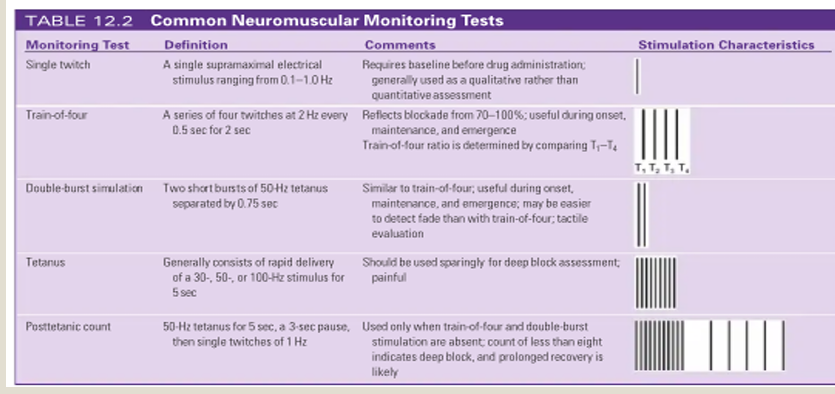
Single Twitch Stimulation: Unless you have a comparison response before any relaxant was given, it can only indicate if 100% paralysis is present.
Train of Four (TOF):
Gold standard PNS, which completes four separate pulses. Fade is caused by antagonism of the presynaptic nicotinic receptors (aka, non-depolarizers only)
Diagnostics:
4/4 twitches = <70% of receptors are blocked
3/4 twitches = 70-80% of receptors are blocked
2/4 twitches = 80-90% of receptors are blocked
1/4 twitches = >90% of receptors are blocked
0/4 twitches = 96-100% of receptors are blocked
Goal to assess for extubation readiness: TOF Ratio T4:T1 >0.9. Remember: Detecting fade is difficult at >0.4; thus, >0.9 ratio is the gold standard and can only be measured using quantitative monitoring (like acceleromyography or electromyography). Especially important for return of genioglossus muscle (airway protection).
Reversal is indicated if <0.9; there is no point to give it when >0.9 because all muscle function strength has returned. Remember, though, still give reversal even if 4/4 twitches present because you are unable to really compare strength of 1st to 4th twitch strength. This means you should pretty much ALWAYS give a reversal, no matter how “strong they appear”, as this could be up to 50% receptors still blocked
Steps:
Clean the forearm skin with alcohol
Place 2 electrode stickers on a) ulnar (pinkie) side on the long length of the forearm or b) near and parallel to the ear
The red one (+) will be connected in whichever direction is closest to the heart, while the black one (-) will be connected in the opposite direction
Get a baseline if possible: starting from level 1, keep going up in strength until you see the thumb twitch 4 times (usually at about 5-6 level). This will be the number you go straight to when assessing your TOF. 1-2 twitches is the goal (usually); less than this number means your patient is too paralyzed, while more than this means the patient is not paralyzed enough. For surgery want 4/4 though?
Post tetanic Count (PTC):
Usage: assessed when there is no response to TOF; a tetanus (continuous stimulation for 5 secs, which “premobilizes” the Ach) occurs, followed by a TOF.
Intense blockade: There is 0 TOF and 0 PTC (could take an hour before recovery)
Deep Blockade: There is 0 TOF but 1-2 PTC (could take 15-30 minutes before recovery)
Moderate block (Some TOF is present, PTC is not needed)
Interpretation: A high PTC >10 means that TOF response is likely to return soon; aka, high count = less intense block. PTC of 1-2 means reversal with Neostigmine would take 50 minutes vs PTC of 6-8 may take 10 minutes for reversal to occur.
Double Burst Stimulation (DBS):
Two short bursts of tetanic stimulation
Designed to make fade easier to feel manually compared to a standard TOF.
Very painful
Avoid TOF 6 minutes after, as this can cause posttetanic potentiation, but it is “false” and will underestimate true degree of muscular blockade
Tetanus:
continuous tetanus for 5 sec; if contraction sustained without fade is seen then significant paralysis is unlikely, while if there is fade then significant paralysis still remains.
Additional Responses
Adjuncts to PNS: Sustained Head Lift/hand grip >5 secs, -40 cm H2O Inspiratory Force (more negative number is better), Holding tongue depressor between teeth against force
Tip: remember, these tests alone do not guarantee that the TOF ratio is >0.9; This puts the patient at risk for residual blockade. Even though electromyography (specifically mechanomyogrpahy) is the best quantitative method, this is not frequently used in ORs d/t needing to calibrate before the NMBD and costs. So, when quantitative measurement is not possible here are the worst to best qualitative indicators of muscle recovery:
Vt of 6 ml/kg means <80% receptors occupied
4/4 twitches with no fade OR normal VC >20 ml/kg means <70% receptors remain occupied
No fade during tetanus or double burst stimulation means <60% receptors remain occupied
-40 mmHg inspiratory force (or more negative), sustained head lift/hand grip >5 sec, and holding tongue depressor against teeth with force means <50% receptors occupied
Special notes:
No amount of muscle relaxant in the world will keep a muscle from twitching if direct electrical stimulation is applied to it in a sufficient amount (e.g., electrocautery from surgeon) — let the OR team know this when they say the patient is moving
Muscle relaxers do not relax smooth muscle, such as from a bronchospasm, increased GI motility, or uterine tone. Those need to be treated with sympathomimics/lytics and supportive care.
Twitch tension is reduced by hypothermia
How should a monitoring location be chosen for a patient with a hemiplegia?
You should place the peripheral nerve stimulator on the non-affected/non-paralyzed side, as the affected/paralyzed side most likely has upregulated receptors.
Phase 1 vs Phase 2 Blocks
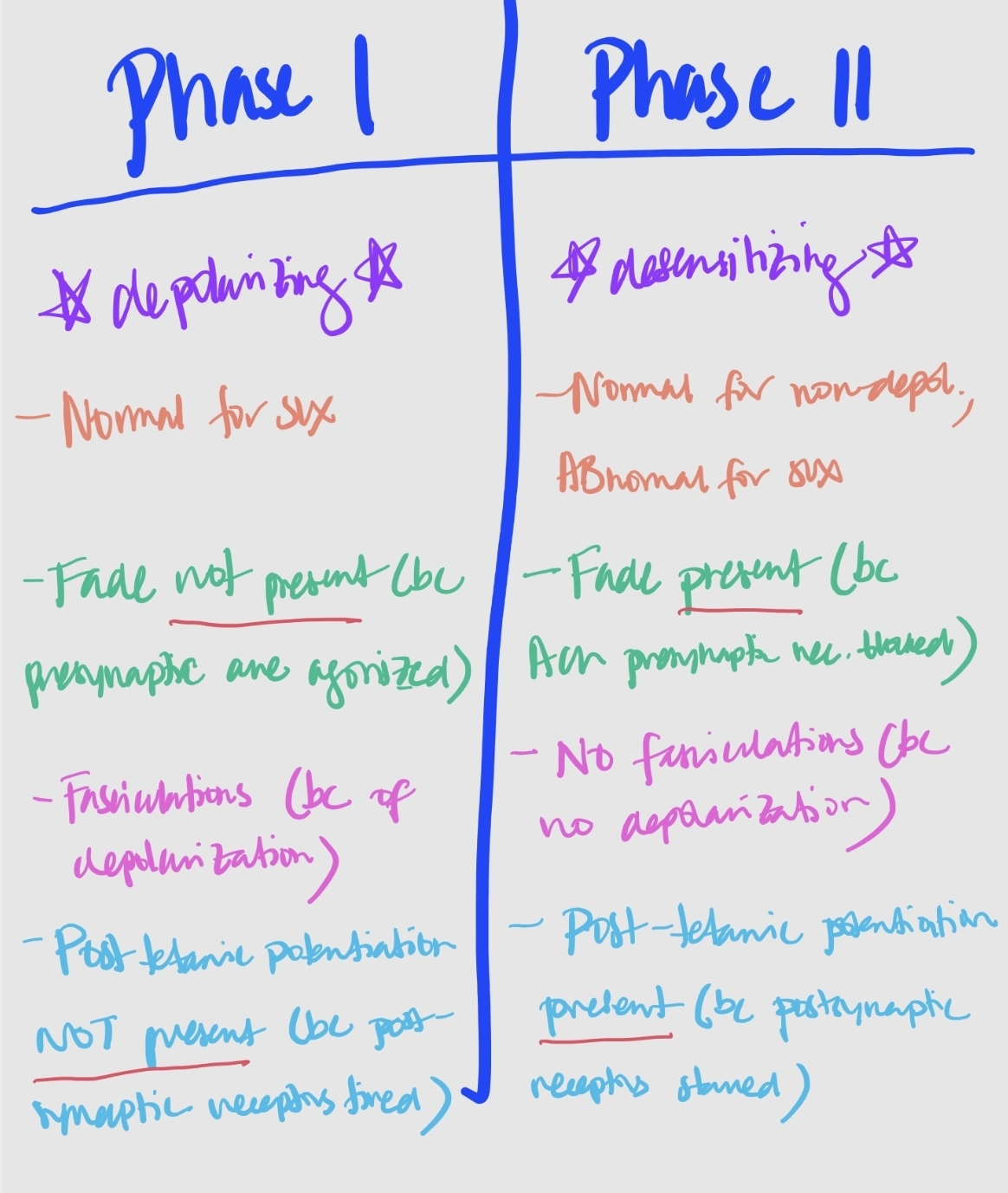
Phase 1 (depolarization): the normal action of sux occurs, including agonism on postsynaptic receptors and minimal changes to presynaptic receptors (thus, Ach is able to mobilize/positive feedback as normal).
TOF: fade is NOT present (all the twitches are EQUALLY decreased in strength, but no gradual decrease in twitching strength occurs; this is because the amount of ACh being released remains constant across all four pulses)
Post tetanic potentiation (tetanus followed by pulse has a stronger pulse than baseline): Absent
**tip: think of all the muscle strength being “worn out”
Fasciculations (aka, muscle twitching): Present (as depolarization still occurs)
Phase 2 (desensitizing): Occurs after large doses >7-10 mg/kg, repeated boluses, or continuous infusions (30-60 min), abnormal with sux; normal with non-depolarizing agents. MOA: Post-synaptic Desensitization occurs (They are closed and won't open easily) + Pre-synaptic Inhibition (at high concentrations or prolonged exposure, sux begins to block those same pre-synaptic receptors that manage the positive feedback loop. However, unlike a nondepolarizing block that can be reversed, sux CANNOT be reversed in phase 2 either, leading to extremely prolonged paralysis that requires ventilation)
TOF: fade is present (gradual decrease in twitching strength, because the positive feedback loop is blocked at presynaptic receptors and the nerve runs out of "ready-to-go/immediate release" ACh)
Post tetanic potentiation (tetanus followed by pulse has a stronger pulse than baseline): Present
**tip: since non-depolarizers cause fade, so they are also “positive” for post tetanic potentiation. The muscles now WANT to contract
Fasciculations (aka, muscle twitching): Absent (no depolarization occurs on administration of a nondepolarizing agent)
Remember that Phase 2 of a depolarizing drug will look like this, too, but is actually a bad sign!
Non-depolarizing REVERSAL AGENTS
Mechanism: Anticholinesterases reversibly inhibit acetylcholinesterase (which normally degrades Ach rapidly into choline and acetate) to prevent the degradation of Ach. Thus, this indirectly increases Ach concentration at the NMJ. Ach is then able to outcompete for the alpha binding sites to antagonize the block you made.
1) Enzyme inhibition occurs through 3 pathways:
a) electrostatic bond at anion site and hydrogen bond at estateric site via competitive inhibition. EX: Edrophonium
b) Formation of carbamyl esters at the estateric site via competitive inhibition. EX: Neostigmine, pyridostigmine, physostigmine
c) Phosphorylation via noncompetitive inhibition. EX: organophosphates, eschothiopate
2) presynaptic effects: similar to sux, as anticholinesterases stimulates the presynaptic receptor to cause additional Ach to be released
The primary MOA of edrophonium is most likely presynaptic
Additional important facts: anticholinesterases have a ceiling effect, where additional drug does not produce any additional effects which prevents them from effectively antagonizing profound deep blocks
This is also why giving more will simply result in toxic effects, primarily paradoxical muscle weakness
When compared with adults, children have greater levels of antagonism to neuromuscular blocks
Mixing anticholinesterases yields an additive effect, not synergistic
Physostigmine is a tertiary amine, which gives it the ability to cross the BBB. 40 mcg/kg reduces the incidence of postop shivering. Primary use is to treat anticholinergic crisis. Efficacy matches clonidine and meperidine
SPECIFIC ANTICHOLINESTERASES
Edrophonium:
Quaternary amine that is poorly lipid soluble (does not cross BBB). Primarily works at presynaptic area, which increases Ach concentration.
Rapid acting but also the shortest acting; only administer with 4/4 twitches but fade still present
Dose: 0.5-1.0 mg/kg.
Duration: 30-60 minutes
onset: 1-2 min
mostly renal elimination
Pair with Atropine to minimize bradycardia risk; Fast onset means it needs to match with a fast antimuscarinic (works just on muscarinic receptors). Also, pushing the ephedrine over 1 full minute to minimize s/e of bradycardia
weaker bonds means less potent than neostigmine, with possibility of re-curarization, which is why not commonly used unless for Tensilon testing (MG dx) + need for Atropine which crosses the BBB; Atropine can cause CENTRAL cholinergic crisis ("Mad as a hatter, Red as a beet, Dry as a bone, Blind as a bat, and Hot as a hare."). However, simply giving neostigmine will not reverse this because it does not cross BBB, which is why physostigmine must be used.
Neostigmine:
A quaternary amine that does not cross the BBB. The most widely used anticholinesterase. It works by increasing levels of acetylcholinesterase (not actually potentiating anything though). It is the best option to reverse 90% block.
You never want to give an anticholinesterase for sux bc neostigmine inhibits BOTH acetylcholinesterase and plasma cholinesterase, so nothing is left to degrade sux. Just worsening it basically!
Requires at least 2 twitches to be administered; cannot reverse a deep block. Best/fastest effect when 4/4 twitches visible.
If it is given for a deep block, the block duration is significantly prolonged. This is d/t how Neostigmine can cause ACh overload (but not able to win the very active non-depolarizing NMBD) and ACh receptor desensitization (resulting in residual muscle weakness instead of returning strength)
Dose: 0.02-0.07 mg/kg (up to maximum of 5 mg)
onset 5-15 minutes
duration 45-90 minutes.
50/50 renal and hepatic elimination.
You do not have to re-dose the anticholinergic if the patient has renal failure, as they/NMBDs/Anticholinesterases will all have prolonged duration equally
Best paired with Glycopyrrolate.
Can cause asystole if administered to a patient with a heart transplant (aka, denervated)
Pyridostigmine is another anticholinesterase that is not widely used d/t long duration of action and longest onset. It is a quaternary ammonium (NOT the same as physostigmine). Typically used for chronic management of MG. IF for some reason used in OR, you would pair it with glycopyrrolate.
Duration: 60-120 min
Because onset is longer than glycopyrrolate (which pairs perfectly with Neostigmine), you should actually give it AFTER administering pyridostigmine instead of before like with edrophonium and Neostigmine
ANTICHOLINERGICs (MUSCARINIC ANTAGONISTS)
Remember that anticholinesterases work on anticholinesterases throughout the ENTIRE body, thus causing likelihood of bradycardia and increase secretions (PNS stimulation); “DUMBBELLS” for cholinergic effects from anticholinesterases (which you don’t want)
Diarrhea
Urination (increased bladder tone)
Miosis/cycloplegia (pupil constriction + paralysis). Think of how scopalamine causes mydriasis and PACU nurses calling code stroke.
Bradycardia
bronchoconstriction
emesis
lacrimation
laxation (increased spasms = BMs)
salivation
Atropine & Scopolamine: Lipophilic tertiary amines that easily cross the BBB
Atropine will be 0.014 mg/kg
Remember that because Atropine works at the SA node, it is not effective for treatment of Mobitz II or 3rd degree HB
Glycopyrrolate: Quaternary amine which does not cross BBB OR GI (which atropine and scopolamine can), thus having no sedative effects.
Dosing: 0.02 mg/kg, or more typical to do 0.2 mg glycopyrrolate for every 1 mg Neostigmine (1 mg glyco for 5 mg Neostigmine)
Rankings:
Increase in HR: atropine > glycopyrrolate > scopolamine
muscarinic antagonists do not increase HR in patients with a heart transplant; but these patients should still receive an antimuscarinic to offset other s/e of anticholinesterases
smooth muscle relaxation: atropine = glycopyrrolate > scopolamine
sedation (think about BBB): scopolamine > atropine > glycopyrrolate
antisialagogue (dry mouth, or xerostomia): scopolamine > glycopyrrolate > atropine
mydriasis/cycloplegia (think about BBB): scopolamine > atropine > glycopyrrolate
SUGAMMADEX
Structure: gamma-cyclodextrin made of 8 sugars assembled in a ring that forms a doughnut to trap the NMBD inside the hole. This makes it inactive d/t inability to interact with the nicotinic receptor. Class: selective relaxant binding agent.
Action: Binds selectively to aminosteroid NMBDs ONLY (rocuronium > vecuronium). IT HAS NO EFFECT ON SUX OR BENZYLISOQUINOLINES CLASS (ATRACURIUM, CISTRACURIUM, AND MIVACURIUM); also, minimal effect on pancuronium.
Mostly renal elimination
Dosage is based on actual body weight, NOT ideal weight, in order to not leave residual paralysis in the obese population (a 1:1 molar ratio)
Moderate block (2/4 twitches or better): 2 mg/kg sugammedex
Deep block (0/4 twitches or post tetanic count is 2 or better): 4 mg/kg
Profound block (3 minutes after RSI dose of roc): 16 mg/kg
If your patient needs to be re-paralyzed after reversal with sugammedex, you need to choose a non-aminosteroid NMBD (aka, cisatracurium, mivacurium, or sux).
Benefits: No systemic effects means no antimuscarinics needed, rapid onset, reverses even deep blockade
Cons:
Not recommended in patients with creatinine clearance < 30 ml/min (but you will still see it used in renal failure patients)
Anaphylaxis in 0.3% of patients
Bradycardia and cardiac arrest
Binds to oral contraceptives, so use alternative birth control methods for 1 week