GEO1: Origins of the universe
In our solar system, the planets make up only about 0.15% of our solar system mass. The sun accounts for the other 99.85% mass! The four inner planets, Mercury, Venus, Earth, and Mars, are the terrestrial or "rocky" planets, with dense, solid cores, while the outer planets are the Jovian or "gas giants" made mostly of the light elements hydrogen and helium.
The universe began 13.7 billion years ago with a big bang. Galaxies are moving apart from one another in a regular pattern described by a mathematical relation now known as Hubble’s law, according to which galaxies that are farther away are moving faster. It is Hubble’s law, played back in time, that points to a big bang 13.7 billion years ago. One of the most important discoveries of 20th century astronomy was made in 1929 by Edwin Hubble (for whom the Hubble space telescope was named). Using astronomical observations, he showed that galaxies generally have Doppler shifts towards the red end of the electromagnetic (EM) spectrum, which indicates that Earth and the source of the light – the galaxies – are moving away from each other.
Energy interconversions are given by simple relationships that allow us to equate energy, distance, and time:
E=hv
or
E=hcλ
where
E = energy (Joules (J))
h = Planck's constant (J*seconds)
v= frequency (seconds-1)
λ= wavelength (meters)
c= speed of light
Based on astronomical observations of other stars, our Sun likely formed from a large mass of collapsing gas within an interstellar cloud. The cloud collapsed for millions of years under gravitational forces until it began to rotate. As gravity pulled the slowly swirling cloud of dust and gas inward, the gas became hotter and denser. Eventually, the temperature and pressure were high enough that nuclear fusion began and a star was born: the Sun. By the time nuclear fusion began, the cooler outer portions of the solar nebula had become compressed enough to condense solid particles and liquid droplets from the gas. Through accretion, these condensates became the building blocks of the planets, moons, and solid bodies in the solar system. Our solar system began forming about 4.6 billion years ago within a concentration of interstellar dust and hydrogen gas called a molecular cloud. The cloud contracted under its own gravity and our proto-Sun formed in the hot dense center. The remainder of the cloud formed a swirling disk called the solar nebula.
Within the solar nebula, scientists believe that dust and ice particles embedded in the gas moved, occasionally colliding and clumping together. Through this process, called "accretion," these microscopic particles formed larger bodies that eventually became planetesimals with sizes up to a few kilometers across. In the inner, hotter part of the solar nebula, planetesimals were composed mostly of silicates and metals. In the outer, cooler portion of the nebula, water ice was the dominant component.
When the nascent planets grew from a few kilometers to a few hundred kilometers across, they became massive enough that their gravity influenced each other's motions. This increased the frequency of collisions, through which the largest bodies grew most rapidly. During this "childhood" stage of growth, the bodies are referred to as planetesimals. Eventually, regions of the nebula were dominated by large protoplanets. The interiors of these more mature bodies were becoming ordered -- differentiated -- into protoplanets. The process of collision and accretion continued until only four large bodies remained in the inner solar system -- Mercury, Venus, Earth, and Mars, the terrestrial planets. In the cold outer solar nebula, much larger protoplanets formed. The largest ones swept up other protoplanets, planetesimals, and nebular gas, leading to the formation of Jupiter, Saturn, Uranus, and Neptune.
Shortly after Earth formed, the Moon did. A large object (about half as wide as Earth) collided with our world. The off-center cosmic smash-up increased Earth's spin, and its energy disintegrated the impacting object, melted Earth's outer layers, and flung debris into orbit around Earth. This material formed a ring of gas, dust and molten rock around Earth. In less than a hundred years -- an incredibly short time for the formation of an entire world -- this debris clumped (accreted), growing larger and larger to form our Moon!
Based the nebular hypothesis and radiometric age dating of rocks from the Moon, a current estimate of the timing of the Moon-forming impact is about 4.51 billion years (b.y.) ago, which is about 40-50 million years (m.y.) after the beginning of solar system formation – not very long in geologic time!
Even after the Moon-forming impact and final accretion phase of planets in the solar system, there remained a large amount of residual solid material – meteorites and asteroids – that frequently collided with the planets, the Earth, and the Moon during the early history of the solar system before about 3.9 b.y. Evidence of these collisions is found in the cratered surface of Mars, our Moon, and other bodies in the solar system.
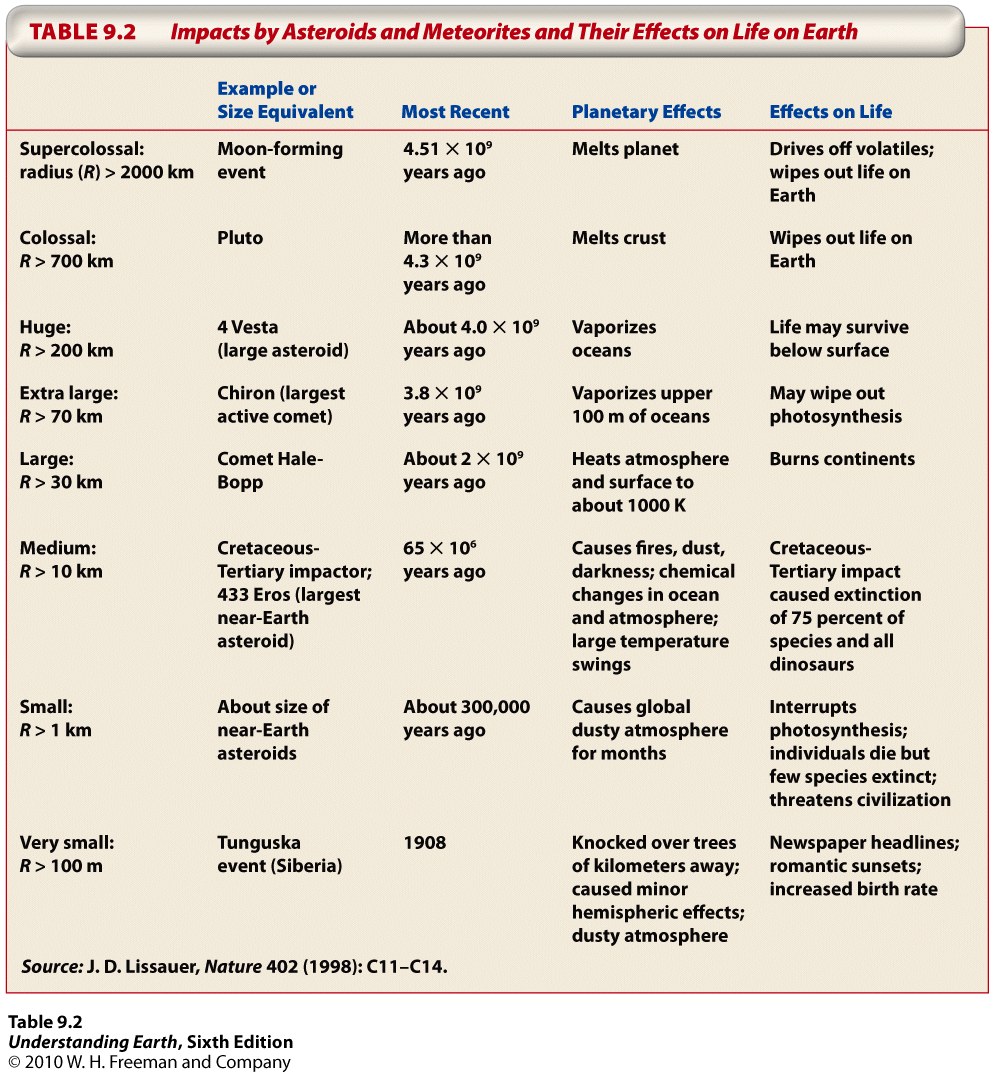
The Moon-forming impact occurred about 4.51 billion years (b.y.) ago, between the beginning of Earth’s accretion (~4.56 b.y.) and the age of the oldest Moon rocks brought back by the Apollo astronauts (4.47 b.y.). The latest period of heavy bombardment by meteorites ended about 3.9 b.y. ago.
Summary
Be sure to review the main points of the lesson:
Collision of a Mars-sized body with Earth about 4.51 b.y. ago
Earth melted to its core, vaporizing or melting anything that existed
Material was propelled from both bodies into space
Impact sped up Earth’s rotation and tilted Earth’s axis by about 23°, which caused Earth to have seasons
Earth reformed initially as a molten body, which then differentiated, with heavier elements sinking into the core and lighter elements coming to the surface, as it re-solidified
Ejected material was caught in Earth’s gravitational field, and aggregated and solidified to form the Moon