Chapter 13 Solids and Modern Materials
Crystalline vs. Amorphous Solids
Crystalline Solids: Characterized by a highly ordered, repeating arrangement of atoms, ions, or molecules (long-range order). They have distinct, sharp melting points.
Amorphous Solids: Lack long-range order; their components are arranged randomly. They do not have a sharp melting point but instead soften over a range of temperatures (e.g., glass, plastics).
Wave Interference
Constructive Interference: Occurs when waves are in phase (peaks align with peaks). The amplitudes add together to create a wave with greater intensity.
Destructive Interference: Occurs when waves are out of phase (peaks align with troughs). The amplitudes cancel each other out, leading to reduced intensity or darkness.

X-ray Diffraction and Bragg's Law
Consider two planes of atoms within a crystalline lattice separated by distance d
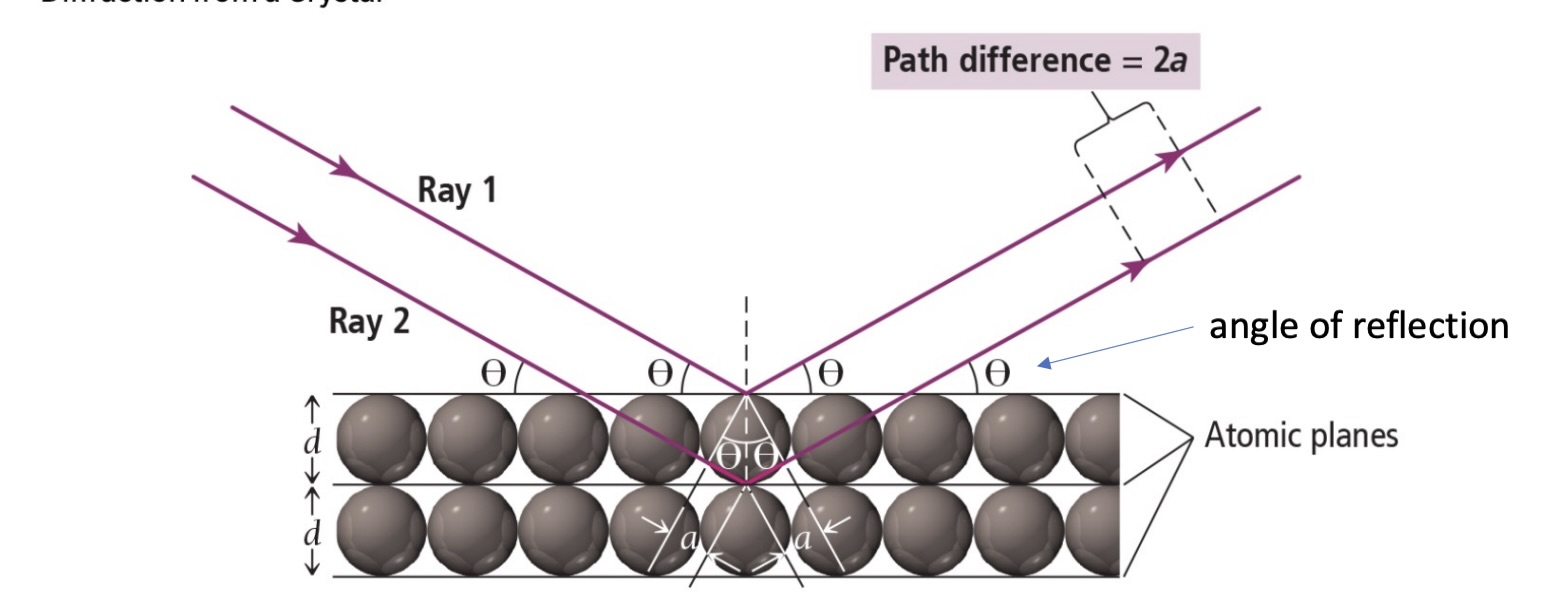
Bragg's Law is used to determine the spacing between layers of atoms using the formula: .
Solving for Interplanar Distance (d):
Rearrange the formula: .
Solving for Wavelength (lambda):
Rearrange the formula: .
Unit Cells
The regular arrangement of atoms within a solid is the Crystalline Lattice (arrangement minimizes energy).
Coordination number is the number of atoms that each atom is in direct contact
The packing efficiency is the % of volume ratio of the volume of the unit cell occupied by atoms to the volume of the unit cell itself.
The higher the coordination number – the greater the packing efficiency
Important Formulas:
Volume of atom (sphere):
Area of a atom (circle):
Volume of unit cell (cube):
Simple Cubic (SC) Unit Cell
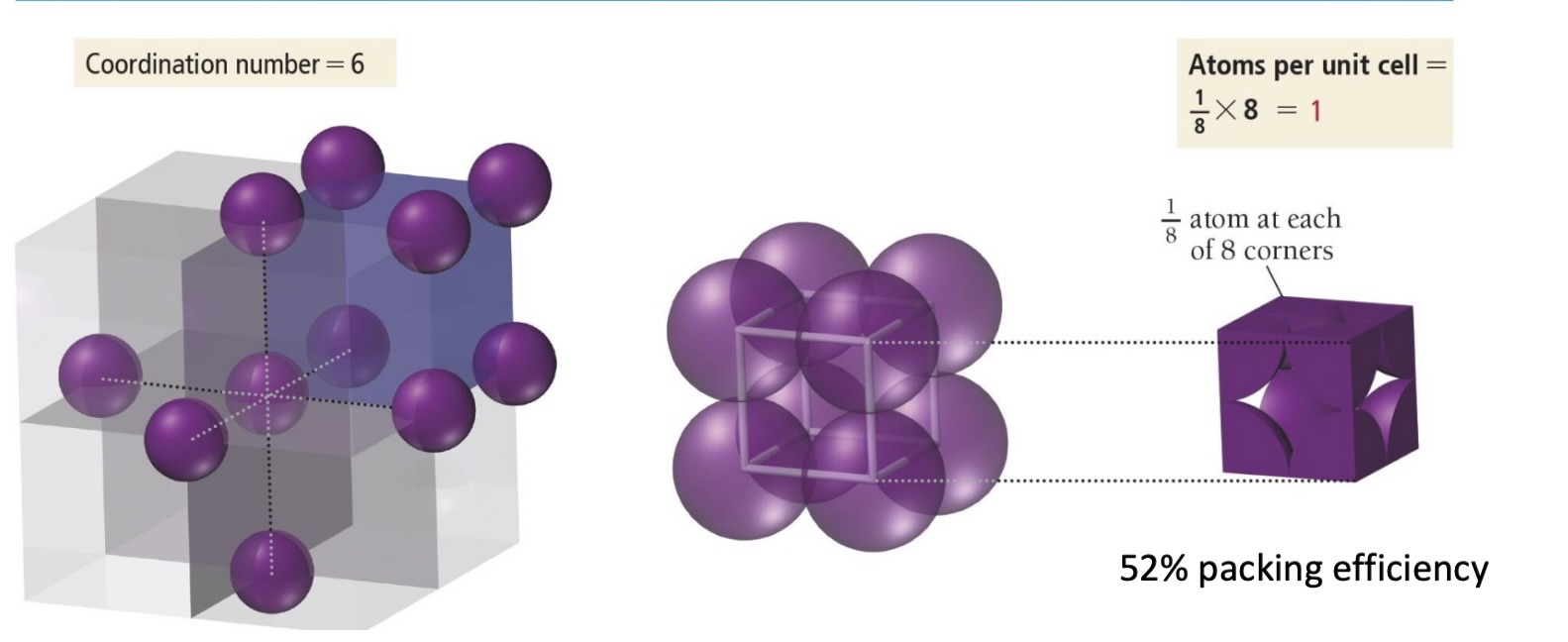
Structure: Atoms are present only at the corners of the cube.
Coordination Number: 6 (each atom is in contact with six neighbors).
1/8 of each atom at 8 corners contributes to the unit cell, resulting in a total of 1 atom per simple cubic unit cell.
, where (l) is the edge length of the cube and (r) is the radius of the atom.
Packing Efficiency in 3D:
Volume of atom (sphere) = .
Volume of cell = .
Efficiency = .
Packing Efficiency in 2D (Square Lattice):
Area of circles in unit square = .
Area of square = .
Efficiency = .
Body-Centered Cubic (BCC) Unit Cell
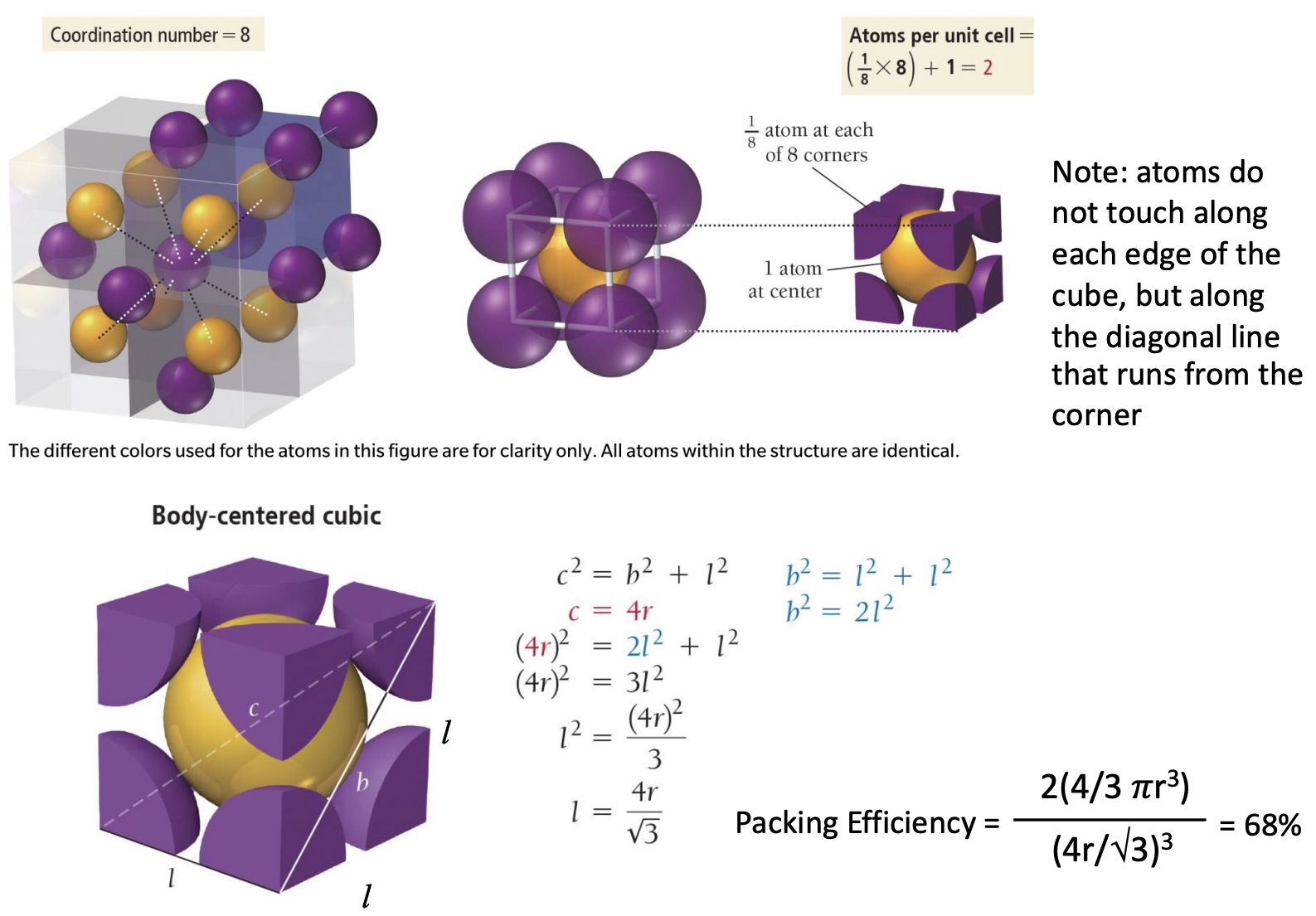
Structure: Atoms at corners and one in the center of the cell.
Coordination Number: 8 (center atom touches all 8 corner atoms).
1/8 of each atom at 8 corners and a full center atom contribute to the unit cell, resulting in a total of 2 atoms per simple cubic unit cell.
Finding Radius (r) Given Volume (V):
Edge length .
In BCC, the body diagonal is .
Solving for radius: .
Face-Centered Cubic (FCC) Unit Cell
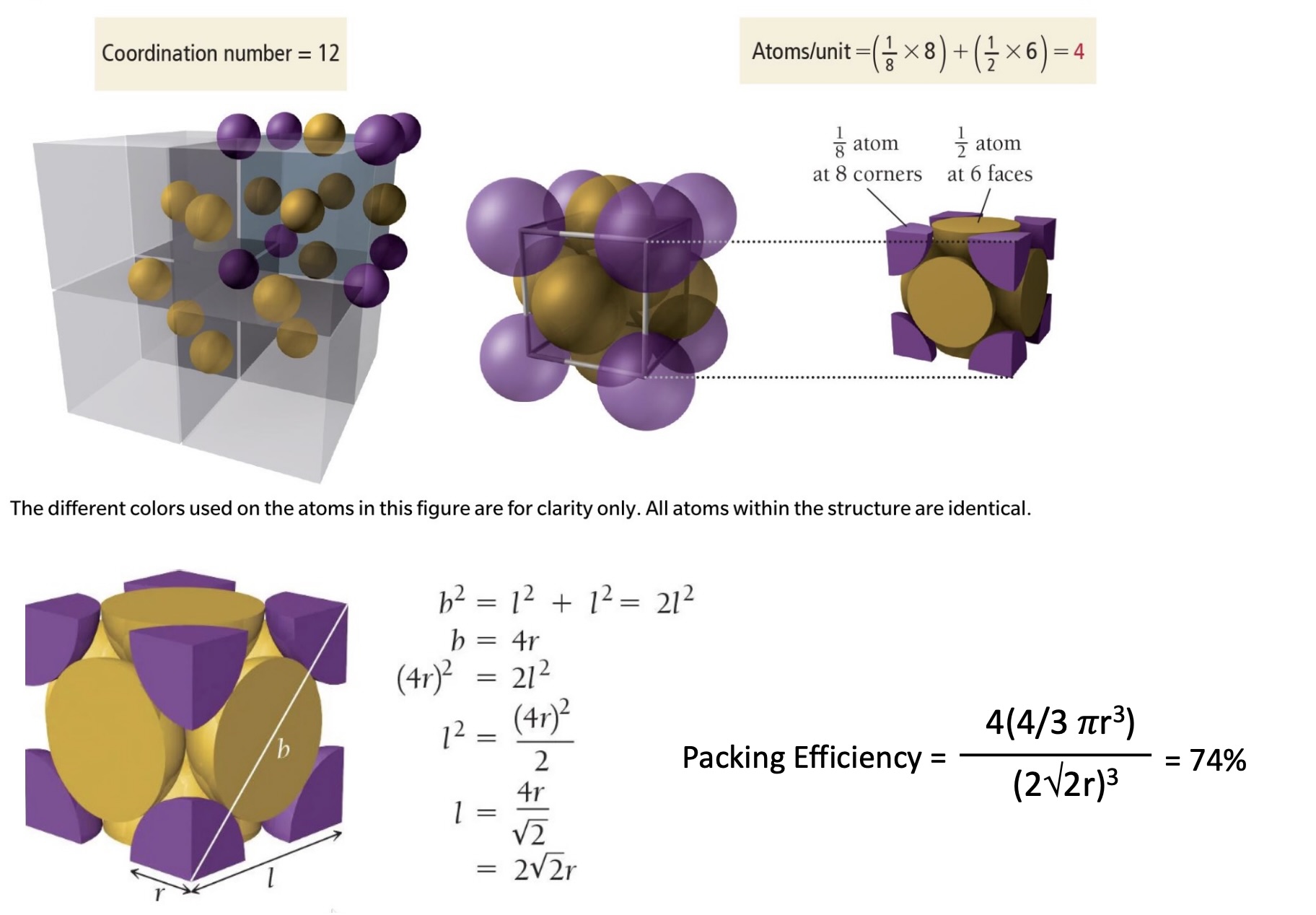
Structure: Atoms at corners and centers of all six faces.
Coordination Number: 12
1/8 of each atom at 8 corners an and 1/2 of each atom at 6 faces contribute to the overall structure resulting in a total of four atoms per unit cell.
Calculating Density Given Radius (r):
Edge length
Volume of cell .
Mass of unit cell = # atoms in unit cell x mass of each atom .
Density .
Closest-Packed Structures
In a simple cubic structure the layers of atoms are stacked directly over each other, leaving a lot of empty space – only 52% of volume is occupied by the atoms with a CN = 6
More efficient stacking offsets the layers giving closest-packed structures that uses 74% of space and a CN = 12
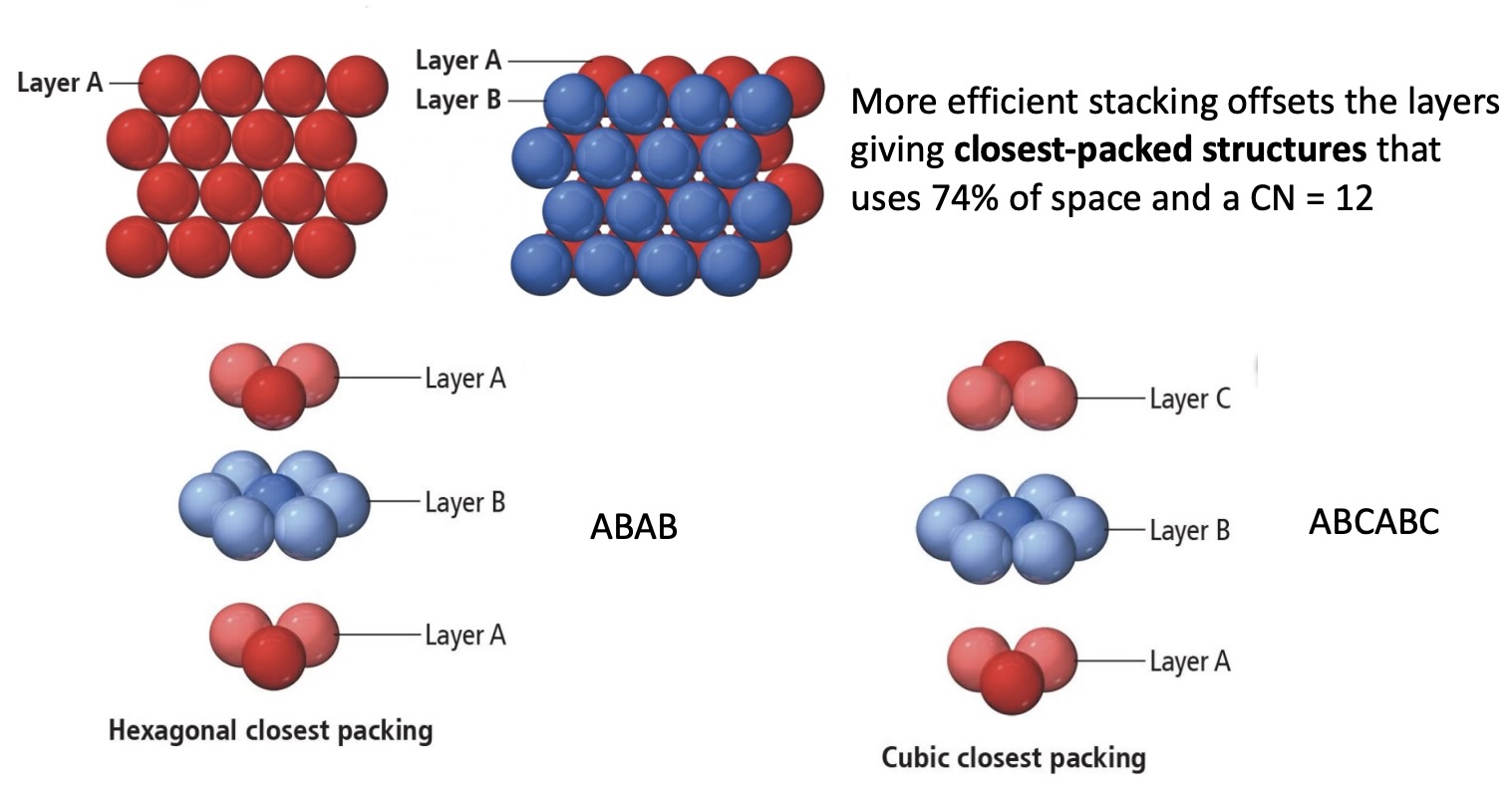
Hexagonal Closest Packing (HCP):
Layer sequence: ABAB…
Coordination Number: 12.
Efficiency: 74%.
Cubic Closest Packing (CCP):
Layer sequence: ABCABC…
Coordination Number: 12.
This structure is geometrically identical to the Face-Centered Cubic (FCC) lattice.
Efficiency: 74%.
Types of Crystalline Solids
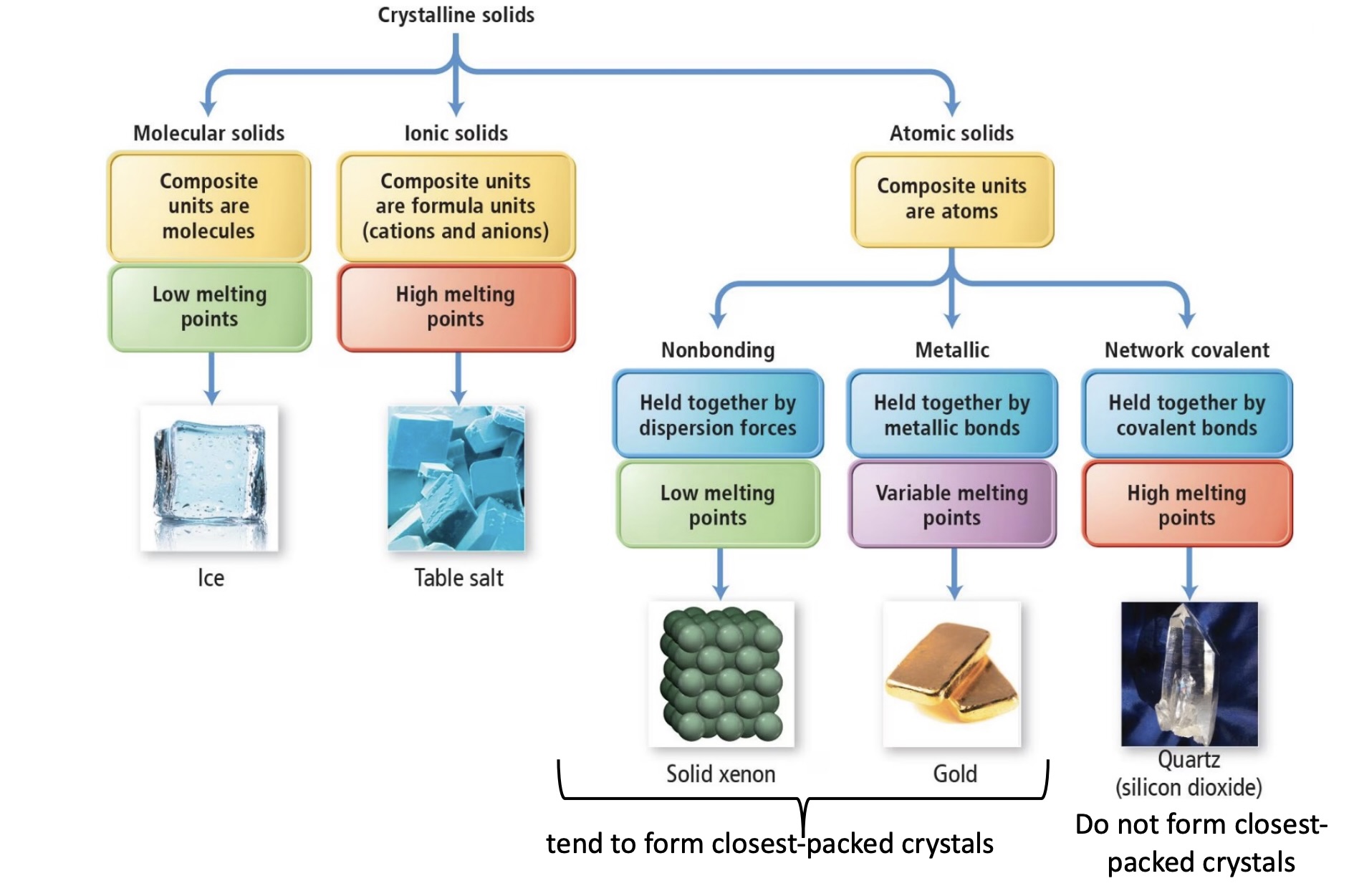
Molecular Solids:
Composed of molecules (nonmetals covalently bonded).
Held together by intermolecular forces (dispersion, dipole-dipole, hydrogen bonding).
Characteristics: Low melting points, poor electrical conductivity.
Example: Iodine (I2), Ethanol (C2H5OH), Dry Ice (CO2).
Ionic Solids:
Composed of cations and anions (metals and nonmetals).
Held together by strong electrostatic attractions (ionic bonds).
Characteristics: High melting points, brittle, conduct electricity when molten or dissolved.
Example: Sodium Chloride (), Magnesium Oxide ().
Atomic Solids:
Nonbonding Solids: Noble gases (e.g., Xenon, Argon) held by dispersion forces; very low melting points.
Metallic Solids: Individual metal atoms (e.g., Gold, Silver) held by metallic bonds; variable melting points.
Network Covalent Solids: Atoms linked by covalent bonds in a continuous structure (e.g., Diamond, Quartz); extremely high melting points.
Classification Examples
Gold (): Atomic (Metallic) solid.
Ethanol (): Molecular solid.
Magnesium Oxide (): Ionic solid.
Iodine (): Molecular solid.
Krypton (): Atomic (Nonbonding) solid.
Benzene vs Toluene
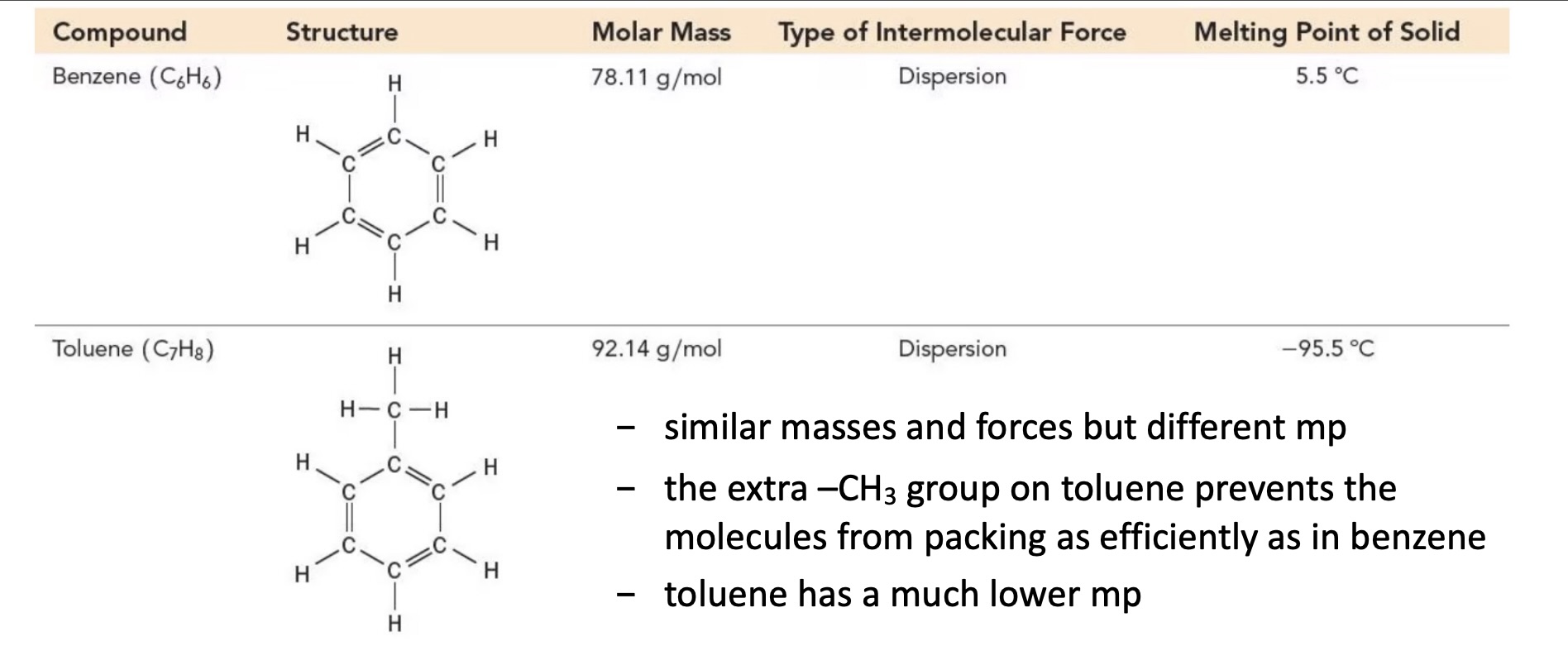
Molecular solids have unit cells occupied by molecules held together by their intermolecular forces. Their specific properties (e.g., mp, bp) depend on the types of intermolecular forces but also by the molecular structure and crystalline structure of the solid
Polymorphs are the same type of solid but different crystalline structure with different properties such as mp, bp, and solubilities
Examples include different forms of same pharmaceutical can have different physiological activities
Ionic Solid Rules
The structure of an ionic solid will:
arrange to maximize the coordination number
have to accommodate both cations and ions (sometimes of very different sizes)
achieve charge neutrality (each unit cell must be charge-neutral)
The structure of an ionic solid is determined by the relative sizes of the cations and anions.
Charge Neutrality: The total positive charge must equal the total negative charge.
The more similar the radii of the cation and anion, the higher the CN
Cesium Chloride ( ): Large cation () allows for high packing efficiency. . Structure is primitive cubic.
Sodium Chloride (): is smaller than , leading to a lower . Structure is face-centered cubic (fcc).
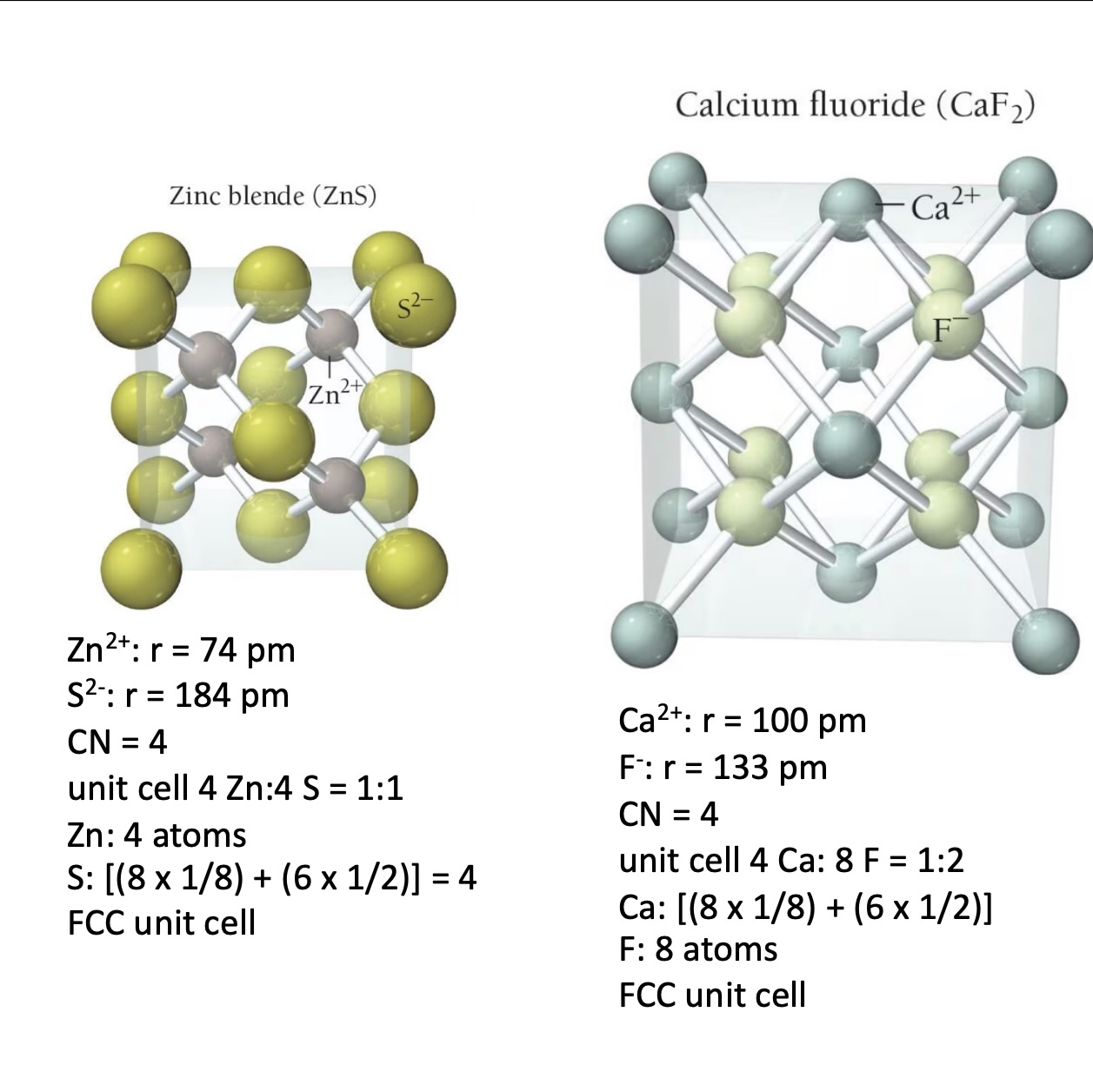
Zinc Blende (): Significant size difference between a smaller cation () and a larger anion () results in . Occurs when the cation is significantly smaller than the anion.
Fluorite (): A ratio cation : anion ratio. Calcium ions (cations) occupy lattice points while Fluoride ions (anions) occupy all tetrahedral holes.
Antifluorite Structure: A ratio cation : anion ratio (e.g., ). Cation and anion positions are swapped compared to fluorite.
Network Covalent Atomic Solids
Carbon and Silicates
Carbon Allotropes:
Graphite: Hexagonal sheets held by weak dispersion forces; allows for electrical conductivity and lubrication.
Diamond: Under high pressure, C atoms in graphite rearrange to form diamond with a higher density. All atoms are bonded covalently (no sheets). FCC unit cell lattice where every Carbon is covalently bonded to four others; extremely hard and high melting point, electrons are confined so no conductivity, used for cutting.
Buckminsterfullerene (): Spherical "Buckyballs" made of 60 carbon atoms in a soccer-ball-like arrangement. 5 and 6 carbon rings wrapped into a 20 sided structure.
Silicates:
Based on the tetrahedron.
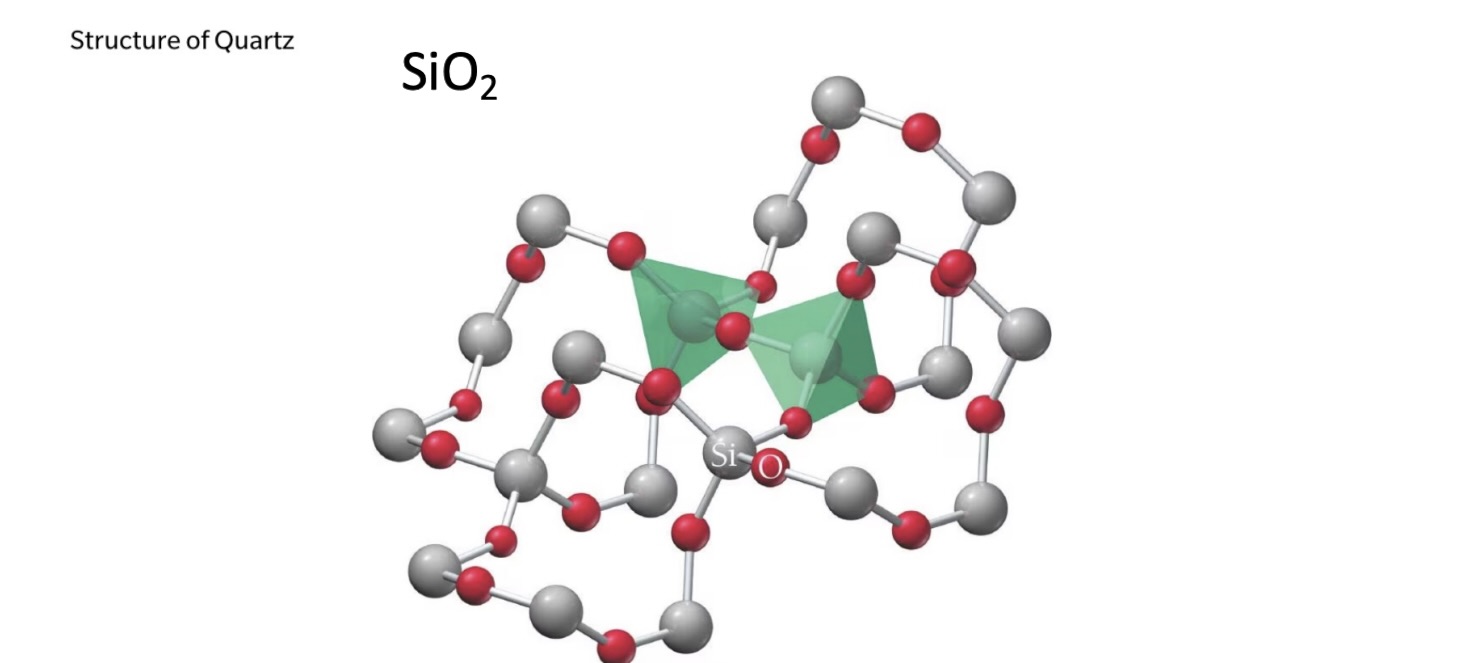
Extended arrays of Si and O – most common network covalent of atomic solids
Single Si bonded to four O - each O is one electron short of an octet, therefore each O atom forms a second covalent bond to a different Si atom.
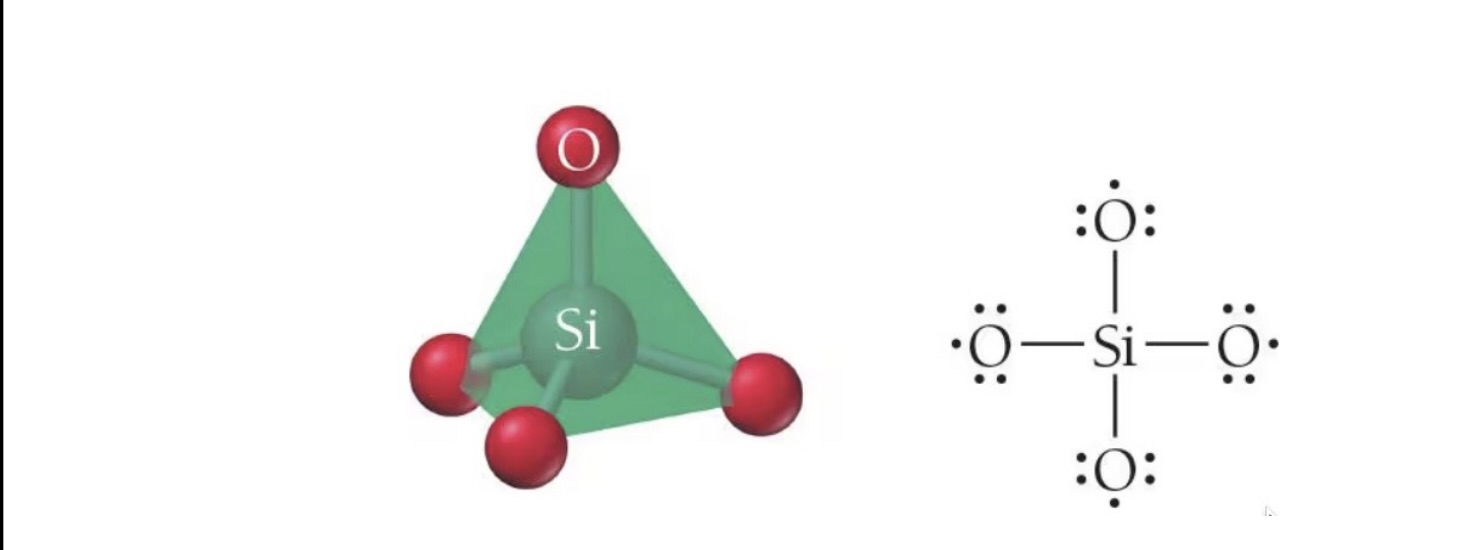
Silicon dioxide (, Quartz) forms a 3D network where tetrahedral share oxygen vertices.
Ceramics, Cement, and Glass
Ceramics: Traditionally made from silicates found in soil/clay, usually mixed with water, formed into a shape and then heatedTypically hard, strong, nonconductive, and brittle
Silicate Ceramics: Pottery and bricks.
Oxide Ceramics: High-strength materials like alumina ( )
Non-oxide Ceramics: Specialized materials like Silicon Carbide ().
Cement: Portland cement is the most common variety, primarily composed of limestone (CaCO3) and silica (SiO2) through a chemical reaction with water.
Glass: Amorphous solid (lacks long-range order).
Fused Silica (Quartz Glass): Pure , excellent for UV transmission.
Soda-lime Glass: Common window glass; contains and to lower melting temperature, transparent to visible but blocks UV
Borosilicate (Pyrex): Contains boron trioxide (B2O3) to reduce thermal expansion when heated
Semiconductors and Band Theory
Valence Band: Occupied molecular orbitals.
Conduction Band: Unoccupied molecular orbitals.
Band Gap: The energy difference between these two bands.
Conductors: Bands overlap; electrons move freely.
Insulators: Large band gap (); electrons cannot jump to the conduction band.
Semiconductors: Small band gap; conductivity increases with temperature or doping (e.g., Silicon).
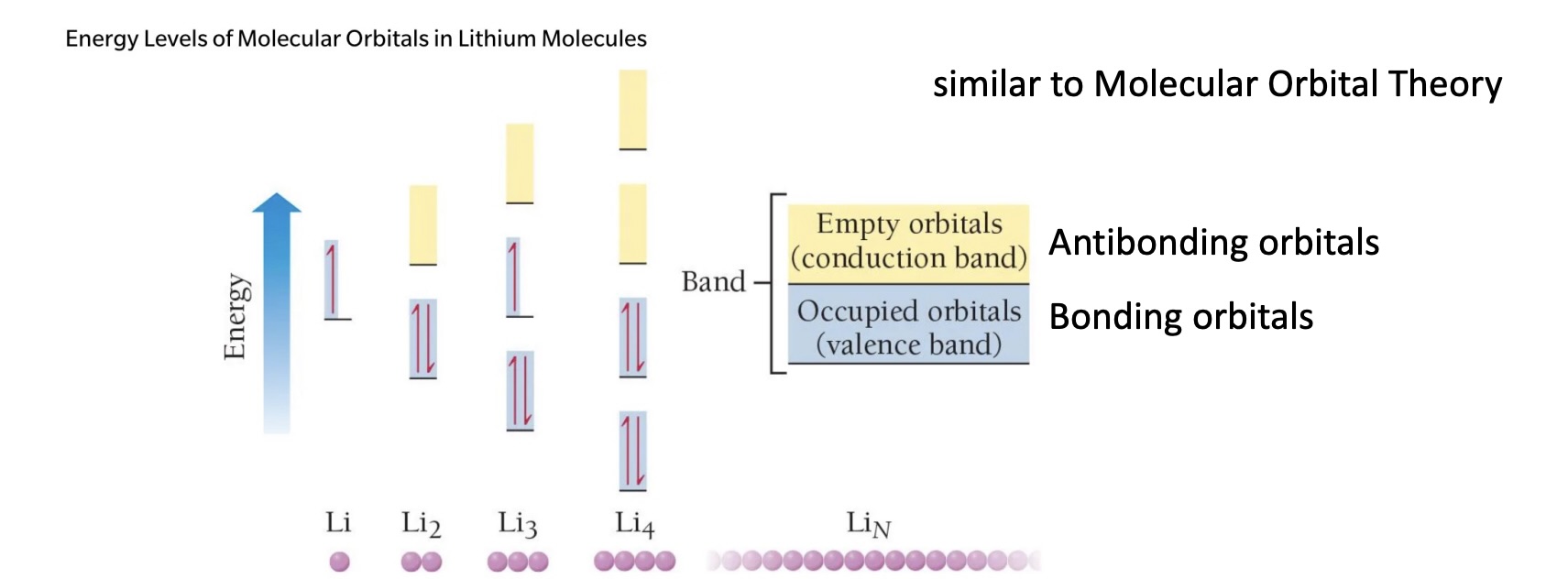
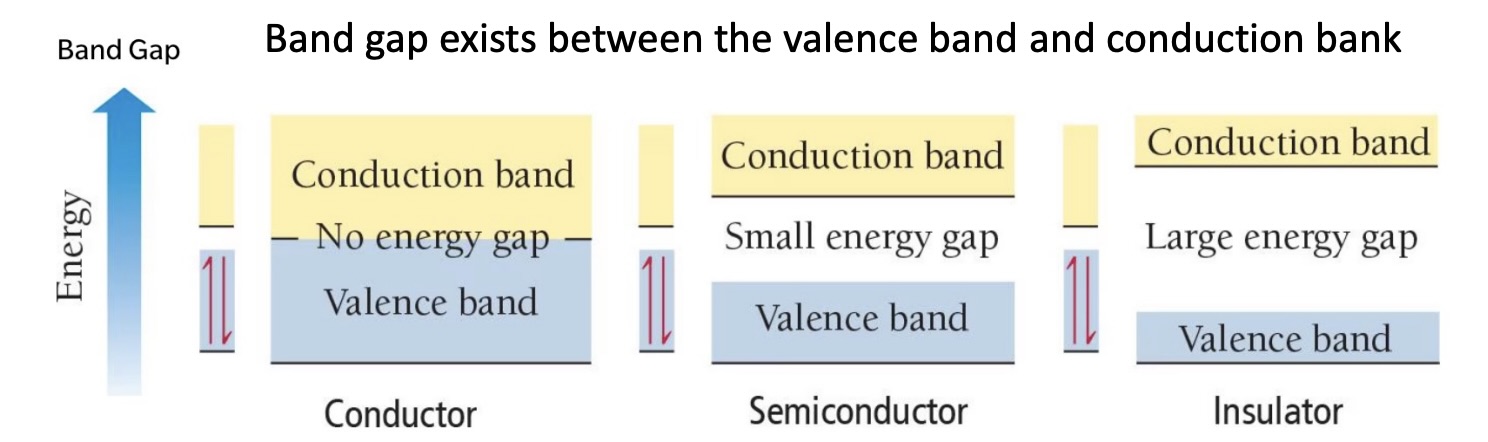
Increasing radius reduces the overlap between orbitals in neighboring atoms, decreases the strength of the interaction, which reduces the energy difference between conduction and valance bands,
A reduced interaction (less overlap) means the antibonding orbital is not pushed as high in energy, and the bonding orbital is not as low. As a result, the energy gap between the top of the valence band and the bottom of the conduction band decreases.
Doping adds impurities that result in additional electrons in the conduction band or electron ‘holes’ in the valence band
Polymers and Plastics
Polymers: Large molecules built from repeating units called monomers.
Addition polymer: monomers link without elimination of any atoms
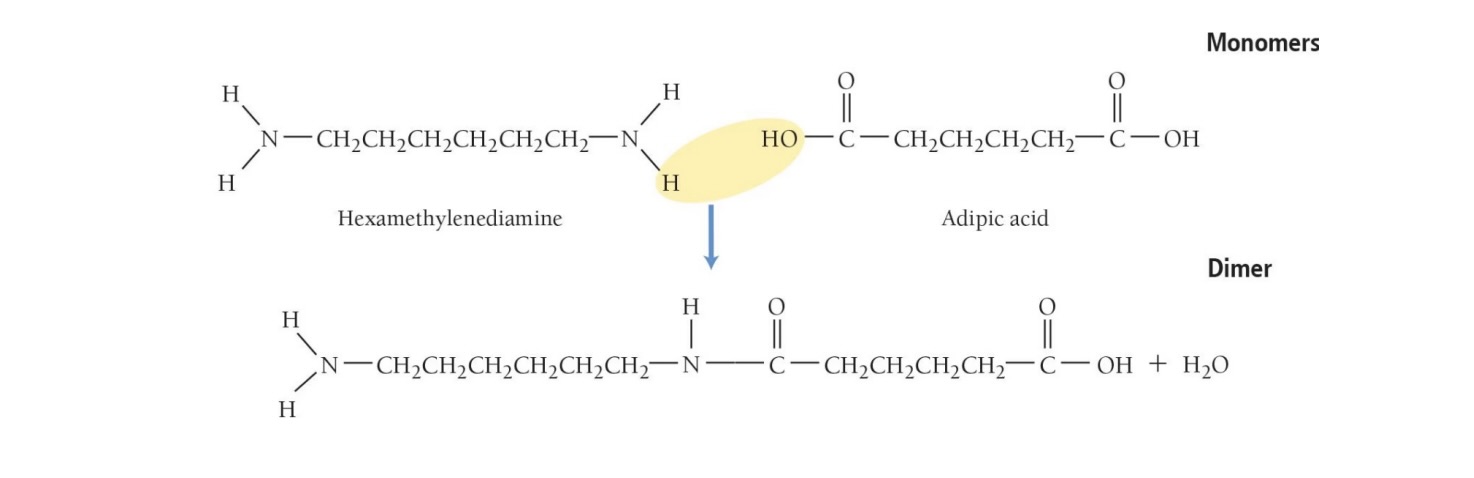
Condensation Polymers: Formed when monomers join by releasing a small molecule, typically water ().
Polyethylene: A common plastic formed from ethylene monomers.
Plastics: Synthetic polymers that can be molded into various shapes.