Public Economics & Political Economy
Session 1.
Definition: Location of resources in the public sector —> Welfare and why government intervention is important. How to measure or evaluate the role of government when the market is not working well by themselves.
Externalities: a side effect or consequence of an activity that is not reflected in the cost of that activity, and not primarily borne by those directly involved in said activity.
Public goods: a commodity or service that is provided without profit to all members of a society, either by the government or by a private individual or organization.
Public vs. private: Public sector organizations are owned, controlled and managed by the government or other state-run bodies. Private sector organizations are owned, controlled and managed by individuals, groups or business entities.
Provision: supplying something, especially food or other necessities.
Production: the process of making or manufacturing goods and products from raw materials or components
Issues of political economy: Political economy is an interdisciplinary branch of the social sciences. It focuses on the interrelationships of individuals, governments, and public policy. Political economists study how economic theories such as capitalism, socialism, and communism work in the real world. Topics in political economy include inequality (across class, gender, race, ethnicity), redistribution, economic development, globalization, macroeconomic policy, economic crises, populism, and environmental policy.
Positive vs Normative Analysis
Positive analysis: No subjection or judgment analysis
Positive is theory.
Empirical studies:
experimental
observation
quasi-experimental analysis
Normative: More emotional
Normative: Welfare economics (should)
Efficiency: using resources in such a way as to maximize the production of goods and services
No one can be made better off without making another worse: (Pareto efficiency)
More output cannot be obtained without increasing cost
Libertarian vs. Interventionist:
Libertarian: let the market work by itself
What to produce: what market demands
How much does it produce? As much needed for the market to work
Price and quantity: The market decided this (perfect competitive market)
Interventionist: Let the government take action in the economy to make it work better (maximum price in masks; minimum wage)
Exception that justify government interventions:
Market failures
Societal Preferences
Justice/ Fairness (you get what you earn/ pay for vs. pure equality)
Justice: If you have the means, you can get it
Fairness: Even if you don’t have a way to get something (if you have the right), you should be able to get it (education, health, etc.)
Societal preferences and justice/ fairness: We could defer in opinion depending on different topics (Exam. Public education)
Models
Definition: Simplifying what you are trying to explain. Not taking everything into account. You cannot measure everything. Example: Google Maps. Answer a need to imply something. Every model is wrong, but some of them are useful.
Income (You increase your income, you can buy more things) vs. substitution effect (if the price increases, you may change the brand of the product you buy):
Voucher School:
Pros: More competition to make better schools (BEST schools get voucher)
Cons: Create further segregation in public vs. private school
How to analyze
Positive Analysis: Measure by analyzing data, observing people benefitting from the policy, and using data to measure the effect.
The cause does not mean correlation. (spurious correlation or misinterpretation of a study)
The cause must proceed with the effect
The cause and effect must be correlated
Experimental vs. observational data
Experimental: Is it ethical to conduct specific experiments? Therefore, it is harder to do in economics.
Another con: You need funding to run an experiment. Hawthorne effect: You behave differently when you know you are being observed.
Pros: You can control pre-treatment characteristics and clear what attribute changed to
Observational:
Regression analysts: Dependent (what you expect in the result) and independent variable (what you want to see their effect).
Limitation: Existing data often do not have every variable you want (ex. personality)
Other explanations for observed correlation must be eliminated.
Just be wary of omitted variable bias.
Counterfactual: What would have happened to the treated without treatment? A control that behaves as the treatment would have
behaved without treatment. And we are always looking for a good counterfactual. No change.
Natural or Quasi-Experiments
Quasi-experiments: Naturally leads to a situation like an experiment but does not have randomization itself.
Differences in differences: We compare the before-and-after of our experiment with the control’s before-and-after.
You need: control, experiment and panel data.
Remember, a policy is NOT an experiment, but we evaluate it like one.
Although pre-policy levels do not need to be the same, the further apart the pre-policy levels, the harder it is to argue that they would have
behaved similarly.Must also assume that the composition of the two groups does not change over time (no huge influx of migration for example)
Nothing else can happen at the exact same time that differentially
affects both groupsIn reality, the treatment and control are not exactly alike, so we do this in a regression format to allow for the addition of controls.
Requires panel data (whether raw DD or estimates off on individual
data)
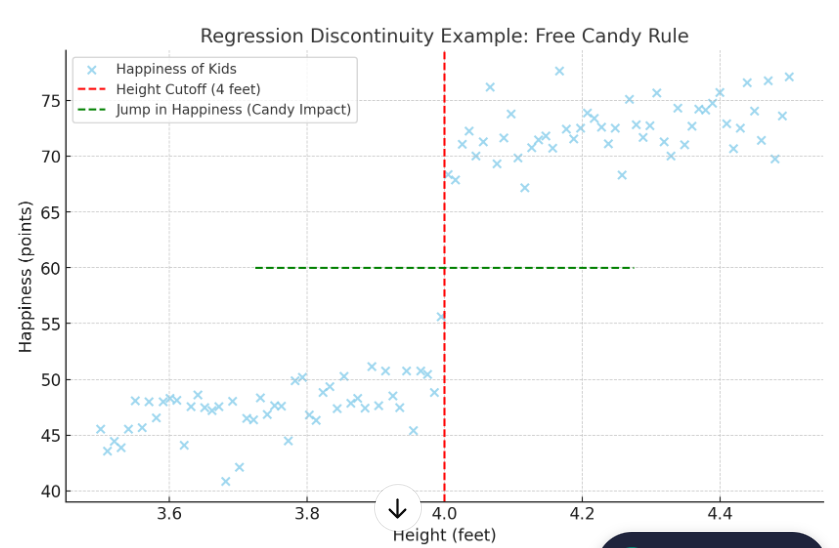
Regression Discontinuity: Treatment is terminated by measurable characteristics and a requirement to be above or below some cutoff.
You must control for treatment/ control, but also your running variable
Must show that other variables are smooth across the threshold
Requires a lot of data
Hard to find nice rules to take advantage of
Instrumental Variables:
Needs: Third variable that affects entry into treatment but does not otherwise affect outcome
The instrument must be correlated with the (endogenous) problematic treatment variable, conditional on the other covariates.
The instrument cannot have the same problem as the original predicting variable.
Natural: A naturally occurring instance of observable phenomena which approximate or duplicate the properties of a controlled experiment
Naturally leads to randomization.
Video 1 “Misinterpreted Research"
Successful decision-making
Serotonin:
How does Serotonin affect when people are treated unfairly?
When tryptophan is low (less serotonin), they are more likely to take revenge.
We must be careful not to let overblown claims detract resources and attention from the real science, which is playing a much longer game.
Ask the tough questions, see the evidence, and seek the part of the story that’s not being told.
Reading
No student left behind? Evidence from the Programme for School Guidance in Spain
How do consumers respond to “sin taxes”? New evidence from a tax on sugary drinks
Abstract: They measured the behaviour of consumers in Catalonia but not in the rest of Spain. The effect of taxes on sugar-sweetened beverages (SSB). They used the Difference in Difference approach. Results suggest that the increment in beverages without taxes increased than the taxed beverages (small increment). This has led to a 2.2% overall reduction in sugar purchases from beverages. Our study implies that although sin taxes moderately change consumer behaviour, combining different policies would be required to tackle obesity.
The tax to be paid by legal entity (in our case, retailers) providing the beverage to the consumer. From the legally defined generic list of taxable beverages, retailers were able to decide which specific drinks were to be taxed.
Infromation form consumer obtained with loyalty card information:
Age, sex, location,
Socioeconomic measures:
Zip codes and estimate household income provided by the chain. For marketing purposes, the chain has asked a consultancy firm to estimate household income by combining customers’ responses to the chain’s loyalty card registration questionnaire and area-level information (e.g. education, population density, housing, employment and type of occupation)
First Model: They measured 26 beverage categories, household, and time (year and month). Catalonia as a dummy variable (1 if bought in Catalonia household, 0 otherwise)
Weaknesses:
Households are aware of the tax: They can buy outside of Catalonia. Then, they controlled for a change in shopping patterns per household and dropped 13 locations of stores that were close to the borders.
Session 2.
Normative Analysis
Welfare Economics
Definition: The branch of economics theory concerned with the social desirability of alternative economic states.
Conditions:
All producers and consumers act as perfect competitors (perfect competitive market)
A market exist for each and every commodity.
And then step back to let powers of trade in the market find the efficient outcome again
Optimal or Pareto: social desire. Get the maximum for everyone/ reduce inequality.
Starts with Efficiency: The difference curve.
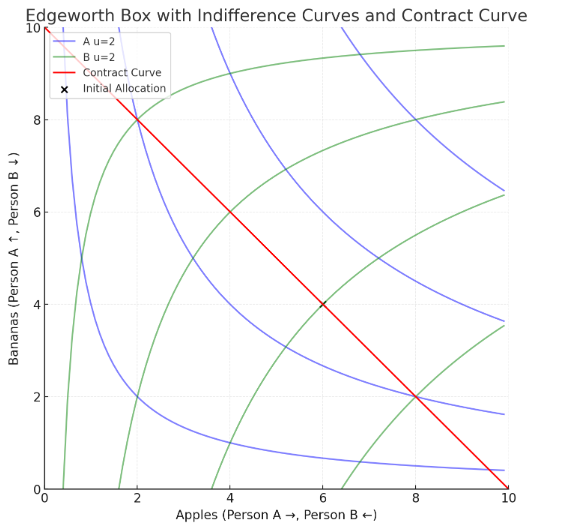
Edgeworth Box: Representation of market with two commodities
Market behaviour will be determined by the consumers' indifference curves (are concave). The blue curves in the diagram represent indifference curves for Octavio, and are shown as convex from his viewpoint (i.e. seen from the bottom left). The orange curves apply to Abby, and are convex as seen from the top right. Moving up and to the right increases Octavio's allocation and puts him onto a more desirable indifference curve, while placing Abby on a less desirable one. This shows just the consumers point of view.
It is possible to reach a Pareto efficiency point and Pareto improvement. The Connection of ALL points is called the contract curve.
Pareto Improvement: A change that makes one person better off without making anyone else worse off.
Pareto Efficient: Location where you can’t make anyone better off without making the other worse off
Production Possibility Frontiers: The maximum amount of a product that can be produced given resources. Line connecting the x and y.
Marginal Rate of Transformation: The rate at which the economy can transform one good into another. Same change in y-axis and different in x-axis (therefore different tarde-offs)
The law of Diminishing return The law of Diminishing return is not linear but curved because the production and reduction of a product are not linear.
Efficient condition: Efficient in both sides the consumer and producer.
Session 3
Welfare loss due to monopoly
Asymmetric information: One party does not have all the information.
Adverse Selection: One party know hidden attributes. Tendency toward non-desire attributes.
Starving Watchdog
Discussion questions:
1. Why is it logical for people to not subscribe to local newspapers anymore?
2. “If I decide not to buy a watch, I save money. If I decide not to pay for a police department, I might save money in the short run, but end up paying more in the long-run.” Explain this sentence thinking about concepts from public economics
3. a. How does moving from all physical to online sources of news change rival and excludability of the good of news consumption? b. How does the John Oliver critique about how often tv cites local newspapers help make this point?
4. How is a local newspaper an externality? What are some examples of the externality created by local newspapers?
Dermot thought there might be a relationship between the cost of loans to cities and towns and disappearing newspapers. The researchers tallied every time a newspaper shut down between 1996 and 2015. They found 200 counties across the United States where there was a decline in the number of newspapers. They compared these counties to similar counties in the same state where newspapers were thriving.
5. How do the authors conduct the tax bill study? What method was this?
6. What is the additional challenge for providing support for newspapers?
Public Policies to solve externalities
Cap and trade: permits of amount of poluution and you can trade them
Summary until Midterm
1. Public Economics Overview
Definition: Public Economics examines how policies and government actions influence economic efficiency and social equity. Economists often analyze policies and establish guidelines, but real-world applications can be challenging due to ideological differences (e.g., libertarian vs. interventionist views).
Key Perspectives:
Libertarian: Advocates minimal government intervention, emphasizing competitive markets.
Interventionist: Supports government intervention, especially to address market failures, societal preferences, and justice/fairness issues.
2. Positive vs. Normative Analysis
Positive Analysis: Focuses on factual descriptions and “what is” (e.g., economic effects of a policy).
Normative Analysis: Centers on values, ethics, and “what ought to be” (e.g., fairness or moral implications).
Tools of Positive and Normative Analysis
Economists use theoretical models to simplify complex real-world scenarios, helping to predict economic outcomes and understand policy impacts.
Income vs. Substitution Effects: Policies that affect wages can have complex impacts on work vs. leisure choices. For instance:
Substitution Effect: Higher wages make leisure relatively more costly, so people may work more.
Income Effect: Higher wages increase overall purchasing power, possibly leading to more leisure consumption.
3. Market Failures and Reasons for Intervention
Market Failures: Situations where free markets do not allocate resources efficiently.
Types of Failures:
Market Power: Includes monopolies and cartels.
Non-existence of Markets: For some goods or services, no market exists.
Asymmetric Information: Imbalance in information (e.g., one party has more knowledge).
Externalities: Costs or benefits not reflected in market prices (e.g., pollution).
Public Goods: Non-excludable and non-rivalrous goods (e.g., national defense).
4. Causal vs. Correlation in Economics
Causal Effects: Direct cause-effect relationships, distinct from mere correlation.
Differences-in-Differences (DiD): Compares the effect of a policy in a treatment group before and after the policy, using a control group as a benchmark. Example: Studying traffic fatalities before and after a seatbelt law.
Regression Discontinuity (RD): Examines outcomes around a cutoff point (e.g., GPA requirement for scholarships) to identify causal effects.
Instrumental Variables (IV): Uses a third variable (instrument) that affects the treatment but not the outcome to help identify causal effects. Example: Using birth month to study educational impacts on wages.
Challenges: Requires eliminating third variables, reverse causation, and selection bias.
5. Experimental and Observational Studies
Experimental: Controlled studies with randomization to establish causation.
Challenges: High cost, ethical considerations, and limited generalizability.
Observational: Analyzes real-world data without manipulation, often using regression analysis.
Data Types:
Cross-sectional: Compares different units at a single time point.
Time-series: Tracks the same unit over time.
Panel Data: Combines both cross-sectional and time-series data.
6. Natural or Quasi-Experiments
Definition: Naturally occurring situations that mimic experimental conditions (e.g., John Snow’s cholera study).
Examples: Policy changes, laws, or natural conditions can serve as quasi-experiments.
7. Welfare Economics
Focus: Evaluates the social desirability of different economic states.
Key Concepts:
Pareto Efficiency: A state where resources cannot be reallocated without making someone worse off.
Pareto Improvement: A change that benefits at least one person without harming others.
Edgeworth Box: A tool to illustrate efficient resource allocations in a two-person, two-good economy.
Market Failures and Intervention Justifications
Asymmetric Information: When one party has more information than another, markets may fail (e.g., used car markets).
Public Goods and Externalities: Justify government provision of goods (e.g., national defense) and regulation of negative externalities (e.g., pollution).
8. Production Possibility Frontier (PPF)
Definition: The maximum combination of two goods that can be produced with available resources.
Marginal Rate of Transformation (MRT): The trade-off rate between two goods on the PPF.
Returns
The PPF illustrates diminishing marginal returns: As more resources are devoted to one good, the opportunity cost of producing additional units rises due to less suitable resources being used.
Critiques and Limitations of PPF and Economic Models
Economic models like the PPF assume simplified, ideal conditions that may not fully capture complexities like resource suitability and variable comparative advantages across resources.
9. Fundamental Theorems of Welfare Economics
First Theorem: Competitive markets lead to efficient resource allocations.
Second Theorem: Efficient allocations can be achieved if resources are redistributed according to societal preferences.
10. Government’s Role
According to the Fundamental Theorems:
Protect property rights for efficient markets.
Redistribute resources based on social preferences.
In Cases of Market Failure: The government may also need to regulate, provide public goods, or correct for externalities.
Market Failures occur when free markets fail to efficiently allocate resources, creating roles for government intervention.
Types of Market Failures:
Market Power: Includes monopolies, oligopolies, and cartels, where fewer firms control prices and output.
Non-existent Markets: Cases where goods/services are underprovided or missing in the market (e.g., some types of insurance).
Asymmetric Information: Situations where one party in a transaction has more information than the other, leading to inefficiencies like adverse selection and moral hazard.
Public Goods and Externalities: Often underprovided or overused in private markets.
11. Types of Policy Analysis: Voucher School Example
School Choice Programs: Voucher schools provide insight into policy analysis by illustrating benefits (e.g., choice, competition) and drawbacks (e.g., potential segregation, impact on public schools).
Empirical analysis is necessary to measure these effects in real-world scenarios.
12. Validity in Economic Studies
Internal Validity: Ensures the study accurately identifies causal relationships (common in experiments).
External Validity: Ensures findings can be generalized to real-world situations (more challenging in experimental setups).
13. Efficiency in Consumption and Production
Efficiency in consumption is reached when the Marginal Rate of Substitution (MRS) between goods is equal for all consumers.
Efficiency in production requires the Marginal Rate of Transformation (MRT) to match the MRS, ensuring optimal allocation of resources across goods.
14. Welfare Economics – Second Fundamental Theorem
Government can achieve social equity by redistributing resources (through taxes or transfers) and allowing markets to allocate them efficiently afterward.
15. Important Terms and Conditions for Efficiency
MRS (Marginal Rate of Substitution): The trade-off consumers are willing to make between two goods.
MRT (Marginal Rate of Transformation): The rate at which one good can be transformed into another in production.
For efficiency, MRS = MRT across consumers and producers, leading to an allocation where no one can be made better off without making someone else worse off (Pareto Efficiency).
16. Public Goods
Definition: Goods that are both non-excludable (cannot prevent others from using them) and non-rival (one person’s use doesn’t reduce availability for others).
Examples: National defense, and street lighting.
Key Concepts:
Free-Rider Problem: Individuals can benefit without paying, leading to under-provision in the market.
Efficient Provision of Public Goods: Requires vertical summation of individual demands to account for each person’s valuation.
17. Types of Goods by Rivalry and Excludability
Private Goods: Excludable and rival (e.g., food, clothing).
Public Goods: Non-excludable and non-rival.
Common Resources: Rival but non-excludable (e.g., fish stocks).
Natural Monopolies: Excludable but non-rival (e.g., cable TV).
18. Cost-Benefit Analysis for Public Goods
Government uses cost-benefit analysis to decide on providing public goods by comparing the total social benefits to total costs. Challenges arise because not all benefits and costs can be quantified (e.g., valuing human life or environmental beauty).
19. Externalities
Definition: Costs or benefits of a transaction that affect third parties outside the transaction.
Negative Externalities: Harm others (e.g., pollution, noise).
Positive Externalities: Benefit others (e.g., education, vaccinations).
Social vs. Private Costs and Benefits:
Negative externality: Social Cost > Private Cost.
Positive externality: Social Value > Private Value.
20. Solutions to Externalities
Private Solutions:
Coase Theorem: If property rights are well-defined and bargaining is costless, parties can negotiate to resolve externalities.
Examples: Noise disputes between neighbors, contractual agreements.
Public Solutions:
Command-and-Control: Regulations (e.g., pollution limits).
Market-Based:
Pigouvian Taxes: Taxes on activities with negative externalities to reflect social costs.
Subsidies: To encourage activities with positive externalities.
Cap-and-Trade: Sets a pollution cap, allowing firms to buy/sell pollution permits.
21. Key Economic Concepts
Free-Rider Problem: Difficulty in charging users who benefit from non-excludable public goods, leading to under-provision.
Tragedy of the Commons: Overuse of common resources because individuals act in self-interest, leading to depletion (e.g., overfishing).
Property Rights: Essential for market efficiency; well-defined rights can prevent overuse or misallocation of resources.
22. Important Takeaways
Public Intervention in Market Failures: Governments can correct market failures by providing public goods and regulating externalities.
Determining Optimal Provision: Not all government interventions are optimal; determining the right level of provision for public goods or regulation for externalities is challenging.
The Role of Incentives: Internalizing externalities by modifying incentives can lead to socially optimal outcomes.
Policy Solutions for Externalities:
Pigouvian Taxes: Taxes equal to the marginal external cost (MEC) at the socially optimal output level, to make firms internalize the negative externalities
Pigouvian Subsidies: Payments to encourage activities with positive externalities, though less commonly used due to practical limitations.
Emission Fees: Fees directly on pollution emissions to incentivize reduction without necessarily decreasing output levels.
Cap-and-Trade: Sets a limit on total emissions and creates tradable pollution permits, ensuring cost-effective pollution reduction
Property Rights and Coase Theorem:
Property Rights: Essential for market efficiency; undefined or unenforced rights often lead to market failures.
Coase Theorem: If transaction costs are low, private parties can negotiate to solve externalities efficiently, regardless of initial rights allocation(3. Public Economics_Ext…).
Cost-Effectiveness in Pollution Reduction:
Ensuring pollution reduction at the lowest cost through efficient allocation of reduction responsibilities (e.g., using emission fees or cap-and-trade).
Does Government Intervention crowd out private education?
Market Failures: when the allocation of goods and services by the gree market does not achieve the efficient allocation
Market power (non-competitive)
Monopoly (1 producer)
Oligopology (few producers)
Monopsony (1 buyer - labor market typically)
Cartels (collaboration to set prices)
Product differentiation
Non-existance of markets
Assymmentric information
Public Goods
Externalities
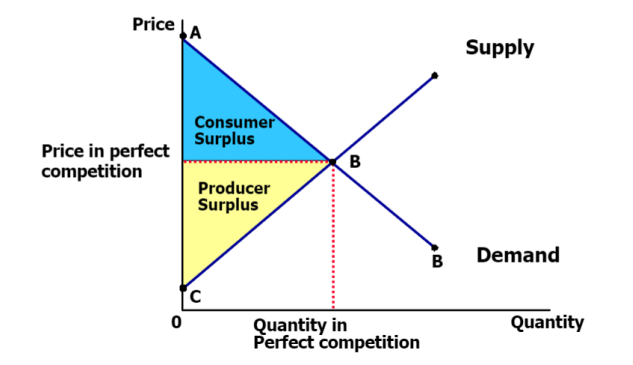
Efficiency in perfect competition
Study for finals
Observational data
Experiment and use of economics. Used regression analysis: how dependent variable changes with independent variable.
Cross-sectional data:
Time series data:
Panel data:
Contrafactual = what would happen without the cure, then we use a…
Natural or Quasi-Experiement
A natural occurring instance of observable phenomena, which approximate or duplicate the properties of a controlled experiment. A natural occurring instance of observable phenomena.
For example:
Effect of family size on labor market
People can chose how many children to have and where to work. However, there are thing that are natural such as the gender of the kid. Families with 2 kids that are both female and male tend to not have another kid.
Differences in differences (DD)
Assumption is that the observed control group also needed a treatment. And both groups should have the same characteristics before and after the treatment. Basically you compare the treated before and after with the control group before and after.
Regression Discontinuity
Basically treatment is given after or before a cutoff. Fopr example, you will give you an extra point of you have more than 7 in your midterm.
Instrumental Variables
Use of an instrument to see the real effect in the group we want to find. For example, if we want to measure the happiness of kids after eating icecream, but suially is also sunny when kids eat ice cream. We can use the inrument of a cream bus schedule that comes every day to measure if the kids are happy when eating the icecream even if it is not sunny.
Welfare economics
Branch of economic tehroy concern for the social welfare and alternative economic states.
Edgeworth Box
Box between two entities that shows how they can trade goods to make each other beter off.
Preto Improvement: One person becomes better off without making the other worse off
Pareto Efficiency: No more Preto improvements are possible
Contract Curve: Set of all allocations in the box
Pareto-Efficient Consumption: Both people agreed to trade, no more Pareto improvements are pos
Public goods
Characteristics of public goods: Non-excludable and non-rivalrous, meaning that one person's consumption does not reduce availability to others.
Categories of goods
Private goods: excludable and rival
Public goods: non excludable and non-rival
Common resources: Rival but not excludables
Natural monopolies: excludable but not rival
Production Possibility Frontiers
The maximum amount of 2 goods that can be produced given a given amount of resources
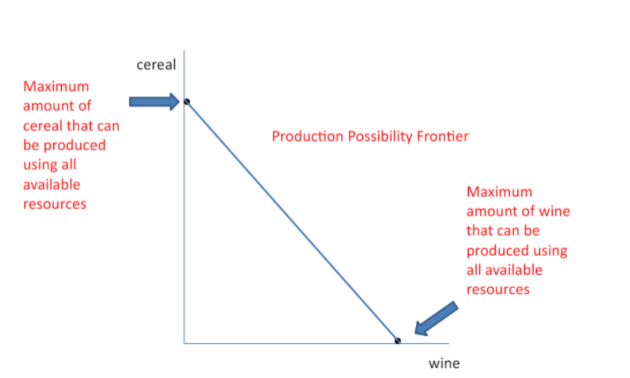
The slope is the Marginal Rate of Transformation (MRT). This is the rate at which the economy can transform one good into another.
First Fundamental Theorem of Wefare Economics
Condtions:
All producers and consumers act as perfect competitors (perfectly competitive market)
A market exist for each and every commodity
and
Protect property rights
Redistribute allocations of resources based on societal preferences
Roles of Government
Market Failures: when the allocation of goods and services by the free market does not achieve the efficient allocation
Market power
Monopoly (1 producer)
Oligopoly (few producers)
Monopsony (1 buyer - labor market typically)
Cartels (collaboration to set prices)
Production differentiation
Non-existance of markets
Asymmetric information
Public goods
Externalities
Efficiency in Perfect Competition
There is a point where supply and demand meet in a efficient way
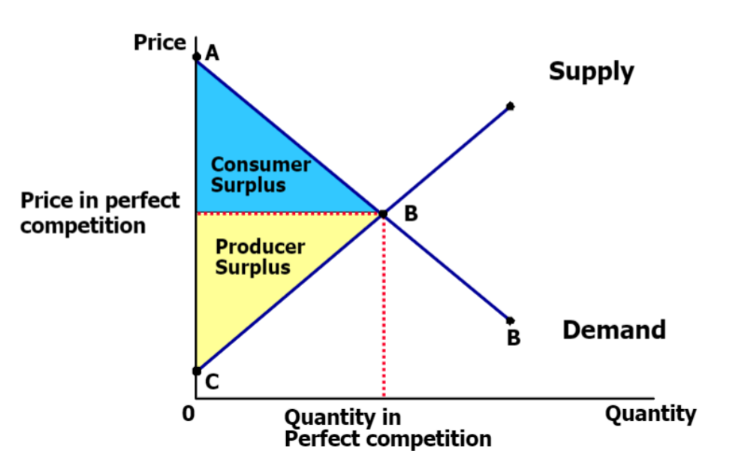
Welfare loss due to monopoly
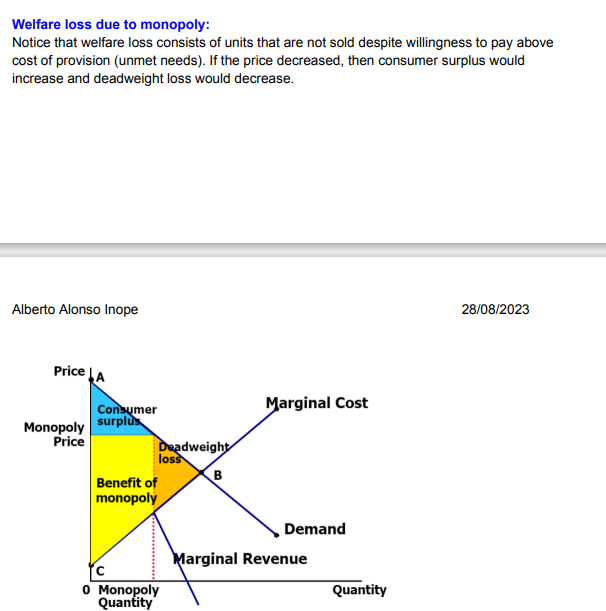
The products that are loss because monopolies increase the price and sell in little amounts. Therefore, there is a lost of product that people were willing to buy but couldn’t because the price was too high.
Consumer surplus (blue area): the consumers that got the product for less price that they were willing to pay
Benefit of monopoly (yellow): Extra money that monopoly got by charging a higher price.
Deadweight loss (orange area): product that people could not buy but wanted to buy
Asymmetric information:
Parties involve in the economic relationship do not have the same information. For example, the insurance company
Quality of a good, skill level of a worker
Tnedency towards non-desirable attributes
Adverse selection
Moral Hazard
A party will have a tendency to take risks because the cost that could be incurred will not be felt by the party taking the risk.
Example | Solutions | |
Insurance company-insurance party | Insurance with exemptions | People are likely to engage in riskier behavior than they would have without the insurance |
Employer-worker | End- of the year bonus | after getting a job, the worker will still have incentive to do just enough, but may try to shrink |
Bank borrower | mortgage | After getting the loan people will tend to not want to pay if there is not mortage |
Implications of Asymetrci information
Markets can be inefficient
Markets may not even exist
unemployment
Parts of the market can be missing
Public Good
Characteristics of goods
Excludable goods
Rival goods
Categories of goods
Private: excludable and rival
public: non-excludable and non rival
Common resources: rival but not excludable
Natural monopolies: Excludable but not rival
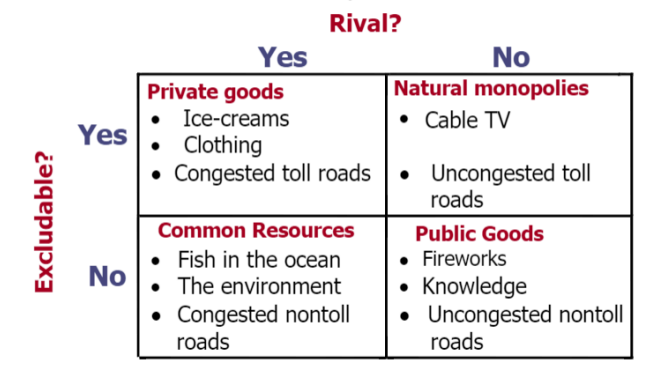
Considerations of public goods
Shared equally, but not often valued equally: national defense spending
The sector that produces or provides it is not what determines whether it is a private or public good. It actually refers to the characteristics and conditions under which ut has those characteristics.
Free-Rider problem
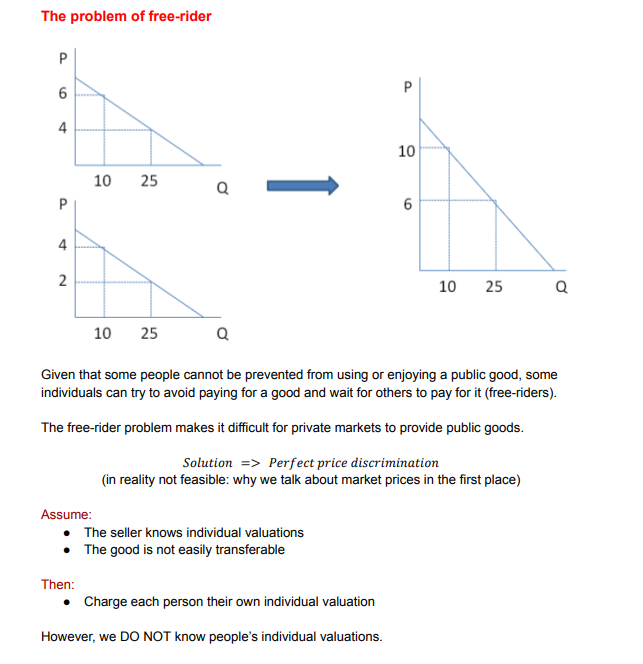
Some people enjoy public goods or things without paying for it. For example, not paying taxes. Having a bunch of free riders can make the thing not have enough funding to be maintained or improved, and government can not provide them efficiently.
Uisng the graphs above, we can measure ethe demands of each person. Then, we can combine them to measure the total willingness to pay. The combined graph shows the total willingness to pay for each quantity.
Problem? some people might not pay at all but still use the good.
Solution is called Perfect Price Discrimination
Imagine the seller know exactly how much each person values the good
The seller charges everyone a different price based on the willingness to pay
Hard to implement:
Sellers do not know how much each person is willing to pay
its is difficult to stop free-riders from enjoying the good without paying
Cost-benefit analysis
To decide if the government should provide a public good, they measure the enjoyment or use of it with the total cost of the provision of the goods (cost-benefit analysis).
Tragedy of the commons
Common resources tend to be overexploited when the individuals do not pay for them. This generates a negative externality. Common resources are used more intesively than they should.
Externalities:
Negative: impact is adverse
Positive: the impact is beneficial
Externalities in production
Social cost is more than private cost when the externality is negative. When the social cost is less than the private cost, then the externality is beneficial.
Supply = marginal private cost
Demand = marginal private benefit
No externatilies —> we maximize total surpluses
Social cost is measure by Private cost + the cost of pollution
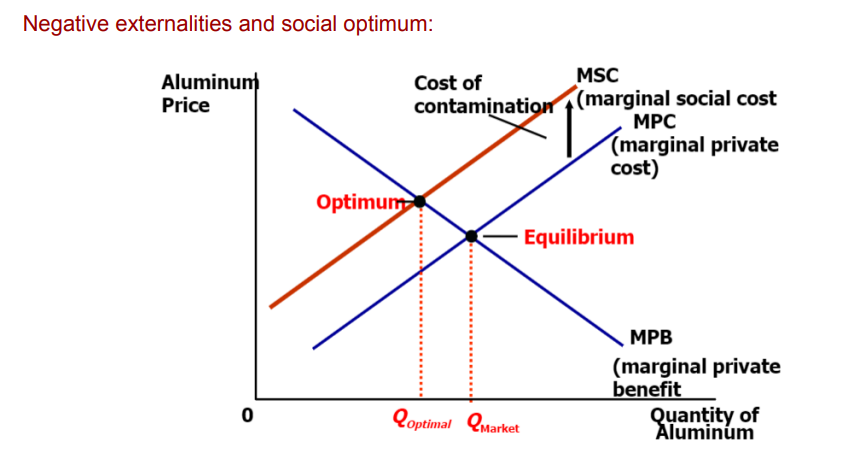
Positive externalities —> Private cost - benefits
Externalities in Consumption
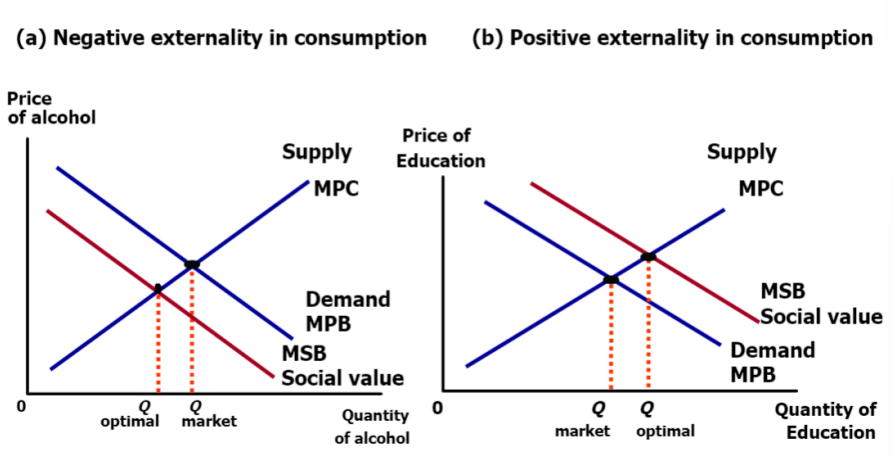
Externalities and economic welfare
When producer and consumer do not consider the external effects of the choices, they do not produce the optimal quantity —> externalities makes market fail and generate welfare loss
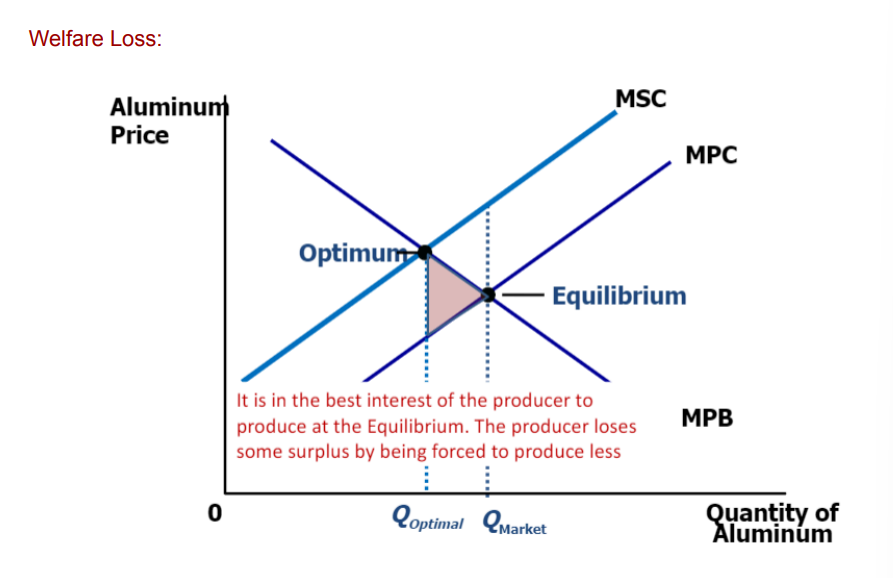
Marginal Social Cost = real cost to society. It includes producer’s cost and harm by pollution
at equilibrium point only they take into account the cost and benefits and ignore externalities
at optimum point they consider society welfare
The problem: Welfare loss
The pick tringle show the wanted resources or harm because too much aluminium is made
With taxes or regulations producers may be forced to make t=less money even if they do not want.
Importance of property rights
When property ruhts are not well established, the markets fail to provide resources. then the government can potentially solve the problem.
examples:
smoking - who has the right (smoker to smoke or non-smoker to clean air)
Polluting factory upstream from a fisheries
Solution to externalities
Internalization of externalities
Modification of incentives to make the agents take into account the external effects of their choices.
Private solutions
moral codes and social actions
charities
integrating different types of business
Generating contracts between the interested parties
The Coase Theorem
Property rights well defined + private parties can bargain without cot over the allocation of resources —> They can solve in their own
Example:
Value for B is $500; Cost of noise for N is $800 ■
If the bar is open: Total welfare = 500-800 = -300.
■ If the bar is closed: Total welfare = 0 (0 > -300). ➢
Let’s assume that the law allows the bar to open
If N offers $700 to B to keep the bar closed, B accepts and the bar remains closed.
Welfare of N = -700; welfare of B = 700
Public Solutions
Measures of command and control: forbid some activitoes or make some activities compulsory
Policies based on the market:
Pegouvian taxes: correct negative externalities (establish a tax for each unit of pollution generated by girls)
Subsidies: to correct the positive externalities
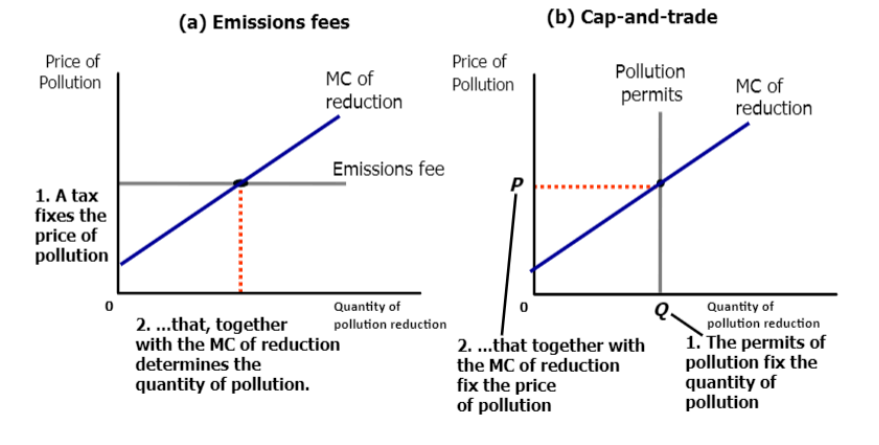
Tradable permits: cap-and trade mechanism (fix upper limit to total pollution.
Regualtion: force compliance
Externalities: happen outside market mechanism. Related to lack of property rights. There is a loss of welfare. Can be solved with internalization.
Pigouvian taxes: Polluter problem
Marginal damage (MD): The marginal cost curve shift to the left due to tax.
Goal: To make the polluter pay for the harm. Align private cost with societal cost.
Calculated:
Determine the damage caused by one unit of pollution
Set the tax rate: The tax per pollution unit is equal to this social cost.
Example:
If the factory pollutes 100 tons and the tax is 50 per ton
100×50=5000
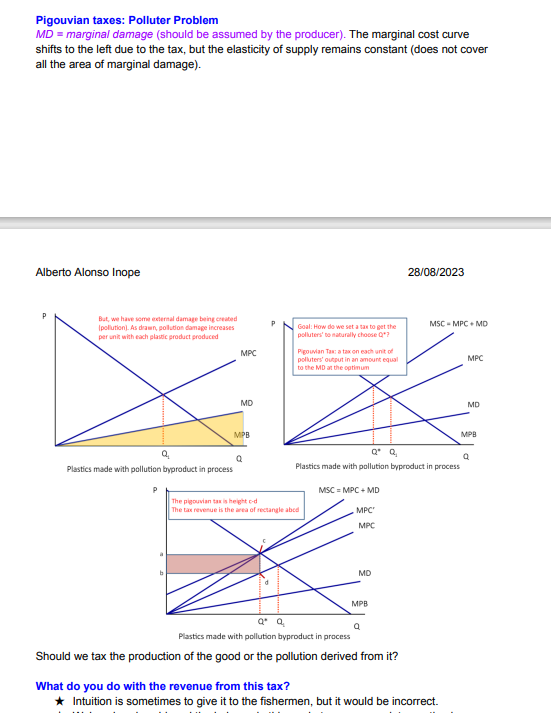
Graph 1:
MPC (Marginal private cost): cost of company to make each unit of plastic (labor, materials, etc)
MPB (Marginal private benefit): This is the benefit people get from buying plastic
MD (marginal danamge): cost of pollution cause by making each unit of plastic. It grows as more plastic is made)
Q= Efficent point without considering the environment
Graph 2: The solution
Pigovian tax: the government add a tax to pollution damage (MD) fro each unit of plastic.
MSC (Marginal social cost): When we add MD (pollution) harm to MPC (comapny’s private cost), we get the real cost to society
Q*: There is where benefit to people eauals the real cost to society
Graph 3:
the tax adds an extra cost per unit of plastic, shown as the height of the rectange
The tax revenue is the are of the recatnagle (a rectangles formed by Q* an d the tax height). This is the money the government collects fro the tax
Emission Fees
Like pigouvian teaxes but are directly tied to the amount of pollution emitted
The polluter pays a fee for every unit of pollution they release
example: 10 euros per ton (no need of measure the damage of the pollution, it is a fixed cost)
Goal: make pollution expensive to encourage reduction of it.
Steps:
1. Restrict MCs to be equal (horizontal line).
2. Find the option where they add up to the desired reduction.
3. Set emissions fees there.
Cap-and-Trade
A market-based approach to controlling pollution:
the government set a cap on the total pollution allowed
Polluters get or buy emmison permits, which allow them to pollute a certain amount
Pollutter can trade permits with each other.
Example:
Fcatory A allowed to 100 tons but only does 60, so they can sell 40
Factory B need to emit 140, so it buys the 40 permits from Factory A
ConceptHow It WorksGoal |
Pigouvian Tax | Polluters pay a tax equal to the social cost of their pollution. | Internalize the external cost of pollution. |
Emission Fees | Fee per unit of pollution emitted. | Directly charge for pollution created. |
Cap-and-Trade | Set a cap on total pollution and allow trading of permits. | Limit pollution while encouraging efficiency. |
Market Failures vs. Government Failures
Free market does not reach the efficient outcome
Government Failures
Majority voting:single peaked preferences
Median Voter theorem
Log-rolling (Vote trading)
Represent democracy
Elected politicians
bureaucrats
Special interest group
Majority Voting: Single-Peaked Preferences
efficient outcome: members of society have single peaked preferences
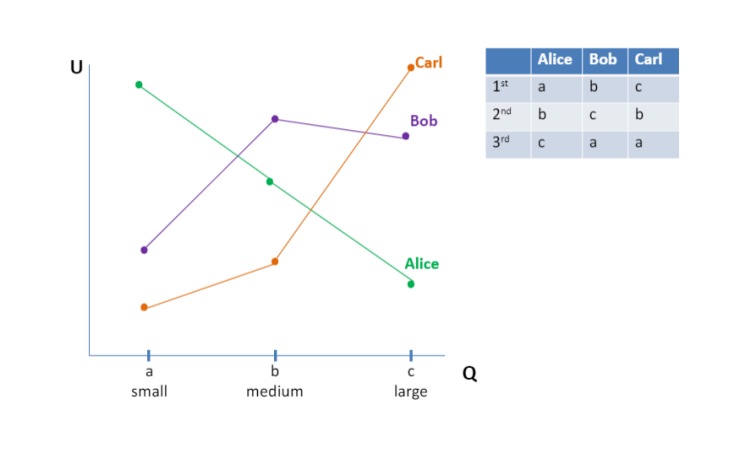
A —> preferred by green
B —> preferred by orange
C —> preferred by purple
Double Peaked
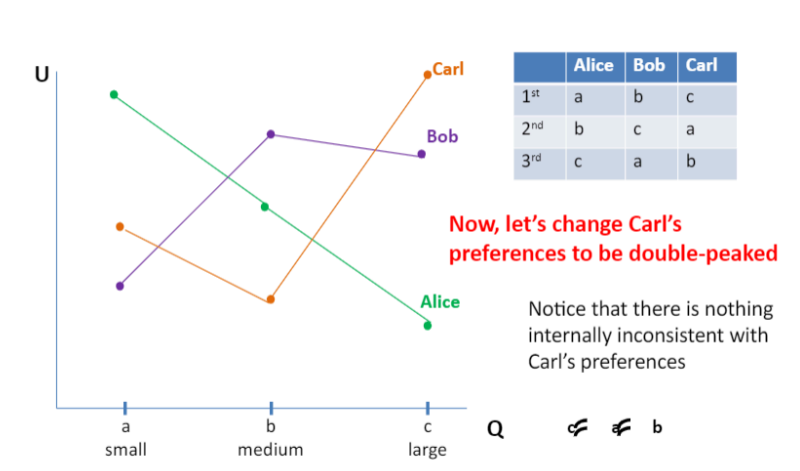
Two individuals have the same preference for one of the choices.
It matters because individual preferences can be consistent, but societal preferences are not (Voting pardox). In multi-peaked preferences, whoever can set the order of votes has immense power in how the vote plays out.
When do Double-peaked preferences Occur: All-or-nothing investments (public transport); Multiple nonlinear things (different packages that cannot be easily ranked.
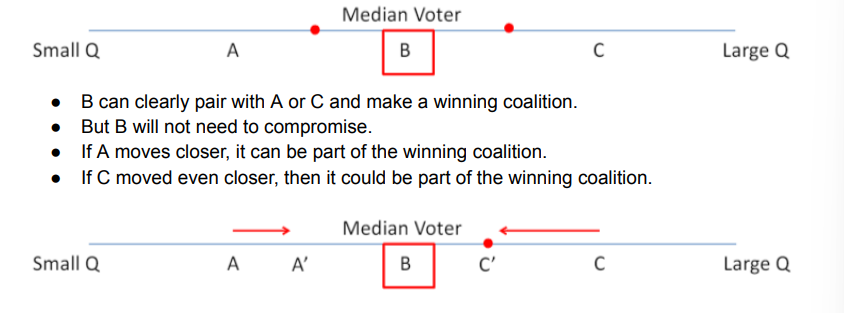
Median Voter Theorem
preferences are singles peaked
Odd number of voter (for the median to be a whole number)
Then:
Median Voter always wins
Median Voter preferences are all that Matters
The closer to the center the more voters you can get
Log-rolling Vote trading
Majority voting treats each person with 1 vote (all equal)
But this does not take into account the size of peopl’s preferences
Logrolling: Allows people to trade votes and therefore accounts for the strength of preferences of an individual.
More efficient provision of public goods
reveals intensity of preferences
Example:
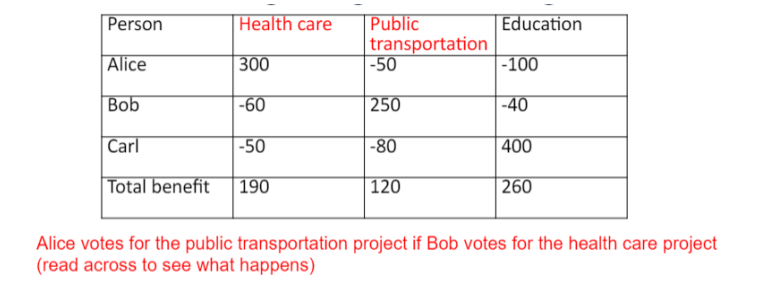
Alice
gains 300
loses 50
overall: 250
Bob
gains: 250
loses: 60
overall: 190
Carl
gains nothing
loses 50 and 80 from projects
Overall: loss 130
Benefits:
benefits society
after vote trading, 2 of these projects can be passed
If Carl and Alice trade:
Alice overall wins: 100
Carl overall wins: 150
However, they have the highest total benefit Alice (300 HC) and Carl (300 Edu), then it is Maximize Aggregate Utility
Detrimental properties:
Overall it may not be beneficial to society
Even if society would gain, the minority could bear a huge cost
traders do not consider a non-trader party
Representative Democracy
Voters elect representatives, who, in turn, make policy decisions.
Elected politicians
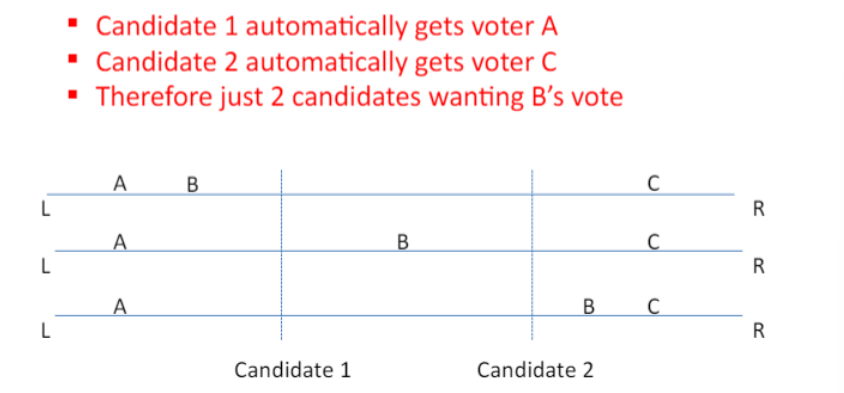
Median voter theorem can still apply
Politicians behave to maximize votes
Adopt median voter preferences
Bureaucrats
Since many laws are clear in terms of goals and vague in terms of how they are implemented.
Pros:
Design and execute programs
last longer than elected officials “institutional memory”
equal treatment and prevent corruption
Cons:
May have their own agendas
not immune to corruption
Niskanen Model:
Maximize own budget (because of status and job security, not innate value)
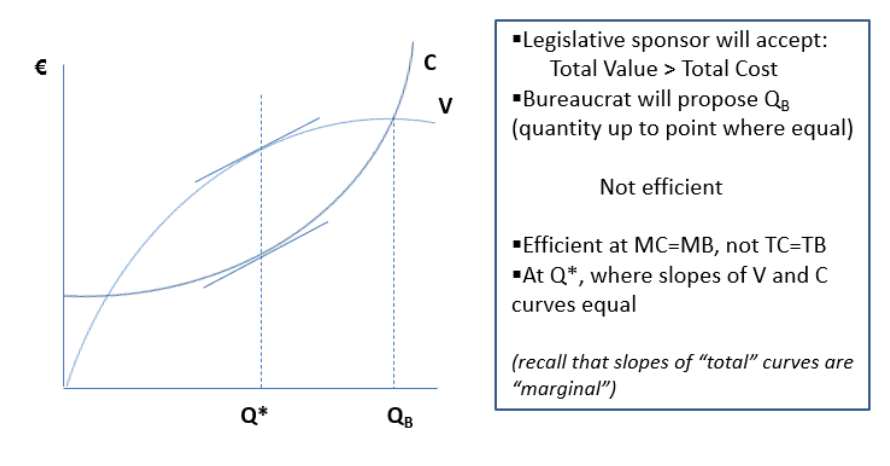
Margocal cost = Marginal benefit will, be where burocrats will chose to be at (QB). However, in this case Q* is the best option because is where Total value (V) is the highest, and total cost (C) is the lowest. Therefore, the bets option.
Speacial interest groups
Group powers from higher voter participation. Campaigns contributions (bribes). United by common interests.
What makes group formation more/less likely to occur?
❖ Small numbers
❖ Suffers from free-rider problems
❖ Ability to punish non-joiners
❖ Access to resources within group Alberto Alonso Inope 28/08/2023
❖ Strength of ideology Goals of special interest groups:
Redistribute income toward the group.
➢ Not bad if a group that is otherwise taken advantage of (monopsony).
➢ But often this results in rent-seeking (wasteful) behavior.
Rent seeking:
When an individual, firm, or organization seeks to gain compensation that does not correspond to production or quality
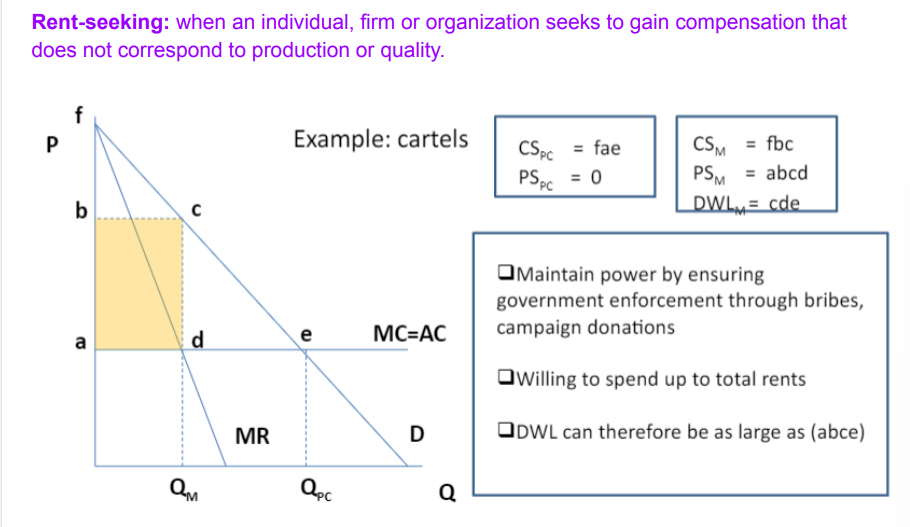
A cartel limits the production and raises prices QM
The actually price and quantity in free market is QPC
D is the demand curve
MC= AC is marginal cost and average cost
MR is the marginal revenue a firm earns
PS is 0 because firms only cover their costs (producer surplus)
Consumer surplus (CS) is fae. The triangle above the price, where consumers benefit from lower prices)
fbc is the lose of benefits for consumers die to higher prices
abcd represents monopoly profits (rent)
DWL is a deadweight loss. Represents the loss of total welfare
Education
It is NOT a public good. An educated society could be non-rival and non-excludable (positive externalities).
Externalities of education
Sociialization
Economic Growth
human capital
Deabte: theater technology is already accounted for in the price
This raises questions about the true value of technological advancements in relation to their impact on productivity and overall economic performance.
Inequitable distribution: low income can be left out. Sometime sonly people with money can access dedication in a market economy
Commodity Egalitarianism: all should be able to access some education (fundamental right)
Free and required education at lower grade levels
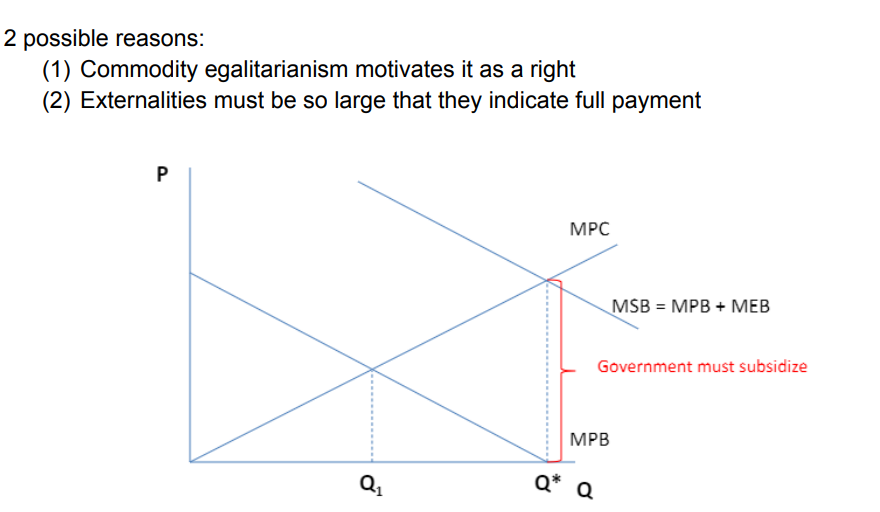
Marginal private cost is what families pay for eduacyion
Marginal private benefit is what a child gets from education
Marginal social benefit is the total social impact
Q1 is where only private benefits are considered and in free market
Q* is reflecting the total social benefit
Welfare gain is the shaded are and whtgovernment should subsize
Case 1: No crowding out
Free but low education level that lowers utility
Cosumer continue to purchase education in private market
No cowed out but no take-up either (people still buy private education)
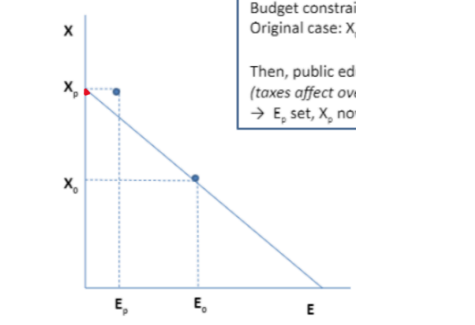
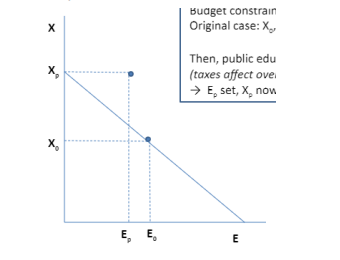
Case 2: Partial Crowding out
even though of lower education, the drop in education is small enough that outweighed by the increase in other consumption
Take up- of public education
Crowd-out occurs (exactly E0)
Families still pay education but eduacton levels increase
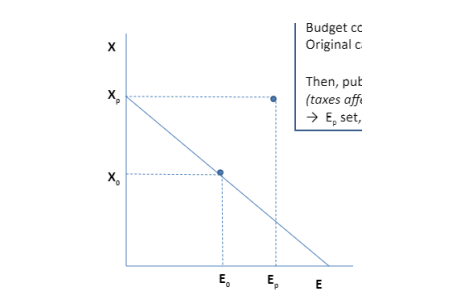
Case 3: Full crowding out
The public option both increases consumption of X and E
Consumers will use public education (take up)
Crowd out occurs (E0)
Families fully shift from private to public schools
Why do we care about crowding out?
If public eduacyom fully crowds out private spending, the increase in total eduacyion might not be as large as expected
Policymakers want to ensure that public spending truly adds to education levels rather than just replacing private spending
Because it shifts the cost to taxpayers instead of the ones receiving the service.
Which programs increase future earnings?
Early childhood investment, teacher quality (yet policy less clear)
Market Failures in the Health Care Market
Asymmetric information
insurance markets
Moral Hazard
Demand of Heath insurance
Externalities: Positive and negative spillover effects that can impact overall societal welfare, often requiring government intervention to correct.
Why?
Consumers are risk averse
Leads to demns for health insurance
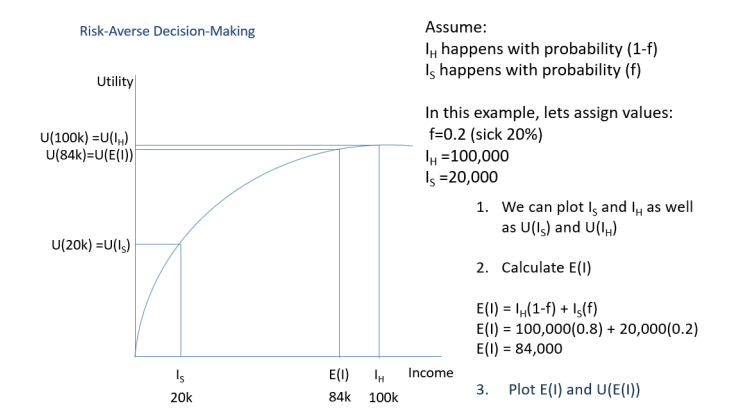
Expected Income
Check this come back (page 43)
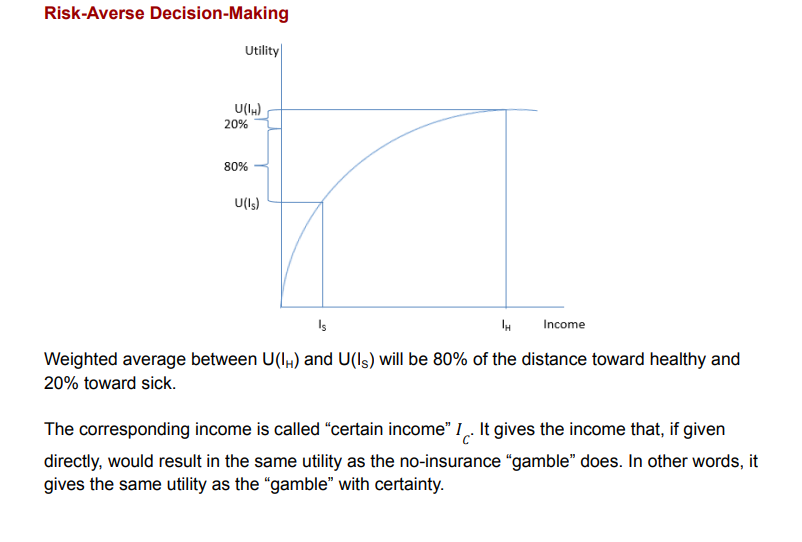
Risk Averse Decision-Making
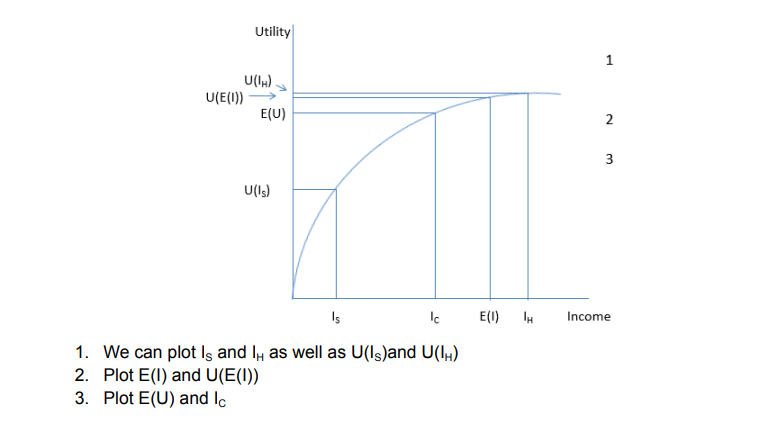
What do we observe?
We are less happy with the situation resembling a gamble than if we just given the expected income directly —> Risk aversion
E(I) is the income that would make us happy as the gamble does with certain is lower than the expected income from the gamble —> Room for improvement
The difference E(I)-Ic is the risk premium. Itd describes how much averse a person dislikes the gambling situation.
Reasons to buy HI:
Decreasing marginal utility of income
Risk aversion
Willingness to pay to avoid income flactuations
Willingness to pay HI
Supply: Risk Pooling
Is we are all risk averse, why is anyone willing to supply this?
Risk Polling: One entity taking on multiple risks, therefore diversifying risk. Overall society risk fall.
Distiguishing Fcators of Health Care Market
Insurance Markets:
Demand for health insurance
Supply: Risk Pooling
Asymmetric information: Buyers of HI know more about their own health and consumption than sellers. HI can give insurance to high-risk individuals that practice risky sports without reporting. So HI gives packages different to each individual.
Moral hazard
When insurer cannot observe differences:
An insurance company offers a policy, priced to cover their costs (no mark-up)
➔ The rate is based on their potential population of customers
➔ The price will be too high for some and too low for others (they all get the same price because the insurance company can’t tell who is who)
➔ The price is too high for the healthier ones and they will “select out”. The population of people the insurance company receives does not therefore look like the population overall. It is a higher cost group (adverse selection).
➔ Therefore, the insurance company ends up paying out more than it brings in (more than anticipated without adverse selection).
Result:
Death spiral:
Realistically only particular plan not offered
low cost- generous plans not offered
only high cost generous or low cost basic
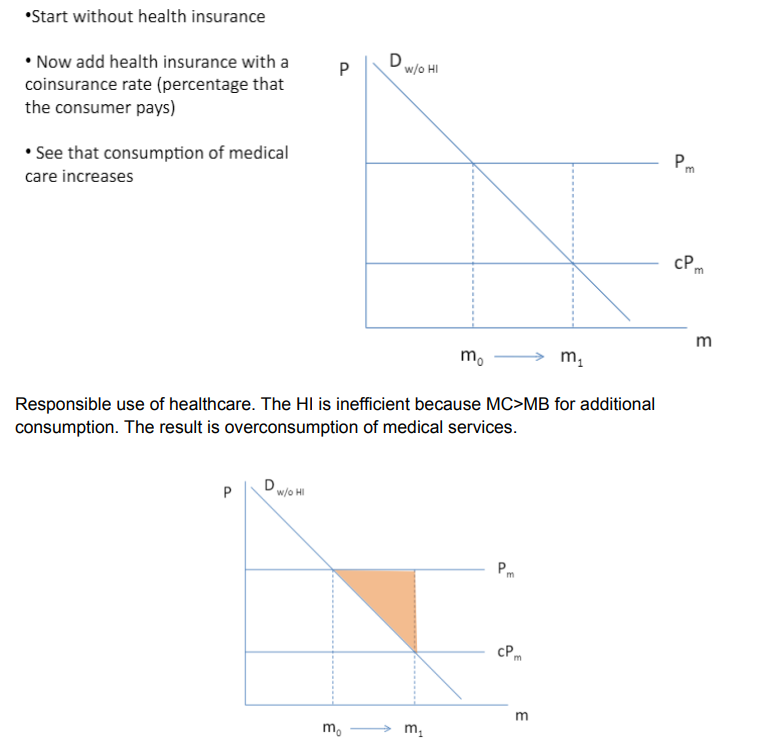
Health insurance: Moral Hazard
Soulutions:
Copaymet
Coinsurance rates\
deductibles
Health Insurance Externalities
Example: Uninsured and emergency care use.
Uninsured cannot afford preventative and routine care
So when sick, they disproportionately rely on emergency care (rational).
Emergency care is the most costly form of care anf the individual does not pay for it at the point of service.
What is the externality?
Emergency care use imposes a cost on society that the individual does not weigh into their decision to use the ER.
Hospitals bear the cost (uncompensated care) and pass it on through pries for the insured (some of which is passed on to consumers of insurance through higher premiums).
Result from this externality:
Insured individuals are therefore paying for uninsured individuals’ additional expensive care.
The uninsured are over-consuming emergency care from a societal standpoint (they are under-consuming preventative and routine care)
SOLUTION: Induce the uninsured to have health insurance so that they do not have an incentive to rely on ER care over routine or preventative care when appropriate.
Effords to inusre more people in society:
Distributional preferences of society
Efficiency improvement
Or
Mandate or subsidize
Preventative care
Antibitics
Vaccination
Social Insurance and Income Maintenance
Social Insurance: Working days, people pay to government. When retired people are eligabke fro monthly payouts. These payments are until person dies.
Why people buy them:
Asure an income level when orld or sick. Consumption soothing.
A risk averse person:
buy health insurance
buys life insurance
buy annuity to assure a steady income In retirement days
Why cant market not offer these?
Assymetric information
sellers do not know buyers life expectancy
Sae death spiral argument as with health insurance
Paternalistic View
Popel could be unirresponsble and do not save for retirement. But socially, we would have to find a way to support the elderies that did not save when young. Morally.
Moral Hazard
Less risk changes behavior of people
Like paternalistic view
lead to inneficuent low private savings
Free riders
Adminsitrative costs
People with high life-time earnings tend to receive proportionally smaller returns on their taxes (paid into SS) than people with low life-time earnings in design on plans (typical due to paternalistic view, plus why it si often mandatory).
Pay-as-you Go
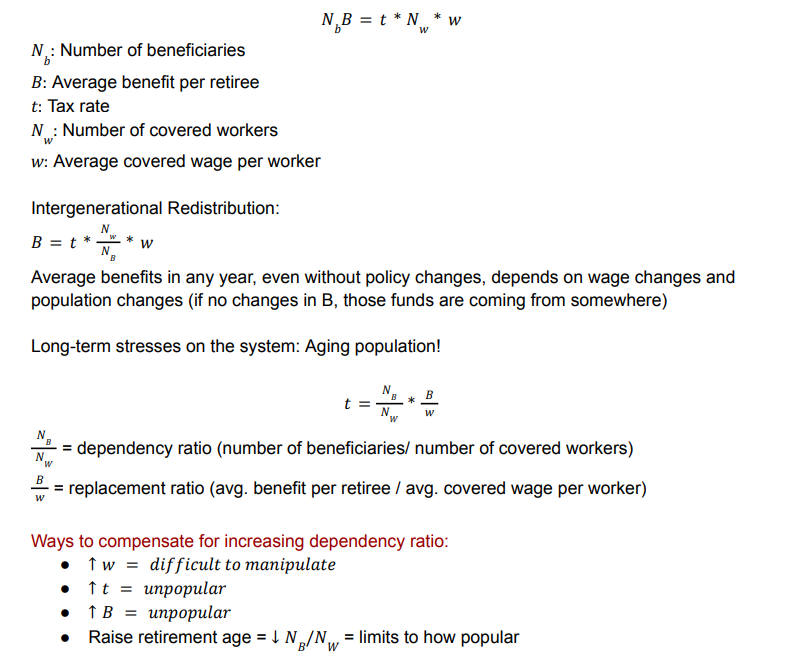
check this agian
Economic behavior
Wealth substitution effect
a. Workers realize that they are paying in now to receive a guaranteed retirement income. They view this as forced “savings”.
b. This can crowd out private savings.
c. Because the pay-as-you-go system does not put taxes into capital accumulation, public savings does not compensate for the reduction in private savings.
Retirement effect
a. To the extent that Social Security induces people to retire earlier, people may save more in order to finance a longer retirement.
Bequest effect
a. We know that Social Security can cause intergenerational redistribution.
b. People may save more to finance a larger bequest to children to offset this.
c. People in retirement age have secure payment → used to finance children
Income Redistribution
Pareto imprvemnets only, everyone equal income, different utilities across people, focus on average utility, focus on person with lowest utility, commodity egalitarianism
In-Kind Transfers: Payments in commodities or services as opposed to cash
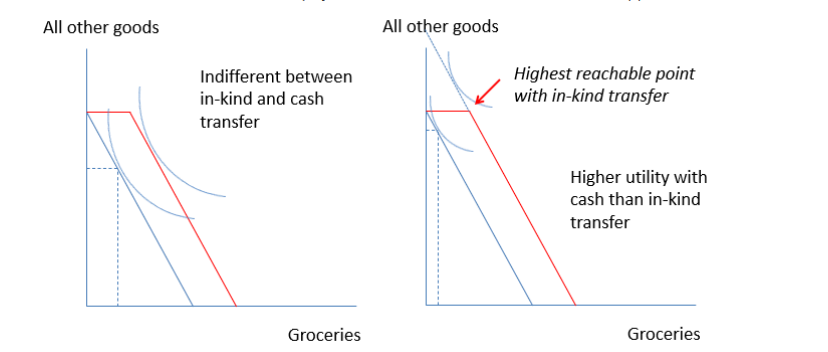
Reasons:
Commodity egaliralism
May curb welfare fraud
Political reasons
Paternalism
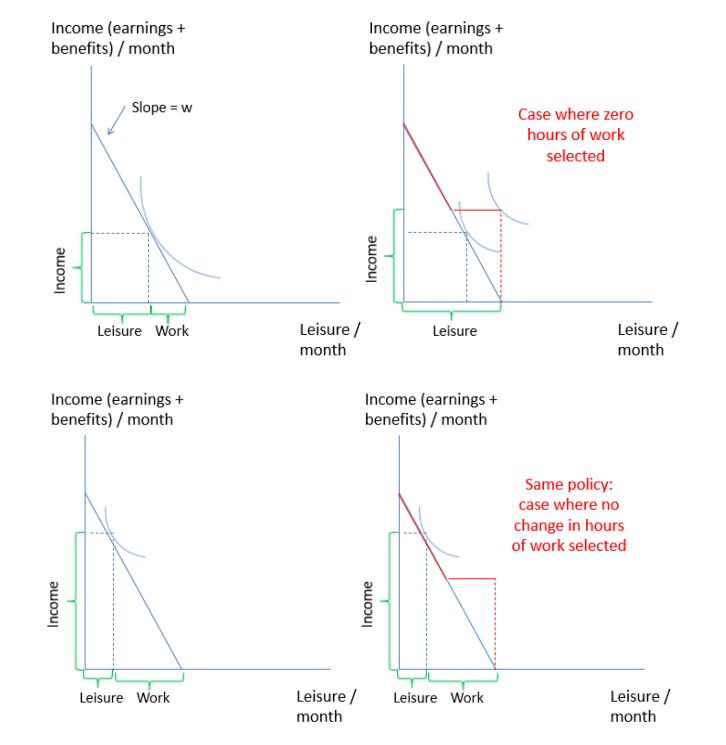
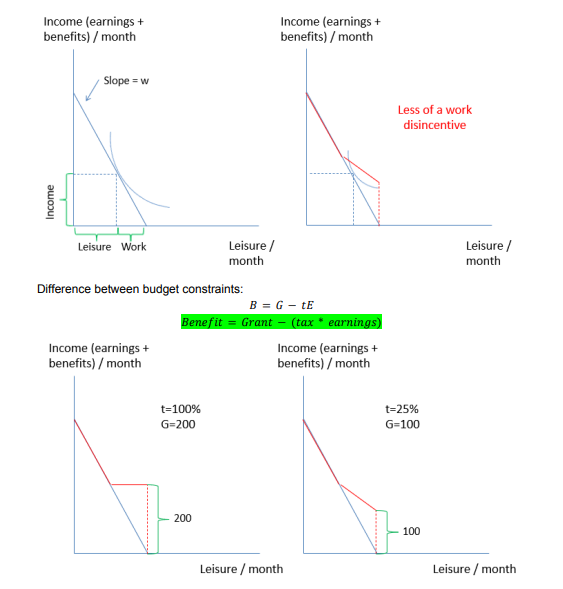
Expenditure Progarms for the poor
Goal: Income maintenance
Main tradeoff: Work incentives
Oter policy details:
Work requirements
Time limits
Family stricture
Other Expenditures programs for the poor:
Halth care
unemployment insurance
food supplemental programs
Hpusing assistance
education
job taring
Taxation and income distribution
Tax incidence
Statutory incidence: who is legally responsible for the tax
Economic Incidence: the change in the distribution of private real income induced by the tax
Tx shifting: Difference between statutory and economic incidence (from producers to consumers)
Only people can bear taxes: tax on corporation may just impact those who gain their income frommcapital, labor, and land
Sources and uses of income matter: A tax on good A will affect consumers of Good A
Tax progressiveness
Average tax rate= tax paid/ income
Proportional: average tax rate constant
Regressive: average tax rate falls with income
Marginal tax rate: the proportion of the last dollar of income taxed by the government.
Incidence works through price setting